

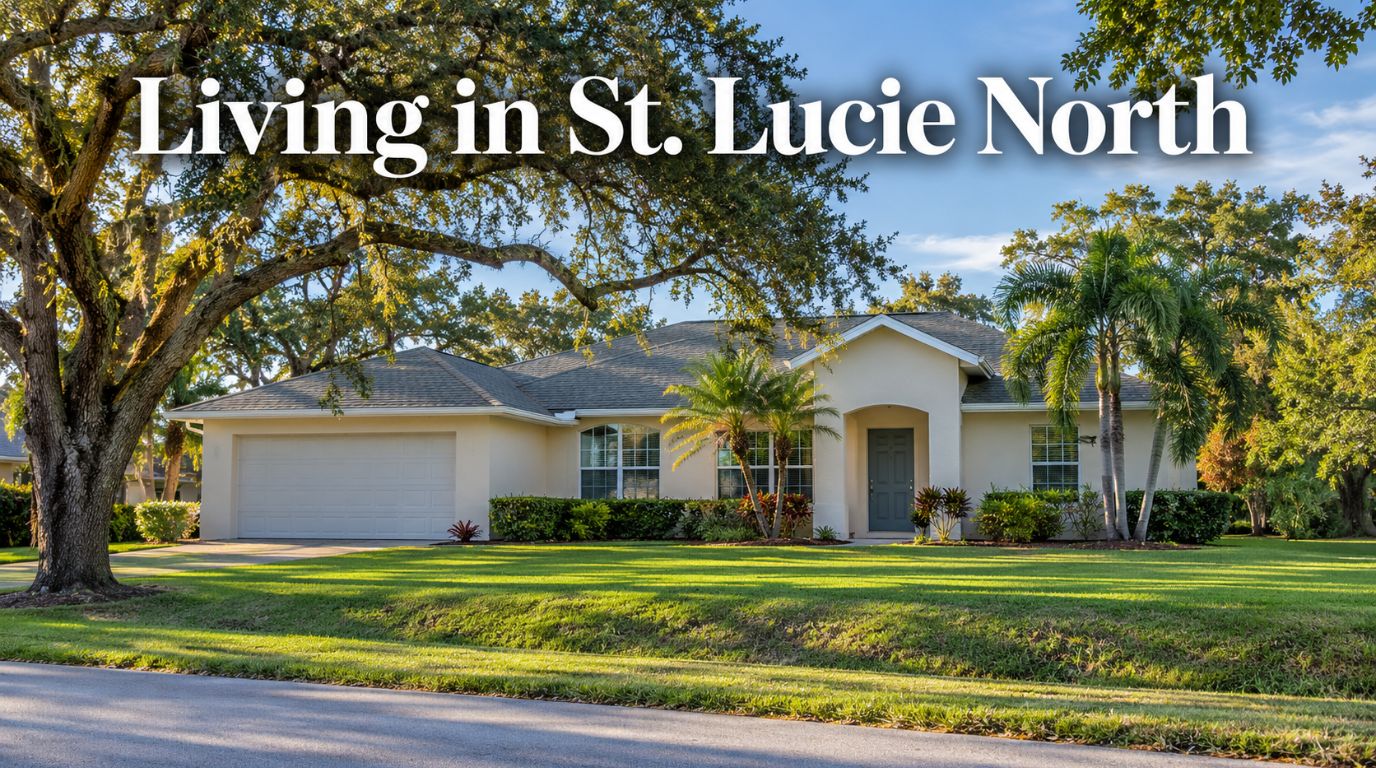
St. Lucie North Neighborhood Guide: Older Homes, Bigger Lots
This St. Lucie North neighborhood guide is for buyers looking at the northern part of Port St. Lucie, where many streets still follow the city’s original plat. The houses tend to be older than in the planned communities to the west, the lots tend to be larger, and the due diligence is different. Here is what to check, and where to check it.
This guide explains how zoning, utilities, insurance and flood rules usually work for homes in Port St. Lucie. It is not legal, insurance, engineering or tax advice. Zoning, fees, flood maps and insurance rules change, and they apply parcel by parcel. Confirm the details for a specific address with the City of Port St. Lucie, the St. Lucie County Property Appraiser, your insurance agent and a licensed inspector, and talk to a Florida real estate attorney before you rely on any rule described here.
The Short Answer
St. Lucie North is the name listing sites give to part of northern Port St. Lucie in ZIP code 34983, around the Champion Turf Club at St. James and the North Fork of the St. Lucie River. Expect homes on the original city plat, quarter-acre lots, a mix of septic and sewer, and streets with and without HOAs.
- General Development Corporation platted 66 square miles of Port St. Lucie into mostly single-family lots, starting in the 1950s and continuing through the 1980s, according to the City of Port St. Lucie Planning and Zoning Department.
- The city says it was incorporated in 1961 by a development group whose goal was to sell quarter-acre lots, and that it was formed without sidewalks, streetlights, water or sewer.
- In the city’s RS-2 single-family zoning district, the minimum lot is 10,000 square feet with a minimum width of 60 feet (Port St. Lucie Code of Ordinances, section 158.073).
- As of October 1, 2025, the city listed a wastewater-only septic to sewer conversion at $8,258, or $67.90 a month over 10 years at 0 percent interest, and counted 12,501 septic tanks remaining as of August 31, 2025.
- Jeannie Jacobson, REALTOR® with RE/MAX Gold, works with buyers in Port St. Lucie and across St. Lucie, Martin and Indian River counties, in English and Spanish.
How should you use a St. Lucie North neighborhood guide when listing sites disagree?
Start with the fact that St. Lucie North is a label, not a legal boundary. Listing portals use it for a part of northern Port St. Lucie in ZIP code 34983, and they describe it around three landmarks: the public Champion Turf Club at St. James golf course, the Oxbow Eco-Center preserve on St. James Drive, and the North Fork of the St. Lucie River along the east side.
Each portal draws the edges a little differently. One site may fold in a subdivision that another site calls by its own name. For that reason, the reliable unit is the address, not the neighborhood name. Before you compare prices or rules, confirm three things for the exact parcel:
- City or county. Port St. Lucie city limits and unincorporated St. Lucie County sit side by side in the north. The answer decides which zoning code, utility and permit office apply.
- Plat or planned community. Is the lot on the original city plat, or inside a newer planned subdivision with its own recorded rules? Section 3 explains why that changes lot size and setbacks.
- Utilities. Is the house on city water and sewer, on septic, or on a mix? Section 5 covers what that means at closing and after.
The St. Lucie County Property Appraiser record for the parcel shows the year built, the lot size and the taxing district.
If you are still choosing between parts of the city, our guide to choosing the right neighborhood when moving to Port St. Lucie compares the north with St. Lucie West, Tradition and the southern sections. This page goes deeper on the north only.
Why are so many homes in St. Lucie North older?
Because much of the north was laid out in the city’s first decades. The City of Port St. Lucie describes itself as a platted community: General Development Corporation subdivided 66 square miles into mostly single-family lots, with minimal infrastructure such as roads and drainage. That platting began in the 1950s and continued through the 1980s, at a time when, in the city’s words, regulations were minimal.
The planned communities came later and sit outside that original plat. The city notes that St. Lucie West and the properties west of Interstate 95, including Tradition, Southern Grove and Riverland, are not considered part of the original platted city. Those areas were planned as whole communities, with roads, utilities and association rules designed together.
In practice, that history produces three kinds of houses on the same few miles of streets in the north:
| House type | What it usually means | What to look up |
|---|---|---|
| An early house on a platted lot | Built when the lot was sold, often before today’s building code, with original systems replaced over time or not at all | Year built, roof permit date, utility type |
| A newer infill house on a platted lot | Built on a vacant lot in the original plat, often to a much newer code, next to older neighbors | Builder, permit and final inspection, any warranty |
| A house in a newer planned subdivision | Part of a single development with its own plat and recorded covenants | Declaration, HOA dues, lot size set by that plan |
So “older homes” is a pattern, not a rule. The year built on the Property Appraiser record and the city permit history tell you which kind you are looking at.
How big are the lots in St. Lucie North?
On the original plat, the starting point is the quarter-acre lot the city was founded to sell. A quarter acre is about 10,890 square feet. The city’s zoning code then sets minimums for each single-family district, and planned developments are treated differently.
| District | Minimum lot for a single-family home | Minimum living area | Setbacks |
|---|---|---|---|
| RS-1 (section 158.072) | 15,000 square feet, 75 feet wide | 1,700 square feet | 25 feet front, 10 feet each side, 25 feet rear |
| RS-2 (section 158.073) | 10,000 square feet, 60 feet wide | 1,200 square feet | 25 feet front, 10 feet each side, 25 feet rear |
| Planned unit development (sections 158.172 to 158.175) | No minimum in the general rules; the City Council may set lot sizes and yards in the approval | As set in the approval | As set in the approval |
This is the real reason buyers describe the north as having bigger lots. The general PUD rules in section 158.174 say that no minimum lot sizes or minimum yards are established for a PUD district under those regulations; the approval for each development decides them. A platted RS-2 lot, by contrast, carries a fixed floor of 10,000 square feet and 25-foot front and rear setbacks.
In RS-2, ten-foot side setbacks on each lot put at least 20 feet between houses, with room for a pool or screened enclosure subject to permits. The trade-off is upkeep: more lawn, trees and drainage, with no association crew. Confirm the zoning for a specific parcel on the city’s zoning map and read the current Chapter 158 text before you plan a pool or an addition.
What river, golf and preserve land is near St. Lucie North?
The public land is a large part of why people look here. Three places define the area on most maps:
| Place | Who runs it | What is there |
|---|---|---|
| Oxbow Eco-Center and Preserve | St. Lucie County | A 225-acre preserve and environmental learning center on the North Fork of the St. Lucie River, with trails through floodplain forest and uplands |
| River Place Park | City of Port St. Lucie | A 7.75-acre park established in 2002, with a boat and canoe launch, trails, a playground, pavilions and ball fields |
| Champion Turf Club at St. James | Privately operated, open to the public | An 18-hole golf course that listing sites treat as the center of St. Lucie North |
The Oxbow Eco-Center sits on St. James Drive, reached from Interstate 95 at exit 126 by way of Midway Road. The county lists free admission, preserve trails open from sunrise to sunset, and separate hours for the center building, which have changed over the years, so check before you visit.
The North Fork itself is a protected waterway. The state manages the North Fork St. Lucie River Aquatic Preserve, and that status, along with local permits, shapes what a riverfront owner can build at the water’s edge. If you are looking at a home that backs onto the river, read our guide to riverfront homes on the North Fork of the St. Lucie River, which covers docks, seawalls and how buyers value river frontage.
A public course means no golf membership tied to the house. Our guide to golf communities in Port St. Lucie compares that with membership and equity clubs.
Jeannie’s take, as a St. Lucie County resident for more than 17 years: drive the area at different times before you decide. The quiet of a preserve-side street and the traffic on the main roads into Interstate 95 are both part of living here, and a single Saturday visit shows you only one of them.
Are homes in St. Lucie North on septic or city sewer?
Some are on each, and the only way to know is to check the address. Port St. Lucie was formed without water and sewer, so many early homes were built with septic systems. The city has been converting them for decades. In its 2025 septic to sewer fact sheet, the City of Port St. Lucie Utility Systems Department reported:
| Item | Figure | As of |
|---|---|---|
| Wastewater-only septic to sewer conversion cost | $8,258 | October 1, 2025 |
| Financed over 10 years at 0 percent interest | $67.90 a month | October 1, 2025 |
| Septic to sewer conversions since 1999 | 11,126 | August 31, 2025 |
| Septic tanks remaining | 12,501 | August 31, 2025 |
| Wastewater customers served | About 82,855 | August 31, 2025 |
The fact sheet says the city provides the materials and labor to connect to the pipe in the street. Confirm the current fee with Utility Systems before you budget, because it is updated over time.
What this means for a buyer in the north:
- Ask the seller in writing whether the house is on septic or sewer, and whether a conversion fee is being paid off on the utility bill.
- On septic, order a septic inspection during your inspection period, with a pump-out if the inspector recommends it. Florida does not require a septic inspection on every sale, so it is on you to ask.
- On sewer, ask about the grinder pump. The city uses a low-pressure system in many areas, which means equipment on the lot that needs power and occasional service.
- Price the difference. Two otherwise similar houses, one on sewer and one on septic, are not the same purchase. Put the conversion cost or the remaining payoff in your comparison.
Sellers see the same question from the other side. Our guide to selling a house with a septic system in Port St. Lucie explains the records a seller should gather, which are the same records a buyer should ask for.
How does an older house in St. Lucie North affect insurance?
Age changes the conversation with the insurer more than the price does. Florida’s first statewide building code took effect in 2002, after Hurricane Andrew changed how the state thinks about wind. Many homes in the north were permitted before that code, and insurers price them on what has been updated since.
Expect to be asked for two reports on an older home:
- A 4-point inspection. It covers the roof, electrical, plumbing and heating and air conditioning, and it shows the age and condition of each.
- A wind mitigation report. It records features such as roof-to-wall connections, roof deck attachment and opening protection. Florida law requires insurers to offer discounts or credits for features that reduce windstorm loss (section 627.0629, Florida Statutes).
The roof is the item that most often decides the quote. Under section 627.7011 of the Florida Statutes, an insurer may not refuse to issue or renew a homeowner’s policy solely because the roof is less than 15 years old. For a roof that is 15 years or older, the insurer must allow an inspection at the homeowner’s expense, and it may not refuse the policy for roof age if the inspection shows at least 5 years of useful life left.
Get a binding insurance quote during your inspection period, and look up the roof permit date at the city: the year the roof was replaced matters more than the year the house was built. Our guide to buying a Port St. Lucie home with an older roof walks through how buyers and sellers handle a roof that is near the end of its life.
Is St. Lucie North in a flood zone?
Parts of it can be, and the answer is lot by lot. The area runs along the North Fork and includes preserve land and low areas that drain toward it.
Check the address on the FEMA Flood Map Service Center before you make an offer, and read the result for the specific parcel rather than the general area. A home outside a special flood hazard area may not need flood insurance for the lender, but a quote is still worth getting for a house near the river or a preserve.
Florida also requires sellers of residential property to give buyers a flood disclosure at or before the time the contract is signed (section 689.302, Florida Statutes). It asks whether the seller has filed a flood insurance claim, received federal flood assistance, or knows of flood damage to the home. Read it alongside the FEMA map; the map shows the designated risk, and the disclosure shows the home’s history.
For how the zones work across the city, and what each letter means for insurance, see our guide to Port St. Lucie flood zones explained before you buy.
Do homes in St. Lucie North have an HOA?
Some do and many do not, which is one reason buyers search for the north. A house on the original plat was sold lot by lot, often with no mandatory association. A house in a newer planned subdivision usually comes with recorded covenants, a homeowners’ association and dues.
| Question | Platted street without an HOA | Subdivision with an HOA |
|---|---|---|
| Who sets the rules? | City code only | City code plus the recorded declaration and association rules |
| Monthly dues | None | Set by the association budget |
| Boats, trailers and work vehicles | City parking rules apply | Often limited further by the declaration |
| Exterior changes | City permit where required | City permit plus association approval |
| Shared amenities | Public parks and the preserve | Whatever the association owns and maintains |
If the home is in an association, Florida requires the seller to give you a disclosure summary before the contract is signed (section 720.401, Florida Statutes). It states that membership is mandatory, lists the dues, and points to the governing documents. Read those documents before your inspection period ends.
No HOA is not the same as no rules. The City of Port St. Lucie code still covers parking, fences, sheds, pools and additions. Our guide to no HOA homes in Port St. Lucie covers what the city enforces on its own and where else in the city buyers find homes without an association.
What should an inspection cover on an older home with a big lot?
A standard home inspection is the base. On an older house on a large lot in the north, add these items to your list and ask your inspector which ones they cover:
| Item | Why it matters here | Who checks it |
|---|---|---|
| Roof age and permit | Drives the insurance quote under section 627.7011 | Inspector and the city permit record |
| Electrical panel and wiring | Older panels and wiring show up on the 4-point and can block coverage | Inspector, then a licensed electrician if flagged |
| Plumbing supply and drain lines | Original materials may be near the end of their life | Inspector, then a licensed plumber with a camera if needed |
| Septic tank and drain field, or grinder pump | See section 5; a failed drain field is a large repair | Septic contractor, or the city for the sewer connection |
| Drainage and grading | Large lots move a lot of water; look for standing water and slopes toward the house | Inspector during or after rain |
| Trees near the house and roof | Mature oaks give shade and also drop limbs in storms | Inspector, then an arborist for large trees |
| Permits for additions, pools and enclosures | Unpermitted work can complicate insurance, financing and resale | Your agent and the city permit record |
| Wind mitigation features | Documented features can lower the premium | A qualified wind mitigation inspector |
How does St. Lucie North compare with St. Lucie West and Tradition?
The three areas solve different problems. This comparison uses only the differences the city’s own planning history explains:
| Question | St. Lucie North | St. Lucie West and Tradition |
|---|---|---|
| How the land was laid out | Much of it on the original city plat from the 1950s through the 1980s | Planned communities outside the original platted city |
| Lot size rules | Zoning district minimums, such as 10,000 square feet in RS‑2 | Set in each development’s approval |
| Associations | Streets with and without HOAs | Associations are the norm, and Tradition homes also sit in a community development district |
| Utilities | A mix of septic and city sewer | Built with central utilities |
| Age of homes | A wide range, from early homes to new infill | Mostly built after the planned communities opened |
For the full picture of the planned community north of Tradition, see our St. Lucie West homes for sale buyer’s guide.
The steps to buy in St. Lucie North:
- Set the budget on total cost. Mortgage, insurance, property tax, any HOA dues, and any septic conversion cost or payoff.
- Get preapproved or gather proof of funds, and ask your lender how they treat septic and older roofs.
- Pull the parcel record for each home you like: year built, lot size, zoning and taxing district.
- Check the FEMA map and the utility type before you write an offer.
- Write the offer with an inspection period long enough for the specialists in section 9 and a binding insurance quote.
- Read the HOA disclosure and documents, if the home has an association.
- Close and file for homestead with the St. Lucie County Property Appraiser if the home will be your primary residence.
What Buyers Say About Working With Jeannie Jacobson
“Jeannie was excellent! She listened to what our needs for a new home were and also what our wants in a new home were. She showed us exactly what we wanted, is personable and extremely accommodating. After spending just one day, showing us thirteen houses we found our forever home because of Jeannie. I highly recommend Jeannie Jacobson and her team!”
Neva Spencer, Google review
“Jeannie is the ultimate professional. Knowledgeable about the area, excellent communication and follow up. I truly enjoyed my time touring the community with her. She even arrived with snacks and cold beverages! Highly recommend for her your real estate needs!”
Kristen Sumrall, Google review, March 8, 2024
Frequently Asked Questions
St. Lucie North is a name listing sites use for part of northern Port St. Lucie in ZIP code 34983, around the Champion Turf Club at St. James, the Oxbow Eco-Center on St. James Drive and the North Fork of the St. Lucie River. Portals draw the edges differently, so confirm each address on the Property Appraiser record.
Often, yes. Port St. Lucie was founded to sell quarter-acre lots, and the city’s RS-2 zoning sets a 10,000 square foot minimum for a single-family lot. Planned developments have no minimum in the general rules and set lot sizes in each approval, which is why their lots are often smaller.
They range widely. Much of the north sits on the original city plat, laid out from the 1950s through the 1980s, so early homes stand next to newer infill houses. The year built on the St. Lucie County Property Appraiser record and the city permit history tell you the age of a specific house and its roof.
As of October 1, 2025, the City of Port St. Lucie listed a wastewater-only septic to sewer conversion at $8,258, which can be financed at $67.90 a month over 10 years at 0 percent interest. Confirm the current fee with the city’s Utility Systems Department before you budget.
Some do and many do not. Homes on the original plat often have no mandatory association, while newer planned subdivisions usually do. If a home is in an association, Florida requires the seller to give you a disclosure summary with the dues before the contract is signed.
It depends on the lot. The area runs along the North Fork of the St. Lucie River, and flood zone designations can change from street to street. Look up the exact address on the FEMA Flood Map Service Center and read the seller’s Florida flood disclosure before you make an offer.
See St. Lucie North Address by Address
The right home in the north is the one whose lot, utilities, roof and flood map you understand before you sign. Jeannie works with buyers in Port St. Lucie and across the Treasure Coast, in English and Spanish, and can help you check each of those items for the houses on your list.
Jeannie Jacobson, REALTOR®, RE/MAX Gold, (772) 877-0268, English and Spanish
Sources
- City of Port St. Lucie, Planning and Zoning Department, Our Growth and Development, https://www.cityofpsl.com/ (accessed November 2026)
- City of Port St. Lucie, Our Story, https://www.cityofpsl.com/News-Stories/Our-Story (accessed November 2026)
- City of Port St. Lucie Code of Ordinances, Chapter 158, sections 158.072 (RS-1), 158.073 (RS-2), 158.172, 158.174 and 158.175 (planned unit development), as published by the city’s code host and mirrored by zoneomics.com (accessed November 2026; confirm the current text on the official code site)
- City of Port St. Lucie Utility Systems Department, 2025 Septic to Sewer Program Fact Sheet, figures as of August 31, 2025 and October 1, 2025, https://www.cityofpsl.com/ (accessed November 2026)
- City of Port St. Lucie Parks and Recreation, River Place Park, https://www.cityofpsl.com/ (accessed November 2026)
- St. Lucie County, Oxbow Eco-Center and Preserve, https://www.stlucieco.gov/ (accessed November 2026)
- Florida Statutes 2026, sections 627.0629, 627.7011, 689.302 and 720.401, http://www.leg.state.fl.us/statutes/ (accessed November 2026)
- FEMA Flood Map Service Center, https://msc.fema.gov/portal/home (accessed November 2026)
- St. Lucie County Property Appraiser, https://www.paslc.gov/ (accessed November 2026; the site may block automated access, so confirm parcel data there)
- Neighborhood name and landmarks as used by real estate listing portals for ZIP code 34983 (accessed November 2026; boundaries differ by portal)