

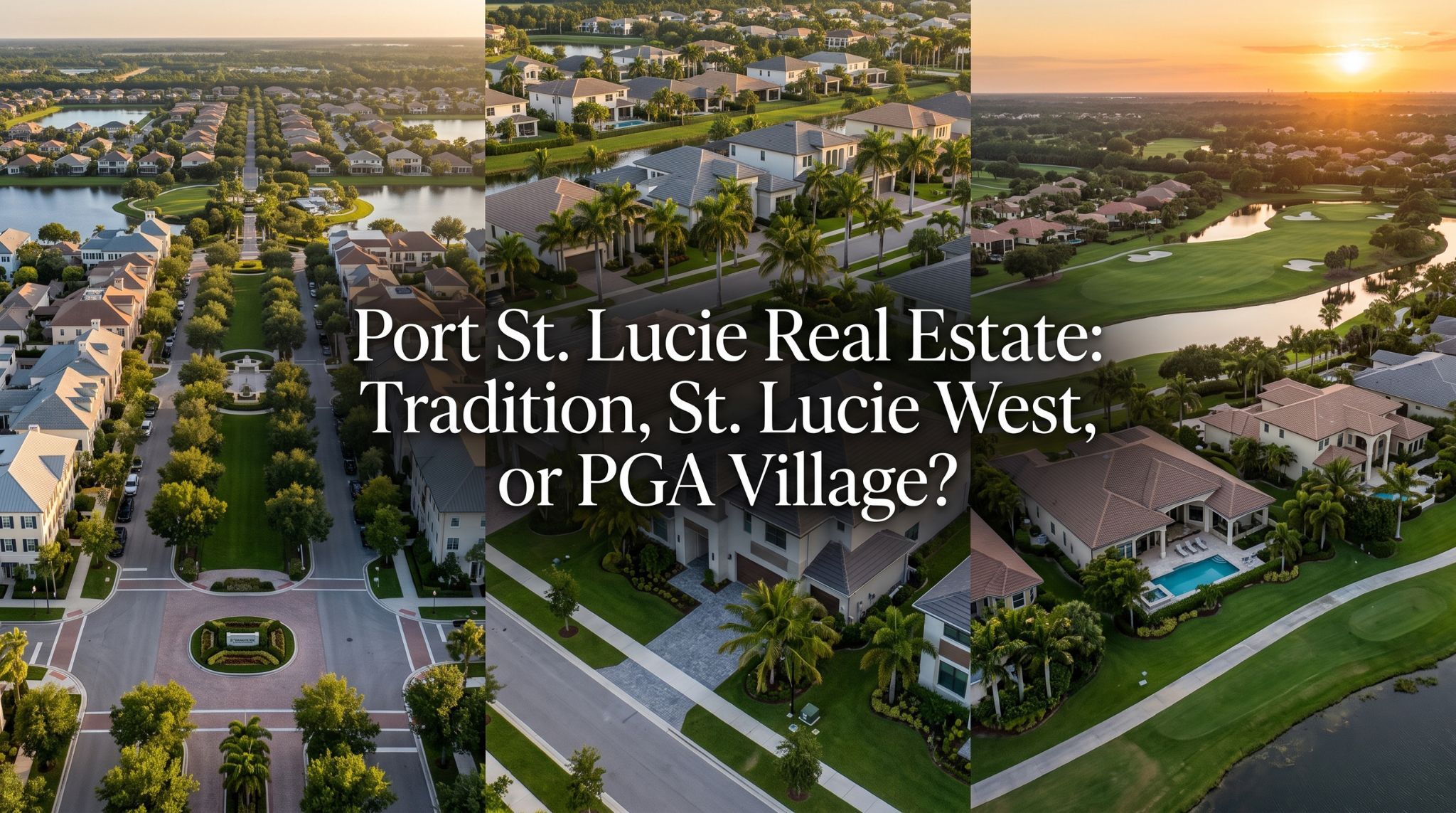
Port St. Lucie Real Estate: Tradition, St. Lucie West, or PGA Village?
Compare home styles, amenities, golf, shopping, HOA and CDD structures, and everyday life across three of Port St. Lucie’s most searched communities.
Schedule a Three-Community ConsultationSearch Homes by Community
Quick Answer: Tradition, St. Lucie West, or PGA Village?
Choosing between Tradition vs. St. Lucie West vs. PGA Village can be harder than deciding whether Port St. Lucie is the right Florida market. All three sit in western Port St. Lucie near I-95, shopping, and recreation, and they can look close together on a map — but the ownership experience differs substantially. Choose Tradition for newer homes, master-planned development, parks and trails, community events, active-adult choices, and builder inventory. Choose St. Lucie West for an established area with mature communities, extensive shopping and dining, Clover Park, and often a lower entry price. Choose PGA Village when golf, controlled access, residential variety, larger or custom homes, and a dedicated resident clubhouse are central to your decision.
Pricing and compliance note. Market statistics, listing prices, builder offerings, association assessments, special-district charges, amenities, and available inventory can change. Figures reflect information available on July 30, 2026. ZIP code statistics are used as geographic indicators — ZIP 34987 broadly represents the western area including Tradition and Riverland, while ZIP 34986 includes St. Lucie West, PGA Village, and other nearby properties. Neither ZIP code corresponds perfectly to a single community boundary. This article is educational and does not constitute legal, tax, appraisal, insurance, lending, engineering, flood-risk, association, or financial advice.
What This Guide Covers
Community Comparison at a Glance
| Category | Tradition | St. Lucie West | PGA Village |
|---|---|---|---|
| General character | Growing master-planned community | Established suburban and commercial district | Controlled-access golf-oriented residential community |
| Housing | New construction, recent resales, townhomes, villas, active-adult homes, larger detached homes | Established single-family, townhomes, condos, gated communities, 55+ neighborhoods, golf properties | Condominiums, garden villas, townhomes, detached homes, pool homes, golf homes, custom estates |
| New construction | Strongest of the three | Limited compared with Tradition | Limited in established PGA Village; newer options in adjacent PGA Village Verano |
| Golf orientation | Golf within driving distance, but not the central identity | Several nearby courses and some golf communities | Strongest golf identity; near 54 holes at PGA Golf Club |
| Shopping and dining | Town Center, The Landing, newer commercial growth, community events | Broad established retail and restaurant corridor | Residential inside the gates; shopping reached via nearby St. Lucie West |
| Walkability within community | Trails, parks, town-center connections, shuttle options in parts of the plan | Varies significantly by neighborhood; most errands involve driving | Recreational walking within subdivisions; external errands require driving |
| HOA structure | Neighborhood HOA or association, possible master obligations, possible CDD assessments | Individual HOA or condo association; St. Lucie West Services District may also be relevant | PGA Village association plus one of many sub-associations; maintenance package varies |
| Buyer who may prefer it | New-construction buyer, relocator, family, active adult, buyer seeking planned amenities | Value-conscious buyer, established-home buyer, downsizer, baseball fan, retail-convenience buyer | Golfer, seasonal owner, gated-community buyer, luxury or estate buyer, buyer wanting range |
This table is a starting point. The final decision must be based on the exact home, subdivision, association documents, tax bill, insurance quotation, and buyer priorities.
2026 Market Context
The City of Port St. Lucie recorded 1,192 single-family sales during Q2 2026, with a citywide median sale price of $405,000, a median 52 days to contract, sellers receiving a median 96.1% of original list price, and 4.7 months of inventory. Those figures describe the full municipality, not one neighborhood. The localized ZIP report shows:
| Q2 2026 single-family metric | ZIP 34987 (Tradition area) | ZIP 34986 (St. Lucie West & PGA Village area) |
|---|---|---|
| Closed sales | 338 | 176 |
| Median sale price | $449,000 | $400,000 |
| Average sale price | $487,345 | $424,037 |
| Cash sales | 135 | 58 |
| Median % of original list price | 95.0% | 94.6% |
| Median time to contract | 59 days | 69 days |
| New listings | 453 | 219 |
| Active inventory | 517 | 276 |
| Months of supply | 5.7 | 5.2 |
The report assigns listings by postal ZIP code rather than by subdivision boundary. Use the data to understand the surrounding market, not to value an individual Tradition, St. Lucie West, or PGA Village property. Track current conditions in the Port St. Lucie real estate market report.
Begin With Lifestyle, Not the Community Name
A community comparison becomes useful only after you define what you expect your normal week to look like. Buyers often begin with a name they recognize — a relocating buyer hears Tradition is popular and assumes every village provides the same experience; a golfer searches PGA Village and assumes every property includes golf access; a buyer familiar with St. Lucie West’s stores assumes every gated community is equally close to the corridor. Each assumption can create an expensive mismatch.
Write Your Daily-Life Requirements
Begin with the activities that occur repeatedly: morning commute, remote work, school or childcare travel, medical appointments, grocery shopping, restaurants, exercise, golf, pickleball or tennis, dog walking, community events, hosting family, airport travel, beach visits, seasonal travel, and home maintenance.
- A buyer who works remotely and wants parks, trails, events, and new construction may prefer Tradition
- A buyer who visits stores and restaurants frequently, wants an established neighborhood, and does not need new construction may prefer St. Lucie West
- A buyer who plays golf several times each week and values controlled access may prefer PGA Village even if ordinary errands require more driving
Separate Amenities You Admire From Amenities You Will Use
Large amenity packages can influence emotion during a tour. Ask how often you expect to use a clubhouse, resort pool, fitness center, golf, tennis, pickleball, walking trails, social clubs, community events, dog parks, restaurants inside the master plan, or shuttle options.
An amenity has financial value when it replaces a service you would otherwise purchase or improves your normal routine. It has less practical value when you visit it twice a year. A buyer who already belongs to an outside gym and does not attend organized events may not benefit from the largest clubhouse. A dedicated golfer may consider proximity to the first tee more important than a town square or weekly market.
Decide Whether You Want Growth or Completion
Growth Can Provide
More new-home choices, current floor plans, new commercial development, improved long-term access to services, additional parks and amenities, builder warranties, and opportunities to select a homesite.
Growth Can Also Produce
Construction traffic, changing views, future phases near the property, incomplete landscaping, builder competition with resales, special-district obligations, and uncertainty about final traffic patterns.
Completion Can Provide
Mature trees, existing traffic patterns, completed clubhouses, prior association budgets, and historical resale activity — the evidence a developer-controlled community cannot yet offer.
Completion Can Also Mean
Older roofs and systems, greater condition variation between listings, insurance-sensitive components, and less new-construction inventory to compare against.
Tradition continues to add homes, parks, businesses, roads, and community features. St. Lucie West is more established, with many communities and commercial areas operating for decades. PGA Village is similarly established — the residential community contains more than 35 miles of roads, three guarded entrances, 34 subdivisions, and more than 2,500 properties — although individual sub-associations and nearby developments vary.
Determine Whether New Construction Is a Requirement
Tradition offers the greatest concentration of current new-construction choices among the three areas, with conventional communities, luxury offerings, and active-adult options from multiple builders. St. Lucie West is primarily a resale environment. Established PGA Village is also predominantly resale — but buyers searching the broader PGA-branded area may encounter new construction in PGA Village Verano, a separate gated development with its own amenities, builders, documents, and obligations. It should not be treated as though it were simply another sub-association inside established PGA Village.
Decide How Much Governance You Want
All three areas include governed communities, but the layers differ. A buyer may be responsible for a neighborhood HOA, a condominium association, a master association, a recreation or amenity charge, a community development district assessment, a special district charge, a cable or internet package, a capital contribution, a transfer charge, and optional or mandatory club costs. Do not classify a property as affordable until every layer has been identified.
Choose the Home First or the Location First?
Location-first buyers are usually unwilling to compromise on community identity — they may accept a smaller home, older roof, or higher fee to remain in the preferred area. Home-first buyers prioritize square footage, garage capacity, lot, pool, office, or condition, and may compare all three communities. Neither approach is incorrect. Problems arise when a location-first buyer pretends to be flexible, or when a home-first buyer pays a premium for community amenities that were never a priority.
Create two lists. Nonnegotiable property requirements: minimum bedrooms, office, garage spaces, pool, single-level living, lot or view, maximum renovation, accessibility, pet needs. Community preferences: golf, town center, gated access, new construction, mature landscaping, social activities, lower HOA, walkability, shopping proximity. The first list should normally control the search; the second helps break ties.
Tradition: Newer Homes and Master-Planned Living
Tradition appeals to buyers who want their neighborhood, commercial areas, parks, events, and residential choices to feel like parts of one coordinated master plan. It is not one subdivision and does not have one universal HOA fee.
Tradition’s General Character
Tradition’s official community platform describes a master-planned mix of single-family homes, townhomes, lifestyle villages, active-adult neighborhoods, parks, trails, shopping, dining, healthcare access, and community events. The Tradition Trail connects to more than 300 acres of parks, and the community promotes electric mobility and the free TIM shuttle along designated routes. The Town Center serves as a recognizable gathering place, with markets, performances, classes, events, shops, restaurants, and an adjacent amphitheater, while Cleveland Clinic facilities provide a significant healthcare presence in the broader area.
This planned structure can be especially attractive to relocating buyers who want a community that is easy to understand — homes, shops, parks, healthcare, and gathering areas within the same part of western Port St. Lucie. For the deeper dive, see the Tradition Port St. Lucie buyer guide.
Tradition Home Styles
Housing varies by village, builder, construction period, and target buyer. A Tradition search may include townhomes, smaller detached homes, villas, one- and two-story family homes, pool homes, preserve- or lake-oriented lots, luxury homes, gated neighborhoods, active-adult communities, builder inventory, recent resales, and older resales near the original Town Center.
A buyer who says “I want a Tradition home” has not yet defined a useful search. The buyer must identify the village, the builder, resale or new construction, HOA structure, CDD, home type, age restriction, amenity access, lot exposure, and completion timeline.
New Construction Versus Tradition Resale
New construction provides a chance to select a current floor plan, new systems, current building-code compliance, and builder warranty coverage — and depending on builder and phase, a homesite, elevation, structural options, and interior finishes. The advertised base price may exclude the homesite premium, structural options, design selections, pool, screen enclosure, window treatments, appliances not in the package, landscaping beyond builder standard, closing charges, CDD assessments, HOA capital contributions, and financing costs.
A completed resale may include improvements expensive to reproduce: a pool, screened lanai, impact-resistant openings, outdoor kitchen, window treatments, upgraded landscaping, storage systems, lighting, and built-in cabinetry. Resales also compete against builder incentives — a seller should know whether nearby builders are offering closing-cost assistance, rate incentives, design credits, or reduced prices on completed inventory, and a buyer should compare total financed cost rather than contract price alone.
Tradition’s Everyday Lifestyle
Tradition offers one of the most coordinated outdoor and community-event experiences in Port St. Lucie. That does not make every Tradition home walkable to every amenity. A home in a western or newer section can be several miles from the original Town Center. Some communities have their own clubhouse; others rely more on master-planned parks. Some residents use the TIM shuttle regularly; others find a car remains necessary for normal errands.
Before purchasing, drive or walk the actual route from the home to the Town Center, grocery shopping, healthcare, community clubhouse, dog park, playground, mail facility, main entrance, interstate access, and workplace. Map proximity and practical access can differ.
Tradition Market Position
During Q2 2026, ZIP 34987 recorded 338 single-family sales and a $449,000 median sale price, with the median property receiving 95% of original list price and going under contract in 59 days. Inventory reached 517 active properties, equal to 5.7 months of supply. Realtor.com’s separate neighborhood data reported a Tradition median listing price of approximately $445,000 and a 73-day median marketing period in June 2026 — because portal boundaries and methodology differ from MLS ZIP reports, the figures should not be combined into a single valuation formula.
Practically: buyers have choices; builders and resale sellers compete for the same prospect; a correctly priced home can still require weeks or months of exposure; the best homes may sell faster than the median; and the difference between villages may matter more than the overall Tradition median.
Tradition HOA and CDD Structure
Tradition properties may have a neighborhood association, a master or shared-community obligation, and a community development district assessment. Tradition has multiple CDDs rather than one universal district. Official district information explains that applicable annual CDD assessments may contain two components — operation and maintenance, and debt service on capital-improvement bonds — appearing in the non-ad valorem section of the property-tax bill.
This means the regular HOA payment may not represent the complete community cost. For each property, request:
- Current HOA assessment and any master-association charge
- CDD district number, current operations assessment, current debt-service assessment, and remaining debt term
- Capital contribution and transfer charge
- Cable or internet package, landscape coverage, and amenity coverage
- Special assessments and any builder subsidy
Who May Prefer Tradition — and the Tradeoffs
Strongest fit for: buyers wanting new construction; relocating households seeking a recognizable master plan; buyers who value parks, trails, and organized events; active-adult buyers comparing several communities; buyers who want modern floor plans; households wanting healthcare and commercial growth nearby; and sellers who want access to a broad buyer pool attracted by the Tradition name.
Potential tradeoffs: construction activity, higher surrounding asking prices than some established St. Lucie West areas, CDD and HOA layers, builder competition with resales, less mature landscaping in new phases, greater distance from the original Town Center in outlying villages, changing commercial and road patterns, and potentially smaller lots in certain newer communities.
St. Lucie West: Established Communities and Everyday Convenience
St. Lucie West is a district rather than a single gated community. Its appeal comes from the combination of residential neighborhoods, mature landscaping, retail, restaurants, entertainment, medical and professional services, golf access, Clover Park, and direct connections to the wider city.
St. Lucie West’s General Character
The area is a well-maintained western Port St. Lucie community with a large concentration of shops and restaurants, proximity to PGA golf facilities, and Clover Park, where the New York Mets hold spring training and the St. Lucie Mets play.
The district was developed earlier than many of Tradition’s current neighborhoods. Buyers will encounter established trees, completed community facilities, mature lakes, older roofs and systems, renovated homes, original-condition homes, and a wider spread of architectural eras. St. Lucie West may feel less coordinated than Tradition, because the residential communities, businesses, golf facilities, stadium, and public roads were not designed as one unified town-center experience. The tradeoff is immediate access to an established commercial corridor.
St. Lucie West Home Types
A search can include conventional detached homes, gated subdivisions, golf-oriented properties, pool homes, lake-view homes, townhomes, condominiums, attached villas, 55+ communities, smaller downsizing properties, and larger homes in country-club-oriented areas. Examples illustrate the range:
Lake Charles
A non-age-restricted gated community with more than 1,100 homes, lakes, preserves, a clubhouse, pool, sports facilities, and recreation — promoting proximity to I-95, shopping, restaurants, entertainment, Clover Park, and golf.
Cascades
An established 55+ community built primarily between 2000 and 2005, offering a clubhouse, fitness facilities, pool, nine-hole golf course, tennis, pickleball, bocce, and organized activities.
Kings Isle
Another gated active-adult community in central St. Lucie West, positioned near shops and restaurants, with a lower median asking price than many newer options.
Why This Matters
These examples demonstrate why “St. Lucie West home” is too broad for pricing or HOA comparisons. The buyer must identify the exact association and property type before comparing anything.
Established Resale: Advantages and Risks
Advantages: mature landscaping, completed amenities, known traffic patterns, historical association budgets, prior reserve studies or financial records, existing pools and enclosures, finished window treatments, owner-installed storage, established neighborhood appearance, and greater negotiating flexibility. A buyer can also evaluate how the property and community have aged — roof replacement patterns, road and drainage maintenance, clubhouse renovation history, pool and gate condition, landscaping standards, association enforcement, reserve funding, prior special assessments, exterior-paint cycles, and insurance history. You receive more historical evidence than may be available in a community still controlled by a developer.
Risks requiring more due diligence: roof age, roof permit, wind-mitigation report, electrical panel, plumbing material, HVAC age, water-heater age, impact windows or shutters, pool and enclosure, prior insurance claims, open permits, garage or lanai conversions, water intrusion, and association violations.
A renovated kitchen does not eliminate the need to review insurance-related systems. Florida’s Department of Financial Services explains that documented hurricane-mitigation features may qualify for insurer credits — but the owner must provide an acceptable mitigation inspection, and the insurer applies its own underwriting rules.
Shopping and Entertainment
St. Lucie West’s strongest practical advantage is the concentration of established daily services: grocery stores, restaurants, general retail, professional offices, entertainment, fitness options, stadium events, golf access, and major-road connections. A resident may still drive for most errands, but the destinations are concentrated along the St. Lucie West corridor. Buyers who prefer established commercial choices over a town-square experience may find this more practical than Tradition.
St. Lucie West Market Position
Realtor.com’s June 2026 neighborhood data reported a median listing price of approximately $349,900, 296 active listings, a 72-day median marketing period, and a 97% sale-to-list ratio, categorizing the area as balanced. The wider ZIP 34986 market — which includes St. Lucie West and PGA Village properties — recorded a $400,000 median single-family sale price in Q2 2026, with 69 median days to contract and 5.2 months of supply.
The apparent difference reflects different boundaries, property sets, listing versus sale data, and methodologies. The figures nevertheless support a reasonable inference: established St. Lucie West can present lower entry prices than many newer Tradition listings, but property age, condition, HOA coverage, and insurance must be included in the comparison.
HOA and District Structure
Many properties belong to an individual HOA or condominium association. The St. Lucie West Services District is also relevant to the broader district — established in 1990 under Florida Statute Chapter 190, serving approximately 4,600 acres and thousands of water customers. A services district is not the same as a homeowners’ association, and Florida Statute Chapter 720 expressly distinguishes an HOA from a community development or similar special district.
A buyer should identify the individual HOA or condominium association, the services provided, the utility district, any non-ad valorem assessment, club or golf charge, exterior-maintenance responsibility, capital contributions, transfer and application charges, leasing restrictions, vehicle restrictions, and age restrictions where applicable.
Who May Prefer St. Lucie West — and the Tradeoffs
Strongest fit for: buyers who want established shopping and restaurants; buyers comfortable with resale homes; buyers wanting mature gated communities; downsizers; 55+ buyers; baseball fans; buyers who want proximity to golf without living in a dedicated golf resort; buyers seeking a lower entry point than some newer master-planned options; and buyers who prefer visible community history over ongoing development.
Potential tradeoffs: older roofs and systems, greater condition differences between listings, insurance-sensitive housing components, less new-construction inventory, more dependence on driving, traffic near commercial areas and events, multiple association structures, and some communities with stricter age, vehicle, rental, or exterior rules.
PGA Village: Golf, Gated Living, and the Widest Housing Range
PGA Village is the most specialized choice in this comparison. Golf is central to its identity, but the community is not limited to golfers. Its residential variety, controlled access, lakes, landscaping, Island Club, seasonal-owner appeal, and range from condominiums to custom estates can attract several buyer profiles.
Understand the PGA Village Name
“PGA Village” may describe several related but distinct concepts: the PGA Golf Club and resort facilities, the established PGA Village residential community, individual subdivisions inside it, nearby PGA-branded development, and PGA Village Verano.
Established PGA Village is a controlled-access community with more than 35 miles of roads, three guard houses, more than 2,500 properties, and 34 residential subdivisions. PGA Village Verano is a separate gated residential development with its own builder offerings, recreation, pickleball, and governing structure. Do not compare their fees or amenities as though they were one association. See the PGA Village luxury guide and the PGA Village Verano lifestyle guide for each.
PGA Village Home Types
The official association describes an unusually broad residential mix: condominiums, garden villas, townhomes, smaller detached homes, two- to four-bedroom single-family residences, pool homes, lake-view homes, golf-course homes, and large custom estates. Many include screened outdoor living, landscaped yards, pools, golf views, or lake views, and both year-round and seasonal residents own within the community.
A July 2026 listing portal snapshot showed asking prices ranging from approximately $235,000 to more than $5 million. The extreme range illustrates property diversity, not a typical value or formal market range — a median price can be misleading when a community contains a one-bedroom golf villa, a conventional three-bedroom pool home, and a custom estate on a premium lot.
PGA Golf Club
PGA Golf Club offers 54 holes of championship golf designed by Tom Fazio and Pete Dye, giving PGA Village a stronger golf identity than either Tradition or general St. Lucie West. The buyer should still verify whether golf membership is required, whether ownership provides any resident benefit, public or member tee-time policies, membership categories, initiation or annual charges, cart charges, practice-facility access, guest policies, and clubhouse privileges. Residential association dues and golf costs should be treated as separate until the documents establish otherwise.
The Island Club
The Island Club is the resident amenity center for established PGA Village, including a fitness center, heated pool with lap lanes, multipurpose rooms, four pickleball courts, a tennis court, recreation field, ballroom, arts and crafts room, card room, billiards, and meeting spaces. It serves as the center for association events and resident activities. A buyer who does not play golf may still find value in the Island Club and controlled-access environment.
Landscape and Water
The association reports 48 lakes and waterways, extensive landscaping, and an engineered drainage system connecting graded basins through pipes and culverts. A lake or golf view can influence value, but evaluate orientation, privacy, cart-path position, golf-ball exposure, afternoon sun, water-management easements, shoreline maintenance, vegetation, insects, noise, future tree growth, and association access rights.
A property described as “golf view” may face a tee box, green, fairway, practice area, or partial corridor. These are not equivalent — and the difference between them shows up in both daily enjoyment and resale.
PGA Village Sub-Associations
The master community contains 34 subdivisions, and landscaping or maintenance is managed through different sub-associations. The assessment package can therefore vary substantially. One subdivision may include roof maintenance, exterior painting, lawn service, building insurance, and common-area maintenance; another may leave most property maintenance to the homeowner.
Request the PGA Village association budget, sub-association budget, master and sub-association assessments, cable and internet information, landscape responsibilities, roof and exterior responsibilities, reserve funding, special assessments, gate and security obligations, club access, leasing rules, pet and vehicle rules, and architectural restrictions. The phrase “PGA Village HOA fee” is incomplete without the subdivision name.
Location, Insurance, and Condition
PGA Village is positioned near I-95 and the St. Lucie West commercial district, so residents can reach shopping, restaurants, Clover Park, golf, and other western services without crossing the full city. Inside the gates the environment is more residential than Tradition’s Town Center or St. Lucie West’s commercial corridor — most errands will involve driving, which can be a benefit for buyers who prefer separation between home and commercial activity.
The community includes homes of varied ages and construction types. Due diligence may need to address roof age, impact openings or shutters, electrical, plumbing, HVAC, pool, screen enclosure, golf-course exposure, drainage, prior claims, association insurance, building insurance for attached properties, permit history, and exterior-maintenance responsibility. Condominium, villa, and detached-home insurance requirements differ — obtain the applicable association insurance information and an individual quotation before the contractual insurance deadline.
Who May Prefer PGA Village — and the Tradeoffs
Strongest fit for: frequent golfers; seasonal residents; gated-community buyers; buyers who value controlled access; buyers wanting scenic lakes or golf views; buyers seeking an estate or custom home; buyers wanting a resident clubhouse; buyers comparing condos, villas, conventional homes, and luxury properties within one general community; and buyers who prefer residential separation from shopping districts.
Potential tradeoffs: multiple layers of association review, wide variation in fees and maintenance coverage, limited traditional new construction in the established community, potentially older systems, greater dependence on driving, separate golf-cost considerations, higher prices for premium estates, golf-course noise or ball exposure on certain lots, and seasonal occupancy patterns in some subdivisions.
Home Prices and Value Across the Three Communities
Price comparisons are useful only when the homes provide comparable ownership experiences. A $350,000 attached villa with exterior maintenance included cannot be compared directly with a $350,000 detached home whose owner is responsible for the roof, landscaping, pool, exterior paint, and insurance.
Current Price Context
The Q2 2026 ZIP data shows a higher median single-family sale price in 34987 ($449,000) than in 34986 ($400,000). The 34987 median increased 0.6% year over year, while the 34986 median decreased 0.7%. That is consistent with the concentration of newer construction in western Port St. Lucie — but the ZIP data also includes properties outside the three named communities, and should not be read as proof that every Tradition home costs more than every St. Lucie West or PGA Village home.
Realtor.com’s June 2026 neighborhood data reported a Tradition median listing price of approximately $445,000 and a St. Lucie West median listing price of approximately $349,900, with similar marketing times of roughly 72 to 73 days. This supports an inference that St. Lucie West may offer lower entry pricing — but older-home repairs and insurance can narrow the apparent savings.
What You May Receive — and What You May Assume
| Community | What you may receive | What you may also assume |
|---|---|---|
| Tradition | Newer construction, current floor plans, builder warranty, community parks, trails, organized events, town-center identity, active development, neighborhood amenities, newer roof and systems | CDD assessments, builder premiums, HOA charges, smaller lot, construction activity, builder-controlled governance, future development uncertainty |
| St. Lucie West | Lower purchase price, mature landscaping, established commercial access, completed amenities, larger or more established lots in some communities, greater resale selection, existing pool or renovations, known neighborhood history | Older roof, system updates, greater insurance review, permit research, renovation expense, association capital projects |
| PGA Village | Controlled access, Island Club, golf proximity, lake or fairway views, mature landscaping, broad housing choice, custom or estate options, seasonal-owner environment, sub-association maintenance | Master and sub-association fees, separate golf costs, older property systems, premium for views, golf-ball or cart-path exposure, varying maintenance obligations |
Use a Three-Year Ownership Comparison
For each property, calculate: purchase and financing cost + three years of taxes + insurance + HOA and district charges + expected repairs + planned improvements + routine maintenance. Include the down payment, mortgage payment, property taxes after purchase, homeowners insurance, flood insurance, HOA, master association, CDD or special district, golf, pool care, lawn care, roof reserve, HVAC reserve, immediate renovation, builder upgrades, and closing costs.
A $40,000 price difference can become less important when one home needs a roof, windows, HVAC, flooring, and pool work. A newer home can also cost more than expected when the advertised price excludes homesite premium, design selections, landscaping, and non-ad valorem assessments.
Compare Search Competition
- A Tradition resale may compete with new builder inventory, quick-move-in homes, other Tradition villages, Riverland, Telaro, Del Webb, Esplanade, and new homes elsewhere in western Port St. Lucie
- A St. Lucie West resale may compete with similar established communities, condos and townhomes, 55+ neighborhoods, non-HOA Port St. Lucie homes, and lower-priced Tradition resales
- A PGA Village property may compete with another PGA subdivision, PGA Village Verano, golf homes in St. Lucie West, gated communities outside the golf corridor, and luxury properties in Palm City or Stuart at higher price levels
A seller should price according to the homes the buyer can choose today, not only the last sale on the same street.
Market Time and Negotiation
During Q2 2026, the median single-family home in 34987 went under contract in 59 days versus 69 days in 34986, with sellers receiving 95% and 94.6% of original list price respectively. These numbers do not mean buyers should automatically offer 5% below list. The outcome depends on original pricing accuracy, time on market, property condition, competition, recent reductions, builder incentives, insurance, appraisal evidence, concessions, seller timing, and multiple offers. A newly listed, fully renovated golf-view home performs differently from an original-condition listing that has been available for four months.
Comparing Amenities, Golf, Shopping, and Everyday Life
The best community is the one that supports your routine after the excitement of the purchase has passed.
Golf
PGA Village is the clear choice for the buyer whose housing decision is organized around golf — PGA Golf Club provides 54 holes designed by Tom Fazio and Pete Dye, while the residential community provides controlled access and a range of properties around golf and lake settings. St. Lucie West provides proximity to multiple golf facilities, and certain residential communities have their own golf component (Cascades includes a nine-hole course as part of its active-adult package). Tradition is not primarily organized around golf — golfers can reach courses in western Port St. Lucie, but the master plan’s identity is parks, trails, gathering spaces, villages, shopping, healthcare, and active-adult amenities.
A golfer should compare more than distance: membership cost, public access, tee availability, practice facilities, cart storage, golf-cart rules, guest access, course conditions, tournament activity, and home exposure to play.
Pickleball, Tennis, Fitness, and Pools
PGA Village’s Island Club includes pickleball, tennis, a heated pool with lap lanes, fitness facilities, and activity rooms. Tradition amenities are generally neighborhood-specific — active-adult communities can offer extensive racquet sports, pools, fitness, social clubs, and lifestyle programming, while conventional villages may provide a smaller clubhouse, community pool, park access, or no private recreation facility. St. Lucie West also varies by association: Lake Charles provides a clubhouse, pool, tennis, sports courts, and trails, while Cascades provides a larger active-adult recreation package. Do not compare community names. Compare the actual amenity rights attached to the address.
Shopping, Restaurants, and Events
St. Lucie West
The most established and concentrated retail corridor of the three, with shops, restaurants, entertainment, and everyday services — plus the closest relationship to Clover Park, where the Mets hold spring training and the St. Lucie Mets play.
Tradition
A growing commercial environment centered on Town Center, The Landing, newer retail areas, restaurants, and frequent town-center events, markets, performances, classes, and seasonal celebrations.
PGA Village
Residents generally leave the residential gates for shopping and restaurants. Events are more likely to be resident association activities, Island Club programming, or golf-related experiences.
Healthcare
Tradition’s advantage is the visible Cleveland Clinic presence and wellness positioning. St. Lucie West has established medical and professional services across its corridor. PGA Village residents reach both — buyers with recurring medical needs should test the actual route.
Parks, Trails, and Outdoor Movement
Tradition’s community trail and more than 300 acres of parks create the strongest master-planned trail identity, and the free TIM shuttle and shared mobility options can connect parts of the development. St. Lucie West outdoor access varies by neighborhood — gated communities may have sidewalks, lakes, preserve areas, and internal trails, but there is no single district-wide trail experience comparable to Tradition’s central branding. PGA Village provides extensive internal roads, lakes, greenery, and recreational facilities, attractive for walking and cycling within subdivisions, though its scale and controlled entrances mean many residents drive to external destinations.
Interstate and Regional Travel
All three provide practical access to I-95, but the exact drive depends on the subdivision and time of day. Buyers commuting toward Fort Pierce, Stuart, Palm City, Jupiter, Palm Beach County, or Vero Beach should test the route during the expected commute period. A Tradition home farther west may provide newer housing and community amenities but add distance to eastern Port St. Lucie or the coast. A St. Lucie West or PGA Village home may provide faster I-95 access but still require significant east-west travel for the beach or St. Lucie River.
Seasonal Patterns and Noise
PGA Village’s villas, golf properties, and seasonal-resident profile can create more noticeable occupancy variation in certain subdivisions — the association expressly describes both year-round and seasonal residents. Tradition and St. Lucie West also contain seasonal and second-home owners, particularly within active-adult communities. Visit during more than one season when possible and ask whether traffic changes during winter, whether clubhouse reservations become more difficult, whether nearby homes are occupied year-round, how association events operate seasonally, how vacant homes are monitored, and what insurance requirements apply during extended absence.
Potential noise sources differ: Tradition — construction, community events, sports fields, main-road traffic, commercial development. St. Lucie West — commercial traffic, Clover Park events, interstate access, schools or recreation areas, golf activity. PGA Village — golf maintenance, early-morning course operations, cart paths, tournament play, guard-gate traffic, pickleball or clubhouse activity.
Tour the route, not only the house. Drive from the property to the grocery store, clubhouse, workplace, healthcare provider, golf facility, interstate entrance, and favorite recreation area before deciding that a location is convenient. And visit at different times of day — a quiet Sunday afternoon may not represent weekday traffic or early-morning golf maintenance.
HOA, CDD, Taxes, Insurance, Flood, and Florida Review
A community comparison is incomplete until the legal and financial documents are reviewed.
HOA Disclosure
Florida Statute 720.401 requires a prospective purchaser of qualifying property subject to mandatory HOA membership to receive a disclosure summary before executing the sales contract, addressing mandatory membership, assessments, special assessments, restrictive covenants, potential association liens, certain recreational or land-use obligations, and the buyer’s responsibility to review the governing documents. When the required disclosure is not provided at the proper time, statutory cancellation rights may arise under the conditions described in the law. The statute does not make every association identical — condominium, cooperative, CDD, and other ownership structures can involve different Florida laws.
HOA Versus CDD
An HOA is a private association operating under recorded governing documents. A community development district is a public special-purpose governmental district created under Florida law, which may finance or maintain infrastructure and collect assessments through the property-tax bill. Florida’s HOA statute expressly states that an HOA does not include a CDD or similar statutory special taxing district.
- Tradition buyers must be particularly careful, because multiple Tradition CDDs collect operation, maintenance, and debt-service assessments in the non-ad valorem section of tax bills
- St. Lucie West has its own services district established under Chapter 190, while individual subdivisions can have separate HOAs or condominium associations
- PGA Village buyers may have a master association plus a subdivision association
Association Document Checklist
Request the declaration, amendments, articles, bylaws, rules, current budget, financial statements, reserve information, meeting minutes, insurance information, assessment history, pending special assessments, litigation, application, approval timetable, pet rules, vehicle rules, leasing restrictions, architectural standards, guest rules, club or golf obligations, capital contributions, and transfer fees. Ask what the association maintains and what the homeowner maintains.
Property Taxes and Homestead Portability
The seller’s current property-tax bill is not a reliable estimate of the buyer’s future bill. The St. Lucie County Property Appraiser explains that a transfer can reset assessed value to market value and remove the prior owner’s exemptions, assessment caps, and classifications. Use the county estimator based on the expected purchase price, and include ad valorem taxes, CDD assessments, services-district assessments, and other non-ad valorem charges.
A Tradition property with a lower HOA but a larger CDD may have a higher combined community cost than expected. An established St. Lucie West property may have no comparable bond assessment but may require more private maintenance. Compare the total, not one line.
A qualifying Florida homeowner may be able to transfer some or all of the Save Our Homes assessment difference from a prior homestead to a new homestead. The county states the maximum portability transfer is $500,000, subject to eligibility, value relationships, filing, and current law, with applications generally due by March 1. Portability is not automatic — do not calculate it without property-specific guidance.
Insurance
Obtain a property-specific homeowners-insurance quotation before the applicable contract deadline, providing year built, construction type, roof date, roof permit, wind-mitigation report, electrical and plumbing information, HVAC and water-heater age, impact openings or shutters, pool and enclosure, prior claims, occupancy type, and flood information.
Florida’s Department of Financial Services explains that admitted carriers must provide information about available hurricane-mitigation credits and accept properly completed uniform mitigation documentation from authorized inspectors. The existence of a feature does not guarantee a policy or a specific discount. This review is especially important for older St. Lucie West and PGA Village resales.
Flood Review
FEMA states that no area is completely free of flood risk — flood maps identify relative risk and the areas with highest mapped exposure, but water does not follow property or municipal boundaries. Review the FEMA map, flood zone, elevation certificate, prior flooding, drainage, lake or canal position, seller disclosure, insurance quotation, lender requirement, equipment elevation, and association drainage responsibility. St. Lucie County explains that an elevation certificate identifies the elevation of the structure’s lowest floor and equipment for floodplain and insurance-related review.
A lake view does not automatically mean a home is in a Special Flood Hazard Area. A home away from visible water is not automatically risk-free. Florida Statute 689.302 also requires a residential seller to provide a statutory flood disclosure at or before contract execution — addressing that standard homeowners insurance does not include flood coverage, known flooding that damaged the property during the seller’s ownership, flood-related insurance claims, and flood-related assistance. The disclosure does not replace the buyer’s map, insurance, inspection, elevation, or drainage review. See the flood zone & insurance guide.
Permits
Port St. Lucie maintains an online property-permit search, and instructs users to review current and legacy address records. Check permits for the roof, windows and doors, hurricane shutters, pool, screen enclosure, generator, HVAC, water heater, electrical panel, plumbing, additions, patio enclosure, garage conversion, solar installation, dock or structural work, and major remodeling. An improvement shown in photographs is not proof that permits were completed.
Brokerage Relationships and FIRPTA
Florida Statute 475.278 permits transaction-broker and single-agent relationships and prohibits disclosed and undisclosed dual agency, with transaction brokerage presumed unless another authorized relationship is established. Before touring extensively, ask which brokerage relationship applies, which duties are owed, what information remains confidential, how new-construction registration is handled, who represents the builder or seller, how offers are prepared, how compensation is documented, and what happens if the brokerage represents another party.
FIRPTA becomes relevant when a seller is a foreign person for U.S. tax purposes. The IRS states that the buyer is generally the withholding agent and can be held responsible when required withholding is not completed — the commonly applicable rate is 15% of the amount realized, subject to exceptions and withholding-certificate procedures. A potentially affected transaction should involve the closing professional, attorney, and tax adviser early.
A Step-by-Step Process for Choosing the Right Community
The strongest decision process uses the same standards for all three areas.
Establish the Full Budget
Purchase price, down payment, mortgage, property taxes after transfer, homeowners and flood insurance, HOA, master association, CDD or district charge, golf costs, pool and lawn maintenance, immediate repairs, builder options, closing expenses, and moving costs. Do not use the lender’s maximum approval as the household budget.
Identify the Required Home
Write the minimum acceptable requirements — bedrooms, bathrooms, office, garage, pool, one or two stories, accessibility, lot, view, maximum age, maximum renovation, minimum storage, outdoor living, pet needs. Search across all three areas before limiting the community.
Rank Lifestyle Priorities
Score each from one to five: golf, shopping, parks and trails, new construction, gated access, social activities, mature landscaping, lower HOA, active-adult living, healthcare access, interstate access, community events, lot size, privacy.
Tour One Representative Property in Each Area
Do not tour ten Tradition homes before seeing St. Lucie West or PGA Village. Start with one Tradition new-construction home, one Tradition resale, one established St. Lucie West home, and one PGA Village home in the appropriate category. The contrast will refine the search faster than volume will.
Compare the Community at Three Times
Weekday morning, weekday afternoon, and a weekend or event period. Observe traffic, gate access, construction, golf maintenance, commercial activity, amenity use, noise, parking, landscaping, and travel time.
Request Documents Early
HOA documents, CDD information, tax bill, insurance documents, permit history, roof records, flood disclosure, elevation certificate, survey, seller disclosure, improvement list, and builder specifications. A home can look like the right choice until the ownership obligations are understood.
Obtain Insurance Before Emotional Commitment
Request quotations early enough to compare carriers, deductibles, wind coverage, flood coverage, roof requirements, inspection requirements, association coverage, and personal coverage for attached properties. Waiting until the last day creates unnecessary pressure.
Compare Resale and New Construction Correctly
New construction: base price, homesite premium, structural options, design selections, pool, landscaping, window treatments, appliances, CDD, HOA, closing costs, incentive conditions, completion date. Resale: contract price, inspection items, roof, HVAC, insurance, pool, renovations, HOA and CDD, seller concessions, immediate maintenance.
Evaluate Resale Flexibility
Consider the buyer who may purchase from you later. A property may have a broader future audience with a functional floor plan, office, appropriate garage, good lot, manageable fees, documented improvements, reasonable insurance profile, popular size, flexible bedroom arrangement, and accessible design. A highly specialized property may be perfect for you but require more time to resell.
Prepare a Written Comparison
Score your finalists side by side on purchase price, estimated taxes, HOA and district cost, insurance estimate, roof and systems, immediate repairs, golf cost, drive to daily destinations, floor-plan fit, community fit, and the three-year ownership estimate.
Advice for Current Homeowners
A homeowner selling in one of the three communities should market the exact reason a buyer chooses that area:
Tradition Seller Positioning
Village, builder, CDD, Town Center or amenity access, new-construction comparison, trails and parks, pool or lot premium, and recent improvements.
St. Lucie West Seller Positioning
Shopping convenience, association services, roof and insurance readiness, mature landscaping, community history, golf or clubhouse access, renovation, and proximity to Clover Park.
PGA Village Seller Positioning
Subdivision, golf or lake exposure, Island Club, master and sub-association coverage, golf access, seasonal usability, pool, custom features, and controlled access.
The Common Mistake
Generic Port St. Lucie marketing misses the buyer’s real reason for selecting the community — and a buyer who cannot see that reason in the listing will assume it is not there.
Comparing communities with a pool in mind? Buying a pool home in Port St. Lucie weighs a private pool against communities where the amenity pool comes with the dues.
Comparing communities on cost? Tax bills are parcel-specific, not community-wide — why Port St. Lucie property taxes change after you buy explains what actually differs.
Comparing communities on cost? HOA and CDD fees in Tradition explains why assessments differ by district, classification and even home category inside one association.
Related: the St. Lucie West buyer guide.
Related: the Port St. Lucie communities guide.
FAQ: Choosing Between the Three Communities
Current data generally places Tradition above St. Lucie West, but the difference depends on home type. Realtor.com reported a June 2026 median listing price of approximately $445,000 in Tradition and $349,900 in St. Lucie West, and ZIP code data showed a $449,000 Q2 median sale price in 34987 versus $400,000 in 34986. Tradition has more newer construction and builder inventory; St. Lucie West has more established resales including condos, townhomes, 55+ homes, and older detached properties. Compare taxes, CDD, HOA, insurance, and repairs before deciding which is actually less expensive.
Tradition offers the greatest concentration of new-construction choices among the three areas, with conventional detached homes, townhomes, luxury properties, and active-adult communities from multiple builders. St. Lucie West is primarily an established resale market. Established PGA Village is also mainly resale, although buyers may find newer construction in the separate PGA Village Verano development. Builder base prices should be compared with the complete price after homesite premiums, options, CDD charges, HOA obligations, and closing expenses.
PGA Village provides the strongest golf-centered experience. PGA Golf Club offers 54 holes designed by Tom Fazio and Pete Dye, and the surrounding residential community includes golf-view villas, homes, and estates. St. Lucie West also offers golf access, and certain neighborhoods have community courses — Cascades includes a nine-hole course. Tradition is not primarily a golf community, although residents can reach several western Port St. Lucie facilities. Buyers should verify membership, public access, costs, cart policies, and whether golf is included in any residential fee.
No. Tradition contains multiple villages, HOAs, amenity structures, builders, and CDDs. Applicable CDD assessments can include operation and maintenance plus debt service, and may appear as separate non-ad valorem charges on the property-tax bill. Request the exact HOA budget, district number, tax bill, CDD assessment, capital contribution, included services, and special-assessment information for the specific address. Do not use the fee from another Tradition village as an estimate.
No. Established PGA Village is a controlled-access residential community with 34 subdivisions, more than 2,500 properties, and the Island Club. PGA Village Verano is a separate gated development with its own homes, amenities, association documents, pickleball facilities, and builder offerings. The two areas may share PGA-oriented branding and geographic proximity, but fees, age restrictions, amenity access, maintenance, and ownership obligations must be reviewed separately.
St. Lucie West offers the most established concentration of shops, restaurants, entertainment, professional services, and everyday retail. Tradition offers a growing commercial environment centered around Town Center, The Landing, and other newer commercial areas. PGA Village is more residential within its gates, with shopping and restaurants reached through nearby St. Lucie West and western Port St. Lucie. The best location depends on the exact subdivision and the destinations you use regularly.
There is no reliable community-wide answer. Tradition may involve a village HOA, master obligations, and CDD assessments. St. Lucie West includes communities with minimal shared services and others with extensive clubhouse, landscaping, cable, golf, or exterior coverage. PGA Village can involve both master and sub-association charges. Compare what each charge includes — a higher fee may replace lawn care, cable, internet, roof maintenance, insurance, or recreation costs, while a lower fee may leave those expenses with the owner.
Not automatically. Insurability depends on the individual home, carrier, roof, electrical system, plumbing, HVAC, openings, claims, and inspection results. Many St. Lucie West homes have replaced roofs, updated systems, impact windows, shutters, generators, and wind-mitigation documentation; others may require improvements. Obtain a quotation and review the roof permit, wind-mitigation report, four-point inspection where applicable, and claims information before the contractual deadline.
PGA Village can appeal strongly to seasonal residents because of golf, controlled access, villas, condominiums, sub-association maintenance, and the Island Club — the association confirms that both seasonal and year-round residents own within the community. Tradition and St. Lucie West also offer seasonal options, especially in active-adult communities and maintenance-included villas. Compare property monitoring, hurricane preparation, insurance occupancy rules, mail, landscape care, pool maintenance, vehicle storage, and association access for contractors.
Tradition may provide newer, larger homes with modern plans and builder options. PGA Village may provide custom estates, golf-course lots, pools, privacy, and larger garages. St. Lucie West may offer established move-up homes in gated or country-club-oriented communities, sometimes at a lower purchase price than comparable new construction. The best option depends on the equity from the current home, required garage and lot, renovation tolerance, association costs, and whether the buyer values new construction or an established setting.
The requirement depends on the property’s mapped flood zone, lender, insurance program, and individual circumstances. FEMA emphasizes that no location is completely free of flood risk. Review the official map, elevation certificate, prior flooding, drainage, seller disclosure, insurance quotation, and lender requirement. Florida’s statutory seller disclosure also reminds buyers that homeowners insurance does not include flood coverage. A lake view does not automatically place a home in a Special Flood Hazard Area, and a home away from visible water is not automatically risk-free.
Compare the exact homes using the same standards: floor-plan fit, total monthly ownership cost, home age and condition, insurance, HOA and district obligations, golf and amenities, shopping and daily travel, lot and view, future resale flexibility, and community rules. Tour representative homes in all three areas before narrowing the search, then review documents, taxes, insurance, permits, flood information, and association finances for the finalists. The right choice is not determined by the community name or an overall median price.
Match the community to the way you will live. Tradition offers the strongest master-planned and new-construction experience. St. Lucie West offers established convenience — gated neighborhoods, mature landscaping, 55+ communities, golf properties, condos, townhomes, and detached homes near a developed shopping corridor. PGA Village offers the strongest golf identity and the broadest range of property types within a controlled-access setting. The right choice depends on the exact address, floor plan, condition, association package, CDD or district obligation, tax estimate, insurance quotation, flood review, golf arrangement, and daily route — not on the community name or an overall median price.
Compare All Three Before You Narrow the Search
Begin with your budget and lifestyle, tour the strongest matches in each area, and evaluate every property using current market evidence, complete ownership costs, and local community knowledge.
Schedule a Community ConsultationRequest a Home Valuation
Jeannie Jacobson · Licensed Florida Real Estate Professional · RE/MAX Gold · Port St. Lucie & the Treasure Coast
Market statistics, listing prices, builder offerings, association assessments, special-district charges, amenities, and available inventory can change. The figures in this guide reflect information available on July 30, 2026. ZIP code statistics are used as geographic indicators — ZIP 34987 broadly represents the western Port St. Lucie area including Tradition and Riverland, while ZIP 34986 includes St. Lucie West, PGA Village, and other nearby properties. Neither ZIP code corresponds perfectly to a single community boundary, and figures reported by different sources use differing methodologies and property sets that should not be combined into a single valuation formula. This article is educational and does not constitute legal, tax, appraisal, insurance, lending, engineering, flood-risk, association, or financial advice. Property-specific decisions should be reviewed with appropriately licensed professionals. Last updated July 31, 2026.