

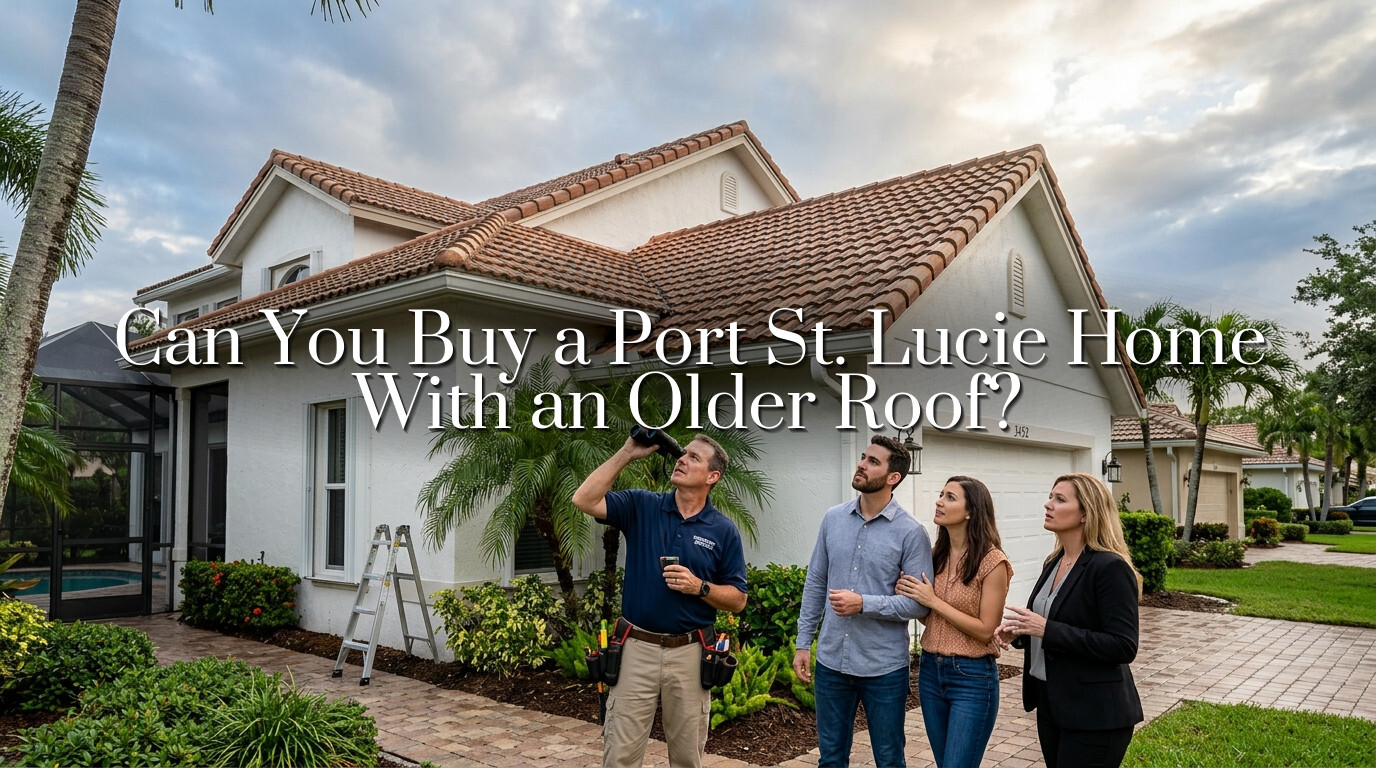
Can You Buy a Port St. Lucie Home With an Older Roof?
A 2026 guide to roof age, homeowners insurance, four-point inspections, wind mitigation, roof certifications, negotiation and what to verify before making an offer.
Quick Answer: Can You Buy a Port St. Lucie Home With an Older Roof?
Yes. An older roof is not automatically a defective roof, an uninsurable roof, or a reason to reject an otherwise good property. Florida does not impose a blanket rule requiring replacement at 15 years. For roofs 15 years or older, state law provides an inspection pathway, and an insurer cannot refuse coverage solely because of roof age when an authorized inspection documents at least five years of useful life remaining. Insurers can still consider roof condition and other underwriting factors, and Citizens applies its own separate thresholds. The practical issue is timing — verify permits, inspections and insurance while your contract still gives you leverage.
Educational only. This is general Florida real estate education, not individualized insurance, legal, building-code, engineering, roofing, mortgage or financial advice. Eligibility, premiums, coverage, deductibles and underwriting vary by insurer, property and policy, and Citizens requirements change independently of the private market. Verify with a licensed Florida insurance professional, a qualified inspector, an appropriately licensed roofing contractor, your lender, the applicable permitting authority, your closing professionals and a Florida attorney where legal advice is required.
What This Guide Covers
- What Counts as an “Older Roof”
- Why Roof Age Matters Here
- What Florida Law Actually Says
- Four-Point vs. Roof vs. Wind Mitigation
- How Citizens Handles Older Roofs
- How to Verify Roof Age in Port St. Lucie
- How to Negotiate an Older Roof
- What Wind Mitigation Tells You
- Deal Breaker or Opportunity?
- Pre-Offer Checklist
- FAQ
Where this fits. The 2026 Port St. Lucie homebuyer guide covers the full purchase process. This page is the roof-and-insurance deep dive. Related due diligence: open permits and pool homes.
What Actually Counts as an “Older Roof” in Florida?
There is no single age at which every Florida roof becomes “old.” A 14-year-old roof, an 18-year-old roof and a 28-year-old roof create very different insurance conversations. The useful approach is to separate three concepts that are related but not identical: chronological roof age, physical condition, and remaining useful life for underwriting.
Roof age is a historical fact
Florida’s homeowners-insurance statute gives a precise definition: for its roof-age provisions, the age generally traces to the last date when 100% of the roof surface area was built or replaced under the building code in effect at the time. The statute also addresses partial work that later results in replacement of the entire surface.
This matters, because a seller saying “we did roof work eight years ago” does not establish an eight-year-old roof. Was it a complete reroof, replacement of one damaged section, a repair around a vent, the roof over an addition, or permitted replacement of 100% of the covering? Buyers need the underlying documentation.
Roof condition is what exists today
A roof can be chronologically younger and poorly maintained, or older and still performing adequately. Condition analysis covers active leaks, evidence of previous leakage, missing or damaged material, deterioration, soft decking, cracking, curling, granule loss, loose or damaged tiles, flashing problems, visible repairs, penetrations and drainage. Citizens’ own roof inspection form asks inspectors to document covering, age, remaining useful life, permit information, update history, overall condition and visible deterioration — which reinforces that age is only one part of underwriting.
Remaining useful life is an opinion about the future
Remaining useful life — RUL — asks how much serviceable life a qualified inspector estimates remains, given current condition. Five years is the critical threshold, both for Florida’s statutory protection on roofs at least 15 years old and in Citizens’ current older-roof rules. It is not a guarantee the roof will last exactly that long, and an inspection is not a warranty against leaks, storm damage or future deterioration.
Two myths worth correcting. First, a 15-year-old roof does not automatically require replacement — the statute provides an inspection pathway, not an expiration date. Second, the often-repeated “25-year shingle rule” reflects a particular underwriting framework, most notably Citizens’ current guidelines, rather than a universal Florida statute. Private carriers set their own guidelines, which is why “my friend’s insurer accepted a 22-year-old roof” proves nothing about your property.
Roof age is not roof condition. A permit showing a 2010 reroof is useful historical evidence; it does not prove the roof is leak-free today. Equally, an older roof is not automatically defective. Verify both the date and the present physical condition.
Why Does Roof Age Matter So Much in Port St. Lucie?
Because buying the property and insuring it are connected transactions. A financed buyer’s lender generally requires acceptable property insurance before closing, and even a cash buyer wants to know reasonable coverage is available before becoming the owner. A roof issue can therefore affect insurance eligibility, premium, the timing of the binder, inspection requirements, financing, repair negotiations, the closing date, your future replacement budget and your eventual resale.
The listing’s roof year is a starting point, not an underwriting decision
A listing might say “Roof: 2011.” Useful — but it does not tell you whether the entire roof was replaced, whether the permit was finalised, whether there is active damage, whether the covering is shingle, tile or metal, whether a carrier will request a four-point, whether five years of remaining life can be documented, what mitigation features exist, or what premium will actually be quoted. A buyer needs more than a data field.
Underwriting is carrier-specific
Florida law creates consumer protections; it does not make every insurer underwrite identically. One company may accept a home another declines under its current program. One may want a four-point, another a specialised roof inspection, and Citizens applies its own published requirements. An agent shopping multiple carriers can return very different possibilities for the same address.
Eligibility and premium are different questions
A carrier may consider a property eligible and still quote a premium that changes your monthly budget. Documented wind-mitigation characteristics can also affect pricing. That is why two Port St. Lucie homes at similar prices can produce different total ownership costs — and why the insurance quote belongs in your payment calculation. The Port St. Lucie mortgage calculators can model scenarios, but replace the default insurance assumption with your real property-specific quote.
Roof history matters in established neighbourhoods
Port St. Lucie contains housing built across many periods. When comparing an established home with newer construction, the roof may be one of the largest components separating their short-term capital needs. That does not make the older property inferior — it may have a roof already replaced under a newer code cycle, documented wind mitigation, updated electrical or plumbing, a preferred location, a larger lot and pricing that reflects future improvements.
Avoid the reverse assumption too. “The roof is only eight years old, so insurance is automatic” is also wrong. The law prevents refusal solely because of age for a roof under 15 years — it does not require an insurer to ignore active leaks or other lawful underwriting concerns. Condition always matters.
If roof age looks potentially important, involve the insurance side early. Your investigation may need time for a general inspection, a four-point, a wind mitigation inspection, a roof-specific evaluation, permit research, agent review, seller response, a contractor proposal and a revised quote. Waiting turns a manageable negotiating issue into a closing emergency.
What Does Florida Law Actually Say in 2026?
The current law is more buyer-friendly — and more nuanced — than many older articles suggest. It sits in Florida Statute §627.7011.
| Roof age | What the statute provides |
|---|---|
| Under 15 years | An insurer may not refuse to issue or renew a homeowner’s policy solely because of the age of the roof |
| 15 years or older | The insurer must allow an authorized roof inspection, at the homeowner’s expense, before requiring replacement as a condition of issuing or renewing coverage |
| 15+ with 5 years of documented life | The insurer may not refuse to issue or renew solely because of roof age |
The word “solely” carries the weight. None of this guarantees a policy. The roof can still have condition problems, the home can present a separate underwriting concern, and the policy type could fall outside the provision. The protection is against an age-only refusal in the circumstances the law covers.
Still current in 2026. Bills that would have expanded these protections died in the House Insurance and Banking Subcommittee in March 2026, so the framework described here — the inspection right for roofs 15 and older and the five-year useful-life standard — remains in place unchanged. Because this provision is revisited most legislative sessions, confirm it is still current before relying on it in a later year.
Who can perform the statutory inspection?
The statute defines authorized inspectors broadly enough to include specified licensed professionals and other qualified entities recognised by the insurer. Because carrier acceptance matters, do not simply hire someone and assume the resulting document satisfies every insurer. Ask the agent or carrier: what inspection form do you require, and which inspector licences will you accept?
How roof age is calculated
Roof age generally uses the date when 100% of the roof surface was built or replaced in compliance with the code then in effect, with a specific rule for a sequence of partial replacements that ultimately covers the entire roof. So “half the roof was replaced five years ago” does not make the whole roof five years old.
Five separate decision-makers
Keep these apart: Florida law addresses when age alone may be the reason for refusal. Citizens’ rules set that insurer’s own inspection and eligibility requirements. Private carrier underwriting varies by company and program. Home inspection findings describe physical condition. Your lender decides whether the insurance satisfies the loan.
Insurance reality check. “Florida law says I can keep the roof” does not equal “this carrier will bind this property at a premium I can afford.” The legal protection, the physical inspection, the underwriting decision and the final quote are four separate steps.
Four-Point vs. Roof Inspection vs. Wind Mitigation
These solve different problems, and confusing them costs buyers time during a contract.
| Inspection | Main purpose | Determines eligibility? | Documents wind credits? |
|---|---|---|---|
| General home inspection | Broad condition review for the buyer | Not by itself | No |
| Four-point | Insurer review of roof, electrical, plumbing, HVAC | Often used by the insurer | Not its purpose |
| Roof-specific | Condition and remaining useful life | Can be decisive | Normally no |
| Wind mitigation | Document qualifying wind-resistant features | Not primarily | Yes |
A general home inspection is your comprehensive due diligence within the inspector’s scope. A four-point is insurance-focused, covering roof, electrical, plumbing and HVAC, with the roof portion typically addressing type, age, condition and estimated life. The name creates confusion — buyers assume it is a four-item version of a normal home inspection. It is not a substitute for buyer due diligence; it exists because insurers want focused information about systems tied to significant loss exposure.
No universal Florida statute requires every home over a single age to have a four-point before sale. Requirements are set by insurers — Citizens currently requires one for property-owner, dwelling and mobile-home applications on properties more than 20 years old, while private carriers can differ.
Roof-specific inspection and “roof certification”
Insurers sometimes request a specialised inspection of one system, with roof life expectancy a common example. Citizens publishes a roof inspection form requesting covering, age, remaining useful life, last permit, last update, full or partial replacement, overall condition and visible damage. In everyday conversation people call such a document a “roof certification” — but there is no single statewide document by that name that every insurer accepts identically. Ask the carrier which form it requires and what licence the inspector must hold before you pay for one.
Order them together where possible. Many inspectors offer the general inspection, four-point and wind mitigation in one visit. Whether an additional roof-specific evaluation is necessary depends on the carrier and the findings — ask your insurance professional exactly what documentation is needed before buying overlapping reports.
How Does Citizens Handle Older Roofs?
Citizens deserves its own section, because buyers often hear its rules repeated as though they were statewide law. They are not — they are Citizens’ own eligibility and underwriting requirements.
| Citizens requirement | Trigger |
|---|---|
| Four-point inspection | Property more than 20 years old (property-owner, dwelling and mobile-home applications) |
| Documentation of 5+ years remaining useful life | Soft coverings such as shingle more than 25 years old |
| Documentation of 5+ years remaining useful life | Hard coverings — tile, slate, clay, concrete, metal — more than 50 years old |
| Proof of full roof replacement before a policy is written | Roof documented with less than 5 years remaining useful life |
A threshold is not a predicted lifespan. That Citizens uses a 50-year documentation trigger for specified hard roofs does not mean every tile roof lasts 50 years. Physical life depends on installation, maintenance, underlayment, weather exposure, damage, repairs and the roof system’s components. The same applies to the 25-year soft-roof threshold — it is not a promise that every shingle roof stays acceptable until year 25. Condition still governs.
Citizens explains that remaining useful life is an estimate made by a trained professional with relevant experience, and that it relies on that assessment during review. A buyer should not try to estimate RUL from listing photos. Citizens also provides circumstances in which its four-point form can serve in place of the separate roof form when the required information, photographs and signatures are included — your agent should confirm which document the specific application needs.
Finally, do not assume Citizens is the first, only or cheapest option. A licensed insurance professional can review carriers currently writing this type of risk, and different insurers weigh age, roof type, mitigation, claims, location and other systems differently within their programs. The goal is not merely to find a policy — it is to understand the coverage, deductibles, price and carrier requirements before the transaction becomes difficult to unwind.
Looking at a Port St. Lucie Home With an Older Roof?
Send the address and the roof year. We can plan the permit search, line up the right inspections, and get insurance feedback while your contract still gives you options.
How Do You Verify the Roof Age on a Port St. Lucie Home?
Do not rely on one source. Build a roof history from several pieces of evidence.
Ask what the seller knows
Request the year of replacement, roofing contractor, invoice, warranty, permit documentation, any insurance inspection, wind mitigation report, prior four-point, known repairs and known leaks. Seller documentation is useful; independent verification is still appropriate.
Search the permit record — and check legacy data
For property inside incorporated Port St. Lucie, the City maintains an online permit search. Its instructions specifically warn that two address records can appear — the current system and legacy data from the older system — and tell users to check both. A buyer who checks only the current record can miss the reroof entirely and wrongly conclude no permit exists.
Look for completion or final status
Finding an application is not the end of the inquiry. Determine whether the permit was issued, inspected, finalised, closed, cancelled or left open. The City refers formal open-permit and title searches to its Lien Services Division.
Pay attention to a flagged record
Port St. Lucie’s permit-search instructions state that addresses displayed in red may indicate a possible violation or issue requiring further inquiry. That does not automatically mean a roof problem — it means investigate rather than ignore the flag.
Verify jurisdiction first
Not every property described as being “in the Port St. Lucie area” uses the City’s permitting system. St. Lucie County’s Building & Code Regulation Division handles unincorporated county property. Use the authority with jurisdiction over the parcel.
Compare the permit against the physical roof
If the permit says reroof in 2012 and the inspector sees significant deterioration, active leak staining and patching, the permit remains useful evidence of age but does not erase condition concerns. The reverse also happens — an older permitted roof that has been maintained may still show acceptable remaining life.
Ask whether replacement was full or partial
A permit for a repair, a partial reroof, an addition or a flat-roof section does not necessarily reset the age of the entire structure. Florida’s statute focuses on when 100% of the roof surface was built or replaced, with a specific rule for sequential partial replacements.
Give everything to your insurance agent
Permit verification is not the last step. The agent needs the roof type, documented age, home age, inspection results, mitigation information, address and other property systems in order to have a real underwriting conversation rather than a guess.
A local detail worth the two minutes. The City’s own system tells users to check both current and legacy property records. For older Port St. Lucie homes, that single step is frequently the difference between finding the reroof record and concluding incorrectly that none exists. The wider method is in open permits in Port St. Lucie.
How Should You Negotiate an Older Roof?
Once you know the age, condition and insurance situation, the question becomes economic. There is no single correct strategy — it depends on insurance availability, premium, remaining life, current defects, replacement timing, seller motivation, lender requirements, price, competition and your contract terms.
Older roof, acceptable inspection, insurance available
The simplest case. No active leak, satisfactory condition, adequate remaining life, an acceptable quote and a price reflecting overall condition. A buyer may reasonably purchase without demanding replacement — it becomes a normal future-capital question. Ask: can I comfortably fund replacement when the roof reaches the end of its life? If yes, the roof is simply part of owning an established home.
Insurable, but the premium is materially higher
Now the issue is carrying cost, not eligibility. Get a real annual quote, convert it to monthly, and compare against alternatives. A seemingly cheaper home loses part of its price advantage if insurance costs materially more.
Carrier requires repair before binding
If the four-point reveals an active leak, damaged covering, a deteriorated section or another repairable deficiency, ask the insurer whether a specified repair by an appropriately licensed contractor, with supporting proof, would satisfy underwriting. Then negotiate around that actual requirement — seller completes the approved repair before closing, seller replaces the roof, the timeline changes, terms are renegotiated, or you change insurance strategy. Do not assume a cosmetic patch will satisfy the carrier. Get the carrier’s response.
Full replacement required before insurance can be bound
A more serious timing question, with several possible structures:
- Seller replaces before closing. The buyer can insure completed work and the lender sees updated documentation. Address who selects the contractor, what product is installed, what warranty transfers, whether permit and final inspection complete before closing, what happens if installation is delayed, and whether closing can extend.
- Purchase price reduction. This compensates economically for future expense — but a price cut does not create a bindable policy. If the carrier requires replacement first, lowering the price by $20,000 does not solve the insurance problem.
- Seller concession. May help with permitted buyer closing expenses depending on the loan program and contract, but lender rules control what credits can be used for. Do not assume a credit becomes cash in hand after closing.
- Escrow or holdback. Some transactions explore repair escrow or lender-approved holdbacks. Whether that is possible depends on the loan program, lender, insurer, contractor and closing arrangement — it should never be promised by an article. Ask the professionals handling the actual financing.
Replacing the roof yourself after closing
This works only if the home can be insured and, when financed, accepted by the lender in its present condition. Do not build the plan backward. Confirm carrier willingness, confirm the lender, understand the conditions of any policy issued, obtain a replacement proposal, budget the work — and close only if the structure is viable.
Compare net cost, not emotion. An older roof looks like a very large problem because replacement is visible and expensive. Compare the whole deal instead: a home at $425,000 with an older roof and an acceptable insurance quote versus one at $450,000 with a newer roof in a similar location. How much more does the second cost? What replacement budget does the first need? What is the insurance difference? What other systems have been updated? The roof should influence your decision — it should not automatically make it.
Market conditions matter to how much leverage you have; see the Port St. Lucie market in 2026. Contract interpretation belongs with a Florida attorney where needed.
What Can a Wind Mitigation Inspection Tell You?
Florida’s official form is the Uniform Mitigation Verification Inspection Form, OIR-B1-1802. The current version is Rev. 04/26, effective April 1, 2026 — inspections conducted on or after that date must use the revised form. It documents qualifying construction characteristics used for insurance rating: applicable building-code information, roof covering, roof-deck attachment, roof-to-wall attachment, roof geometry, secondary water resistance and opening protection.
What it is not. A wind mitigation form is not a full home inspection, a guarantee against hurricane damage, a roof warranty, an appraisal, a universal roof-life certificate, or proof an insurer must issue coverage. The form itself cautions that its definitions are for inspection purposes and cannot be treated as certification that a product or construction feature will provide protection from hurricanes.
Roof covering age and structural attachment are different things
A home might have a relatively new shingle roof but older roof-to-wall connection characteristics — or an older covering with stronger documented structural connections. Those are separate mitigation attributes, which is why “new roof” cannot substitute for the actual form. Secondary water resistance is another separate feature: a roof permit alone does not prove it qualifies, and the inspector needs supporting evidence consistent with the form. Opening protection — impact-rated windows and shutters — belongs to yet another portion of the review, so “this house has impact windows, so the roof gets a discount” confuses two different things.
How long the form stays valid
The current form states it can remain valid for up to five years where the structure has not materially changed and no inaccuracies are discovered. If the roof or openings are materially changed, an older report may no longer describe the home accurately.
A practical transition note. Citizens has indicated it will continue to accept the previous version of the form — Rev. 01/12 — where it was completed within the five years before April 1, 2026. So a wind mitigation report a seller hands you from 2022 may still be usable. Give it to your insurance agent and let them determine whether it remains acceptable or a new inspection should be ordered.
Could a wind mitigation inspection lower your premium? Potentially — documented mitigation features can qualify a home for available windstorm credits. The actual premium depends on the insurer and policy, so no specific savings percentage should be promised without a carrier quote.
Two roof questions, not one. When you evaluate a Port St. Lucie roof, ask separately: is the condition and remaining useful life acceptable for eligibility? And what documented construction features qualify for available wind-related credits? One inspection does not necessarily answer both.
Deal Breaker or Negotiation Opportunity?
There is no universal answer. The goal of due diligence is not to eliminate every older property — it is to identify risk before making an irreversible financial decision.
| Roof situation | Insurance | Buyer response |
|---|---|---|
| Older, good condition, adequate remaining life | Acceptable | Budget replacement; negotiate only if the economics justify it |
| Adequate life, expensive premium | Available but costly | Compare total monthly cost against alternatives |
| Repairable deficiency | Conditional | Get the carrier’s approved repair requirements in writing |
| Less than required remaining life | Difficult or conditional | Explore replacement before closing |
| Active leakage or damage | Uncertain | Investigate extent and full repair scope |
| Permit history unclear | Uncertain | Search City and County records; ask the carrier what proof it accepts |
| Seller offers a new roof | Potentially favourable | Control scope, permit, timing and documentation |
| No reasonable insurance path | Not workable | Renegotiate hard or consider another property |
Where extra caution is warranted
Active leaks or water intrusion can extend beyond the covering into decking, attic materials, insulation, ceilings and interior finishes — investigate cause and extent rather than accepting “it is just a small leak.” Unexplained roof history is another: if the seller says 2015 and the permit search shows nothing, do not assume wrongdoing. Consider an address or legacy-record mismatch, a permit recorded differently, work under another permit, a limited repair, or a jurisdiction issue — investigate, and if documentation still cannot be established, ask the carrier what it will accept as proof. An unfinalised permit can become a closing or title issue separate from roof condition, and is not the home inspector’s responsibility to resolve.
Where it becomes an opportunity
An older roof can create leverage where the seller is prepared to address buyer concerns. A lower price may let you buy in a preferred location and install a roof after closing — if insurance and financing permit that plan. A seller-replaced roof under contract can give you a new permitted roof while the transaction continues, but review materials, scope, permit, contractor, warranty, final inspection and wind mitigation documentation. A new roof installed cheaply and incompletely is not automatically better than an older roof that was well installed and documented.
Reconsider when the capital planning does not work. Even an insurable roof with limited remaining life creates a substantial future expense. If you will have little cash reserve after the down payment, closing costs, moving and furnishings, accepting a near-term replacement can create real financial stress. Do that planning before closing, not after.
Port St. Lucie Older-Roof Checklist
You do not need to become a roofer or an underwriter. You need to know which questions to ask, and when.
Before making the offer
- Ask for the stated roof age from the seller or listing
- Identify the covering — asphalt shingle, concrete or clay tile, metal, low-slope, or a combination
- Search the permit history, checking both current and legacy records
- Request available invoice, permit, warranty, wind mitigation, four-point or roof report
- Call your insurance professional early with the address, roof age, material, year built and any mitigation report, and ask whether obvious concerns exist
After going under contract
- Complete the general home inspection
- Obtain a four-point if the carrier requires one
- Obtain roof-specific documentation only after confirming what the prospective insurer accepts
- Obtain or update wind mitigation — inspections after April 1, 2026 use OIR-B1-1802 Rev. 04/26
- Get real insurance quotes, not a statewide average
- Give the real premium to your lender, since it affects payment, escrow and debt-to-income analysis
- Price the likely roof work with appropriate contractor estimates
- Decide the negotiation approach — price, seller repair, replacement, timing or permitted concessions
- If the seller replaces the roof, verify the permit and final inspection rather than accepting “the roof is done”
- Keep the final documentation — permit, final inspection, invoice, warranty, four-point, wind mitigation, roof report and insurance approval — for future renewals and resale
Searching now? Use the Port St. Lucie home search to identify properties by location and price first, then let due diligence determine whether the roof, insurance and total ownership cost work — rather than filtering homes solely by roof year.
Ready to decide, not just research? This guide covers the law and the underwriting. For the decision framework — the five gates, financing programs, permit jurisdiction by neighbourhood and the five negotiation structures compared — see older roof, great house: should you still make the offer?
FAQ: Buying a Port St. Lucie Home With an Older Roof
Potentially, yes — a 20-year-old roof is not automatically uninsurable. For roofs at least 15 years old, Florida Statute §627.7011 provides an inspection pathway, and if an authorized inspection shows at least five years of useful life remaining, an insurer cannot refuse issuance or renewal solely because of roof age. That protection does not eliminate normal underwriting — the insurer can still evaluate condition, leaks, deterioration, other home systems and other lawful risk characteristics. Obtain the quote while your contract still gives you practical options.
No. Florida law creates no blanket 15-year replacement mandate. Once a roof is at least 15 years old, the statute requires the insurer to allow an authorized inspection before requiring replacement as a condition of issuing or renewing coverage, and if that inspection establishes at least five years of useful life the insurer cannot refuse solely because of age. A roof may still need replacement because of its physical condition. Fifteen years is an insurance-law threshold, not an expiration date.
No statewide rule requires every home above one universal age to have a four-point inspection. Insurers set the requirement as part of underwriting, and four-points are commonly requested on older homes to evaluate roof, plumbing, electrical and HVAC. Citizens currently requires one for property-owner, dwelling and mobile-home applications on properties more than 20 years old. A private carrier may use a different threshold or request different documentation — ask the agent serving your transaction.
No. A four-point is primarily an underwriting tool evaluating four major systems: roof, plumbing, electrical and HVAC. A wind mitigation inspection documents construction features that may qualify the property for windstorm premium credits, using Florida’s uniform form OIR-B1-1802, currently Rev. 04/26 effective April 1, 2026, covering roof covering, roof-deck attachment, roof-to-wall connections, roof geometry, secondary water resistance and opening protection. A buyer can need both — one does not replace the other.
“Roof certification” is a marketplace term rather than one universal Florida form accepted identically by every insurer. An insurer may request a specialised roof inspection documenting age, covering, condition, remaining useful life and permit history, and Citizens publishes its own roof inspection form with those fields. Before paying for a certification, ask the prospective insurer or agent exactly which form is accepted and what licence the inspector must hold. The right document is the one that satisfies the policy you are seeking.
Not automatically rejected on that fact alone, but Citizens’ older-roof rules become important once a soft covering such as shingle is more than 25 years old — at that point documentation showing at least five years of remaining useful life is required. Condition and other underwriting requirements still apply, and if documented life falls below the threshold, proof of full replacement may be required before a policy is written. Have the Citizens agent review the actual property and current documentation.
Citizens applies a different age threshold to hard coverings, listing tile, slate, clay, concrete and metal among those for which five-year remaining-life documentation is triggered when the roof is more than 50 years old. That does not mean a 40-year-old tile roof is automatically in good condition or has another decade of life — the threshold is an underwriting rule, not a lifespan warranty. Tile systems also contain components beyond the visible tile, so obtain condition information appropriate to the property and the insurer.
Not necessarily. Florida’s statutory roof-age rule generally looks to when 100% of the roof surface area was built or replaced, and also addresses a sequence of partial replacements that eventually covers the entire surface. Replacing one section does not automatically reset the age of every roof plane. This is why permit scope matters — determine whether the record indicates a full reroof, a repair, a partial replacement or roof work connected to an addition, then give that documentation to your insurance professional.
For property inside incorporated Port St. Lucie, use the City’s online property permit search: enter the address, select the property record and review the permit history. The City specifically warns that both a current address record and a legacy data record can appear, and tells users to inspect both. An address shown in red may indicate a possible issue requiring further inquiry, and formal open-permit or title searches are referred to Lien Services. For property outside the city limits, verify whether St. Lucie County has permitting jurisdiction first.
Yes, if the contract and transaction allow it, but the details matter. Address the licensed contractor, agreed scope, materials, permit, final inspection, completion deadline, warranty, access, what happens if work is delayed, and updated insurance documentation. Work must comply with the applicable permitting framework and current Florida Building Code edition for the jurisdiction. The buyer should also obtain an updated insurance quote and, where appropriate, new wind mitigation documentation once the work is complete.
Possibly, but a credit does not automatically solve an insurance or financing problem. If the insurer will not bind coverage until the roof is replaced, receiving money from the seller does not create a policy. The structure must satisfy the contract, the lender, the insurer and closing requirements, and loan programs limit how seller concessions may be used. Avoid proposing “the seller gives me $20,000 and I replace it next month” until the lender and insurance professionals confirm the transaction can close that way.
Yes, if the home can be insured and, when financed, accepted by the lender in its current condition. The plan fails if the carrier requires replacement before issuing acceptable coverage. Before making an after-closing replacement part of your offer, obtain the inspection, get carrier feedback, verify lender requirements, obtain a contractor estimate, confirm your cash reserves and understand what coverage exists until replacement occurs. Cash buyers face the same underlying question — whether the property can be insured on acceptable terms.
It can, primarily through property condition and insurance. A lender needs the collateral and required property insurance to satisfy the loan program and its own standards, so if roof condition makes acceptable coverage unavailable, financing can be affected even where the buyer otherwise qualifies. A materially higher premium can also change the monthly housing expense and potentially the debt-to-income calculation. Give the lender the real quote rather than continuing with an early estimate — roof and insurance due diligence belong inside financing planning.
The current OIR-B1-1802 Rev. 04/26 states the form can remain valid for up to five years where no material changes have been made to the structure and no inaccuracies are discovered. A report may no longer be useful after roof replacement, major opening changes or other material mitigation changes. The revised form took effect April 1, 2026, and Citizens has indicated it will continue accepting the previous Rev. 01/12 version where completed within the five years before that date — give any older form to your agent and ask.
Whenever possible, yes. Your strongest moment to discover an insurance problem is while contractual due-diligence options still exist. Waiting until shortly before closing risks discovering a carrier rejection, a roof certification requirement, an unexpected four-point issue, a high premium or a replacement requirement after your leverage has narrowed. A practical sequence is: inspect, obtain the required insurance reports, send them to your agent, receive preliminary underwriting feedback and a quote, then negotiate while contract rights remain available.
Verify the Roof, Verify the Insurance, Then Decide
An older roof should trigger due diligence. It should not automatically trigger rejection.
Florida’s current insurance law does not say every 15-year-old roof must be replaced. For roofs at least 15 years old the statute provides an inspection path and protects against refusal solely on roof age when an authorized inspection documents at least five years of remaining useful life. That is only one part of the decision — insurers still evaluate physical condition and other underwriting factors.
Citizens applies additional eligibility requirements of its own: four-point inspections for properties more than 20 years old, five-year remaining-life documentation for soft roofs more than 25 years old, and similar documentation for specified hard roofs more than 50 years old. Private carriers can differ. And the wind mitigation form is different again from both the four-point and the roof-life inspection — OIR-B1-1802 Rev. 04/26 took effect April 1, 2026 and documents features that can affect available windstorm credits.
For a Port St. Lucie home, permit research adds another layer. The City maintains an online permit system, and its own instructions tell users to check both current and legacy address records — a small step that frequently decides whether a reroof record is found at all.
A workflow that works: verify roof age, inspect condition, determine remaining useful life where needed, check permit history, obtain the four-point if required, obtain the wind mitigation report, send everything to your insurance agent, obtain a real premium, confirm lender requirements — and only then negotiate.
You may discover the older roof is perfectly manageable. You may discover the price should change. You may decide the seller should replace it, or that another property is the better financial choice. The purpose of due diligence is to make that decision with evidence rather than fear.
Jeannie Jacobson works with Port St. Lucie buyers to coordinate the real estate side of this process — property research, inspection timing, seller negotiations, and the questions that need to be taken to the insurance agent, lender, inspector, roofer or closing professional. If you are considering a property with an older roof, start there rather than with assumptions drawn from the roof year alone. More on how buyer representation works here.
Considering a Port St. Lucie Home With an Older Roof?
Let’s organise the investigation — permit history, inspection timing, seller questions, insurance-document requests and negotiation strategy — so you can decide before critical contract deadlines pass.
Serving Port St. Lucie, Tradition, St. Lucie West, PGA Village, Fort Pierce, Stuart, Palm City, Jensen Beach, and the Treasure Coast · Jeannie Jacobson · RE/MAX Gold · Florida License SL 3516612
Important insurance and inspection disclaimer. This article provides general Florida real estate education. It is not individualized insurance, legal, building-code, engineering, roofing, mortgage, tax or financial advice. Insurance eligibility, premiums, coverage forms, deductibles and underwriting requirements vary by insurer, property and policy, and Citizens requirements can change independently of private-market underwriting. Building-code requirements depend on the work, the permit date and the applicable jurisdiction. Roof condition and remaining useful life should be evaluated by appropriately qualified professionals. Sources: §627.7011, Florida Statutes (roof age, inspection pathway, five-year remaining-useful-life standard and roof-age calculation); Florida Department of Financial Services consumer guidance on homeowners insurance inspections; Citizens Property Insurance Corporation inspection and older-roof eligibility requirements; Florida Office of Insurance Regulation Uniform Mitigation Verification Inspection Form OIR-B1-1802 Rev. 04/26, effective April 1, 2026; City of Port St. Lucie Building Department permit search guidance; St. Lucie County Building & Code Regulation Division. Verified August 2026 — the roof-age provision is revisited in most legislative sessions and Citizens rules change independently, so confirm currency before relying on any of it. Verify property-specific questions with a licensed Florida insurance professional, a qualified home inspector, an appropriately licensed roofing contractor or accepted roof inspector, your lender, the applicable permitting authority, your title and closing professionals, and a Florida attorney where legal advice or contract interpretation is required.