

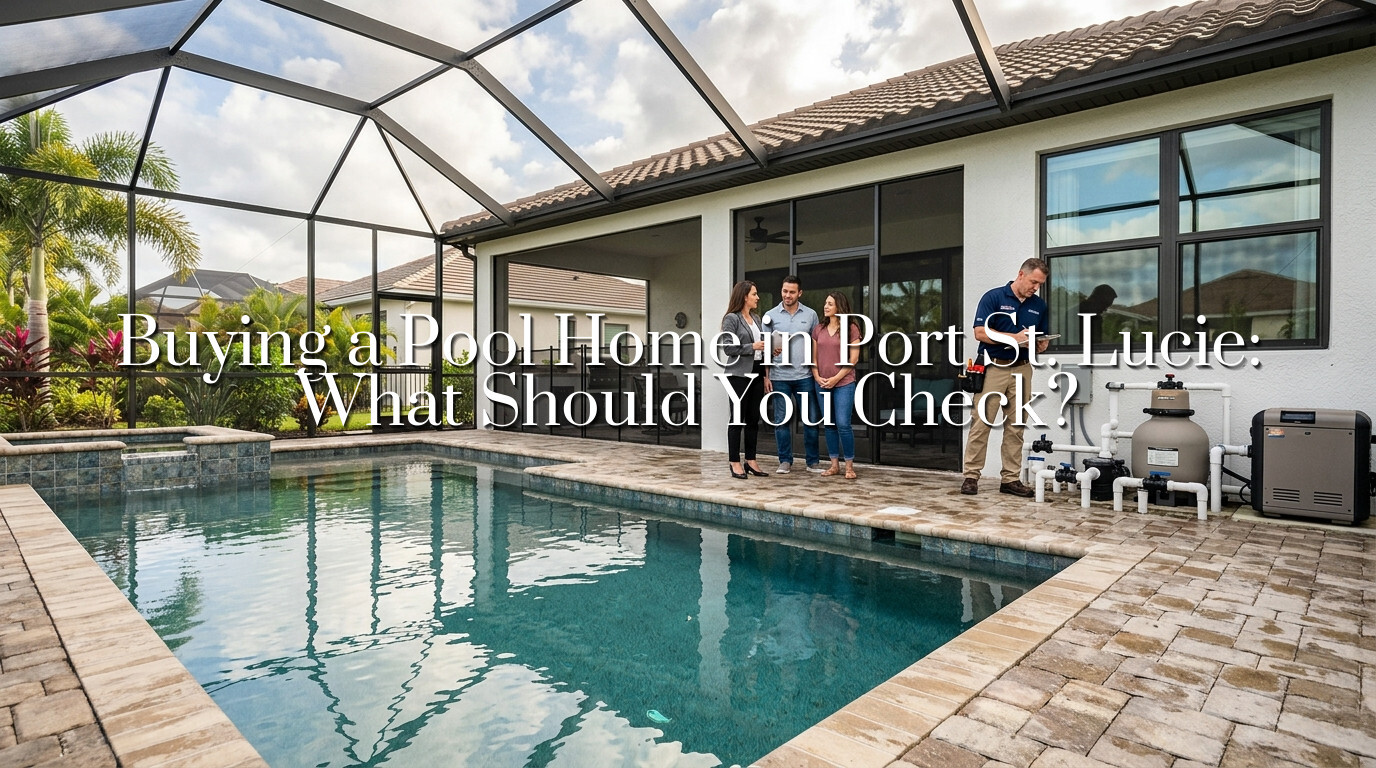
Buying a Pool Home in Port St. Lucie: What Should You Check?
What to check before buying a pool home in Port St. Lucie: why the pool is usually excluded from the general inspection, how to read the shell, equipment, deck and screen enclosure, what Florida law requires for safety, permit history, insurance questions, and how to negotiate repairs inside the inspection period.
Quick Answer: What Should You Check When Buying a Pool Home in Port St. Lucie?
Start by ordering a dedicated pool inspection, because a standard home inspection often excludes the pool entirely or disclaims it. Then work through six things: the shell and surface for leaks and cracks, the equipment age and condition — pump, filter, heater, automation — the deck and screen enclosure, the safety features Florida law requires, the permit history for the pool and any later additions, and the insurance and maintenance cost you are taking on. Most pool disputes in a Port St. Lucie transaction come from something that was visible and simply never inspected.
Educational only. This is general real estate information, not legal, engineering, insurance, or code advice. Pool construction, equipment, and local requirements vary by property. Confirm permit and code questions with the City of Port St. Lucie or St. Lucie County building department, use licensed pool and home inspectors for condition, and consult a licensed Florida attorney for contract and legal questions.
What This Guide Covers
- Why the Pool Needs Its Own Inspection
- The Shell, Surface, and Structure
- Pump, Filter, Heater, and Automation
- Deck, Screen Enclosure, and Lanai
- What Florida Law Requires for Safety
- Permits and Unpermitted Work
- Insurance Questions to Ask Early
- What It Actually Costs to Run
- Taxes, Value, and Resale
- Negotiating Repairs Before Closing
- Private Pool, Community Pool, or No Pool
- Saltwater or Chlorine
- Storm Season for Pool Owners
- Buying With a Pool vs. Adding One
- FAQ
Where this fits. For the wider purchase process, see the Port St. Lucie buyer guide and how to write a strong offer here. This page covers only the pool.
Why the Pool Needs Its Own Inspection
This is the single most useful thing a Port St. Lucie buyer can know, and it surprises almost everyone: a general home inspection frequently does not cover the pool. Many inspectors either exclude it outright or include a disclaimer limiting what they examined. Read the scope section of your inspection agreement before you assume the pool is included.
The reason is not laziness. Evaluating a pool properly requires running equipment through cycles, checking electrical bonding, assessing the shell, and — where there is any suspicion of loss — pressure-testing the plumbing. That is a different trade from evaluating a roof and an air handler.
The two levels of pool inspection
A visual or basic inspection covers the shell surface, visible deck condition, equipment operation, safety features, and obvious defects. It is inexpensive and fast, and it is the minimum.
A full inspection with leak detection and pressure testing is a different scope and costs considerably more. It is what you order when the visual inspection raises a question, when the pool is older, when the equipment or water level behaviour suggests loss, or when the purchase price makes the risk worth removing.
Get local quotes rather than national figures. Published pool-inspection prices vary widely by market and by scope, and figures quoted for other parts of the country are not Port St. Lucie prices. Ask two local inspectors what each level includes and what it costs here. The gap between the two scopes is the whole decision.
Order the inspection early in the inspection period, not near the end. If the visual report recommends leak detection, you need time to schedule the second visit and still respond within your contractual deadline. Buyers who order on day eight of a ten-day period lose the option entirely.
The Shell, Surface, and Structure
The shell is the expensive part. Everything else on a pool can be replaced at a manageable cost; structural problems are a different category.
Surface finish
Marcite, plaster, pebble, and quartz finishes all have finite service lives. Look for rough patches, staining, delamination, chips, and areas where the finish has worn through to the substrate. Resurfacing is a normal maintenance event, not a defect — but knowing whether it is due in one year or ten materially changes what the home costs you.
Tile and coping
Loose or missing waterline tile and lifting coping stones can indicate ordinary wear, or they can indicate movement. Ask the inspector to distinguish between the two.
Cracks
Fine surface crazing in the finish is common. Structural cracks in the shell are not, and they are the finding that should slow a purchase down. If an inspector flags a possible structural crack, that is a question for a licensed engineer, not for an agent or a pool service company.
Signs of water loss
All Florida pools lose water to evaporation. Losing noticeably more than the surrounding conditions explain, an autofill that runs constantly, persistently damp deck areas, or unexplained ground settling near the equipment pad all point toward leak detection.
Ask a question the seller can answer factually: when was the pool last resurfaced, and by whom? A dated invoice tells you more about remaining life than any visual assessment. Sellers who have it will produce it; sellers who do not have told you something as well.
Pump, Filter, Heater, and Automation
Equipment is where the near-term money sits. Every component has an age, and the useful question for each one is not “does it work today” but “how many years are left.”
- Pump. Note the make, model, and age, and whether it is single-speed or variable-speed. Listen for bearing noise and check for leaks at the seal. Variable-speed pumps cost more to replace and considerably less to run.
- Filter. Cartridge, sand, or diatomaceous earth — each has different upkeep and replacement intervals. Ask when the media or cartridges were last changed.
- Heater. The most commonly neglected component in Florida, because it is used seasonally and failures go unnoticed. Have it run through a full cycle during the inspection. Gas heaters, heat pumps, and solar pool heating are three different systems with different costs.
- Salt chlorine generator. If present, the cell is a consumable with a limited life and a meaningful replacement cost. Ask its age.
- Automation and lighting. Confirm controls actually operate the equipment, and that pool and landscape lighting work. Older lighting may raise electrical questions.
- Electrical bonding and GFCI protection. A safety item, not a comfort item. It belongs in the inspection scope explicitly.
Photograph the data plate on every component. The model and serial number establish the manufacture date, which is the honest basis for estimating remaining life — far better than a seller’s recollection that something is “pretty new.”
A practical note from working Port St. Lucie contracts: heaters and salt cells are the two items most likely to be quietly at end of life at the time of sale, because neither one announces itself until it fails. Testing them during the inspection period costs nothing extra and regularly changes the negotiation. That is a professional observation, not a published statistic.
Touring Port St. Lucie Pool Homes This Month?
Before you write an offer, let’s line up a pool inspector alongside the general inspector and build the inspection period around both. The scheduling is what buyers usually get wrong, not the evaluation.
Deck, Screen Enclosure, and Lanai
In Port St. Lucie the enclosure is often worth more attention than the pool. Screen cages are a defining feature of Florida outdoor living and one of the most common sources of post-closing disappointment.
The screen enclosure
Check the aluminum frame for corrosion at the base where it meets the deck, missing or backed-out fasteners, sagging or bowed members, torn or slack screening, and the condition of the door and its closer. Then ask the question that matters more than any of those: was the enclosure permitted, and is there a final inspection on record?
Enclosures are also treated differently by insurers than the house itself. Coverage for screen enclosures and pool cages is frequently limited, sub-limited, or excluded under Florida homeowners policies, particularly for wind. Do not assume the cage is insured the way the roof is. Ask the carrier specifically, in writing, before your inspection period closes.
The deck
Look for settlement, trip hazards, cracking, and drainage that runs toward the house rather than away from it. Pavers can be reset; a deck that has settled because of a drainage or soil problem is a different conversation. Check that the surface is not so worn that it has become slick.
Drainage and grading
Standing water on the deck after rain, or grading that channels water toward the slab, is worth understanding before closing. On a Treasure Coast property this connects to broader water management — the same discipline that matters on waterfront properties, where drainage and elevation get examined closely.
What to verify on the enclosure before your inspection period ends: permit and final inspection on record, current condition of frame and fasteners, whether your insurer covers it and at what limit, and whether the HOA has any architectural requirement affecting repair or replacement materials.
What Florida Law Requires for Safety
Florida’s Residential Swimming Pool Safety Act, Chapter 515 of the Florida Statutes, applies to residential pools at one- and two-family dwellings and townhouses no more than three stories high. Under §515.27 a residential swimming pool must have at least one of five safety features:
- An enclosure isolating the pool from the home that meets the barrier requirements of §515.29
- An approved safety pool cover
- An exit alarm on all doors and windows with direct access to the pool, with a minimum sound rating of 85 dB at 10 feet
- A self-closing, self-latching device on all doors with direct access to the pool, with the release mechanism no lower than 54 inches above the floor
- A pool alarm that sounds on accidental or unauthorized entry into the water, independently certified to ASTM Standard F2208
Where a barrier is used, §515.29 requires it to be at least four feet high on the outside, with no gaps, openings, indentations, or protrusions that would let a young child crawl under, squeeze through, or climb over it. Gates must open outward away from the pool, be self-closing and self-latching, with the release mechanism on the pool side and positioned out of a young child’s reach.
Violating the Act is a second-degree misdemeanor. The statute provides that the charge may be dismissed if, within 45 days of arrest, the person equips the pool with at least one safety feature and completes a drowning prevention education program.
What this means for you as a buyer. The Act dates from 2000, and whether a specific existing pool was required to comply when it was built — and what you as the new owner must do after closing — depends on the pool’s construction date and any later modifications. That is a question for the City of Port St. Lucie or St. Lucie County building department, not for a general article. Ask during the inspection period, because if a safety feature has to be added, you want to know the cost before you remove your contingency.
Separately from the law: if you have young children or grandchildren, evaluate the barrier situation on its own terms rather than treating minimum compliance as adequate. Meeting a statute and matching your household are different standards.
Permits and Unpermitted Work
Unpermitted work is the pool issue that costs the most and gets checked the least. When you close, it becomes yours — including the cost of bringing it into compliance, and any complication it creates for insurance or a future sale.
Pull the permit history for the parcel from the City of Port St. Lucie or St. Lucie County, depending on where the property sits. Look for permits and final inspections covering:
- The original pool construction
- The screen enclosure or cage
- Any deck extension or resurfacing that altered the structure
- Electrical work at the equipment pad
- Gas line installation for a heater
- Later additions — spa, water features, outdoor kitchen, pergola
An open permit — one that was pulled but never finalised — is a specific and common problem. It can hold up a closing and it is far easier for the seller to resolve before you are under contract than for you to resolve afterwards.
Ask the question in writing during the inspection period: was the pool, enclosure, and all attached equipment permitted, and are all permits closed with a final inspection? Put it to the seller through your agent rather than assuming, and verify independently with the building department instead of relying on the answer alone.
If unpermitted work turns up, you have real options: ask the seller to obtain retroactive permitting before closing, negotiate a credit reflecting the cost to resolve it, or decide the property is not worth the exposure. What you should not do is proceed without pricing it. The related pitfalls on the seller side are covered in costly mistakes selling a Port St. Lucie house.
Insurance Questions to Ask Early
Get a homeowners quote on the specific property early in the inspection period, not at the end. In Florida the insurance answer can change the affordability of a home, and a pool adds several variables.
Liability
A pool generally increases liability exposure, and carriers treat it accordingly. Ask what liability limit the carrier recommends and what it costs to raise it. Many owners also carry an umbrella policy — worth pricing alongside the base quote.
Features that can affect coverage
Diving boards, slides, and certain safety configurations can affect whether a carrier will write the policy at all, or at what price. If the home has any of these, raise it with the agent up front rather than discovering it during underwriting.
What is and is not covered
Policies generally respond to sudden and accidental loss, not to wear, gradual deterioration, or pre-existing damage. An aging pump that fails six months after closing is a maintenance cost, not a claim. Understand that distinction before you rely on coverage as a safety net.
The screen enclosure
As noted above, cages are frequently sub-limited or excluded, particularly for wind. Ask specifically.
Insurance availability and premiums vary by property, carrier, and time. Nothing in this article is an insurance quote. Work with a licensed Florida insurance professional on the actual address, and do it while you still have the ability to act on what you learn.
What It Actually Costs to Run
Buyers routinely budget the mortgage and forget the pool. It is not a large number, but it is a recurring one, and it is entirely predictable if you ask the right questions before closing.
The ongoing categories are:
Routine service
Weekly or biweekly cleaning and chemical balancing, whether you hire it out or do it yourself. Ask the seller who services the pool now and what they pay.
Chemicals and consumables
Ongoing for a chlorine pool; a salt system trades chemical cost for periodic cell replacement.
Electricity
The pump is the driver. A single-speed pump running long hours costs meaningfully more than a variable-speed unit.
Heating
Optional and seasonal, and the largest swing item. Gas, heat pump, and solar have very different running costs.
Periodic replacement
Pumps, filters, heaters, salt cells, and lighting all have finite lives. This is why equipment age matters at purchase.
Resurfacing
The large, infrequent one. Knowing when it was last done tells you whether it lands on your watch.
The most useful document you can ask for: twelve months of pool service invoices and the last two years of electric bills. Between them you get the real running cost of this specific pool rather than an average from an article. Published maintenance figures vary widely by market and by service level, and national averages are not Port St. Lucie quotes.
If the home is in an association community such as Tradition or a St. Lucie West subdivision, check whether the HOA has requirements affecting pool equipment, enclosure materials, or screening. Those rules do not usually add cost, but they can dictate how a repair must be done.
Taxes, Value, and Resale
A pool is part of your assessment
Unlike solar equipment, which Florida excludes from residential assessed value under §193.624, a swimming pool is an improvement that the property appraiser can consider. If you are comparing a pool home against a similar home without one, expect the tax picture to differ. Verify the assessment for the specific parcel with the St. Lucie County Property Appraiser rather than estimating.
Remember also that the seller’s current tax bill is not the one you will pay. The property is reassessed on sale and the seller’s accumulated Save Our Homes cap does not transfer, so a long-time owner’s low bill is not a preview of yours. That mechanic is explained in more detail in the Port St. Lucie cost-to-sell guide.
Does a pool add resale value?
In this market a pool is common enough that it is usually a normal feature rather than a premium one, and its effect on value depends on condition, the size and usability of the yard, the enclosure, and what competing homes offer. A well-maintained pool with a sound cage and documented service history presents very differently from a neglected one — and the difference is largely about documentation, which is the same principle that governs how a home value review gets built.
What I would not do is buy a pool as an investment. Buy it because you will use it. Purchased for use, it is worth the upkeep; purchased for resale, the arithmetic rarely works out the way people expect.
Negotiating Repairs Before Closing
Once you have the inspection report, you have a defined window to act. How you use it determines whether findings become leverage or become your problem.
Separate safety and structure from wear
A structural crack, a failed safety feature, or unpermitted electrical work is a different category from an aging heater. Lead with the first group. Bundling everything into one long list weakens the items that actually matter.
Price it before you ask
A request supported by a written quote is a negotiation. A request without one is an opinion. Get estimates during the inspection period, even if it means paying for a service call.
Decide credit or repair
A credit gives you control over who does the work and how. A seller repair gets it done before closing but you inherit their choice of contractor. For anything technical, a credit is usually the stronger option — but confirm your lender permits the structure you are proposing.
Watch the deadlines
Inspection periods in Florida contracts are short and specific. Notice requirements and delivery method are set by the contract, not by convenience. Missing the deadline can waive the right entirely.
Know what you will accept before you send it
Decide in advance which findings would make you walk. Negotiating without that line already drawn is how buyers end up accepting things they were not comfortable with.
Contract language on inspection rights, notice, and cancellation should be read carefully, and legal interpretation belongs with a Florida attorney. The offer-side strategy is covered in writing a strong Port St. Lucie offer.
Private Pool, Community Pool, or No Pool
Before you commit to the upkeep, it is worth asking whether you actually want a private pool or simply want pool access. In Port St. Lucie both are readily available, and the decision changes what you should be shopping for.
| Consideration | Private pool | Community pool | No pool |
|---|---|---|---|
| Availability | Whenever you want it | Set hours, shared use | n/a |
| Upkeep | Yours — service, chemicals, equipment | Covered by association dues | None |
| Cost pattern | Ongoing plus periodic replacement | Included in dues | Lowest |
| Inspection burden at purchase | Dedicated pool inspection needed | Association review instead | Standard inspection |
| Insurance | Liability and enclosure questions | Association carries it | Simplest |
| Yard space | Consumed by pool and deck | Yard stays open | Yard stays open |
| Best suited to | Frequent use, privacy, entertaining | Occasional use, low maintenance | Buyers who will not use one |
Many Port St. Lucie master-planned and age-restricted communities include amenity pools in the dues, which is why some buyers who assumed they needed a private pool end up choosing otherwise. If that is worth exploring, compare community structures in Tradition, St. Lucie West, and PGA Village or in the 55+ community comparison.
There is no wrong answer here. There is only an expensive mismatch between what you bought and how you actually live.
Not Sure a Pool Home Is the Right Fit?
Tell me how you would actually use it, and we can compare private-pool listings against communities where the pool comes with the dues — and what each option costs to own in Port St. Lucie.
Saltwater or Chlorine: What You Are Inheriting
Buyers often ask which is better. The more useful framing is that you are not choosing — you are inheriting whichever system the home already has, and each one carries different costs and different inspection questions.
A common misconception first: a saltwater pool is a chlorine pool. The salt cell generates chlorine from dissolved salt through electrolysis. The difference is how the chlorine arrives, not whether it is there.
| Consideration | Salt chlorine generator | Traditional chlorine |
|---|---|---|
| Day-to-day chemical handling | Less frequent — salt added periodically | Regular chlorine purchase and dosing |
| Recurring consumable | The salt cell, replaced periodically | Chlorine tablets or liquid |
| Equipment to inspect | Cell, control board, flow switch | Feeder or floater, simpler |
| Corrosion considerations | Salt can be harder on some metal fixtures, railings, and nearby hardware | Fewer corrosion questions |
| Repair complexity | More electronics to fail | Fewer failure points |
| Key question at purchase | How old is the cell, and does the board work? | How is chlorine currently dosed? |
If the home has a salt system, get the cell’s age. Cells are consumables with a finite service life and a meaningful replacement cost, and a cell nearing the end of its life is one of the most common near-term expenses a pool-home buyer inherits without realising it. The control board matters too — confirm it reads salinity correctly and that the system is not simply switched off.
Neither system is a reason to buy or avoid a home. Both are a reason to price the next few years accurately, which is the whole purpose of inspecting equipment by age rather than by whether it runs today.
Storm Season: What a Pool Owner on the Treasure Coast Deals With
Owning a pool in Port St. Lucie means owning it during hurricane season, and there are a few things worth understanding before you buy rather than during your first watch.
Do not drain the pool
The instinct is to empty it ahead of a storm. That is generally the wrong move. Water in the shell provides weight against hydrostatic pressure from a saturated water table, and an empty or partly empty pool can be damaged by the ground itself. Guidance from pool professionals and local emergency management is the source to follow here — not intuition.
The equipment pad
Pumps, heaters, and control panels are the vulnerable components. Owners typically shut down and protect equipment ahead of a storm. Ask the seller what their routine is and whether the pad has ever flooded.
The screen enclosure
Cages are engineered to a wind standard and are among the first things damaged in a significant event. Some owners remove screen panels ahead of a major storm so wind passes through the frame instead of loading it. Given how frequently enclosures are sub-limited or excluded on Florida policies, understanding the cage’s condition and your coverage position before closing is not a formality.
Two questions to ask the seller: has the enclosure ever been damaged or replaced, and was an insurance claim filed? A prior claim history is relevant to your own insurability, and a replaced cage with permits on file is a genuine positive rather than a red flag.
Debris after a storm is the ordinary aftermath — vegetation in the water, a filter working hard, and chemistry to rebalance. It is manageable. What is not manageable is discovering after closing that the cage was already compromised and the policy will not respond.
Buying a Pool Home Versus Adding a Pool Later
Some buyers reach the end of this list and reasonably ask whether they should buy a home without a pool and build one. In a market with substantial new construction, that is a live option — particularly in Tradition and the newer western communities.
The honest comparison is not simply price. It is time, disruption, and control.
Buying with a pool
Available immediately, and the cost is inside the mortgage. You inherit someone else’s design, equipment, and maintenance history — which is exactly why the inspection matters.
Building afterwards
You choose the design, the equipment, and the finish. It requires permitting, contractor scheduling, construction in your yard, and financing that is usually separate from the mortgage.
Builder pool package
Some builders offer a pool as an option at purchase. Confirm what is actually included — enclosure, deck size, heater, and equipment tier are frequently extras, not standard.
Lot and community limits
Not every lot accommodates a pool. Setbacks, easements, lot dimensions, and HOA architectural rules all constrain it. Verify before assuming a yard is buildable.
If you are weighing a builder’s pool option, look closely at what the base price includes. That gap between advertised price and finished cost is a recurring theme in new construction, and it is examined in what a new construction base price does not include.
There is no universally better answer. A buyer who wants a specific design and can wait is often better served building. A buyer who wants to swim this summer is better served buying — and inspecting properly.
Verifying pool and enclosure permits? Open permits in Port St. Lucie explains which department has jurisdiction, why a title search will not find an open permit, and how to clear one before closing.
Weighing a condo instead? The due diligence is different — see buying a Treasure Coast condo in 2026 for the association documents to read before you make an offer.
Remember the tax side. A pool is an improvement the appraiser can consider — and reassessment resets the picture. See why Port St. Lucie property taxes change after you buy.
Roof age matters as much as the pool. See buying a Port St. Lucie home with an older roof for the insurance rules and inspections that decide whether a property is workable.
Also check the flood picture. Pool homes sit on graded lots where drainage matters. See Port St. Lucie flood zones explained for FEMA map checks, elevation certificates and flood insurance before you buy.
Ready to inspect a specific pool? This guide covers the ownership decision. For the inspection playbook — the ten checks, permit searches, the 2026 safety-law correction and how to turn findings into a negotiation — see the Port St. Lucie pool inspection guide.
FAQ: Buying a Pool Home in Port St. Lucie
Often not, or only with limitations. Many general home inspectors exclude the pool or add a disclaimer narrowing what they examined, because evaluating a pool properly means running equipment through cycles, checking electrical bonding, assessing the shell, and sometimes pressure-testing the plumbing. Read the scope section of your inspection agreement rather than assuming. If the pool is excluded, order a dedicated pool inspection early in your inspection period so there is still time to act on what it finds.
It depends entirely on scope, and you should get local quotes rather than rely on published averages. A basic visual inspection covering shell surface, deck, equipment operation, and safety features is relatively inexpensive. A full inspection adding leak detection and pressure testing is a different service at a substantially higher price. Ask two local inspectors what each level includes and what it costs here. Figures published for other markets are not Port St. Lucie prices.
Under §515.27, Florida Statutes, a residential swimming pool must have at least one of five features: an enclosure isolating the pool from the home meeting the barrier requirements of §515.29; an approved safety pool cover; exit alarms rated at least 85 dB at 10 feet on all doors and windows with direct pool access; self-closing, self-latching devices on those doors with the release no lower than 54 inches; or a pool alarm certified to ASTM Standard F2208. Violation is a second-degree misdemeanor.
A residential pool barrier must be at least four feet high measured on the outside, under §515.29 of the Florida Statutes. It may not have gaps, openings, indentations, or protrusions that would let a young child crawl under, squeeze through, or climb over it. Gates must open outward away from the pool, be self-closing and self-latching, with the release mechanism on the pool side and out of a young child’s reach. Confirm how the requirement applies to a specific existing pool with the local building department.
It depends on when the pool was built and whether it has been modified, and that is a building department question rather than something an article can answer. Florida’s Residential Swimming Pool Safety Act dates from 2000, and how it applies to an existing pool, plus what you as the new owner must do after closing, should be confirmed with the City of Port St. Lucie or St. Lucie County. Ask during the inspection period, so that if a safety feature must be added you know the cost before removing your contingency.
Signs include water loss beyond what evaporation and weather explain, an autofill valve that runs constantly, persistently damp areas of deck or landscaping, unexplained settling near the equipment pad, and rising water bills. A visual inspection can raise the suspicion; confirming it requires leak detection and pressure testing, which is a separate scope. If the visual report flags any of these, schedule the second inspection immediately rather than at the end of your inspection period.
Record the make, model, and age of the pump, filter, heater, salt chlorine generator if present, automation controls, and lighting, and photograph every data plate. The serial number establishes manufacture date, which is a far better basis for estimating remaining life than a seller’s description. Have the heater run a full cycle during the inspection, since seasonal use means failures often go unnoticed. Electrical bonding and GFCI protection should be inspected explicitly as safety items.
Frequently they are sub-limited or excluded, particularly for wind, and treatment varies by carrier and policy. Do not assume a pool cage is insured the way the roof is. Ask your insurance professional specifically about the enclosure, in writing, and get the answer while you still have time to act within your inspection period. Also confirm the enclosure was permitted and finalised, because unpermitted structures can create both coverage and code complications after closing.
It becomes your problem at closing, including the cost of bringing it into compliance and any effect on insurance or a future sale. Pull the permit history for the parcel from the City of Port St. Lucie or St. Lucie County and look for finals on the pool, enclosure, deck work, equipment electrical, and any gas line. An open permit — pulled but never finalised — is a common and specific problem. Options include asking the seller to resolve it before closing, negotiating a credit, or walking.
Ask for the actual numbers rather than an average: twelve months of pool service invoices and two years of electric bills for the specific property. The recurring categories are routine service and chemical balancing, electricity driven largely by the pump, optional heating, periodic replacement of pumps, filters, heaters, salt cells and lighting, and infrequent resurfacing. Published maintenance figures vary widely by market and service level, so national averages are not a reliable guide for this address.
It can. A pool is an improvement that the property appraiser may consider in assessed value — unlike solar equipment, which Florida excludes from residential assessed value under §193.624. Also remember the seller’s current tax bill is not the one you will pay, because the property is reassessed on sale and the seller’s accumulated Save Our Homes benefit does not transfer. Verify the assessment for the specific parcel with the St. Lucie County Property Appraiser.
A credit usually gives you more control, because you choose the contractor and the scope rather than inheriting the seller’s choice under time pressure. A seller repair has the advantage of being finished before closing. For technical work — equipment, electrical, structural — a credit is generally the stronger position. Confirm with your lender that the structure you propose is permitted, since some loan programs restrict how credits may be applied, and check the contract’s notice requirements and deadlines.
Buy a pool because you will use it, not as an investment. In this market pools are common enough to read as a normal feature rather than a premium one, and the effect on value depends on condition, yard usability, the enclosure, and what competing homes offer. A well-maintained pool with a sound cage and documented service history presents very differently from a neglected one. If you would use it rarely, a community with an amenity pool may fit better.
When was it last resurfaced and by whom, with the invoice. How old are the pump, filter, heater, and salt cell. Who services the pool and what is the current charge. Were the pool, enclosure, deck work, and equipment electrical permitted and finalised. Has there ever been a leak, and was it repaired. Are there any known cracks or structural repairs. Does the HOA impose requirements on equipment or enclosure materials. Ask in writing through your agent.
Schedule it at the very start of your inspection period, alongside the general inspection, not near the end. A basic pool inspection is not lengthy, but if it recommends leak detection you need time to book a second visit and still deliver notice within your contractual deadline. Buyers who order the pool inspection late frequently lose the option to investigate further, which converts a solvable question into an accepted risk.
Inspect It Like a System, Not an Amenity
A pool is not a feature of the house. It is a small piece of infrastructure with a shell, plumbing, electrical, mechanical equipment, a structure over it, and a legal safety requirement attached. Buyers who treat it that way have ordinary transactions. Buyers who treat it as a nice extra find out afterwards what it needed.
Four things matter more than the rest. Order a dedicated pool inspection, because the general one probably will not cover it. Record the age of every component, because that is what predicts your next five years of spending. Verify the permits, because unpermitted work transfers to you at closing. And get the insurance answer early, particularly on the screen enclosure, while you still have time to act on it.
Then ask the honest question underneath all of it: how often will you actually swim? A private pool bought for regular use is worth every bit of the upkeep. The same pool bought because the listing photos looked good becomes a monthly bill attached to a yard you cannot use for anything else. Port St. Lucie has plenty of both options, and choosing correctly costs nothing at the front end.
Three things to verify with a primary source rather than an article: the permit and final-inspection history with the City of Port St. Lucie or St. Lucie County, the insurance position on the specific address with a licensed Florida insurance professional, and the condition of the shell and equipment with a licensed pool inspector. No general guide substitutes for those three.
Jeannie Jacobson is a licensed Florida real estate sales associate with RE/MAX Gold, working with buyers in Port St. Lucie, St. Lucie West, Tradition, PGA Village, Fort Pierce, and the Martin County communities of Stuart, Palm City, and Jensen Beach. If you are touring pool homes, the useful step is lining up the right inspections before the offer, not after it.
Let’s Look at Pool Homes the Right Way
Send me a listing you are considering and we can plan the inspection sequence, the permit check, and the insurance questions before you write the offer — while all of it is still negotiable.
Serving Port St. Lucie, Tradition, St. Lucie West, PGA Village, Fort Pierce, Stuart, Palm City, Jensen Beach, and the Treasure Coast · Jeannie Jacobson · Licensed Florida Real Estate Sales Associate · RE/MAX Gold
Sources and scope. Residential pool safety requirements, barrier specifications, gate requirements, and penalties: Chapter 515, Florida Statutes — Residential Swimming Pool Safety Act, §§515.25, 515.27, 515.29 and 515.31, as published by the Florida Legislature. Referenced standards: ASTM F1346-91 for safety pool covers and ASTM F2208 for residential pool alarms. Property tax treatment of renewable energy source devices, referenced by contrast: §193.624, Florida Statutes. Verified August 2026. Whether a particular existing pool was required to comply at construction, and what a subsequent owner must do, depends on the pool’s construction date and later modifications — confirm with the City of Port St. Lucie or St. Lucie County building department. Inspection scopes and prices, service costs, equipment lifespans, insurance availability and premiums, and association rules vary by property, provider, and time; figures published for other markets do not represent Port St. Lucie pricing. This article is educational and is not legal, engineering, insurance, code, or tax advice, and is not an inspection, quote, or commitment for any specific property. Consult licensed pool and home inspectors, a licensed Florida insurance professional, the applicable building department, and a licensed Florida attorney for guidance on your transaction.