

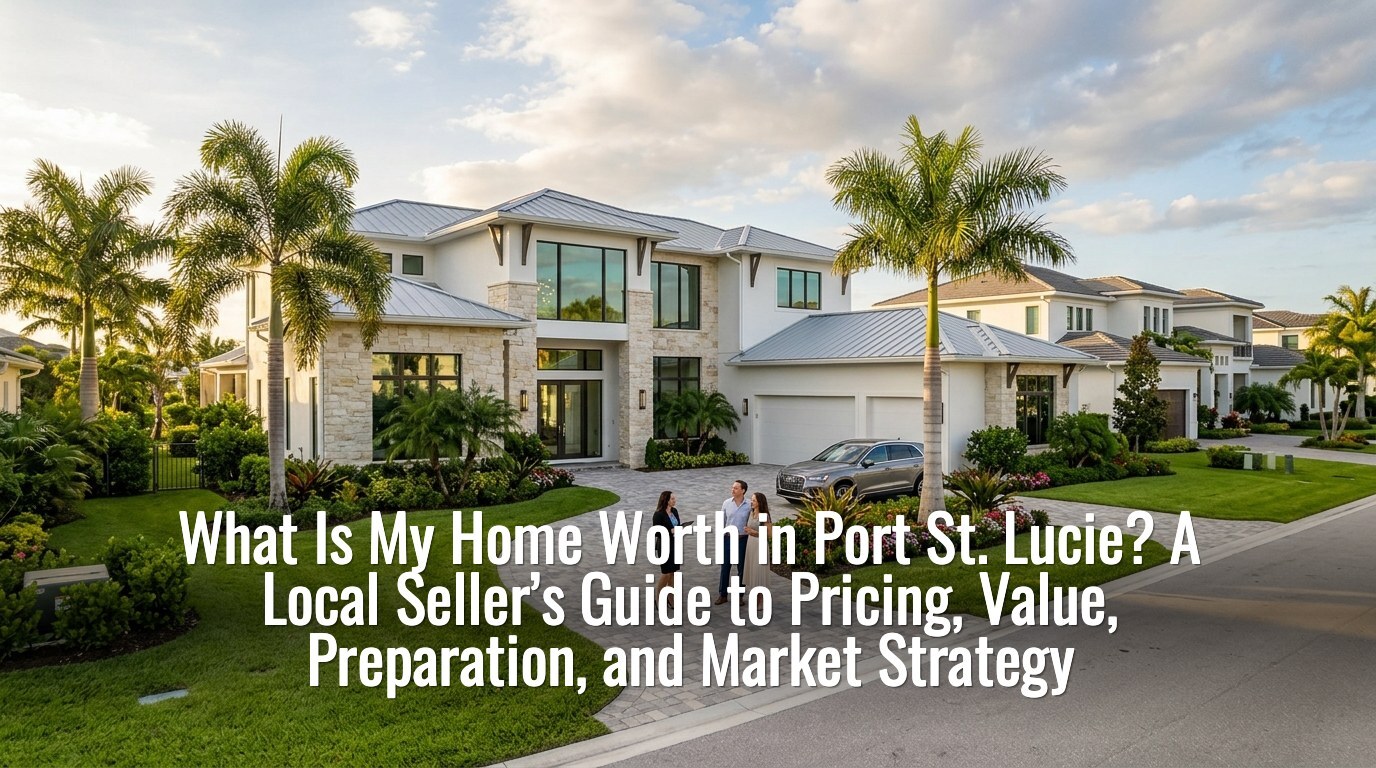
What Is My Home Worth in Port St. Lucie?
A local seller’s guide to pricing, value, preparation, and market strategy — how recent sales, condition, upgrades, location, buyer demand, and appraisal factors really shape what your home is worth.
Quick Answer: What Is My Home Worth in Port St. Lucie?
Your Port St. Lucie home value is a range, not a single number. It is shaped by relevant recent comparable sales, active competition, property condition, upgrades, roof age, floor plan, lot and view, HOA fees, flood zone and insurance considerations, buyer demand in your price bracket, and appraisal support. Online estimates are a starting point, but they cannot see your renovated kitchen, newer roof, water view, or deferred maintenance. The most accurate answer comes from a local home value review that combines market data with a real evaluation of your property — then turns that into a pricing strategy that matches your timeline.
What This Guide Covers
- Why Value Is Not Just One Number
- Are Online Estimates Accurate?
- What Factors Affect My Home Value
- How Condition Changes Value
- How Upgrades Affect Value
- Should I Price High and Negotiate Down?
- How Appraisal Risk Affects Pricing
- Recent Sales & Active Competition
- Buyer Demand, Timing & Your Goal
- HOA, Flood Zone & Disclosure
- Marketing Accuracy & Buyer Agreements
- The Professional Home Value Review
- Special & Specialty Properties
- Market Value vs. List Price & Net Proceeds
- FAQ: Port St. Lucie Home Value
Why Is Home Value in Port St. Lucie Not Just One Number?
One of the first questions most homeowners ask before selling is simple: “What is my home worth?” It sounds like it should have a simple answer — type your address into an online tool, check what your neighbor listed for, and hope the number makes sense. If you own a home in Port St. Lucie, the real answer is usually more detailed.
Your home value depends on more than square footage. It is shaped by your neighborhood, property condition, floor plan, lot size, upgrades, roof age, insurance considerations, HOA rules, recent comparable sales, current competition, buyer demand, appraisal expectations, and how your home is positioned before it ever hits the market.
A home in Tradition may attract a different buyer than a home in St. Lucie West. A golf course home in PGA Village may be evaluated differently than a non-HOA home near Crosstown Parkway. A waterfront property may need a different pricing conversation than a smaller interior-lot home.
A homeowner may think, “My neighbor sold for $520,000, so my house must be worth the same.” Maybe it is. Maybe more. Maybe less. The difference depends on details. Their home may have had a newer roof, updated kitchen, impact windows, a pool, a lake view, or a larger lot. Their sale may have included concessions, unusual financing, furniture, or a buyer paying a premium for timing. Their closing price may not tell the full story.
A professional pricing review should compare your home against relevant properties, not just nearby ones — considering location, property type, size, bed/bath count, lot, year built, condition, upgrades, roof and HVAC age, pool, garage, view, HOA fees, amenities, sale date, active competition, pending listings, buyer demand, and financing or appraisal risk.
For many sellers, home value is tied to major life decisions — downsizing, relocating, selling before buying, helping a parent move, managing an inherited property, or preparing for retirement. The price you choose affects your equity, timeline, negotiating power, next purchase, and confidence throughout the sale. That is why this question deserves a conversation, not a rushed answer.
This guide is educational only. It is not legal, tax, financial, probate, insurance, title, lending, or investment advice. If your sale involves legal authority, estate questions, taxes, financing, insurance, flood coverage, HOA rules, or title issues, consult qualified professionals.
Are Online Home Value Estimates Accurate in Port St. Lucie?
Online estimates can be a starting point, but they are not a complete pricing strategy. Automated tools use public records, recent sales, tax data, square footage, and algorithmic comparisons. Useful for a quick reference — but they usually do not know the full story of your home.
What an Algorithm Cannot See
- Your kitchen was renovated or your roof was replaced
- Your HVAC system is newer
- Your home backs to water or your yard has privacy
- Your home needs flooring, or has storm protection
- Your community has HOA fees, or your home has an insurance concern
- Your property has an open permit
- Your floor plan feels more functional than others
- A nearby sale was distressed, inherited, tenant-occupied, or unusually negotiated
- Your neighborhood has stronger or weaker demand than surrounding areas
Buyers do not walk through an algorithm. They walk through your home. They notice lighting, smell, layout, flooring, ceiling height, storage, noise, landscaping, cleanliness, roof age, curb appeal, and whether the home feels maintained — comparing your property to others they have toured across Port St. Lucie, Tradition, St. Lucie West, PGA Village, and nearby markets.
A professional review combines market data with real property evaluation: what has sold, what is currently listed, what buyers are seeing now, and how your home compares today.
Before you rely on an online estimate, request a Port St. Lucie home value review with Jeannie Jacobson. A local pricing conversation helps you understand your value range, likely buyer pool, and next best step.
What Factors Affect My Home Value in Florida?
Square footage matters, but it is only one piece. Buyers also look closely at condition, major systems, monthly ownership costs, insurance concerns, HOA fees, location, and lifestyle fit.
Location
Tradition appeals to buyers wanting newer development and walkability. St. Lucie West attracts buyers wanting convenience, medical access, and I-95. PGA Village draws golf and lifestyle buyers. Becker Road attracts Turnpike commuters. Buyers also compare Stuart, Palm City, Jensen Beach, Fort Pierce, and Vero Beach.
Property Condition
A clean, well-maintained home creates confidence. Visible deferred maintenance makes buyers assume hidden issues. Includes paint, flooring, appliances, roof, HVAC, plumbing, electrical, landscaping, windows, pool equipment, and irrigation.
Upgrades & Floor Plan
A newer roof may matter more than decorative finishes. Buyers may prefer open living areas, split bedrooms, office space, storage, larger primary suites, and comfortable outdoor living.
Lot & View
Lot size, privacy, water, preserve, or golf course views, fenced yards, corner lots, and outdoor space all affect buyer interest.
Roof Age & Insurance
Florida buyers ask about roof age, wind mitigation, four-point items, flood zone awareness, and insurance availability. Sellers should not give insurance advice — buyers should consult insurance professionals.
HOA, Comps & Demand
HOA fees and rules, truly comparable recent sales, active competition, and buyer demand by price range, rates, and inventory all shape the outcome.
How Does Property Condition Change a Home’s Value?
Condition is one of the most important pricing factors because buyers connect condition with risk. A clean, cared-for, move-in-ready home creates emotional confidence. A home with visible issues creates hesitation — and even small issues add up in a buyer’s mind: peeling paint, dirty grout, damaged flooring, pet odor, overgrown landscaping, leaky faucets, stained ceilings, old appliances, cracked windows, broken screens, cluttered rooms, a poorly maintained pool, or HVAC, roof, and moisture concerns.
These do not always mean a home cannot sell. They affect pricing, marketing, buyer confidence, inspection negotiations, and sometimes financing or insurance. A home that needs updates can still be valuable — some buyers prefer to renovate, some investors look for projects, some homeowners want a lower price and the ability to personalize over time. The key is positioning.
Where Does Your Home Stand?
| Condition Tier | Pricing Implication |
|---|---|
| Move-in ready | Market the readiness clearly; strongest buyer pool |
| Light cosmetic updates needed | Small prep may deliver outsized return |
| Moderate repairs needed | Price and description should reflect the work |
| Major repairs needed | Target buyers comfortable with projects |
| Investor / project property | Position the opportunity honestly |
| Estate or inherited (needs cleanout) | Coordinate legal, title, and cleanout first |
| Waterfront or specialty | Requires additional review and documentation |
Unsure whether repairs would improve your position? Schedule a pre-listing value review with Jeannie Jacobson to understand which condition issues matter most to Port St. Lucie buyers — before you spend money.
How Do Upgrades Affect My Port St. Lucie Home Value?
Upgrades can add appeal, but they do not always add dollar-for-dollar value. Buyers appreciate improvements, but they still compare your home against other options — considering style, quality, age of the improvement, permits where applicable, and whether the upgrade solves a meaningful concern.
Upgrades that may influence buyer interest include a newer roof, updated HVAC, impact windows or shutters, updated kitchen and bathrooms, newer flooring, fresh interior paint, screened lanai, pool updates, outdoor kitchen, fenced yard, irrigation improvements, energy-efficient features, garage storage, updated appliances, waterfront improvements, and smart home features.
Impact depends on the segment. A luxury buyer expects a higher finish level. A first-time buyer may prioritize affordability and insurance confidence. A snowbird buyer may want low-maintenance features. A downsizer may value single-story layout and manageable outdoor space.
Documentation helps. If you replaced the roof, serviced the HVAC, installed impact windows, updated electrical, or completed permitted work, gather records before listing. Buyers will ask; appraisers may also consider documented improvements, though the appraisal opinion is independent.
A home value review should not just ask “What did you spend?” It should ask, “How do buyers in this price range respond to this improvement?”
Should I Price High and Negotiate Down?
Many sellers are tempted to price high and leave room to negotiate. It sounds reasonable, but it can create problems. Buyers search within price ranges. If your home is priced above where buyers see value, they may never schedule a showing. Some assume you are unrealistic. Others compare your property to better-updated homes in the same bracket.
- Fewer showings and lower online engagement
- Longer time on market and more price reductions
- Weaker buyer urgency, stronger buyer negotiation leverage
- Appraisal concerns
- Reduced confidence in the listing
The strongest listing launch often happens in the first days and weeks. Active buyers notice new listings quickly. If the price feels right, they schedule a showing. If it feels too high, they wait. Once a listing sits, buyers start asking why: Was it overpriced? Are there inspection issues? Is the seller difficult? Is the property less desirable than it appears? Even if none of that is true, buyer perception affects negotiation.
This does not mean you should underprice. It means the price should be supported by data, condition, and strategy. A confident pricing strategy does not chase an unrealistic number — it positions the home to attract the right buyers while protecting your equity.
How Does Appraisal Risk Affect Pricing?
If a buyer is using financing, the lender may order an appraisal — an opinion of value based on the property, comparable sales, and market factors. If it supports the contract price, the transaction can continue. If it comes in below, the sale may need renegotiation depending on contract terms.
| If the Appraisal Comes In Low | Possible Outcome |
|---|---|
| Seller adjusts | Price is reduced to the appraised value |
| Buyer adjusts | Buyer brings additional cash to close the gap |
| Both adjust | Parties negotiate a compromise or split the difference |
| Buyer exits | Buyer cancels if the contract allows |
| No agreement | The transaction fails |
Unique homes need special attention. Waterfront, golf course, luxury, extensively upgraded homes, and homes in neighborhoods with limited recent comparable sales may be harder to appraise. That does not mean they cannot sell well — it means the strategy should include accurate documentation, strong comparable analysis, and clear feature descriptions.
A high offer is not a finished result. The contract still moves through inspection, financing readiness, appraisal, title review, HOA requirements, and closing coordination. Model your numbers with the mortgage calculators.
Before you choose a list price, talk with Jeannie Jacobson about both buyer demand and appraisal considerations. A strong strategy attracts attention while preparing for the realities of financing and closing.
How Do Recent Sales and Active Listings Affect My Value?
Recent sales are one of the most important tools, but they must be interpreted, not just pulled. The best comparable sales are close in location, recent in timing, and similar in size, condition, and features. Even a nearby sale may not be a match — it may differ by condition, upgrades, roof age, pool, water or golf view, lot size, HOA fees, amenities, seller concessions, financing type, distress or estate circumstances, tenant occupancy, closing timeline, personal property included, or negotiated repairs.
A home may close at a strong price because it had a newer roof, updated interior, screened pool, and water view. A nearby home with the same square footage but older systems may not support the same value.
The question is not “What did nearby homes sell for?” The better question is: “Which nearby sales are most relevant to my home, and how should we adjust for differences?”
Why Active Listings Matter If They Have Not Sold Yet
Recent sales show what buyers already paid. Active listings show what buyers can choose right now. Both matter. If your home is listed at $500,000 but three similar homes are available at $485,000 with better updates, buyers may compare unfavorably. If your home offers stronger features, your pricing may be more justified.
When inventory is limited, buyers act faster. When they have more choices, they get selective — comparing price, condition, location, concessions, HOA fees, insurance factors, and closing flexibility. In Port St. Lucie, competition includes resale and new construction with builder incentives. Some buyers also compare Port St. Lucie against Stuart and Jensen Beach.
A smart strategy answers: What else can buyers buy at this price? Does my home show better or worse? Do we need to adjust preparation? Will buyers see clear value? Are we competing with new construction incentives or homes with lower HOA fees and newer roofs? Pricing is about standing out in the buyer’s actual search environment.
A strong review includes both sold data and active competition. Contact Jeannie Jacobson to see how your home compares to what buyers are looking at right now.
How Do Buyer Demand, Timing, and Your Reason for Selling Affect Value?
Buyer demand is the market’s response to your home, your price, and your competition. A home can be attractive, but if priced above the current buyer pool, demand is limited. A home can need updates, but if priced appropriately and located well, it may still attract strong interest.
Demand is influenced by mortgage rates, affordability, local inventory, relocation trends, seasonal demand, insurance costs, property taxes, HOA fees, amenities, school and commute preferences, lifestyle goals, condition expectations, and price range. Your pricing and marketing should speak to the buyer most likely to value your home — a first-floor primary suite and low-maintenance yard may appeal to downsizers; a large fenced yard to families or pet owners; a golf course home to lifestyle buyers.
How Does Timing Affect Value?
Timing influences strategy, but it does not replace good pricing. Florida sees activity from snowbirds, relocation buyers, retirees, and out-of-state buyers at different times; families consider school schedules. But the best time to sell is not the same for every homeowner. If your home needs preparation, rushing may hurt your outcome. If you need to move quickly, waiting may not be practical. If your next purchase depends on your sale, coordinate carefully. Timing is not just the calendar — it is your complete plan.
Your Reason for Selling Shapes the Strategy
Selling Quickly
Price competitively from the start. Preparation focuses on highest-impact items, not slow renovations.
Maximum Exposure
With time, focus on staging, photography, repairs, and a broader marketing launch.
Selling Before Buying
Timing and offer terms become critical — contingencies, closing dates, or post-closing occupancy.
Inherited or Probate
Consult qualified legal and tax professionals before listing. Legal authority, estate documents, title, and tax questions come first.
Your selling goal should shape your pricing strategy. Request a local strategy consultation with Jeannie Jacobson to discuss your timeline, equity goals, property condition, and next move.
HOA, Flood Zone Awareness & Disclosure
What If My Port St. Lucie Home Is in an HOA Community?
HOA communities are common in Tradition, St. Lucie West, PGA Village, and other planned neighborhoods. HOA details affect value because they affect buyer lifestyle and ownership costs. Some buyers value amenities, community standards, gated access, lawn care, clubhouses, pools, and fitness centers. Others prefer non-HOA homes for fewer restrictions.
When pricing an HOA property, consider monthly or quarterly fees, amenities included, gated access, application process and approval timelines, transfer fees, capital contributions, pet and leasing restrictions, parking rules, architectural guidelines, age restrictions if applicable, known special assessments, and budget or reserve considerations.
Buyers should review HOA documents carefully and consult appropriate professionals. Sellers should avoid unsupported statements about what the HOA will allow or approve. A value review should compare your home to similar properties in a similar HOA environment when possible — a home with a higher HOA fee should be compared differently than a non-HOA property. The HOA is not a side detail. It can be part of the value story.
How Does Flood Zone Awareness Affect Home Value?
Flood zone awareness can influence buyer questions, insurance conversations, financing considerations, and pricing. Not every home has the same flood risk, and sellers should not guess about insurance requirements or coverage — buyers should speak with licensed insurance professionals.
Florida Statute 689.302 requires a seller to complete and provide a flood disclosure to a purchaser of residential real property at or before the sales contract is executed. The statute also states that homeowners insurance does not include coverage for flood damage and encourages buyers to discuss separate flood insurance with an insurance agent.
For valuation, buyers consider total cost of ownership — two homes at similar prices may differ in insurance considerations, elevation, or flood-related questions. Gather relevant documents when available: elevation certificates, prior insurance information, flood-related records, drainage documents, or documentation of improvements. Provide accurate information; encourage buyers to verify with qualified professionals.
How Do Disclosure Responsibilities Affect Pricing?
Disclosure awareness is not separate from home value — it affects buyer trust, negotiations, inspection outcomes, and closing confidence. Florida Realtors explains that under Johnson v. Davis, when a seller knows facts that materially affect the value of the property and those facts are not readily observable and not known to the buyer, the seller has a duty to disclose them.
This does not mean sellers should be afraid to list. It means being prepared and truthful. Known material facts may involve water intrusion, roof leaks, structural concerns, unpermitted work, mold concerns, major system defects, or drainage issues. If unsure, speak with your real estate professional and consult a qualified attorney.
Disclosure can also affect pricing. A property with known issues may need different pricing, marketing, inspection strategy, or buyer pool. An as-is sale does not mean “say nothing.”
Unsure how condition, flood awareness, repairs, or known material facts affect your value? Schedule a confidential seller consultation with Jeannie Jacobson before you list.
Marketing Accuracy and Written Buyer Agreements
Strong marketing helps buyers notice your home. Misleading marketing creates problems. Florida’s advertising rule requires advertising to make clear that the public is dealing with a real estate licensee, requires ads to include the licensed name of the brokerage firm, and prohibits advertising that is fraudulent, false, deceptive, or misleading.
Verify before marketing: square footage, lot size, HOA fees, community amenities, school information, waterfront access, golf course views, renovation claims, permit status, appliance details, roof age, pool features, zoning or usage claims, rental possibilities, and flood zone statements.
AvoidUnsupported Claims
“Best home in Port St. Lucie.” “Guaranteed to sell fast.” These are not verifiable and can mislead buyers.
Use InsteadAccurate, Benefit-Led Copy
“Located near Tradition’s shopping, dining, and community amenities.” “Screened lanai offers comfortable outdoor living space.” “Buyer should verify HOA rules, restrictions, and fees.”
How Do Written Buyer Agreements Affect Sellers?
The National Association of REALTORS states that as of August 17, 2024, an MLS participant working with a buyer must enter into a written agreement with that buyer before touring a home, including in-person and live virtual tours. Buyers now have clearer conversations about representation, services, and compensation before viewing homes — which may influence how offers are structured, including requests related to seller concessions, closing costs, or buyer broker compensation.
For sellers, the key point is simple: do not evaluate an offer by purchase price alone. Review purchase price, seller concessions, buyer financing readiness, earnest money, inspection period, appraisal terms, closing date, cash vs. financing, contingencies, requested personal property, HOA review timelines, and net proceeds. The highest price may not create the strongest net result. Commissions and compensation are negotiable.
What Is a Professional Home Value Review?
A professional home value review is a local analysis of your property and your current selling opportunity. It is not just a number. It is a pricing conversation.
A strong review may include your property details, recent comparable sales, active and pending listings, expired listings when relevant, neighborhood trends, property condition, major upgrades, roof and system ages, HOA information, flood zone awareness, buyer demand, appraisal considerations, potential repair concerns, marketing opportunities, an estimated net proceeds discussion, and timeline planning.
It should also help you decide what to do before listing. Sometimes the best step is cleaning and photography. Sometimes minor repairs. Sometimes gathering documents. Sometimes speaking with a title professional, attorney, lender, insurance agent, tax professional, or HOA contact first — especially if your home has an open permit, title issue, trust ownership, probate question, or multiple owners.
What Documents Help Support My Home Value?
Before listing, consider gathering:
- Roof replacement records and roof permit information
- HVAC service records and water heater information
- Appliance manuals and warranties
- Impact window or shutter documentation
- Wind mitigation and four-point inspection reports if available
- Elevation certificate and survey if available
- HOA documents and utility information
- Receipts for improvements; pool service and pest treatment records
- Solar documents; lease documents if tenant-occupied
- Title or estate documents and open permit information
This does not mean every document should be publicly advertised — it means organization helps answer questions quickly. If a buyer asks about roof age and you can provide permit documentation, that reduces uncertainty. Value is not only about appearance. It is also about confidence.
Ask Jeannie Jacobson which documents may help support your pricing and buyer confidence. A prepared seller moves through listing and closing with fewer surprises.
Preparation, Showings, Inspections & Title
How Can Preparation Improve Value Perception?
Preparation may not change your square footage, but it changes how buyers experience the property. A clean, bright, organized home feels larger and better maintained. Simple steps: deep cleaning, decluttering, removing personal items, cleaning windows, freshening paint, improving curb appeal, pressure washing, trimming landscaping, replacing bulbs, fixing small repairs, organizing closets, cleaning the garage, removing odors, staging outdoor spaces, and preparing for professional photography.
You do not always need expensive renovations — sometimes the highest-impact preparation is basic care. Walk through your home like a buyer: What would you notice first? What might distract you? What would make you hesitate?
How Do Showings Reveal Whether Your Price Is Right?
Showings provide real market feedback. Many online views but few showing requests may mean price, photos, or presentation are not matching expectations. Buyers touring without offering may be reacting to condition, layout, price, repairs, or competition. If buyers consistently mention the same concern, that feedback matters.
Common feedback: priced too high, needs too many updates, roof age concern, flooring needs replacement, rooms feel small, yard needs work, HOA fee higher than expected, insurance concerns, or better value found nearby. Feedback is not personal — it is market information. Sometimes a pricing adjustment is needed; sometimes preparation; sometimes clearer marketing; sometimes patience.
How Do Inspection Periods Affect Value After an Offer?
Your home value is tested again after an offer. A buyer may love the home and offer a strong price, but inspection findings can change the conversation — roof, electrical, plumbing, HVAC, appliances, pool equipment, water heater, windows and doors, moisture, drainage, pest, structural, safety, and insurance-related concerns.
Inspection periods do not automatically mean trouble, but they require careful response. A home priced at the top of the market may receive more resistance if inspections reveal significant issues. A home priced with condition in mind gives sellers stronger context during negotiations. This is why a realistic value review considers condition before listing — not after the inspection report arrives.
How Does Title Review Affect Marketability?
A buyer may be interested, the price right, the inspection resolved — but title issues can delay closing: unreleased liens, open permits, code violations, unpaid taxes, estate or probate issues, multiple owners, trust ownership, divorce-related matters, name discrepancies, boundary or survey concerns, HOA estoppel issues, or mortgage payoff delays.
If you suspect any issue, address it early — do not wait until a buyer is under contract. A home with unresolved title issues may still have value, but the sale requires more planning.
A strong pricing strategy prepares for inspection conversations, not ignores them. Contact Jeannie Jacobson to review how your property condition may affect pricing, negotiation, and buyer confidence.
Inherited, Luxury, Waterfront, Golf Course & 55+ Properties
Selling an Inherited Property in Port St. Lucie
Inherited homes require special care because value is only one part of the process. You may also need to determine who has legal authority to sell, whether probate is required, whether all heirs agree, whether there are unpaid taxes or liens, whether the home is insured, and whether title can transfer.
Speak with a qualified Florida probate attorney, tax professional, and title professional before listing. A real estate valuation helps you understand market value — it does not answer legal authority or tax questions. Inherited properties may also need cleanout, repairs, utility activation, lawn care, security checks, insurance review, title review, personal property decisions, and family communication.
Luxury, Waterfront, Golf Course & 55+ Homes
Luxury
Requires deeper analysis of buyer expectations, architectural features, finish quality, privacy, outdoor living, and recent luxury sales.
Waterfront
Attention to view, water access, dock and seawall condition, flood zone awareness, insurance, elevation, and drainage. Buyers should verify all waterfront, boating, insurance, and flood questions with qualified professionals.
Golf Course
PGA Village and similar communities need lifestyle-focused pricing and marketing — course views, club access, amenities, privacy, and seasonal living.
55+ Communities
Pricing considers age restrictions, HOA fees, amenities, community rules, buyer lifestyle, and resale demand. See the 55+ communities guide.
These homes should not be priced only by square footage. The buyer pool is more specific, and the marketing should speak directly to that buyer.
Waterfront, golf course, luxury, inherited, or 55+? Request a specialized value review with Jeannie Jacobson. Unique properties deserve a pricing strategy that reflects more than basic square footage.
Market Value vs. List Price — and Your Net Proceeds
Market value is the likely range a buyer may be willing to pay based on current conditions, comparable sales, features, and demand. List price is the strategic number used to introduce your home to the market. They are related — but not the same.
| List Price Approach | Effect |
|---|---|
| At the likely market value range | Balanced exposure and equity protection |
| Slightly below | Attracts more attention and urgency |
| Slightly above | Can work if the home has strong differentiators |
| Too high | Reduces buyer activity; risks appraisal problems |
| Too low | Creates unnecessary risk if not part of a clear strategy |
If comparable sales suggest a home may sell between $475,000 and $500,000, the list price should be chosen based on buyer search behavior, competition, condition, and your strategy. A good pricing conversation explains the tradeoffs clearly.
How Do Seller Concessions Affect My Net Value?
Sellers often focus on sale price — but net proceeds may matter more. Net proceeds are what you may receive after closing costs, mortgage payoff, commissions, prorations, concessions, repairs, and other expenses.
A buyer may offer a strong price but ask for concessions — buyer closing costs, prepaid expenses, rate buydown assistance, repair credits, HOA fees. Another may offer less with fewer concessions. The better offer depends on the net result and contract strength. If the buyer is financing, concession limits may apply based on loan type and lender rules.
The number that matters is not always the number on the first line of the contract. A value review estimates likely market value; an offer review estimates your net proceeds.
How Can Jeannie Jacobson Help Me Understand My Home Value?
Jeannie Jacobson helps Port St. Lucie homeowners move from guessing to understanding. A local home value conversation can answer: What is my home worth in today’s market? Which recent sales are most relevant? What active listings am I competing with? Should I make repairs before listing? How does my roof age affect buyer interest? How do HOA fees affect pricing? How could flood zone awareness or insurance questions affect buyers? What documents should I gather? How should we position the home online? What price range makes sense for my timeline? How do I prepare for appraisal, inspection, and closing?
The goal is not to pressure you into listing before you are ready. The goal is to give you clarity. Whether you are selling in Tradition, St. Lucie West, PGA Village, central Port St. Lucie, Palm City, Stuart, Jensen Beach, Fort Pierce, or another Treasure Coast market, local pricing guidance helps you make a more informed decision. You can read what past clients say or review the Port St. Lucie market report.
Wondering what your Port St. Lucie home is worth? Request a home value review before you make your next move.
Confused by the online estimates? See are online home value estimates accurate in Port St. Lucie — why the websites disagree, what an automated model cannot see, and how estimate, assessed, and appraised value differ.
Value is only half the answer. Once you have a price, see what it costs to sell a house in Port St. Lucie — the statutory lines you can calculate today, and the four decisions that actually move your net.
Do the panels count toward value? Only under specific conditions — see selling a Port St. Lucie home with solar panels for the appraisal rules on owned, leased, and PACE-financed systems.
FAQ: What Is My Home Worth in Port St. Lucie?
Tap any question to expand the answer.
Online estimates can provide a starting point, but they may not fully account for upgrades, condition, roof age, HOA rules, flood zone awareness, buyer demand, lot features, views, or current competition. A local home value review gives a more complete picture.
Florida home value can be affected by location, recent comparable sales, property condition, roof age, upgrades, insurance considerations, flood zone awareness, HOA fees, buyer demand, appraisal support, and current inventory.
Pricing high can reduce buyer interest, limit showings, increase time on market, and create appraisal or negotiation challenges. A better strategy is to price based on local data, property condition, competition, and your selling goal.
Recent sales help establish value when they are truly comparable. The most useful sales are similar in location, size, condition, features, community type, and timing. Not every nearby sale is a reliable comparable.
Upgrades can improve buyer appeal, but they do not always add dollar-for-dollar value. The impact depends on the type of upgrade, quality, age, buyer demand, and your local competition.
Roof age can affect buyer confidence, inspection results, insurance conversations, and sometimes financing considerations. Sellers should gather roof permits, replacement records, warranties, and related documents when available.
Yes. HOA fees, amenities, restrictions, application requirements, leasing rules, pet rules, and approval timelines can affect buyer interest and affordability. Some buyers value HOA amenities, while others prefer non-HOA properties.
Flood zone awareness may affect buyer questions, insurance conversations, and overall cost-of-ownership considerations. Florida requires residential sellers to provide a flood disclosure at or before the sales contract is executed. Buyers should speak with licensed insurance professionals about coverage and flood insurance.
The best way is to request a professional home value review that considers recent comparable sales, active competition, property condition, upgrades, location, buyer demand, appraisal considerations, and your timeline.
Yes. Jeannie Jacobson can help you review your home’s value range, compare local market data, identify preparation steps, and create a pricing strategy for your Port St. Lucie or Treasure Coast property.
Final Thoughts: Do Not Rely on Guesswork
If you are asking, “What is my home worth in Port St. Lucie?” your value is shaped by recent sales, current competition, property condition, upgrades, location, buyer demand, HOA details, flood zone awareness, insurance considerations, appraisal support, and your personal timeline.
Before you list, request a Port St. Lucie home value review with Jeannie Jacobson. A local pricing conversation can help you understand your home’s value, protect your equity, prepare with confidence, and plan your next move.
What Is Your Port St. Lucie Home Worth?
Start your home value conversation with a licensed Florida real estate professional who lives and works on the Treasure Coast.
Disclaimer: This article is for general educational purposes only and is not legal, tax, financial, probate, insurance, title, lending, or investment advice. Real estate laws, insurance rules, and market conditions can change. Sellers should consult qualified professionals — including licensed attorneys, tax professionals, lenders, insurance agents, HOA representatives, and title professionals — for guidance specific to their transaction. All information is deemed reliable but not guaranteed and should be independently verified. Jeannie Jacobson is a Licensed Florida Real Estate Professional with RE/MAX Gold. Equal Housing Opportunity.