

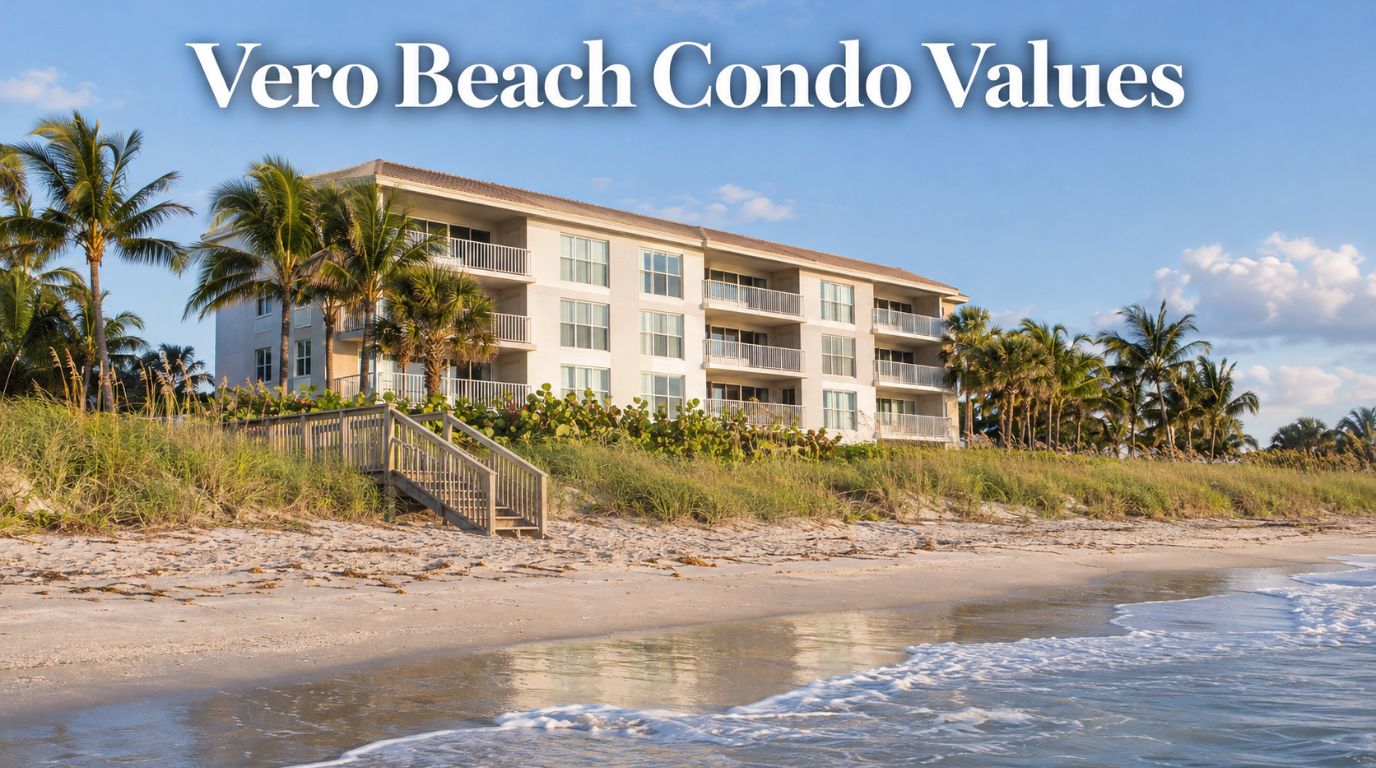
Vero Beach Condo Values: Oceanfront, Island and Mainland
Vero Beach condo values depend on three things at once: where the building sits, how the building itself is doing, and what it costs to own a unit in it. This guide explains how oceanfront, island and mainland condos price, using Florida’s condo and building laws rather than portal estimates.
This guide explains how condominium values, inspections, reserves, insurance and financing usually work in Indian River County. It is not legal, tax, insurance, lending or appraisal advice, and a home value from a REALTOR® is a pricing opinion, not an appraisal. Condo laws, association budgets, flood maps and lender rules change and apply building by building. Confirm the details for a specific unit with the association, the Indian River County Property Appraiser, your insurance agent, your lender and a Florida real estate attorney before you rely on them.
The Short Answer
Vero Beach condo values split three ways: oceanfront buildings on the barrier island, island buildings off the ocean, and mainland communities west of the lagoon. Location sets the starting point. The building then moves the price: its height and age, its reserves and assessments, its insurance and whether lenders will finance it.
- Florida requires a milestone inspection for condo buildings of three habitable stories or more by December 31 of the year the building reaches 30 years of age, and every 10 years after (section 553.899, Florida Statutes).
- The local building agency may move that first inspection to 25 years where local conditions, such as proximity to salt water, call for it (section 553.899).
- A condo association must complete a structural integrity reserve study at least every 10 years for each building of three habitable stories or higher (section 718.112, Florida Statutes).
- On a resale, the buyer can cancel within 7 days, excluding weekends and legal holidays, after signing and receiving the required association documents (section 718.503, Florida Statutes).
- Jeannie Jacobson, REALTOR® with RE/MAX Gold, works with buyers and sellers across St. Lucie, Martin and Indian River counties, in English and Spanish.
In this guide
- What decides a condo’s value
- Oceanfront condos
- Island condos off the ocean
- Mainland condos
- Building age and the milestone inspection
- Reserves and special assessments
- Insurance and flood
- Financing and who can buy
- Comparing two condos
- Real sale prices, and steps to buy or sell
- Frequently asked questions
What decides Vero Beach condo values?
A condo price pays for two things: the unit you live in and a share of a building you own with your neighbors. A house buyer weighs the house and the lot. A condo buyer has to weigh the unit, the building and the association that runs it.
That is why two units with the same square footage and the same view can sell far apart. These are the layers that set Vero Beach condo values, from the outside in:
| Layer | What it includes | Where you check it |
|---|---|---|
| Location | Oceanfront, island off the ocean, or mainland; the taxing district | Property Appraiser parcel record and a site visit |
| The unit | Floor, view, size, layout, updates, balcony, parking | Listing, floor plan, showing |
| The building | Height, age, structure, roof, windows, elevators | Milestone inspection summary and reserve study |
| The money | Monthly assessment, reserves, special assessments, loans | Budget, financial statement, board minutes |
| The rules | Rentals, pets, age restrictions, approval of buyers | Declaration, bylaws and rules |
| Insurance and financing | Master policy, flood coverage, lender eligibility | Association, insurance agent, lender |
Location tells you the range a condo should fall in. The other five layers tell you where in that range a specific unit belongs. A buyer who only looks at the first two layers is comparing views, not values.
How are oceanfront condos in Vero Beach priced?
Oceanfront condos sit on the barrier island, between State Road A1A and the Atlantic, in ZIP code 32963. They usually carry the highest prices per square foot in the area, because the supply of beachfront land is fixed and the view cannot be built in front of easily.
Within one oceanfront building, price follows the unit’s view of the water more than anything else:
- Direct ocean view. Units facing the beach, usually the highest price per square foot in the building.
- Partial or angled view. Corner and side units that see the ocean at an angle.
- Upper floors. In taller buildings, a higher floor often means a wider view and less street noise.
- Garden or west facing. Units facing A1A or the parking area, usually the lowest price in the same building.
Oceanfront buildings also carry the most exposure. Salt air, wind and storm surge wear on concrete, rebar, balconies and windows faster than they do inland. That is why the building’s inspection and reserve records matter more here than anywhere else in Vero Beach.
Coastal rules also shape what an oceanfront building can do. Building or excavating seaward of the state’s coastal construction control line needs a permit from the Florida Department of Environmental Protection under section 161.053, Florida Statutes. For an association planning a seawall, a dune walkover or a major repair near the beach, that adds time and cost. Our guide to Vero Beach property values on the island and the mainland explains that line and the town tax rates on the island in more detail.
How do island condos off the ocean compare?
Not every condo in 32963 faces the ocean. The island also has buildings on the west side of A1A, along the Indian River Lagoon, and inside larger island communities. They share the island address and the island tax districts, but they price as a different market.
| Island condo type | What buyers pay for | What to check |
|---|---|---|
| Oceanfront | Beach frontage and a direct ocean view | Coastal construction line, salt exposure, reserves |
| Ocean access, across A1A | A short trip to a beach access, often at a lower price | Deeded or shared beach access, crossing A1A |
| Lagoon front | Sunset views over the Indian River Lagoon, sometimes boat slips | Who owns the docks or slips, seawall condition |
| Inside a club community | Club amenities as well as the unit | Membership rules, initiation and dues, set by each club |
Two points trip up island buyers most. First, the town matters: part of the island is in the City of Vero Beach, part in the Town of Indian River Shores, part in the Town of Orchid and part in unincorporated Indian River County, and each sets its own tax rate. Second, a boat slip may be a deeded part of the unit, a separate assignment by the association, or not available at all. The condo documents decide which, not the listing.
A lagoon front or across-A1A condo can be the better value for a buyer who wants the island but not the oceanfront exposure. It is often lower in price, and some of these buildings are low-rise, which changes the inspection rules covered in section 5.
What sets mainland condo values in Vero Beach?
West of the lagoon, condos look different. Many mainland communities are one- and two-story buildings set around lakes, golf courses or pools, with a few mid-rise buildings along the lagoon shore. Prices are usually lower than on the island, and the drivers are different.
- Building type. Low-rise garden buildings, villas and townhouse-style condos make up much of the mainland supply.
- Water or golf view. A lake or fairway view usually adds to the price within the same community.
- Age and updates. Many mainland communities were built decades ago, so updated kitchens, baths, windows and roofs separate one unit from the next.
- Community rules. Rental limits, pet rules and age-restricted (55 and over) status narrow or widen the pool of buyers, and that pool affects price.
- Monthly cost. Lower assessments are common in low-rise communities, but only the budget shows what they cover.
The biggest legal difference is height. Florida’s milestone inspection and structural integrity reserve study laws apply to condo buildings of three habitable stories or more. Section 718.112 states that the reserve study rule does not apply to buildings less than three stories in height. Many mainland garden condos fall below that line.
That cuts both ways. A one- or two-story building avoids the cost of those state-required studies, which can mean lower assessments. But the roof, plumbing and structure still age, and the association may set aside less for them. A buyer of a low-rise unit should still read the budget and reserve schedule closely, because no state study is there to flag a shortfall.
How do building age and the milestone inspection change condo values?
Age is one of the clearest dividing lines in Vero Beach condo values today, because Florida’s inspection law is tied to it. Under section 553.899, a condo building of three habitable stories or more needs a milestone inspection by December 31 of the year it reaches 30 years of age, based on its certificate of occupancy, and every 10 years after.
The law gives the local building agency room to act sooner. It may require the first inspection at 25 years where local circumstances, including environmental conditions such as proximity to salt water, call for it. For an oceanfront building, ask the association which deadline applies.
The inspection has two phases:
- Phase one. A licensed architect or engineer does a visual examination of the building’s major structural components.
- Phase two. Required only if phase one finds substantial structural deterioration. It can include testing and leads to a repair plan.
How the inspection affects value depends on where the building is in that cycle:
| Building status | What it usually means for a buyer |
|---|---|
| Newer, years from its first inspection | Less near-term repair risk; price reflects the newer structure |
| Inspection due soon | Unknown results; ask how the association plans to pay for any repairs |
| Phase one done, no phase two needed | A clearer picture; the main questions move to reserves and routine upkeep |
| Phase two and repairs under way | Possible special assessments or a loan; price often reflects the cost |
| Repairs finished and paid for | The cost is behind the building; units can be easier to sell and finance |
On a resale, the seller must give the buyer a copy of the inspector-prepared summary of the milestone inspection report, if one applies, under section 718.503. Read it before your cancellation window closes. Sellers can find more on timing in our guide to selling a condo after the milestone inspection.
How do reserves and special assessments change Vero Beach condo values?
Reserves are the association’s savings for big repairs. In a building of three habitable stories or more, section 718.112 requires a structural integrity reserve study at least every 10 years. It covers, at a minimum, the roof, the structure, fireproofing and fire protection, plumbing, electrical systems, waterproofing and exterior painting, and windows and exterior doors.
The study changes value because it changes the monthly cost. Associations must fund reserves for those items based on the study’s recommendations, and the law limits waiving or reducing them. A building that saved steadily for years can meet the rule with modest increases. A building that waived reserves for years may need large increases, a special assessment or a loan to catch up.
Here is how to read the money side of a building:
- The budget. Shows the monthly assessment and how much of it goes to reserves.
- The reserve study. Shows the expected cost and remaining life of each major item. On a resale, the seller must give you the most recent study or a statement that none has been done (section 718.503).
- The financial statement. Shows what the association actually has in the bank.
- Board minutes. Often the first place a coming assessment or loan shows up, before it is approved.
Unpaid assessments follow the unit. Under section 718.116, a new owner is jointly and severally liable with the previous owner for unpaid assessments that came due up to the transfer of title. That is why the estoppel certificate matters: it states what is owed at closing. See our guide to the Florida estoppel certificate for how it works.
A useful way to think about it: a lower price in a building with a large assessment coming is not always a bargain. Add the assessment to the price, and compare that total with a unit in a building that has already paid for its repairs.
How do insurance and flood rules differ for Vero Beach condos?
Condo insurance comes in two layers, and both affect what a unit costs to own:
| Policy | Who buys it | What it usually covers |
|---|---|---|
| Master policy | The association, paid through assessments | The building and common areas, as the declaration defines them |
| Unit owner policy (often called HO‑6) | You | Your interior finishes, belongings, liability and loss assessments, as written |
| Building flood policy | The association, if it carries one | Flood damage to the building, up to the policy limits |
| Unit flood policy | You, if you choose or your lender requires it | Flood damage to your unit and contents, as written |
On the island, the master policy is often a larger part of the monthly assessment, because the building faces wind and surge from the ocean and the lagoon. On the mainland, it varies with the building’s elevation, age and roof.
Three checks before you commit:
- Ask for the master policy declarations page. It shows the coverage, the deductibles and the renewal date. A large wind deductible can come back to owners as an assessment after a storm.
- Look up the flood zone for the building on the FEMA Flood Map Service Center. A lender may require flood coverage in a high-risk zone.
- Get your own HO-6 quote during the review period, so the monthly cost in your budget is real.
Florida sellers of residential property must also give buyers a flood disclosure at or before contract signing under section 689.302, Florida Statutes. For a condo, read it next to the FEMA map and ask the association about any past flood claims on the building.
How does financing change what a Vero Beach condo sells for?
A condo’s value depends on who can buy it. If lenders will finance units in a building, the pool of buyers includes people using conventional, FHA and VA loans. If they will not, the pool shrinks to cash buyers and a few portfolio lenders, and prices often adjust.
Lenders review the building as well as the buyer. Common questions include:
- Is the budget adequate, and are reserves being funded?
- Are there unresolved structural or safety issues, or a pending special assessment?
- How many owners are behind on assessments?
- Is the association in litigation?
- Is the building insured as the lender requires?
A building that cannot answer these well may be treated as ineligible for some loan programs, often called non-warrantable. For an FHA loan, the condo project generally needs FHA approval, unless the loan qualifies for a single-unit approval. Our guide to the FHA loan in Port St. Lucie covers condo approval and the current loan limits for the area.
On the island, many buyers pay cash, so financing limits can affect prices less there than on the mainland, where more buyers rely on loans. Either way, ask a lender to review the building early, before your inspection and document review periods run out.
How do you compare two Vero Beach condos fairly?
Compare the total cost of owning each unit over the years you plan to own it, not the list price alone. This worksheet puts two condos on the same footing:
| Item | Where to find it | Why it matters |
|---|---|---|
| Price per square foot | Recent closed sales in the same building or a similar one | Shows value better than total price across units of different size |
| Floor and view | Floor plan and showing | Sets the unit’s place in its building’s range |
| Building height and age | Certificate of occupancy date and association records | Decides whether the milestone and reserve study laws apply, and when |
| Milestone inspection status | Inspector-prepared summary | Shows whether repairs are ahead or behind the building |
| Reserve funding | Reserve study and budget | Shows whether assessments are likely to rise |
| Pending assessments or loans | Board minutes and the estoppel certificate | Adds to the real price of the unit |
| Insurance | Master policy page and your HO-6 quote | Changes the monthly cost and storm risk |
| Financing eligibility | Your lender’s review of the building | Decides who can buy it later, too |
| Rules | Declaration, bylaws and rules | Rental and pet rules shape your use and resale |
| Taxes at your price | Current millage times your expected taxable value | The seller’s bill may not match yours |
The same-building comparison is the most reliable one. Two units in the same building share the same reserves, insurance and assessments, so the price difference comes down to floor, view, size and updates. Across buildings, every row in the table can move.
Be careful with automated estimates for condos. They rely on recent nearby sales and often cannot see a pending assessment or a building’s inspection status. See why online home value estimates disagree.
Where do you find real Vero Beach condo sale prices, and what are the steps?
Real values come from closed sales, not asking prices. Two sources show them:
- The multiple listing service. A REALTOR® can pull closed sales by building, floor, view and date, with days on market and price changes.
- The Indian River County Property Appraiser. Each parcel record shows recorded sales, the just value and the year built. It does not show the unit’s condition or what the sale included.
Use sales from the last several months in the same building first, then similar buildings on the same side of the lagoon. Oceanfront sales do not tell you much about a mainland garden condo, and the reverse is also true.
Jeannie’s take, as a St. Lucie County resident for more than 17 years who works across the Treasure Coast: with condos, the building’s paperwork often decides the sale as much as the unit does. A seller who gathers the milestone summary, the reserve study, the budget and the master policy page before listing can answer a buyer’s first questions on day one.
The steps for a buyer:
- Choose the market first: oceanfront, island off the ocean, or mainland.
- Get preapproved on a payment that includes the assessment, insurance and taxes at your price, and ask your lender about the building.
- Check each building’s height and age to see whether the milestone and reserve study laws apply.
- Write the offer with time to review the association documents and get insurance quotes.
- Read the documents within the 7-day window under section 718.503, including the milestone summary and reserve study.
- Apply for association approval if the declaration requires it, and order the estoppel certificate.
- Close and file for homestead with the Property Appraiser if the unit will be your primary residence.
For the full condo checklist from showing to closing, see our guide to buying a Treasure Coast condo, and for the wider city, our Vero Beach area guide.
What Clients Say About Working With Jeannie Jacobson
“My sister and I purchased a condo long distance from Minnesota. Jeannie was there for us every step of the way! She is professional and personal, trustworthy and honest! We had a couple “Hiccups” along the way and Jeannie Jacobson had the answers!”
Gina Posivio, Google review, April 18, 2024
“Our experience with Jeannie was outstanding. She is so professional and passionate about her dedication to her clients and listings. We will highly recommend her to anyone looking to buy or sell.”
harkinsk143, sold a condo home in 2026 in Fort Pierce, FL, April 30, 2026
Frequently Asked Questions
Beachfront land on the barrier island is limited, and a direct ocean view is hard to block or replace. Oceanfront buildings also face more salt, wind and storm exposure, so their inspection, reserve and insurance records matter more. Compare units of the same view type, ideally in the same building.
The milestone inspection in section 553.899 applies to condo buildings of three habitable stories or more, and section 718.112 says the reserve study rule does not apply to buildings less than three stories in height. A two-story building still ages, so read its budget and reserve schedule.
By December 31 of the year the building reaches 30 years of age, based on its certificate of occupancy, and every 10 years after. The local building agency may require it at 25 years where conditions such as proximity to salt water call for it. Ask the association which date applies.
Under section 718.503, a resale buyer can cancel within 7 days, excluding Saturdays, Sundays and legal holidays, after signing the contract and receiving the required documents. They include the declaration, bylaws and rules, the budget and financial statement, and the milestone summary and reserve study when they apply.
Section 718.116 makes a new owner jointly and severally liable with the previous owner for unpaid assessments due up to the transfer of title. The estoppel certificate states what is owed, so those amounts can be paid at closing.
Island condos, especially oceanfront ones, usually price higher than mainland condos. The cost of owning them also differs: island buildings are more often three stories or taller, so state inspection and reserve rules apply, and insurance tends to weigh more. Compare closed sales on the same side of the lagoon.
Find the Right Vero Beach Condo for the Price
The right condo is the one whose building, budget, insurance and financing you understand before you sign. Jeannie works with buyers and sellers across the Treasure Coast, including Indian River County, in English and Spanish, and can help you weigh oceanfront, island and mainland condos building by building.
Jeannie Jacobson, REALTOR®, RE/MAX Gold, (772) 877-0268, English and Spanish
Sources
- Florida Statutes 2025, section 553.899, Mandatory structural inspections for condominium and cooperative buildings, https://www.flsenate.gov/Laws/Statutes/2025/553.899 (accessed November 2026)
- Florida Statutes 2025, section 718.112, Bylaws, structural integrity reserve study, https://www.flsenate.gov/Laws/Statutes/2025/718.112 (accessed November 2026)
- Florida Statutes 2025, section 718.503, Developer and nondeveloper disclosure, https://www.flsenate.gov/Laws/Statutes/2025/718.503 (accessed November 2026)
- Florida Statutes 2025, section 718.116, Assessments, liability, https://www.flsenate.gov/Laws/Statutes/2025/718.116 (accessed November 2026)
- Florida Statutes, sections 161.053 and 689.302, http://www.leg.state.fl.us/statutes/ (accessed November 2026)
- FEMA Flood Map Service Center, https://msc.fema.gov/portal/home (accessed November 2026)
- Indian River County Property Appraiser, https://www.ircpa.org/ (accessed November 2026; confirm parcel values, sales and taxing districts there)