

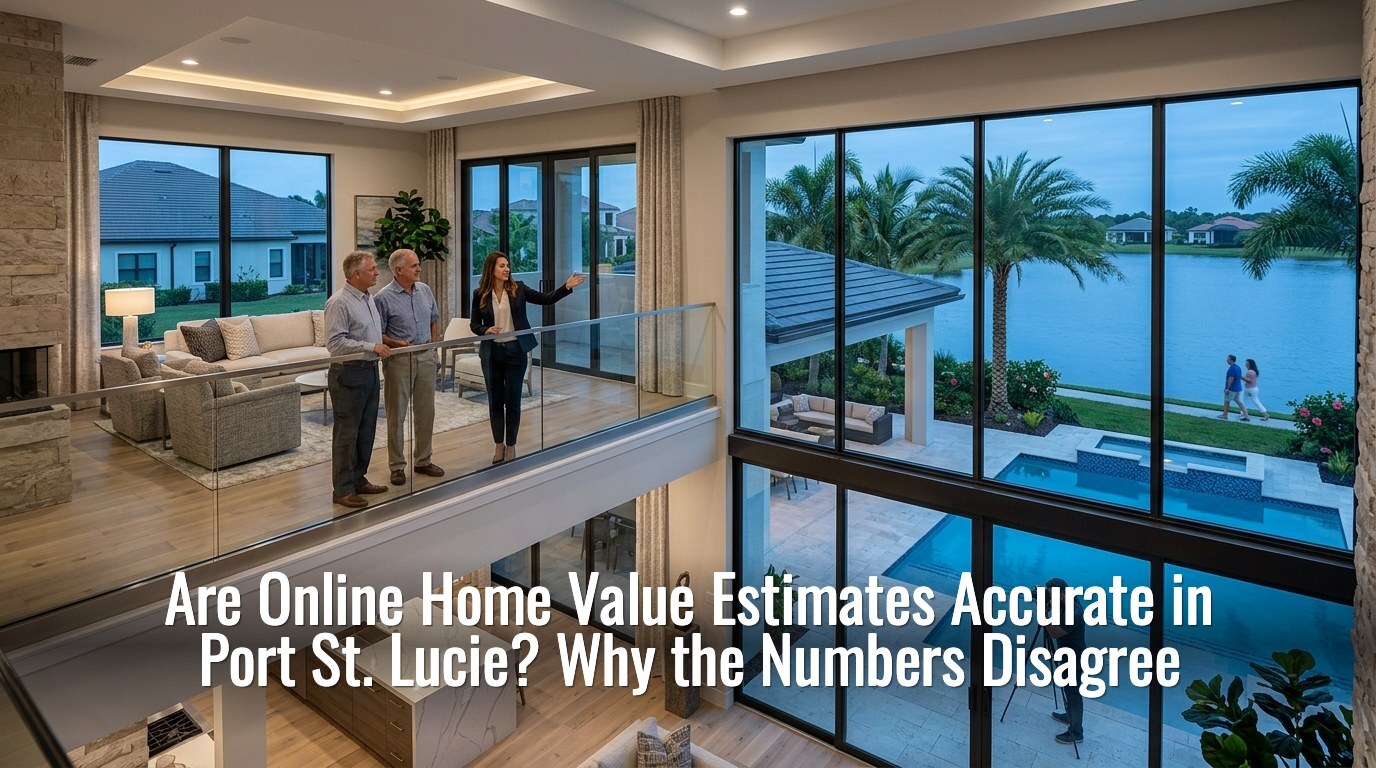
Are Online Home Value Estimates Accurate in Port St. Lucie? Why the Numbers Disagree
Three websites, three different numbers — why automated estimates disagree, what they cannot see, and how to read them without being misled.
Quick Answer: Are Online Home Value Estimates Accurate in Port St. Lucie?
Online home value estimates are a starting point, not an answer — and the reason they disagree is that no two of them use the same model. Are online home value estimates accurate in Port St. Lucie? Only within a wide range. One tool weights tax assessments, another weights recent recorded sales, another projects from regional trends — and none of them can walk through your kitchen, see a new roof, or know that your lot backs a preserve in Tradition instead of a busy road. Treat any single automated number as one data point among several, and understand what it can and cannot know before you rely on it.
Educational only. This article is general real estate information, not legal, tax, financial, insurance, or appraisal advice. Property values, market conditions, and data sources change and should be verified. Consult qualified professionals for your circumstances. No estimate, price, or valuation can be guaranteed.
What This Guide Covers
Ready for the real number instead of the range? See what is my home worth in Port St. Lucie for the full home value review — comparables, condition, upgrades, appraisal risk, and pricing strategy. This guide explains why the online numbers you already looked up disagree.
Why Do Online Home Value Estimates Disagree So Much?
You type your address into one site and get a number. A second site gives a different one. A third is higher; a fourth, tens of thousands lower. The common assumption — that every website sees the same data — is wrong.
Most automated valuation models (AVMs) draw on public records, tax data, and recent sales, but each company runs its own proprietary formula and weights those inputs differently:
- One may lean on tax assessments
- Another may emphasise recently recorded sales
- Another may project appreciation from regional trends
- Some update far more frequently than others
- Several have incomplete information about recent renovations or current neighbourhood activity
So the disagreement is not a glitch — it is the models doing different things with different data. That is exactly why no single estimate should be treated as definitive. They are broad estimates, not pricing tools.
What an Online Estimate Cannot See
Technology has improved, but an AVM still cannot walk through your home. It cannot evaluate the things a buyer notices in the first thirty seconds of a showing — and those are often what separates two identical floor plans by tens of thousands of dollars.
Can’t See the Good
Natural light, ceiling height, interior flow, custom cabinetry, high-end finishes, outdoor living, a water or preserve view, privacy, recent remodelling, overall care.
Can’t See the Bad
Deferred maintenance, dated interiors, an aging roof or HVAC, functional obsolescence, or a lot that backs a busy road rather than a preserve.
Can’t See the Setting
Whether the home overlooks a lake in Tradition, sits on a cul-de-sac in St. Lucie West, or has a golf view in PGA Village.
Can’t See the Buyer
How today’s buyers are actually reacting to homes like yours, right now, in your specific neighbourhood.
This is why two homes with identical square footage can get near-identical online estimates — and then sell at very different prices. Real buyers evaluate far more than what appears in public records.
What Market Value Actually Is
Market value is created by buyers, not calculators. It is what a knowledgeable buyer is willing to pay under current conditions, with neither side under undue pressure. It is not what you hope to receive, what you paid, your mortgage balance, your insurance coverage, your tax assessment, or what a neighbour says their home is worth.
And it moves. Interest rates change, inventory changes, buyer demand changes, neighbourhood popularity changes. Even within Port St. Lucie, one neighbourhood can run hotter than another in the same month. Understanding market value means understanding today’s buyers — which is precisely what an estimate generated from historical data cannot do.
Online Estimate vs. Assessed Value vs. Appraised Value
Homeowners often blur three different numbers that exist for three different reasons. They are rarely the same, and none of them is automatically your market value.
| Number | What it is for | Why it differs from market value |
|---|---|---|
| Online estimate (AVM) | A quick, automated ballpark from public data | Cannot see condition, upgrades, setting, or current demand |
| Assessed value | Set by the property appraiser for taxation | Reflects assessment limits and exemptions, and may lag the market |
| Appraised value | An appraiser’s opinion for a lender in a financed sale | Usually close to market value, but based on selected comparables and lender needs |
| Market value | What a buyer will actually pay now | Set by real-time demand — the thing the other three are all trying to approximate |
Do not assume your tax assessment represents what buyers will pay, and do not assume the appraisal and market value are identical — usually they are close, but multiple offers, low inventory, rapid market shifts, thin comparables, or hard-to-measure features can separate them.
Why Buyer Demand Beats the Calculator
A home is worth what a qualified buyer will pay under current conditions — not what a model estimates from historical data. And demand changes constantly with mortgage rates, inventory, local employment, population growth, seasonal patterns, relocation activity, and new construction.
If only two homes like yours are available and demand is steady, your property may draw strong attention. If dozens hit the market at once, buyers have options and pricing strategy shifts. An online estimate generated months earlier cannot capture either situation — which is why a current comparative market analysis is more meaningful than an automated number.
Four Home-Value Myths
| Myth | Reality |
|---|---|
| “My neighbour sold for $700,000, so mine is worth the same.” | Lot size, updates, roof age, floor plan, pool, views, and condition all differ — and a sale six months ago happened under different conditions than today’s. |
| “Price high because buyers always negotiate.” | Buyers compare online before touring. A home that looks overpriced is skipped, and the strongest interest comes right after listing — pricing right from the start protects that window. |
| “Every dollar of renovation adds a dollar of value.” | Improvements help marketability but do not always return their cost, and highly personalised work appeals to fewer buyers. Neighbourhood expectations decide the impact. |
| “Online estimates are always wrong.” | Also an oversimplification. They are a useful starting range from public data — just not the final answer, because they cannot see condition, upgrades, or current demand. |
Each myth points the same direction: a number without context — a neighbour’s price, a hopeful markup, a renovation receipt, or an AVM — is one input, not a valuation. See the costly mistakes sellers make for how these play out in a real listing.
What a Comparative Market Analysis Adds
A comparative market analysis (CMA) does the thing an AVM cannot: it adjusts for your specific property and current conditions. Rather than one automated number, it looks at recently sold comparables, pending transactions, active competing listings, and expired listings — alongside neighbourhood trends, price-per-square-foot, condition, buyer demand, seasonal activity, and local inventory.
A CMA is not a formal appraisal, but it gives a practical framework for where your property fits in today’s market — and unlike an estimate from public records, it can account for your new roof, your renovated kitchen, and the preserve behind your lot. Many homeowners request one simply to understand their position, even without plans to sell immediately. See how a full home value review is built.
FAQ: Online Home Value Estimates in Port St. Lucie
They are accurate only within a wide range. Online home value estimates draw on public records and recent sales, but each site uses a different proprietary model, so they disagree — and none can see your home’s condition, upgrades, setting, or how buyers are reacting to it right now. Treat any single estimate as one data point, not a definitive value.
Because each automated valuation model weights its inputs differently — one leans on tax assessments, another on recently recorded sales, another projects from regional trends, and they update at different intervals with different levels of information about renovations and current activity. The disagreement reflects different formulas, not one right answer and several wrong ones.
Usually no. Assessed value is set by the property appraiser for taxation and reflects assessment limitations and exemptions, and it can lag the market. Market value is driven by current buyer demand. They exist for different purposes and often produce different numbers, so an assessed value should not be assumed to be what buyers will pay.
An appraisal is an appraiser’s opinion of value performed for a lender in a financed sale, based on selected comparable sales and property characteristics — a human evaluating the specific home. An online estimate is an automated calculation from public data with no inspection. Appraisals are usually much closer to market value than AVMs are.
It can improve buyer confidence and marketability, and in Florida it also affects insurability, which matters to buyers. But the impact on value depends on location, overall condition, competing listings, and current buyer expectations — an online estimate often will not reflect a recent roof at all.
Yes. Many homeowners request a comparative market analysis simply to understand where their property sits in the current market, whether or not they plan to sell. It accounts for your home’s specific condition and setting in a way an automated estimate cannot.
If you are considering selling, refinancing, or a major financial decision tied to the home, updated market information helps because conditions change over time. A number you looked up months ago — online or otherwise — may no longer reflect current demand or inventory.
Get the Real Number, Not the Range
An online estimate is a fine first glance. Before you price, refinance, or plan a move, compare your home against recent neighbourhood sales, current competition, and today’s buyer demand — the things a calculator cannot see.
Serving Port St. Lucie, Tradition, St. Lucie West, PGA Village, Palm City, Stuart, Jensen Beach, Fort Pierce, and the Treasure Coast · Jeannie Jacobson · Licensed Florida Real Estate Professional · RE/MAX Gold
This article is for educational and informational purposes only. It is not legal, tax, financial, insurance, appraisal, or estate advice. Property values, market conditions, data sources, lending guidelines, and insurance requirements change over time and should be independently verified. Consult qualified attorneys, tax professionals, lenders, insurance professionals, title companies, and appraisers for questions specific to your property. No estimate, price, appraisal, or valuation can be guaranteed.