

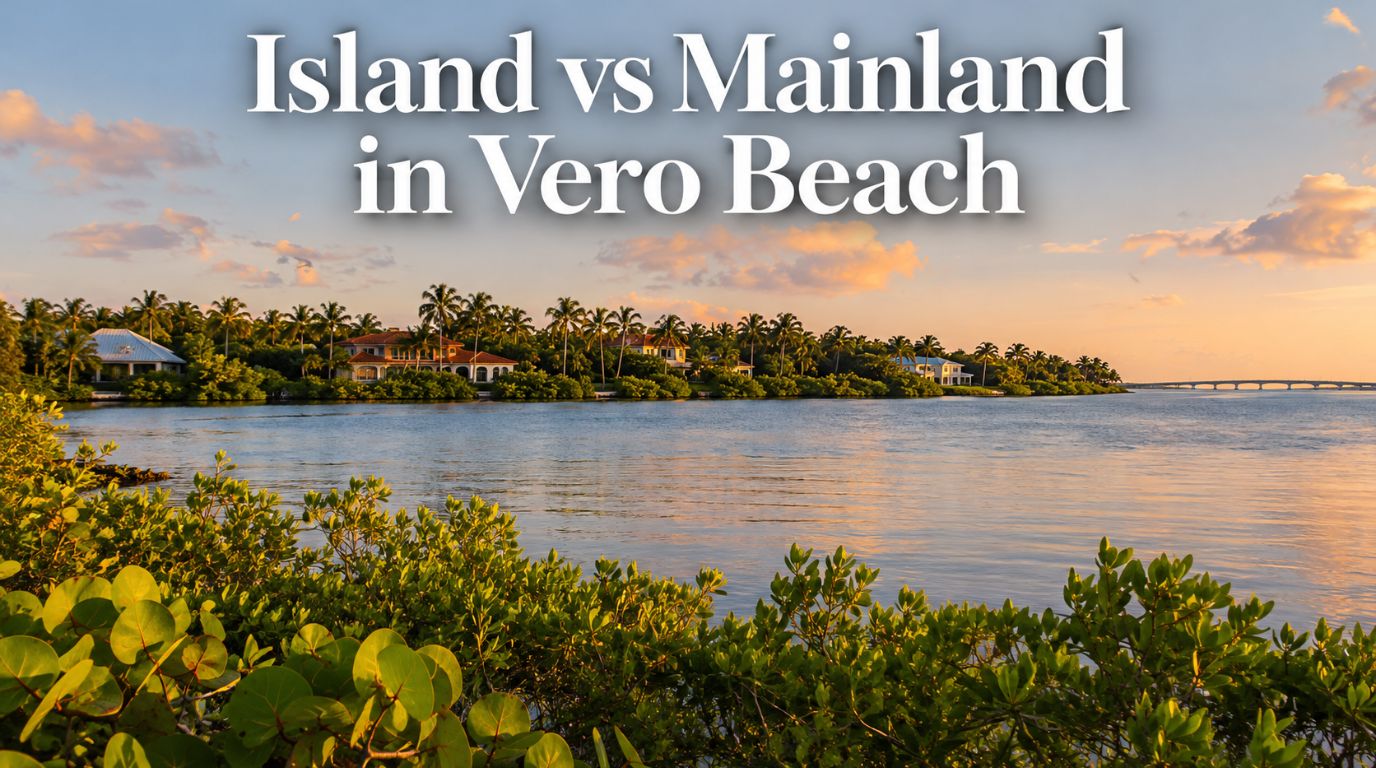
Vero Beach Property Values: Island vs Mainland Explained
Vero Beach property values follow a line on the map: the Indian River Lagoon. A house on the barrier island and a similar house on the mainland can carry very different prices, tax bills and insurance quotes. This guide explains why, using the tax rolls, state law and county rules rather than portal estimates.
This guide explains how property taxes, assessments, flood rules and insurance usually work for homes in Indian River County. It is not legal, tax, insurance or appraisal advice, and a home value from a REALTOR® is a pricing opinion, not an appraisal. Tax rates, exemptions, flood maps and insurance rules change and apply parcel by parcel. Confirm the details for a specific address with the Indian River County Property Appraiser, the Tax Collector, your insurance agent and a Florida real estate attorney or tax professional before you rely on them.
The Short Answer
Vero Beach property values split along the Indian River Lagoon. Homes on the barrier island, ZIP code 32963, often price higher for scarce land near the ocean and lagoon. The cost of owning them differs too: island towns set their own tax rates, and coastal flood, construction and insurance rules weigh more there.
- For fiscal year 2025-26, the Florida Department of Revenue lists adopted municipal millage rates of 2.9816 for the City of Vero Beach, 1.2810 for the Town of Indian River Shores and 0.7000 for the Town of Orchid.
- In the Property Appraiser’s June 2025 estimate, as reported by Vero Beach 32963, value on the tax roll rose 10.5 percent in Orchid, 8.9 percent in Indian River Shores and 5.76 percent in the City of Vero Beach.
- A homestead’s assessed value can rise each year by no more than 3 percent or the change in the Consumer Price Index, whichever is lower, and it resets to just value after a sale (section 193.155, Florida Statutes).
- Building seaward of Indian River County’s coastal construction control line needs a permit from the Florida Department of Environmental Protection (section 161.053, Florida Statutes).
- Jeannie Jacobson, REALTOR® with RE/MAX Gold, works with buyers and sellers across St. Lucie, Martin and Indian River counties, in English and Spanish.
In this guide
- Where the island ends and the mainland begins
- Why values differ across the lagoon
- Water frontage on each side
- Town and city tax rates
- Reading the Property Appraiser’s numbers
- Flood zones and the coastal line
- Insurance on each side
- Condos and club communities
- Comparing two homes across the lagoon
- Pricing a home, and steps to buy or sell
- Frequently asked questions
What counts as the island and what counts as the mainland in Vero Beach?
The Indian River Lagoon draws the line. East of it is the barrier island, a long, narrow strip of land between the lagoon and the Atlantic Ocean. In Indian River County, much of it is often called Orchid Island, and it shares the ZIP code 32963. West of the lagoon is the mainland, where most of the county’s homes sit.
The name “Vero Beach” covers more than one government, and the government decides the tax rate and the building rules:
| Side | Who governs the land | What to know |
|---|---|---|
| Barrier island | Part of the City of Vero Beach | The city spans both sides of the lagoon, so a city address can be on the island or the mainland |
| Barrier island | Town of Indian River Shores | A separate town north of the city, with its own council and tax rate |
| Barrier island | Town of Orchid | A small town farther north, with its own council and tax rate |
| Barrier island | Unincorporated Indian River County | Stretches of the island outside any town, governed by the county |
| Mainland | City of Vero Beach | The city’s mainland neighborhoods west of the lagoon |
| Mainland | Unincorporated Indian River County | Many homes with a Vero Beach mailing address sit outside city limits and are governed by the county |
Three crossings link the two sides in the Vero Beach area: the Merrill P. Barber Bridge on State Road 60, the Alma Lee Loy Bridge at 17th Street, and the Wabasso Causeway to the north.
The mailing address does not tell you the government. The Indian River County Property Appraiser record for the parcel shows the taxing district, and that is the first thing to check before you compare prices.
Why do Vero Beach property values differ between the island and the mainland?
Because buyers pay for a bundle, not just a house. Two homes with the same square footage, age and finish can sit in very different bundles on each side of the lagoon. These are the parts of the bundle that change:
| Factor | Barrier island | Mainland |
|---|---|---|
| Land supply | A narrow strip with little room to add lots | More land, including newer subdivisions |
| Water access | Ocean, lagoon or both within a short distance | Lagoon frontage on the west shore, canals, lakes and golf views inland |
| Municipal tax rate | Set by the City of Vero Beach, Indian River Shores, Orchid or the county | Set by the City of Vero Beach or the county |
| Coastal construction rules | Lots near the beach can sit seaward of the state’s coastal construction control line | Not on the Atlantic beach, so that line does not apply |
| Flood and wind exposure | Between the ocean and the lagoon, in the county’s first evacuation zone | Varies widely; low areas near the lagoon carry more risk than higher ground |
| Insurance | Often a larger share of the cost of owning | Often a smaller share, but still address by address |
| Associations and clubs | Many condos and some private club communities | A mix of HOAs, golf communities and homes with no association |
Land is usually the largest part of the gap. A house can be rebuilt; an ocean or lagoon lot on a narrow island cannot be made again. That is why island values tend to move with land, while many mainland values move more with the house itself: its age, roof, size and condition.
How does water frontage change value on each side of the lagoon?
Water is the single biggest reason two nearby homes carry different prices, and Vero Beach has more kinds of water than most towns. When you read a listing, place it in one of these groups before you compare it with anything:
- Oceanfront. On the island, facing the Atlantic. The most limited supply and the most exposure to storms and coastal rules.
- Ocean access, not frontage. On the island, a short distance from a beach access point.
- Lagoon front on the island. On the west side of the island, facing the Indian River Lagoon, often with room for a dock, subject to permits.
- Lagoon front on the mainland. On the east edge of the mainland, facing the island across the water.
- Canal, lake or golf. Mostly on the mainland, valued for the view and for boating where a canal reaches open water.
- Interior. No water view on either side. Price follows the house more than the land.
The fair comparison is like with like: island lagoon front against island lagoon front, mainland interior against mainland interior. Comparing an island interior home with a mainland lagoon home tells you little about either one.
If water is the main thing you are buying, our guide to buying waterfront property on the Treasure Coast covers docks, seawalls, permits and the due diligence a waterfront home needs.
How do property tax rates compare on the island and the mainland?
The municipal rate is the part that changes most from one government to the next. A millage rate is the tax per $1,000 of taxable value: 1 mill is $1 for every $1,000. These are the adopted municipal and county operating rates for fiscal year 2025-26, from the Florida Department of Revenue’s comparison of taxes levied for Indian River County:
| Taxing authority | Where | 2024-25 rate | 2025-26 adopted rate |
|---|---|---|---|
| Town of Orchid | Island | 0.7000 | 0.7000 |
| Town of Indian River Shores | Island | 1.3349 | 1.2810 |
| City of Vero Beach | Island and mainland | 2.7680 | 2.9816 |
| Indian River County, county MSTU | Generally unincorporated areas, island and mainland | 1.1506 | 1.1506 |
| Indian River County Board of County Commissioners | Countywide | 3.5475 | 3.5475 |
An MSTU is a municipal service taxing unit, a county levy that generally applies outside city and town limits.
Here is what the municipal gap means in dollars. On $400,000 of taxable value, each mill is $400 a year. The difference between the City of Vero Beach rate and the Indian River Shores rate is 1.7006 mills, or about $680 a year. The difference between the city and Orchid is 2.2816 mills, or about $913 a year.
Three cautions before you use these figures:
- They are not the whole bill. School district, county, water management and other levies also apply. The Tax Collector’s bill for the parcel shows the full list.
- They change every year. Each government sets its rate in public hearings each September.
- The rate is only half the math. Taxable value usually changes after a sale, as the next section explains.
What do the Property Appraiser’s numbers mean for Vero Beach property values?
The Indian River County Property Appraiser lists three values on each parcel, and they are not the same as a market price:
| Value | What it is | Why it can differ from a sale price |
|---|---|---|
| Just value | The appraiser’s estimate of market value as of January 1 | It is based on mass appraisal of past sales and lags the market |
| Assessed value | Just value after any assessment cap | Caps hold it below just value for long-held homes |
| Taxable value | Assessed value minus exemptions, such as homestead | Exemptions belong to the owner and leave with them |
The caps explain why two neighbors can pay very different taxes. Under section 193.155, a homestead’s assessed value can rise by no more than 3 percent a year, or the change in the Consumer Price Index if that is lower. After a change of ownership, the home is reassessed at just value as of the next January 1. Non-homestead residential property, such as a second home or rental, has its own 10 percent annual cap under section 193.1555, Florida Statutes, which also resets after a sale.
On the island, where many homes have been held for years and land values have climbed, the gap between the seller’s assessed value and just value can be wide. The seller’s tax bill is not your tax bill. Estimate your taxes from your expected purchase price and the current millage, not from the last bill.
Selling one Florida homestead and buying another? Part of your capped savings may move with you. Our guide to Florida homestead portability when selling explains how.
How fast has value grown? The Property Appraiser publishes an estimate of taxable value each June. In the June 2025 estimate, as reported by Vero Beach 32963, value on the tax roll rose 10.5 percent in Orchid, 8.9 percent in Indian River Shores and 5.76 percent in the City of Vero Beach, where tornado damage reduced the gain. They measure the whole tax roll, including new construction, so they show direction, not any one home’s price.
How do flood zones and the coastal construction line affect island homes?
On the island, three separate maps matter, and buyers often confuse them:
| Map | Who draws it | What it decides |
|---|---|---|
| Flood insurance rate map | FEMA | The flood zone, whether a lender requires flood insurance, and how a flood policy is rated |
| Coastal construction control line | Florida Department of Environmental Protection | Whether building, remodeling or excavating near the beach needs a state permit |
| Evacuation zones | Indian River County Emergency Management | Who is told to leave first when a storm threatens |
Flood zones. Look up the exact address on the FEMA Flood Map Service Center. Zones can change from one lot to the next on both sides of the lagoon. An elevation certificate, if the seller has one, shows how the house sits relative to the base flood elevation.
The coastal construction control line. Section 161.053 of the Florida Statutes has the state set a line, county by county, marking the part of the beach and dune system that can see severe changes from a 100-year storm surge and storm waves. Indian River County’s line runs from Sebastian Inlet south to the St. Lucie County line, as described in Florida Administrative Code rule 62B-26.018. Building or excavating seaward of the line needs a permit from the Florida Department of Environmental Protection. For an oceanfront buyer, that limits what can be added or rebuilt.
Evacuation zones. The Town of Orchid tells its residents they are in Evacuation Zone A, and county materials place the barrier island in Zone A. It shapes how owners plan for storm season.
Florida also requires sellers of residential property to give buyers a flood disclosure at or before the time the contract is signed (section 689.302, Florida Statutes). It covers past flood insurance claims, federal flood assistance and known flood damage. Read it next to the FEMA map: the map shows the designated risk, and the disclosure shows the home’s history.
How does insurance differ between the island and the mainland?
Insurance is set address by address, and on both sides of the lagoon the same items drive the premium:
- Wind. Florida law requires insurers to offer discounts or credits for features that reduce windstorm loss, such as roof-to-wall connections and opening protection (section 627.0629, Florida Statutes). A wind mitigation report documents them.
- Roof age. Under section 627.7011, an insurer may not refuse to issue or renew a homeowner’s policy solely because the roof is less than 15 years old. For a roof 15 years or older, the insurer must allow an inspection, and it may not refuse the policy for roof age alone if the inspection shows at least 5 years of useful life left.
- Flood. A standard homeowner’s policy does not cover flood. If the home is in a high-risk zone and has a federally backed mortgage, the lender will require flood insurance. Outside those zones it is optional, and still worth pricing near the water.
What changes on the island is exposure. A house between the ocean and the lagoon faces wind and surge from more directions than a house on higher ground inland. That often makes insurance a larger share of the monthly cost on the island, which is one reason a lower-priced island home can still cost more to own than a mainland home.
Get binding quotes for wind and flood during your inspection period, before your deposit is at risk. Ask the seller for the latest wind mitigation report and any elevation certificate.
How do condos and club communities change the math on the island?
Condos. A condo price includes a share of the building, and the building has its own budget, reserves and inspection duties. Florida requires milestone structural inspections for condominium buildings three stories or taller (section 553.899, Florida Statutes) and structural integrity reserve studies for many associations (section 718.112). The results can lead to special assessments. Our guide to buying a Treasure Coast condo lists the documents to ask for.
Club communities. Where a home sits inside a private club community, the price of the house and the cost of the membership are separate questions. Membership rules, initiation fees and dues are set by each club and can change, so read the club’s current documents rather than relying on a listing or a past sale. Our guide to selling a home in John’s Island, Vero Beach shows how membership and resale fit together in one island community.
How should you compare two homes on opposite sides of the lagoon?
Compare total cost and long-term value, not list price. This worksheet puts two homes on the same footing:
| Item | Where to find it | Why it matters |
|---|---|---|
| Taxing district | Property Appraiser parcel record | Sets the municipal rate and whether the county MSTU applies |
| Estimated taxes at your price | Current millage times your expected taxable value | The seller’s bill may reflect years of capped growth |
| Flood zone and elevation | FEMA map and any elevation certificate | Drives lender requirements and the flood premium |
| Coastal construction line | Florida Department of Environmental Protection | Limits what an oceanfront owner can build or rebuild |
| Wind and flood quotes | Your insurance agent, during the inspection period | Often the largest swing in monthly cost |
| Roof age and permits | Permit records and the seller’s disclosures | Affects insurance under section 627.7011 |
| Association, condo or club costs | Disclosure summary, budget, reserves, club documents | Dues, assessments and membership change the true price |
| Water type | Survey and site visit | Oceanfront, lagoon front, canal and interior are different markets |
| Bridge and daily trips | A drive at the times you would travel | Island life depends on the crossings |
Be careful with online estimates for island homes. Automated models lean on recent nearby sales, and on a narrow island with few sales of each water type, the nearest sale may be a very different property. See why online home value estimates disagree.
How is a Vero Beach home priced for sale, and what are the steps?
A pricing opinion for a Vero Beach home starts with the same side of the lagoon, the same water type and the same kind of property. An island lagoon front home is priced from other island lagoon front sales, adjusted for lot, elevation, age, roof, condition and any association or club. A mainland interior home is priced from mainland interior sales.
Jeannie’s take, as a St. Lucie County resident for more than 17 years who works across the Treasure Coast: on the island, the costs of ownership come up in nearly every showing, so a seller who gathers the wind mitigation report, the elevation certificate and the association documents before listing answers the buyer’s first questions before they are asked.
The steps for a buyer:
- Choose the side and the water type first.
- Get preapproved on a payment that includes estimated taxes at your price, insurance and any dues.
- Pull the parcel record for each home: taxing district, just value, year built and exemptions.
- Check the FEMA map and, for oceanfront, the coastal construction line before you write an offer.
- Write the offer with an inspection period long enough for a 4-point, a wind mitigation report and binding insurance quotes.
- Read the condo, HOA or club documents before the inspection period ends.
- Close and file for homestead with the Property Appraiser if the home will be your primary residence.
For a wider look at the city and its neighborhoods, start with our Vero Beach area guide, and for the buying process from first showing to closing, see our Vero Beach homebuyer guide.
What Clients Say About Working With Jeannie Jacobson
“We established a great relationship and felt like we were her only clients. She was in constant contact and helped us step by step right down to signing day. Very honest and up front and worked very hard helping us buy the property.”
Darren and Suzanne C., Vero Beach, FL, verified review, March 1, 2022
“Jeannie was wonderful! She helped us determine the right price to list the house based on the market. She explained the process and kept me informed every step of the way. Once we received an offer she made sure the process went smoothly and efficiently. If you are looking for a realtor that is proactive, communicative and knowledgeable I would recommend you contact Jeannie.”
Carrie Wiley, Port Saint Lucie, FL, verified review, March 26, 2022
Frequently Asked Questions
Island homes often price higher because the land between the ocean and the lagoon is limited and close to the water. The cost of owning them also differs: town tax rates, flood and coastal construction rules and insurance vary by side. Compare homes of the same water type on the same side of the lagoon.
The barrier island uses ZIP code 32963. It includes part of the City of Vero Beach, the Town of Indian River Shores, the Town of Orchid and unincorporated parts of Indian River County. The ZIP code does not tell you the taxing district, so check the Property Appraiser record for each parcel.
For fiscal year 2025-26, the Florida Department of Revenue lists an adopted municipal rate of 1.2810 mills for Indian River Shores and 2.9816 for the City of Vero Beach. That is only the municipal part of the bill; county, school and other levies also apply, and rates are reset every September.
Florida caps the yearly growth in a homestead’s assessed value at 3 percent or the change in the Consumer Price Index, whichever is lower. After a sale, the home is reassessed at just value as of the next January 1, and the seller’s homestead exemption leaves with the seller.
It is a state line set under section 161.053, Florida Statutes, marking the part of the beach and dune system exposed to severe storm changes. In Indian River County it runs from Sebastian Inlet to the St. Lucie County line. Building seaward of it needs a Florida Department of Environmental Protection permit.
Not exactly. Just value is the Property Appraiser’s mass appraisal estimate of market value as of January 1, and it lags the market. A sale price depends on the specific home, its water type and condition, and the buyers at the time. A pricing opinion from a REALTOR® is not an appraisal.
Compare Vero Beach Homes on Both Sides of the Lagoon
The right Vero Beach home is the one whose price, taxes, flood map and insurance you understand before you sign. Jeannie works with buyers and sellers across the Treasure Coast, including Indian River County, in English and Spanish, and can help you weigh the island and the mainland address by address.
Jeannie Jacobson, REALTOR®, RE/MAX Gold, (772) 877-0268, English and Spanish
Sources
- Florida Department of Revenue, Property Tax Oversight, Table 1, Comparison of Taxes Levied, County and Municipal Governments, Indian River County, fiscal years 2024-25 and 2025-26, https://floridarevenue.com/property/dataportal/ (accessed November 2026)
- Florida Statutes 2026, sections 161.053, 193.155, 193.1555, 553.899, 627.0629, 627.7011, 689.302, 718.112 and 720.401, http://www.leg.state.fl.us/statutes/ (accessed November 2026)
- Florida Administrative Code rule 62B-26.018, Description of the Indian River County Coastal Construction Control Line (accessed November 2026)
- Florida Department of Environmental Protection, Coastal Construction Control Line Program, https://floridadep.gov/ (accessed November 2026)
- FEMA Flood Map Service Center, https://msc.fema.gov/portal/home (accessed November 2026)
- Steven M. Thomas, “Island, county property values continue impressive rise,” Vero Beach 32963, June 2025, reporting the Indian River County Property Appraiser’s June 1, 2025 estimate (accessed November 2026)
- Town of Orchid, Frequently Asked Questions, evacuation zone, https://www.townoforchid.com/ (accessed November 2026)
- Indian River County Property Appraiser, https://www.ircpa.org/ (accessed November 2026; confirm parcel values, exemptions and taxing districts there)
- Indian River County Emergency Management, evacuation zones (accessed November 2026; confirm your zone on the county’s current map)