

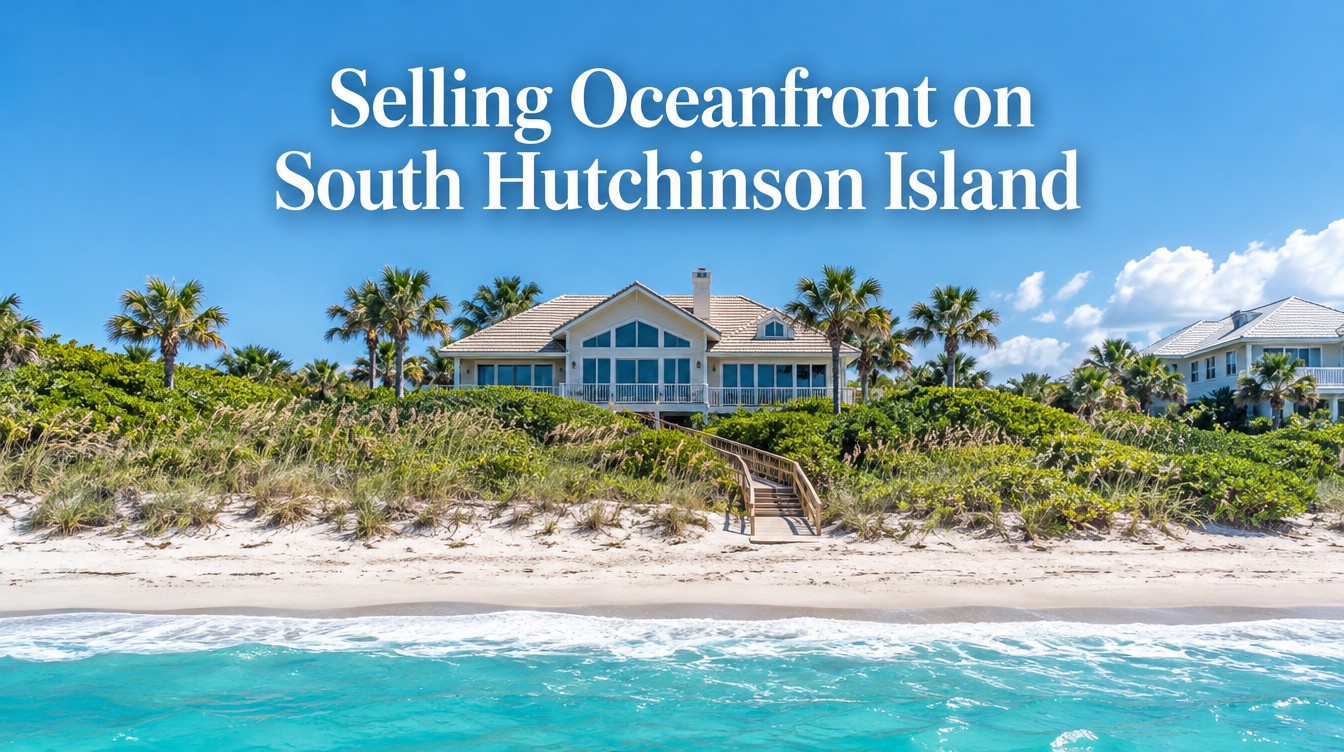
Selling Oceanfront on South Hutchinson Island in St. Lucie County
An oceanfront sale on South Hutchinson Island is decided by paperwork that a mainland sale never needs: which height zone the parcel sits in, where the state coastal line falls, whether the building’s milestone inspection is done, what the reserve study says, and which segment of beach the Army Corps of Engineers just rebuilt. This guide puts those items in the order a buyer will check them, so an island owner can answer each question before the listing goes live.
Seller Answer in Brief
To sell oceanfront on South Hutchinson Island, gather the evidence first: the parcel’s height zone under the 1995 Hutchinson Island Height Overlay, a survey showing the state Coastal Construction Control Line, the building’s milestone inspection summary and reserve study, the insurance declarations, and the beach segment’s renourishment history. Condominium buyers in St. Lucie County get a 7 business day review window once they receive those documents, so missing items cost time and leverage.
- St. Lucie County’s milestone page applies a 25 year inspection threshold to buildings within 3 miles of the coastline, which covers the island (St. Lucie County, accessed October 2026).
- The Hutchinson Island Height Overlay, adopted in 1995, sets a 125 foot maximum in Zone A and 35 feet in Zone B, as described by the county’s planning director in 2025.
- The St. Lucie County Coastal Construction Control Line has been in effect since September 15, 1988 under Rule 62B‑26.021.
- A $14.7 million renourishment of about 3.3 miles, from Normandy Beach to the Martin County line, began in January 2026 (CBS12, January 5, 2026).
- For resale contracts signed after December 31, 2024, the contract must state whether the association has completed its milestone inspection and structural integrity reserve study (s. 718.503, 2026).
- Citizens Property Insurance requires flood coverage on new and renewed wind policies from January 1, 2027, but condominium unit owner policies are excluded (Citizens, accessed October 2026).
In this guide
- Which office handles your sale
- The Hutchinson Island Height Overlay
- The Coastal Construction Control Line
- Beach condition and renourishment
- Milestone inspections for island towers
- Reserves, assessments and financed buyers
- The resale disclosure package
- Insurance evidence
- Sea turtle lighting and showings
- Pricing evidence by building
- Timing, storm season and access
- Frequently asked questions
Which Office Handles Your Sale Depends on Where on South Hutchinson Island You Own
Start with the parcel record, because the island is split three ways. Hutchinson Island runs from the Fort Pierce Inlet south to the St. Lucie Inlet. The northern two thirds sit in St. Lucie County and the southern third in Martin County. Within the St. Lucie County portion, most oceanfront parcels are unincorporated county land, while the north end near the inlet, around Jetty Park and South Beach, lies inside the City of Fort Pierce. That split matters. When the beach between Jetty Park and South Beach lost sand in February 2026, it was the City of Fort Pierce that declared the local state of emergency (St. Lucie Voice, February 27, 2026), while the county runs the renourishment program to the south.
So the same question, “who issued the permit for this balcony repair,” gets a different answer depending on the address. A unit at the north end may carry City of Fort Pierce permit history. A unit near Normandy Beach or Dollman Beach will carry St. Lucie County history. A buyer’s inspector or attorney will search the wrong portal if the listing does not say which one applies.
Owners in the Martin County third, including Sailfish Point and the Jensen Beach end of the island, deal with a different county building department, a different property appraiser and different beach programs. This guide covers the St. Lucie County portion. Sailfish Point has its own article in this series: selling a home in Sailfish Point.
The table below lists the offices an island seller in St. Lucie County is most likely to touch. It is organized by seller step, not by agency, because that is how the questions arrive during a contract.
| Seller step | Office | What to pull before listing |
|---|---|---|
| Confirm jurisdiction, parcel and condo unit record | St. Lucie County Property Appraiser | Parcel card, legal description, assessed and just values, exemptions that end at sale |
| Permit history, open permits, milestone filings (unincorporated parcels) | St. Lucie County Planning and Development Services, Building and Code Regulation, 2300 Virginia Avenue, Fort Pierce | Permit search results, final inspections, milestone report status |
| Permit history (north end parcels inside the city) | City of Fort Pierce building department | Same items, from the city’s records |
| Height zone and zoning | St. Lucie County Planning and Development Services | Zone A or Zone B under the Hutchinson Island Height Overlay |
| Work seaward of the coastal line | Florida Department of Environmental Protection, Coastal Construction Control Line Program | Prior CCCL permits for walkovers, pools, decks, seawalls |
| Beach program status | St. Lucie County Erosion District (Public Works) | Renourishment history for the segment in front of the property |
| Deed recording and documentary stamp tax | St. Lucie County Clerk of the Circuit Court and Comptroller | Vesting deed, any recorded association liens or releases |
| Storm access after an order | St. Lucie County Sheriff’s Office | Current re-entry rules for the barrier island |
The building office address and its weekday hours come from the county’s building inspections page (St. Lucie County, Building Inspections). The county website blocks some automated access, so print or save each record as a PDF when you pull it. Buyers’ attorneys ask for them, and having the file ready avoids a second request during the inspection period.
One more practical point. The census designated place called Hutchinson Island South is a statistical area, not a town. There is no island town hall, no island building department and no island planning board. Every approval runs through the county or, at the north end, through Fort Pierce.
The Hutchinson Island Height Overlay and What It Does to Land Value
The height overlay is the single local rule most likely to change what a buyer will pay for oceanfront land on South Hutchinson Island, and it is the one most listings never mention. St. Lucie County adopted the Hutchinson Island Height Overlay in 1995. Speaking to the County Commission in 2025, the county’s Planning and Development Services Director described Zone A as carrying a 125 foot height maximum and Zone B a 35 foot maximum (Hometown News, 2025).
The difference between those two numbers is the difference between a site that could hold a mid-rise building and a site limited to roughly the height of a two or three story house. For an owner of a vacant oceanfront lot, or of an older low-rise building on a large parcel, the zone is a pricing input on the same level as frontage and lot depth.
The overlay has already been tested. In January 2024 the County Commission resolved a conflict between the overlay’s written legal description and its adopted map for three narrow oceanfront parcels north of the Regency Condominium. The text placed them in Zone A. The map placed them in Zone B. The Commission chose the map, which left the private owner of two of those lots at 35 feet instead of 125. The owner challenged the decision in circuit court, lost in December 2024, appealed to the Fourth District Court of Appeal, and filed a Bert J. Harris, Jr. Private Property Rights Act claim that its attorney valued at $6.7 million. In March 2025 the Commission voted to take no action on settlement options (Hometown News, 2025). Before a listing describes any parcel near the disputed area as Zone A or Zone B, ask St. Lucie County Planning and Development Services for the current overlay text and map in writing, and ask a land use attorney whether the appeal or the Bert J. Harris claim is still open. A pending case can change what a buyer may build, and a buyer’s attorney will ask.
Three lessons for a seller come out of that dispute.
Read both the text and the map
Near a zone boundary, the two can disagree. If your parcel sits near the line where Zone A ends and Zone B begins, ask county planning staff to confirm in writing which zone applies. A buyer paying for development potential will ask the same question, and a written answer from staff is stronger than a marketing claim.
Height is not the only limit
The settlement options the county discussed in 2025 included changes to the building spacing formula, minimum setbacks, lot coverage and density. Those standards also cap what a buyer can build. A Zone A lot with a narrow frontage may not reach 125 feet once spacing and setbacks apply, so do not price a lot on height alone.
Existing buildings are priced differently
For a unit owner in an existing tower, the overlay matters less to unit value and more to the view. A Zone B parcel next door limits what can rise in front of or beside your building. That can be a reasonable talking point in marketing, stated as a fact about the code and not as a promise about the future, since codes change.
For single family oceanfront homes, most of which sit in lower height areas, the overlay usually confirms what the buyer already expects. The value question there shifts to the coastal line and the dune, covered next.
The Coastal Construction Control Line Buyers Will Look For
Every oceanfront parcel on South Hutchinson Island sits near the state Coastal Construction Control Line, and buyers increasingly ask where it falls before they make an offer. The St. Lucie County line is described in Florida Administrative Code Rule 62B-26.021, effective September 15, 1988 (Rule 62B-26.021, F.A.C.). The state’s description runs the line along the county’s Atlantic coast from the Indian River County line south to the Fort Pierce Inlet and then on to the Martin County line, which takes in the whole St. Lucie County portion of the island.
Seaward of that line, construction and excavation need a permit from the Florida Department of Environmental Protection in addition to local building permits. DEP describes the program as regulating structures and activities that can cause beach erosion or destabilize dunes, and it publishes a map viewer for locating the line (DEP, Coastal Construction Control Line Program). The statute behind the program also limits new major habitable structures seaward of the projected 30 year erosion line (s. 161.053, F.S.).
Why does a seller care about a line drawn in 1988? Because a buyer’s surveyor will draw it on the survey, and anything seaward of it becomes a question: the dune walkover, the pool deck, the beach access stairs, the fence, the seawall or retaining wall that was added after a storm. If that work had a DEP permit, the buyer’s attorney will want a copy. If it did not, the buyer may ask for a credit, a price change or a longer inspection period.
The order of work that keeps this from becoming a late surprise:
- Locate your parcel on the DEP map viewer and note whether any structure sits seaward of the line.
- Find the most recent survey. If it does not show the line, consider ordering an updated survey that does. A buyer will likely order one anyway, and it is better to see the result first.
- Pull DEP permits for any seaward work. For a condominium, ask the association manager for the building’s file, since walkovers and dune work are usually common elements.
- Pull the local permit for the same work from the county or, at the north end, Fort Pierce. DEP approval does not replace the local permit.
- List what you found in a short memo for the listing file. If a permit cannot be found, say so and let a real estate attorney advise on disclosure.
For condominium owners, the line mostly affects the association. Where it shows up in a unit sale is through the association’s repair plans. A building whose dune walkover was lost in Hurricane Nicole in November 2022 and rebuilt under a DEP permit is in a different position from one whose walkover is still a pending item in the board minutes. The site’s broader guide to waterfront homes over $1 million covers seawalls and docks on the river side; this article stays on the ocean side.
Beach Condition, Renourishment and Erosion as a Pricing Input
Buyers on South Hutchinson Island now ask about the beach in front of a building the way mainland buyers ask about the roof. The answer differs by segment, and the public record is detailed enough to give a specific one.
The southern 3.3 miles of the county’s Atlantic shoreline, from Normandy Beach to the Martin County line, are a federal storm risk management project. The county’s Erosion District reports that initial federal construction was completed in 2022 (St. Lucie County Erosion District, South Hutchinson Island Renourishment Project). The county’s project timeline lists earlier emergency dune restoration in 2005 and 2007 and a 2013 emergency nourishment, and it records that federal support was sought at the request of property owners and the Presidents Council of South Hutchinson Island (St. Lucie County, project timeline).
Hurricane Nicole struck the island in November 2022 and scarped the dunes. The follow-up project, the South St. Lucie County Coastal Storm Risk Management Project, started in January 2026 at a reported cost of $14.7 million, with about 400,000 cubic yards of sand pumped from offshore and completion expected at the end of June 2026. Dollman Beach closed first, and work proceeded in sections. Most of the funding came from state and federal partners, with a significant share from Erosion District taxes (CBS12, January 5, 2026). Before quoting the project in a listing, ask the St. Lucie County Erosion District for the completion notice and the post-construction beach profile survey for the segment in front of the building. Those two documents date the work, and a buyer’s agent can check them against the same public record.
The north end is a separate story. In February 2026, escarpments close to 10 feet high formed between Jetty Park and South Beach, the City of Fort Pierce declared an emergency, and county communications staff said the inlet “severely limits the amount of sand reaching this beach” (St. Lucie Voice, February 27, 2026). The same report cited DEP survey results classifying 7.6 miles of the county’s beaches as critically eroded.
| Segment (as reported) | DEP classification | Length | Recent work |
|---|---|---|---|
| Fort Pierce Beach, Jetty Park to South Beach | Critically eroded | 2.3 miles | Emergency sand placement February 2026; Army Corps sand scheduled from March 10, 2026 |
| Walton Rocks area, near the FPL St. Lucie plant | Critically eroded | 1.9 miles | None reported in the sources reviewed |
| Dollman Beach to the Martin County line | Critically eroded | 3.4 miles | Federal project, 2022 construction and 2026 renourishment |
| Remaining county shoreline | Non-critically eroded | 7.9 miles | Varies |
Source: DEP survey figures as reported by St. Lucie Voice, February 27, 2026. Segment names follow that report. Confirm the current classification with DEP’s critically eroded beaches report before quoting it in a listing.
How to use this in a sale. A seller in a renourished segment can document the work with dates and public sources, which answers the question before it becomes a negotiation point. A seller in a segment that has not received recent work should not hide it; buyers’ agents can read the same reports. The stronger approach is to show what the association has done at the dune line, with permits, and what reserves exist for it.
There is also a tax line. Erosion District taxes help fund these projects, and the levies on an island bill can differ from those on a mainland bill. Pull the most recent bill from the St. Lucie County Tax Collector, which lists each taxing authority and its millage by line, and put it in the listing file so the buyer’s lender and insurance agent work from the real figures rather than a mainland estimate.
Milestone Inspections for Island Condominium Towers
Most oceanfront ownership on South Hutchinson Island is condominium ownership, and most island buildings are tall enough to fall under the state’s milestone inspection law. Under section 553.899, a residential condominium or cooperative building of three or more habitable stories needs a milestone inspection by December 31 of the year it reaches 30 years of age, then every 10 years. The statute lets the local enforcement agency set a 25 year deadline where local conditions, such as proximity to salt water, justify it (s. 553.899, F.S., 2026).
St. Lucie County uses that option. Its milestone inspections page states that inspections are required at 30 years and every 10 years after, or at 25 years and every 10 years after if the building is located within 3 miles of the coastline. The page also says the county accepts milestone reports for unincorporated St. Lucie County and that the design professional, not the condominium owner, registers through the county’s EnerGov portal (St. Lucie County, Milestone Inspections). Every oceanfront building on the island sits inside that 3 mile band. A building whose certificate of occupancy is 25 years old is on the clock, not one that is 30.
That is the first misconception to clear up with island owners. Many have read that the trigger is 30 years. In the county’s unincorporated area, for an oceanfront tower, the county’s own page sets it at 25. North end buildings inside Fort Pierce follow the city’s building official, so confirm the city’s threshold directly.
| Step | Who acts | Deadline under s. 553.899 | What the seller should have |
|---|---|---|---|
| Written notice that an inspection is required | Local building official, by certified mail | Triggers the clock | Date the association received notice |
| Notice to unit owners | Association | Within 14 days of receiving notice | The owner notice, with completion date |
| Phase one inspection | Licensed architect or engineer | Within 180 days of notice | Confirmation the report was submitted |
| Summary to owners | Association | Within 45 days of receiving the report | Inspector-prepared summary, posted and distributed |
| Phase two, only if substantial structural deterioration is found | Architect or engineer | Progress report within 180 days of phase one report | Phase two scope and timeline |
| Repairs | Association | Commenced within 365 days after the phase two report is received | Contract, schedule, funding source |
A seller does not control any of these steps. What a seller controls is how clearly the status is presented. Ask the association manager for four items: the date of the county notice, the phase one report and summary, any phase two report, and the board’s repair schedule with its funding plan. If the building has not reached its threshold, ask for the certificate of occupancy date so the buyer can see when the inspection will come due.
Phase two findings deserve plain treatment. The state’s program analysis office reported, as summarized by local news, that three St. Lucie County buildings were deemed unsafe or uninhabitable after phase two inspections in 2024 and were vacated (CBS12, reporting on an OPPAGA report). The report as summarized does not name the buildings or say whether they were on the island. Island buyers know that outcomes like this exist, which is why a clean phase one summary, shown early, carries weight in negotiation.
The site’s statewide guide to selling a condo after the milestone inspection explains the report categories in more depth. The island specific point is the 25 year threshold and the county portal where the report is filed.
Reserves, Special Assessments and the Financed Buyer on Hutchinson Island
The structural integrity reserve study, usually called the SIRS, is where a milestone finding turns into a monthly number. Under section 718.112(2)(g), a condominium building of three or more habitable stories needs a SIRS at least every 10 years. It must cover the roof, structure and load bearing elements, fireproofing and fire protection, plumbing, electrical systems, waterproofing and exterior painting, windows and exterior doors, and other items over $25,000 whose failure would affect those systems (s. 718.112, F.S., 2026).
For an oceanfront tower, “waterproofing and exterior painting” and “windows and exterior doors” are not small lines. Salt air, wind driven rain and sun load all show up in them. That is why the SIRS figure for an island building can differ sharply from a mainland building of the same age.
Three provisions shape how buyers read the numbers.
- For budgets adopted on or after December 31, 2024, an association required to have a SIRS may not waive or reduce reserves for the SIRS items, with a narrow exception for some multicondominiums.
- For budgets adopted on or before December 31, 2028, if a milestone inspection was completed in the previous two calendar years, a majority of the total voting interests may temporarily pause or reduce reserve funding so the money goes to the recommended repairs, for no more than two consecutive annual budgets.
- An association may delay a required SIRS for up to two consecutive budget years after completing a milestone inspection.
A buyer who sees a reserve pause in the budget will ask why. The honest answer is usually that the building is paying for repairs now instead of saving for them later. Show the board resolution, the repair contract and the assessment schedule together, so the pause reads as a plan rather than a gap.
Why the financed buyer matters more on the island
Lender rules reach into the building’s paperwork. Fannie Mae’s Selling Guide treats a project as ineligible if it needs critical repairs that significantly affect safety, soundness, structural integrity or habitability. Unfunded repairs costing more than $10,000 per unit that should be done within 12 months are treated as critical, though repairs funded through a special assessment are excluded from that test. If a structural or mechanical inspection was completed within three years of the lender’s review, the lender must obtain and review it (Fannie Mae Selling Guide, B4-2.1-03, August 2026).
Read together, the rules point to a sequence. A milestone report that recommends repairs, funded by a special assessment the board has already adopted, may keep the building financeable. The same repairs left unfunded may not. When an island building falls out of conventional eligibility, the buyer pool narrows to cash buyers and portfolio lenders, and that usually shows up in price and time on market. The site’s guide to selling a non-warrantable condo covers the financing side in detail.
One further point for sellers: a special assessment adopted before closing is typically allocated by the contract, not by custom. Read the assessment language in your purchase contract with your attorney before you accept an offer, and get the association’s estoppel certificate early so the buyer sees the same figure you do. See the guide on the estoppel certificate.
The Resale Disclosure Package and the 7 Day Window
A condominium resale on South Hutchinson Island now runs on a document clock. Section 718.503(2) entitles the buyer, at the seller’s expense, to current copies of the declaration, articles, bylaws and rules, the annual financial statement and budget, the inspector-prepared summary of the milestone inspection report if applicable, the most recent SIRS or a statement that one has not been completed, the turnover inspection report for turnovers on or after July 1, 2023, and the association’s question and answer sheet. The buyer may cancel within 7 days, excluding Saturdays, Sundays and legal holidays, after signing and receiving the documents (s. 718.503, F.S., 2026).
Since contracts entered into after December 31, 2024, the contract must also state in conspicuous type whether the association is required to have, and has completed, a milestone inspection, a turnover inspection report and a SIRS. A contract that does not meet these requirements is voidable by the buyer before closing.
Put plainly: the 7 business day window does not start until the buyer has the documents. Every day spent chasing a missing SIRS from a management company is a day the buyer can still walk away. On the island, where many associations are run by off-site management firms and some boards meet seasonally, that delay is common enough to plan around.
The remedy is to assemble the package before the listing goes live. A practical checklist, with the source for each item:
| Document | Usually obtained from | Seller note |
|---|---|---|
| Declaration, articles, bylaws, rules | Association or management company | Confirm you have the current amended versions, including leasing and pet rules |
| Annual financial statement and budget | Association | Check whether the budget shows a reserve pause |
| Milestone inspection summary | Association; report also filed with the county | If not yet required, note the certificate of occupancy date |
| Most recent SIRS, or a statement that none exists | Association | Pull the funding plan page, not only the cover |
| Turnover inspection report | Association | Only for turnovers on or after July 1, 2023 |
| Frequently asked questions and answers sheet | Association | Check that fee figures match the current budget |
| Governance form | Prepared by the state division | Buyer entitlement under s. 718.503(2)(b) |
| Estoppel certificate | Association | Order when under contract; shows dues, assessments and balances |
| Board minutes for the last 12 months | Association | Not a statutory item but buyers’ attorneys often request them |
Once the package exists, deliver it before the buyer signs when possible. If the buyer acknowledges receipt more than 7 business days before signing, the contract can use that acknowledgment instead of the voidability clause. That is a cleaner contract for both sides, and it removes the post-signing window entirely.
For single family oceanfront homes, the condominium package does not apply, but a homeowners’ association, if any, will have its own disclosure under a different chapter. The general seller disclosure duties still apply. The site’s guide to seller disclosure requirements explains them.
Two island specific items often missing from the package: the building’s DEP permits for dune and walkover work, and the record of any post-Nicole repairs. Neither is required by section 718.503. Both are the first questions a careful island buyer asks.
Insurance Evidence an Island Buyer Will Ask For
On South Hutchinson Island, insurance is a closing condition, not a monthly afterthought. The buyer’s lender will not fund without a binder, and the buyer’s agent will want to see the premium history before writing an offer. The evidence differs by property type.
Condominium units
The association insures the building under a master policy. The unit owner carries an HO-6 policy for interior finishes, contents and liability. Buyers will ask for the master policy declarations, the wind deductible, and whether the association carries flood coverage on the building. Request the current declarations page from the manager and add it to the package. If the master policy renewal is coming within the expected contract period, say so, because a renewal increase usually flows into dues or an assessment.
A point island unit owners often get wrong: Citizens Property Insurance’s flood requirement does not reach them. Citizens states that condominium unit owner policies, tenant contents policies and policies that exclude wind are not required to buy flood coverage (Citizens Property Insurance, Flood). The building’s flood position depends on the association’s choices, not the unit policy.
Single family oceanfront homes and townhomes
For a house insured through Citizens with wind coverage, flood insurance is now part of eligibility. The phase-in began with special flood hazard areas in 2023, then moved through dwelling values of $600,000 (2024), $500,000 (2025) and $400,000 (2026). From January 1, 2027, new and renewed Citizens policies with wind coverage need flood coverage regardless of value (Citizens). A buyer who plans to insure through Citizens will price that in. A seller with a current flood policy and an elevation certificate gives the buyer’s agent a real number instead of an estimate.
Florida’s seller flood disclosure law also applies to residential sales, including a question about flood insurance claims and federal assistance. The site’s guide to flood disclosure for sellers explains the form. For local flood maps and premium factors, see the site’s page on flood insurance in Port St. Lucie; the island is in unincorporated St. Lucie County or Fort Pierce, so its community rating differs from the City of Port St. Lucie’s. Ask the floodplain administrator for the jurisdiction that holds the parcel, St. Lucie County for the unincorporated island or the City of Fort Pierce at the north end, for its current Community Rating System class. The class sets the discount on National Flood Insurance Program policies in that community, so the answer belongs in the listing file next to the elevation certificate.
What to have in hand before listing
- Current wind and flood declarations pages, with deductibles
- Elevation certificate, if one exists for the house
- A recent wind mitigation inspection report for a single family home, which insurers use to apply credits
- A claims history summary from your carrier, especially for Ian and Nicole in 2022
- For condominiums, the master policy declarations and the most recent appraisal of the building used for insurance
None of this lowers a premium by itself. What it does is shorten the time between an offer and a firm insurance quote, which on the island is often the step that holds up the inspection period. If storm damage from 2022 or later was repaired, have the permits and invoices ready; the site’s guide to selling a house with hurricane damage covers the disclosure side.
Sea Turtle Lighting Rules and Evening Showings on the Island
From March 1 through November 15, beachfront lighting on Hutchinson Island is regulated to protect nesting sea turtles. St. Lucie County’s public guidance asks that exterior lights visible from the beach be shielded, redirected or turned off between sunset and sunrise, and that windows in the beach’s line of sight use blackout drapes, shade screens or approved tint (WQCS, August 23, 2022; UF/IFAS St. Lucie County Extension). The binding rule is section 6.04.02 of the St. Lucie County Land Development Code. During each nesting season, March 1 through November 15, exterior light sources directly visible from the beach or lighting areas seaward of the primary dune must be turned off between sunset and sunrise, and windows within line of sight of the beach must have window treatment, with blackout draperies or shade screens preferred and tint allowed (St. Lucie County LDC sec. 6.04.02). The section covers the area between State Road A1A and the ocean, or between the coastal construction control line and the ocean, whichever is greater. That code governs unincorporated parcels; at the north end of the island, inside Fort Pierce, ask the city for its own lighting rules.
For a seller, the rule shows up in three places.
Evening showings and photography. Twilight photos with every light on and the pool glowing toward the ocean are a mainland habit. On the island during nesting season, that image can document a violation. Schedule exterior photography at dusk outside the season, or shoot with seaward lights off and interior window treatments drawn on the ocean side. During a showing after sunset, keep seaward fixtures off.
Inspection items. A buyer’s inspector or a condominium association may note fixtures that are not turtle compliant, such as unshielded floodlights on a deck. For a condominium, exterior lighting is usually a common element, so the question goes to the association. For a house, a simple fixture change before listing removes the item.
New construction and major renovation. A buyer planning to rebuild or substantially renovate a beachfront house will have to meet the lighting standards in the permitting process. Under section 6.04.02, coastal development that installs permanent light fixtures within the covered area needs a Sea Turtle Protection Plan approved before a building permit is issued, and before a certificate of occupancy a Florida registered architect or professional engineer must run a night inspection with the beachfront lighting on and certify compliance. Mention the requirement in the listing for lots and teardown candidates so a buyer’s architect plans for it.
Related beach rules also matter for staged photography and open houses: the county prohibits bonfires and fireworks on its beaches and discourages leaving furniture on the sand overnight (WQCS, 2022). Keep the beach in listing photos as it is, without props left behind.
The renourishment projects are timed around the same season. The 2026 work was planned outside the main nesting period, with biologists on site to watch for early nests (CBS12, 2026). If future work is scheduled in front of your building, the turtle calendar will tell you roughly when the equipment will be gone, which is useful for choosing a listing date.
Pricing Evidence: Building by Building, Not Island Averages
An honest price for oceanfront on South Hutchinson Island comes from sales in the same building or in buildings with the same physical and legal profile. Island wide medians blend direct oceanfront towers with river side units and older low-rises, and they are not useful for a specific unit.
Start by correcting a common misreading. Reports of top sales in the “Port St. Lucie metro area” cover a federal metropolitan area that includes Martin County. Redfin data republished by Stacker on September 9, 2025, current as of August 5, 2025, listed the area’s largest 2025 sales on Jupiter Island and in Hobe Sound, led by a $39,000,000 sale at 320 S Beach Rd on Jupiter Island (Stacker, 2025, secondary). Those sales say nothing about values in the St. Lucie County portion of Hutchinson Island. Use them only to understand why metro headlines do not fit your building.
This article does not publish island sales figures. Recorded prices can be read from deeds, but the St. Lucie County Property Appraiser’s website refused automated queries when this guide was checked in October 2026, and the measures that matter most for timing and list price, such as days to contract, sale to list ratio and price reductions, exist only in the MLS. The method below is how a pricing review should build the evidence for a specific unit or lot.
Method
- Data: recorded sales from the St. Lucie County Property Appraiser’s sales records and the deeds at the Clerk of the Circuit Court, paired with the MLS listing history for each sale.
- Area: parcels on the barrier island within St. Lucie County, from the Fort Pierce Inlet to the Martin County line, split by city and unincorporated county.
- Period: the most recent 24 months, stated with the sample size.
- Top tier: if too few sales reach $3 million, the top 5 percent of island sales by price in the period, with the threshold written down.
- Segments: direct oceanfront condominium, ocean view condominium, single family oceanfront, river side.
- Adjustments noted, not averaged: milestone and SIRS status at the time of sale, special assessments outstanding, height zone for land, and beach segment.
What to ask for, and from whom. From the listing agent’s MLS access, ask for every sale in your building and in buildings with the same profile over the period, with the original list price, the list price at contract, the days to contract and every price change. The sale to original list ratio shows how far opening prices in those buildings have had to move; where sellers routinely cut before contract, the case for opening closer to the evidence is strong. Ask for the expired and withdrawn listings too, because they show the prices at which units in your segment did not sell. From the Property Appraiser’s record cards, take the recorded price and date of each sale, which confirms the MLS figures and catches sales that never went through the MLS. From each association, ask whether a special assessment was outstanding at the time of each comparable sale. Days to contract by month, read against the turtle season and storm season covered in this guide, is the figure that should set the listing date.
How the figures feed the decision. Within a single building, unit sales usually differ by floor, stack, ocean exposure, renovation and parking. Across buildings, the larger gaps on the island tend to follow the legal and structural file: a building with a clean phase one summary and funded reserves competes for financed buyers, while a building with unfunded repairs competes mostly for cash. Price per square foot alone hides that difference. A pricing review should show the comparable sales with each building’s milestone and assessment status at the time of sale, so the seller can see which sales actually match.
For land and teardown candidates, add the height zone and the coastal line to each comparable. A Zone A lot and a Zone B lot of the same frontage are not the same product, as the 2024 overlay dispute showed.
Port St. Lucie owners comparing island values to the mainland top tier can read the companion article on the top of the Port St. Lucie housing market. The two markets share a county but not a buyer profile, since the island’s inventory is largely condominium.
Timing, Storm Season and Island Access for a Hutchinson Island Sale
Three island conditions affect when to list and how to run the contract: storm season, the rules for getting back on the island after an order, and the questions buyers ask about the St. Lucie nuclear plant.
Storm season and the contract calendar
A contract that runs into an active storm can stall at the insurance step, because carriers may suspend new binding when a storm threatens. On a barrier island, that pause is more likely to matter than on the mainland. Build a little extra time into the inspection and financing periods for contracts signed during the season, and keep the insurance evidence from section 8 ready so the buyer can bind early.
Re-entry after an evacuation order
When the county orders the barrier island evacuated, access back across the bridges is controlled. The St. Lucie County Sheriff’s Office has said island residents and property owners no longer need a re-entry placard, though existing placards still work. Instead, deputies at a roadblock ask for photo identification plus two documents such as a utility bill or property tax statement. The Sheriff’s Office also asks condominiums and businesses on the island for lists of authorized workers so repairs can start sooner (WPTV). Confirm the current procedure before each season.
For a seller who lives elsewhere, that matters. If your unit is vacant and listed, make sure the association, your listing agent and any contractor are on the building’s authorized list, and keep a copy of your tax bill where someone local can reach it. The site’s guide to selling from out of state covers remote signing and closing.
The St. Lucie plant
FPL’s St. Lucie nuclear plant sits on Hutchinson Island on A1A between Stuart and Fort Pierce, and the island lies inside its 10 mile emergency planning zone. Outdoor warning sirens cover the zone and are tested on a published schedule, and residents within 10 miles receive emergency information from FPL and the county (Florida Division of Emergency Management, St. Lucie plant public information; WQCS, October 23, 2023). Buyers from out of the area sometimes ask about it. The best answer is the official material itself, kept in the listing file, rather than a summary in your own words.
A working sequence for an island sale
Ninety days out: the record
Pull the parcel card, confirm city or county jurisdiction, confirm the height zone, locate the coastal line, and request the condominium package from the manager.
Sixty days out: the building
Read the milestone summary, SIRS, budget and the last year of minutes. Identify any adopted or pending special assessment and the repair schedule.
Forty-five days out: insurance and permits
Gather declarations pages, the elevation certificate and wind mitigation report, and the local and DEP permits for any seaward or storm repair work.
Thirty days out: price
Build the comparable set by building and segment, with each sale’s legal and structural status noted. Set the price from that set.
Launch: photography and showings
Schedule exterior photography with turtle season in mind, and deliver the disclosure package to serious buyers before they sign when possible.
Under contract: estoppel and closing
Order the estoppel certificate, track the 7 business day window, and keep the insurance binder on schedule. The deed is recorded with the St. Lucie County Clerk, and documentary stamp tax on the deed is $0.70 per $100 of consideration (s. 201.02, F.S.). See the site’s page on seller closing costs for the other lines.
Commission and other compensation in the sale are negotiable and set by written agreement; nothing in this sequence assumes a particular rate.
What Sellers Say About Working With Jeannie Jacobson
These reviews come from sellers in other markets. None of them describes a sale on Hutchinson Island. They are included because they speak to pricing and communication during a sale, the two areas this guide covers.
“Jeannie was wonderful! She helped us determine the right price to list the house based on the market. She explained the process and kept me informed every step of the way. Once we received an offer she made sure the process went smoothly and efficiently. …”
Carrie Wiley, Port Saint Lucie, FL, March 26, 2022, Verified review
“Jeannie was wonderful! She quided us in pricing, staging, and the actual selling process. Needless to say, our house was sold in record time! Her continuous contact with us, allowed us to know how things were going throughout the wait time between contract an closing, was great! …”
Diane, Delray Beach, FL, June 22, 2023, Verified review
“I recently had the pleasure of working with Jeannie to sell my house and I couldn’t be happier with the experience. … She was always prompt in responding to my emails, calls, and texts. She kept me informed every step of the way, explaining the process clearly and patiently answering all of my questions, no matter how big or small.”
Sim Miller, 4 Feb 2025, Google review
This guide is general information about selling property on South Hutchinson Island in St. Lucie County. It is not legal, tax, insurance or financial advice. Statutes, county codes, insurer rules and lender guidelines change, and several items above are marked for verification. Consult a condominium or real estate attorney, a licensed insurance agent, and the named county or state office before acting on any point.
Frequently Asked Questions
No. The St. Lucie County part of the island is mostly unincorporated county land, with the north end near the Fort Pierce Inlet inside the City of Fort Pierce. The City of Port St. Lucie has no jurisdiction there. Permits, zoning and milestone filings go to St. Lucie County or, at the north end, to Fort Pierce. Check the property appraiser’s parcel card to confirm which applies to your address before you list.
St. Lucie County’s milestone page applies a 25 year threshold, then every 10 years, to buildings within 3 miles of the coastline, which includes oceanfront buildings on the island in the unincorporated county. The statute sets the inspection by December 31 of the year the building reaches the threshold age, measured from the certificate of occupancy. Buildings inside Fort Pierce follow the city’s building official. Ask your association manager for the notice date and report status.
Under section 718.503(2), the buyer is entitled at your expense to the declaration, articles, bylaws and rules, the annual financial statement and budget, the milestone inspection summary if applicable, the latest structural integrity reserve study or a statement that none exists, any turnover inspection report from July 1, 2023 on, and the association’s question and answer sheet. The buyer may cancel within 7 business days after receiving them, so deliver the package early.
It depends on how the repairs are funded. Fannie Mae treats unfunded repairs over $10,000 per unit due within 12 months as critical, which makes the project ineligible, but repairs funded through a special assessment are excluded from that test. A lender must also review any structural inspection completed within three years. A building that has adopted an assessment for its milestone repairs is in a better position than one that has not.
Citizens states that condominium unit owner policies are not required to carry flood coverage under its phase-in. The requirement applies to residential policies with wind coverage, such as a single family oceanfront home insured through Citizens, and from January 1, 2027 it reaches those policies regardless of value. Your building’s flood coverage is the association’s decision under its master policy, so ask the manager for those declarations for your buyer.
Yes, from March 1 through November 15. The county asks that exterior lights visible from the beach be shielded, redirected or turned off from sunset to sunrise, and that ocean facing windows be treated. Twilight listing photos with seaward lights on can document a violation during the season. Schedule exterior photography outside the season or with seaward lights off, and keep those fixtures off during evening showings.
It matters less to the unit price and more to the view. Under the Hutchinson Island Height Overlay, Zone A allows up to 125 feet and Zone B 35 feet, according to the county’s planning director in 2025. A neighboring parcel in Zone B limits what can be built beside your building. You can state that as a fact about the current code, but not as a promise, since codes and maps can be amended.
It can affect buyer questions more than the price itself, depending on the segment and on what the association has done. The southern 3.3 miles, from Normandy Beach to the Martin County line, received a federal renourishment in 2022 and another project starting in January 2026. The north end near Jetty Park saw emergency work in February 2026. Document the segment’s history and the association’s dune work with permits before listing.
The St. Lucie County Sheriff’s Office has said placards are no longer required, though old ones still work. Bring photo identification plus two documents such as a utility bill or property tax statement. If you live out of the area, ask your association to put your listing agent and contractors on the building’s authorized worker list, and confirm the current procedure with the Sheriff’s Office before storm season begins.
The buyer’s surveyor will usually show the Coastal Construction Control Line on the survey, and the buyer’s attorney will ask for permits for anything seaward of it. Work there needs a permit from the Florida Department of Environmental Protection as well as the county or city building permit. Search both records before listing, and ask your association for its file if the structure is a common element.
Start With the File, Then Set the Price
An island sale goes more smoothly when the zone, the coastal line, the building’s milestone and reserve status, and the insurance evidence are in one folder before the first showing. A written pricing analysis and pre-listing plan for a South Hutchinson Island property can be built from that folder, with comparable sales matched by building and status.
Request an island pricing review
Jeannie Jacobson, REALTOR®, RE/MAX Gold, (772) 877-0268, English and Spanish
Sources
- Rule 62B-26.021, Description of the St. Lucie County Coastal Construction Control Line, Florida Administrative Code, https://www.flrules.org/gateway/ruleNo.asp?id=62B-26.021 (accessed October 2026)
- Coastal Construction Control Line Program, Florida Department of Environmental Protection, https://floridadep.gov/rcp/coastal-construction-control-line (accessed October 2026)
- Section 161.053, Florida Statutes, Coastal construction and excavation, http://www.leg.state.fl.us/statutes/index.cfm?App_mode=Display_Statute&URL=0100-0199/0161/Sections/0161.053.html (accessed October 2026)
- Section 553.899, Florida Statutes (2026), Mandatory structural inspections for condominium and cooperative buildings, http://www.leg.state.fl.us/statutes/index.cfm?App_mode=Display_Statute&URL=0500-0599/0553/Sections/0553.899.html (accessed October 2026)
- Section 718.112, Florida Statutes (2026), Bylaws, including structural integrity reserve study, http://www.leg.state.fl.us/statutes/index.cfm?App_mode=Display_Statute&URL=0700-0799/0718/Sections/0718.112.html (accessed October 2026)
- Section 718.503, Florida Statutes (2026), Developers and unit owners other than developers; disclosure prior to sale, http://www.leg.state.fl.us/statutes/index.cfm?App_mode=Display_Statute&URL=0700-0799/0718/Sections/0718.503.html (accessed October 2026)
- Section 201.02, Florida Statutes, Tax on deeds and other instruments, http://www.leg.state.fl.us/statutes/index.cfm?App_mode=Display_Statute&URL=0200-0299/0201/Sections/0201.02.html (accessed October 2026)
- Milestone Inspections, St. Lucie County Planning and Development Services, https://www.stlucieco.gov/departments-and-services/planning-and-development-services/permitting-zoning/milestone-inspections (page content read through search index; direct access blocked; accessed October 2026)
- Building Inspections, St. Lucie County Planning and Development Services, https://www.stlucieco.gov/departments-and-services/planning-and-development-services/building-inspections (accessed October 2026)
- South Hutchinson Island Renourishment Project, St. Lucie County Erosion District, https://www.stlucieco.gov/departments-and-services/public-works/erosion-district/2022-south-hutchinson-island-renourishment-project (accessed October 2026)
- South County Renourishment Project Timeline, St. Lucie County, https://www.stlucieco.gov/departments-and-services/public-works/erosion-district/2022-south-hutchinson-island-renourishment-project/south-county-renourishment-project-timeline (accessed October 2026)
- “Beach closures begin as nearly $15M renourishment project underway on Hutchinson Island,” CBS12, January 5, 2026, https://cbs12.com/news/local/beach-closures-begin-as-147m-renourishment-project-underway-on-hutchinson-island (secondary; accessed October 2026)
- “Beach erosion prompts state of emergency,” St. Lucie Voice, February 27, 2026, https://stlucievoice.com/2026/02/27/beach-erosion-prompts-state-of-emergency/ (secondary, reporting DEP survey figures; accessed October 2026)
- “County may bog down in Bert J. Harris case,” Hometown News Treasure Coast, 2025, https://www.hometownnewstc.com/news/st_lucie/county-may-bog-down-in-bert-j-harris-case/article_06429dcd-e125-5d99-a82e-5f9b5664168a.html (secondary, reporting statements by the county’s Planning and Development Services Director; accessed October 2026)
- “3 St. Lucie buildings vacated as Palm Beach County condo inspections surge: State report,” CBS12, https://cbs12.com/news/local/state-report-palm-beach-county-leads-condo-safety-inspections-3-st-lucie-buildings-vacated-unsafe-uninhabitable-office-program-policy-analysis-government-accountability-inspection-data-2024-2025-surfside-champlain-towers-south-sb-4d (secondary, reporting an OPPAGA report; accessed October 2026)
- Selling Guide B4-2.1-03, Ineligible Projects, Fannie Mae, version dated August 5, 2026, https://selling-guide.fanniemae.com/sel/b4-2.1-03/ineligible-projects (accessed October 2026)
- Flood insurance requirements, Citizens Property Insurance Corporation, https://www.citizensfla.com/flood (accessed October 2026)
- “St. Lucie County changing storm rules regarding barrier island access,” WPTV, https://wptv.com/news/region-st-lucie-county/st-lucie-county-changing-storm-rules-regarding-barrier-island-access (secondary, undated; accessed October 2026)
- St. Lucie Plant public information postcard, Florida Division of Emergency Management, 2019, https://prod.floridadisaster.org/contentassets/393a16d97fc84bb8ac06c796f6f09883/101868–2019-psl-postcard-public-information.pdf (accessed October 2026)
- “St. Lucie Nuclear Power Plant revised safety schedule,” WQCS, October 23, 2023, https://www.wqcs.org/wqcs-news/2023-10-23/st-lucie-nuclear-power-plant-revised-safety-schedule (secondary; accessed October 2026)
- “Help save the sea turtles: bonfires, fireworks prohibited on St. Lucie County beaches,” WQCS, August 23, 2022, https://www.wqcs.org/wqcs-news/2022-08-23/help-save-the-sea-turtles-remember-bonfires-fireworks-prohibited-on-st-lucie-county-beaches (secondary; accessed October 2026)
- “Update on Sea Turtle Friendly Beaches in St. Lucie County,” UF/IFAS St. Lucie County Extension, https://blogs.ifas.ufl.edu/stlucieco/2021/02/04/sea-turtle-2023/ (accessed October 2026)
- “The most expensive homes sold in Port St. Lucie this year,” Stacker, September 9, 2025, Redfin data current as of August 5, 2025, https://stacker.com/stories/florida/port-st-lucie/most-expensive-homes-sold-port-st-lucie-year (secondary; accessed October 2026)
- St. Lucie County Land Development Code, sec. 6.04.02, Sea Turtle Protection, Municode, Supplement 36, https://library.municode.com/fl/st._lucie_county/codes/land_development_code?nodeId=CHVIREPRST_6.04.00HAENTHSP_6.04.02SETUPR (accessed October 2026)