

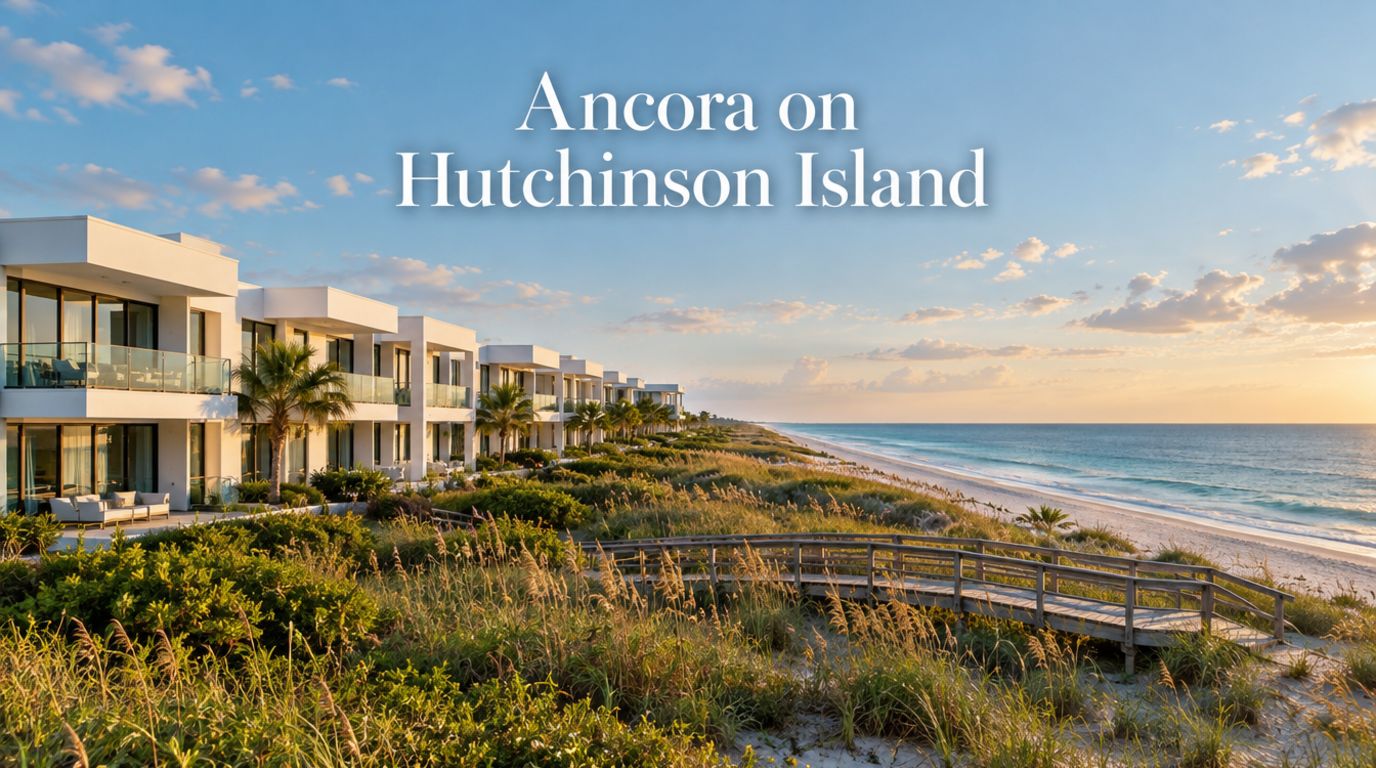
Ancora Hutchinson Island: Residences, Fees and What Buyers Ask
Ancora Hutchinson Island is a small new development between the Atlantic and the Indian River Lagoon, and most of the questions buyers ask about it are really questions about buying before a building is finished. This guide covers what has been announced about the residences, where the fees appear in the offering documents, how Florida law protects your deposit, your right to cancel and what happens when owners take over the association.
This guide explains how Florida rules usually apply to a purchase from a developer. It is not legal, tax, insurance or lending advice. Prices, fees, unit features and timelines come from the developer and can change, and the recorded documents control. Have a Florida real estate attorney review the contract and offering documents before you sign or send a deposit.
The Short Answer
Ancora is a boutique development of 24 duplex-style residences on Hutchinson Island, announced in April 2026 with first deliveries expected in March 2027. Buying there now means buying from the developer before completion, so the offering documents, the escrowed deposit and a 15-day right to cancel matter more than any listing photo.
- Press coverage from April 10, 2026 describes 24 duplex-style townhomes of about 3,100 square feet with four bedrooms and 3.5 baths, priced from $1.75 million, with seven private boat slips (South Florida Agent Magazine).
- A developer contract for a Florida condominium must say the buyer may cancel by written notice within 15 days after signing and receiving the required documents (Florida Statutes, section 718.503).
- Deposits up to 10% of the price go into escrow before completion; amounts above 10% go into a special escrow account and may be used for construction only if the contract says so (Florida Statutes, section 718.202).
- For a condominium of more than 20 residential units, the developer must file a prospectus that attaches an estimated operating budget and shows the assessment each unit type would pay (Florida Statutes, section 718.504).
In this guide
- What Ancora is and who is building it
- Where it sits and which county applies
- The residences and shared amenities
- Where the fees show up before you sign
- How your deposit is protected
- Your right to cancel a developer contract
- When owners take over the association
- Warranties on a new building
- Flood zones, the coastal line and insurance
- The steps from reservation to closing
- Frequently asked questions
What is Ancora Hutchinson Island, and who is building it?
Ancora is a new waterfront development on Hutchinson Island, the barrier island that runs along the Atlantic coast of St. Lucie and Martin counties. On April 10, 2026, South Florida Agent Magazine reported that the project is developed by Matthew Madrazo of Civitella and that SERHANT. was named its exclusive sales and marketing firm.
The same report gives the timeline that buyers ask about most. The model residence was expected to be finished in January 2027, and first deliveries were expected to start in March 2027. Those are the developer’s projections, not dates set by law. Construction schedules on the coast move with permits, weather and materials, so read the completion language in the purchase contract rather than relying on a marketing date.
Local listings in the multiple listing service show Ancora units as condominiums with a Jensen Beach mailing address, while the press release calls them townhomes. Both can be true. A townhome is a style of building; a condominium is a form of ownership. What decides the rules is the recorded declaration. If it is a condominium, Chapter 718 of the Florida Statutes governs the sale and the association. If the community is set up as a homeowners association instead, Chapter 720 applies. The answer is on the first pages of the documents, and the rest of this guide assumes the condominium form shown in the listings.
Where is Ancora on the island, and which county applies?
Ancora sits on South Hutchinson Island along the stretch of ocean road that carries Jensen Beach addresses. The homes face the Atlantic on one side and the Indian River Lagoon on the other, with deeded beach access across the road, according to the April 2026 report.
A Jensen Beach mailing address does not settle the county. Jensen Beach itself is in Martin County, but much of the island south of Fort Pierce Inlet with Jensen Beach addresses is in St. Lucie County, and nearby oceanfront condominiums on the same road are listed in St. Lucie County records. Confirm the parcel for any unit on the St. Lucie County Property Appraiser site before you budget for taxes. The county decides who assesses the property, who issues building permits and which tax rates apply.
For the wider area, from the causeway to the beach parks, see the Jensen Beach area guide. For the island’s oceanfront buildings from a seller’s point of view, read selling oceanfront on South Hutchinson Island.
What do the Ancora residences and shared amenities include?
Here is what has been published about the project so far. Treat every line as a developer description to confirm in the plans and specifications attached to your contract.
| Item | As announced in April 2026 | Where to confirm it |
|---|---|---|
| Number of residences | 24 duplex-style townhomes | Declaration of condominium and plot plan |
| Size and layout | About 3,100 square feet, four bedrooms and 3.5 baths | Floor plans attached to the contract |
| Starting price | From $1.75 million | Current price sheet and your contract |
| Boat slips | Seven private slips | Declaration: who owns, assigns or sells each slip |
| Beach access | Deeded access across the ocean road | Survey and recorded easement |
| Shared amenities | Clubhouse, pool, sun deck, fitness center with sauna | Prospectus description of recreational facilities |
Source: South Florida Agent Magazine, April 10, 2026. Check each item against the current offering documents.
The slip math buyers notice
Seven slips for 24 residences means not every owner will have one. Ask how slips are handled: sold separately, assigned as limited common elements, leased by the association, or kept by the developer. Ask too whether a slip can be sold to another owner later, what size boat it fits and who pays for dock maintenance. The prospectus must describe recreational facilities, any fees for them and whether membership is required, so the answer should be in writing.
Where do the Ancora fees show up before you sign?
Monthly or quarterly association fees for a building that is not finished yet are an estimate, and Florida law tells you where to find it. Under section 718.504, a developer of a residential condominium with more than 20 residential units must file a prospectus, also called an offering circular, before it signs binding contracts. With 24 residences, Ancora falls into that group if it is a condominium.
Three parts of that document answer the fee question:
- The estimated operating budget. It is attached as an exhibit, covers at least 12 months and is labeled a good-faith estimate. It lists what the association expects to spend on insurance, reserves, management, the pool and clubhouse, landscaping, utilities and the docks.
- The frequently asked questions page. It states the assessment each unit type would pay under that budget, and how often it is due. Special assessments are not included in that figure.
- The recreational facilities disclosure. It shows whether any amenity is leased or run as a club, what that costs and whether membership is mandatory.
Costs that sit outside the association budget
- Property taxes. New construction is assessed by the county property appraiser, and a homestead exemption needs a separate application.
- Your own unit insurance. The association insures the building under its master policy; owners usually insure interiors, contents and liability on their own policy.
- Flood insurance. Whether a lender requires it depends on the flood zone of the parcel.
- A slip or dock fee, if you buy or rent one of the seven slips.
- Closing charges in the developer contract, such as a working capital contribution to the association. These vary by contract, so read that section line by line.
Budgets for a new association often rise after owners take control and set their own reserve funding, so ask your attorney to review the reserve lines with that in mind. For condo budgets, reserves and inspections across the region, read buying a Treasure Coast condo.
How is your deposit protected on a pre-construction purchase?
Section 718.202 of the Florida Statutes sets the rules for deposits paid to a condominium developer before construction, furnishing and landscaping are substantially complete.
| Part of the deposit | What the law requires |
|---|---|
| Up to 10% of the price | Held in escrow by an approved escrow agent independent of the developer, such as a Florida bank, a Florida Bar attorney or a licensed title insurer |
| Above 10% of the price | Held in a separate special escrow account; the developer may withdraw it after construction begins only if the contract says so in a conspicuous legend, and only for actual construction and development costs |
| What it may not pay for | Sales salaries or commissions, advertising, loan costs, attorney or accounting fees and insurance |
| A reservation deposit | Held in escrow and fully refundable on written request until a purchase contract is signed |
Source: Florida Statutes 2026, section 718.202.
On a $1.75 million contract, 10% is $175,000. Anything paid above that figure is the part to watch. If the contract allows its use for construction, that money is in the building, not in an account, until closing. Ask for the deposit schedule, the name of the escrow agent and a written escrow receipt for each payment, which the law entitles you to on request.
If you properly cancel, the escrowed funds go back to you with any interest earned. If you default, they go to the developer. If the contract is silent on interest, the interest goes to the developer at closing. Those rules make the cancellation and default sections of the contract the most important pages after the price.
Can you cancel a developer contract after you sign?
Yes, within a set window. Section 718.503 requires every developer contract for a Florida condominium to carry a legend, in conspicuous type, stating that the agreement is voidable by the buyer by written notice within 15 days after the buyer signs it and receives all of the items the developer must deliver. Those items include the declaration, the bylaws, the articles of incorporation, the estimated operating budget and, for a project of this size, the prospectus.
Two practical points follow. First, the clock does not start until you have the full set of documents, so keep a record of what you received and when. Second, the notice has to be written and delivered the way the contract says. Do not rely on a phone call or a text.
Use the window. Fifteen days is enough time for a real estate attorney to read the declaration and the budget, for an insurance agent to quote the unit policy and for a lender to look at the project if you plan to finance. If the answers change your mind, cancel in writing before the deadline.
Later amendments matter too. Section 718.503 also gives a buyer the right to cancel if the developer makes changes to the offering documents that materially alter or modify the offering in a way that is adverse to the buyer, so ask how the developer will notify you of changes before closing.
When do owners take over the association from the developer?
At first the developer controls the association board. Section 718.301 sets when that changes. Once 15% of the units are conveyed to buyers, the owners other than the developer may elect at least one-third of the board. They may elect a majority at the earliest of several events, including:
- three years after 50% of the units are conveyed to buyers;
- three months after 90% of the units are conveyed;
- when all units are completed, some have been sold and the developer is no longer offering the rest in the ordinary course;
- when the developer files for bankruptcy; or
- seven years after the surveyor’s certificate or a unit deed is recorded, whichever comes first.
With 24 residences, 15% is four units and 90% is 22 units, so turnover can arrive quickly after deliveries if sales go well.
What the developer must hand over
At turnover the developer must deliver the association’s records and property. The 2026 statute includes a turnover inspection report under seal from a qualified architect, engineer or reserve professional that contains a structural integrity reserve study covering the roof, structure, fireproofing and fire protection, plumbing, electrical, waterproofing and exterior painting, and windows and exterior doors. A second report covers elevators, heating and cooling, pools, seawalls, pavement, drainage and irrigation. For an island building with docks, the seawall and dock items deserve close reading by the first owner board.
What warranties come with a new condo in Florida?
Section 718.203 gives every buyer from a condominium developer implied warranties of fitness and merchantability. The periods depend on what is covered.
| What is covered | How long |
|---|---|
| The unit | 3 years from completion of the building |
| Roof, structural components, and the mechanical, electrical and plumbing elements serving the building (not those serving only one unit) | 3 years from completion, or 1 year after owners other than the developer take control of the association, whichever is later, but never more than 5 years |
| Other improvements for the owners’ use, such as the clubhouse and pool | 3 years from completion of those improvements |
| Appliances and other personal property sold with the unit | The manufacturer’s warranty period |
Source: Florida Statutes 2026, section 718.203.
The warranties depend on routine maintenance being done. Keep the maintenance records for your unit from the first month, and make sure the association does the same for the building. A new owner board should calendar the warranty end dates at turnover so claims are made in time.
What about flood zones, the coastal line and insurance on the island?
Barrier island property carries three questions that inland homes do not.
The flood zone. Look up the parcel on the FEMA Flood Map Service Center. If the property is in a Special Flood Hazard Area, a lender making a federally backed or regulated loan will require flood insurance. Ask the developer for the elevation certificate once it exists, because the building’s elevation compared with the base flood elevation affects the premium. For how flood policies work locally, read flood insurance near Port St. Lucie.
The coastal construction control line. Florida sets this line county by county to mark the part of the beach and dune system exposed to a 100-year storm. Building, excavating or changing the ground seaward of the line requires a state permit under section 161.053. For buyers, that matters for anything planned on the ocean side, such as a beach walkover or dune landscaping, and for future repairs.
Insurance on the building. The association insures the building under its master policy, and that premium is one of the largest lines in the operating budget. Ask an insurance agent to quote your own unit policy and wind coverage during the 15-day window, not after.
What are the steps from reservation to closing at Ancora?
Here is the order that keeps a pre-construction purchase on the island organized, from the first deposit to the keys.
- Reserve only with a refundable deposit. A reservation deposit must be escrowed and returned on written request until a contract is signed.
- Collect the full document set. Contract, declaration, bylaws, articles, estimated budget, prospectus, plans and specifications. Note the date you received the last item.
- Hire your own Florida real estate attorney. Ask for a review of the cancellation, default, completion date, deposit and amendment sections.
- Price the monthly cost. Assessment from the budget, property tax estimate, unit insurance, flood insurance if required, and any slip fee.
- Talk to a lender early if you will finance. New condominium projects can face extra review before a lender approves a loan, so ask what the lender needs from the developer.
- Decide inside the 15 days. Cancel in writing if the answers do not work; keep going if they do.
- Track deposits and changes. Keep every escrow receipt and every amendment the developer sends.
- Inspect before closing. Walk the residence with your own inspector before the final walkthrough, and put the punch list in writing.
- Close and file for homestead. If it will be your primary home, apply for the homestead exemption with the county property appraiser. You must own and live in the home on January 1 of the tax year, and the filing deadline is March 1.
For how other new builds in the area handle builder contracts, deposits and upgrades, see new construction homes in Port St. Lucie.
From experience
I have lived in St. Lucie County for more than 17 years, and many of the island buyers I talk with are buying from out of state. With a pre-construction purchase, distance makes the paperwork deadlines harder to manage, not easier. My first step with those buyers is a dated list: when each document arrived, when the 15 days end and when each deposit is due, shared with the buyer and their attorney.
What Buyers Say About Working With Jeannie Jacobson
“Jeannie is the one! She will go the extra mile for you! She takes pride in her work and is very good at what she does. My sister and I purchased a condo long distance from Minnesota. Jeannie was there for us every step of the way! She is professional and personal, trustworthy and honest! We had a couple ” Hiccups” along the way and Jeannie Jacobson had the answers! Thanks Jeannie for making our dream come true!!”
Gina Posivio, 18 Apr 2024, Google review
“Jeannie did a really great job. As first time homebuyers, she guided my wife and I through the experience of purchasing a new construction home, and we are ecstatic with our home and very grateful for her expertise.”
Caleb Rosen, bought a single family home in 2026 in Port Saint Lucie, FL, 4/15/2026
Frequently Asked Questions
The April 2026 announcement describes 24 duplex-style townhomes of about 3,100 square feet, each with four bedrooms and 3.5 baths. Confirm the final count and floor plans in the recorded declaration and the plans attached to your contract.
The official estimate is in the developer’s offering documents. For a condominium of more than 20 units, Florida law requires an estimated operating budget and a page showing the assessment each unit type would pay. Ask for the current version and have your attorney review the reserve and insurance lines.
The April 2026 report said the model residence was expected in January 2027 and first deliveries in March 2027. Those are projections. The completion terms that bind the developer are in your purchase contract.
No. The announcement lists seven private slips for 24 residences. Ask how slips are sold, assigned or leased, whether they can be transferred later and what each one costs to buy and maintain.
A reservation deposit is refundable on written request before you sign a contract. After you sign, Florida law lets you cancel by written notice within 15 days after signing and receiving all required documents, and escrowed funds go back to you. After that window, the contract’s default terms control.
It carries a Jensen Beach mailing address, but neighboring oceanfront buildings on the same road are in St. Lucie County. Confirm the parcel with the St. Lucie County Property Appraiser, since the county sets the assessment, the tax rates and the permits.
Weighing Ancora or Another Island Home?
A pre-construction purchase goes more smoothly when the documents, the deadlines and the monthly cost are clear before the first deposit. Jeannie works with buyers in English and Spanish across Hutchinson Island, Jensen Beach, Port St. Lucie and the Treasure Coast.
Jeannie Jacobson, REALTOR®, RE/MAX Gold, (772) 877-0268, English and Spanish
Sources
- South Florida Agent Magazine, SERHANT. names Tyler Cameron exclusive sales agent for Hutchinson Island development, https://southfloridaagentmagazine.com/2026/04/10/serhant-tyler-cameron-ancora/ (April 10, 2026; accessed October 2026)
- Florida Statutes 2026, section 718.503, Developer disclosure prior to sale, http://www.leg.state.fl.us/statutes/ (accessed October 2026)
- Florida Statutes 2026, section 718.202, Sales or reservation deposits prior to closing, http://www.leg.state.fl.us/statutes/ (accessed October 2026)
- Florida Statutes 2026, section 718.504, Prospectus or offering circular, http://www.leg.state.fl.us/statutes/ (accessed October 2026)
- Florida Statutes 2026, section 718.301, Transfer of association control, http://www.leg.state.fl.us/statutes/ (accessed October 2026)
- Florida Statutes 2026, section 718.203, Warranties, http://www.leg.state.fl.us/statutes/ (accessed October 2026)
- Florida Statutes 2026, section 161.053, Coastal construction and excavation, http://www.leg.state.fl.us/statutes/ (accessed October 2026)
- FEMA Flood Map Service Center, https://msc.fema.gov/portal/home (accessed October 2026)
- St. Lucie County Property Appraiser, https://www.paslc.gov/ (parcel and exemption records; confirm directly)