

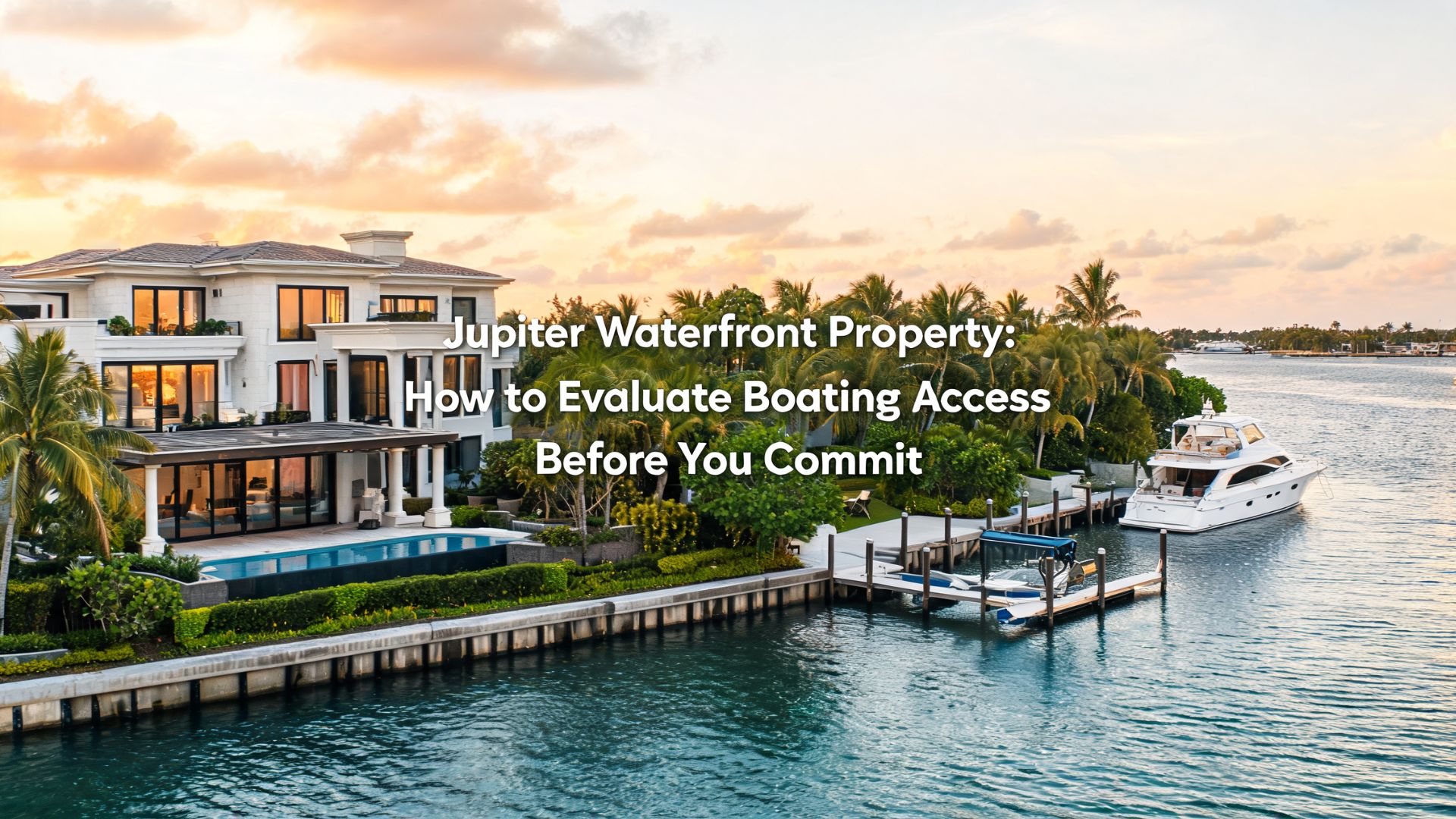
Jupiter Waterfront Property: How to Evaluate Boating Access Before You Commit
A waterfront listing tells you that a property touches water. It rarely tells you what that water can actually do for you.
In Jupiter, that gap matters more than it does in most South Florida markets. The town sits at the meeting point of the Loxahatchee River, the Intracoastal Waterway, an inlet to the Atlantic, and a network of residential canals — and those four kinds of water behave very differently. A dock on one of them may accommodate a sixty-foot sportfisherman with a flybridge. A dock a mile away, on water that photographs identically, may not clear a fixed bridge with a center console and a T-top.
This article is written for buyers who intend to use the water, not merely to look at it. It explains how experienced purchasers verify navigability before they are contractually committed, which questions belong to qualified marine and engineering professionals rather than to a real estate conversation, and how the answers should influence price, contingency structure, and long-term ownership planning.
It also addresses the seller’s side of the same question, because the owner who can document water access clearly is negotiating from a materially different position than the owner who can only describe it.
One note on what this article deliberately does not contain: there are no market statistics here. Price levels, inventory, and days-on-market figures move continuously, and a number presented without a current, identified source is worse than no number at all. What follows is a decision framework. Where a specific measurement matters to your purchase, it must be verified for that parcel, by a professional qualified to measure it.
- What “Waterfront” Actually Describes in Jupiter
- The Four Water Bodies, and Why the Distinction Is Not Cosmetic
- Vertical Clearance: The Constraint That Cannot Be Negotiated
- Depth: Charted, Maintained, and Actual Are Three Different Numbers
- Route Analysis: From This Dock to the Places You Actually Go
- Dockage: What Exists, What Conveys, and What Is Permitted
- Seawalls and Shoreline Structures: The Expense Nobody Budgets
- The Inlet Question: Ocean Access as an Operating Condition
- Reading a Listing’s Water Claims Against Verifiable Evidence
- Assembling the Right Professional Team, in the Right Order
- Insurance and Coastal Exposure: A Real Variable, Not a Formality
- How Water Attributes Shape Valuation — and Why Comparables Mislead Here
- For Sellers: Documenting Access Instead of Describing It
- Negotiation and Contingency Structure Around Water Attributes
- Long-Term Stewardship, Carrying Costs, and Resale Considerations
- Luxury Seller FAQ: Jupiter Waterfront Property
- Luxury Buyer FAQ: Jupiter Waterfront Property
What “Waterfront” Actually Describes in Jupiter
Waterfront is a category of frontage, not a category of access. A property is waterfront if its boundary meets navigable or non-navigable water. Whether a vessel can reach that boundary, tie to it, and travel from it to the destinations the owner cares about is an entirely separate question with an entirely separate set of answers.
In practice, Jupiter waterfront property falls into several distinct situations that a listing description often flattens into one word:
Direct ocean-access frontage where a vessel can reach the Atlantic without passing beneath a fixed structure. This is the narrowest category and the one most consequential to vertical clearance.
Intracoastal frontage with north-south travel along the waterway, which may or may not include unobstructed access to the inlet depending on the parcel’s position.
River frontage on the Loxahatchee, where conditions, depth, and applicable environmental designations vary considerably along the river’s length and among its forks.
Canal frontage within residential canal systems, where the parcel’s position along the canal, the canal’s maintained depth, and the route out of the canal system determine what is possible.
Lake, pond, or preserve frontage, which delivers view, light, and privacy but no boating utility at all.
Each of these can be marketed with the same photograph of water behind a house. Only some of them will accept the vessel a particular buyer already owns, and fewer still will accept the vessel that buyer may want in five years.
The practical consequence: the first task in evaluating a Jupiter waterfront property is not valuation. It is classification. Until you know which of these situations you are looking at, no comparison to another waterfront sale means very much.
The Four Water Bodies, and Why the Distinction Is Not Cosmetic
Jupiter’s geography is unusual in a way that rewards precise thinking.
The Jupiter Inlet connects inland waters to the Atlantic Ocean. Its conditions — current, shoaling, and sea state at the mouth — are dynamic, influenced by tide, wind, and periodic maintenance activity. Owners who transit it regularly develop a working knowledge of when it is comfortable and when it is not. A buyer evaluating a property whose value proposition rests on ocean access should understand that inlet conditions are a real operational variable, not a fixed characteristic of the property, and should speak with people who run that inlet routinely.
The Loxahatchee River flows to the inlet and carries environmental designations along portions of its course, including federal Wild and Scenic status on a designated section. Where such designations apply, they can affect what is permissible along the shoreline — dock construction, shoreline hardening, vegetation, and dredging among them. The applicable rules depend on precisely where a parcel sits and which agencies have jurisdiction over it. This is a matter for qualified environmental, permitting, and legal professionals, and it is one of the more common places where a buyer’s assumption and a parcel’s reality diverge.
The Intracoastal Waterway provides the north-south corridor. A parcel on the Intracoastal has different exposure characteristics than a parcel tucked into a canal: more open water, more wake, more visibility from passing traffic, and often different depth and dockage conditions.
The residential canal systems offer protection and privacy, and they introduce their own variables — the maintained depth of the canal, the width available for maneuvering, the turning basin if one exists, and every structure between the dock and open water.
A buyer who understands which body of water a property sits on, and what lies between that water and the ocean, is asking better questions within the first hour of a showing than a buyer who is still evaluating the view.
Vertical Clearance: The Constraint That Cannot Be Negotiated
Vertical clearance is the height available beneath a fixed structure at a given tide. It is the single most absolute constraint in waterfront ownership, because unlike depth — which can sometimes be addressed through permitted dredging — a fixed bridge cannot be modified by a homeowner under any circumstances.
The framework is simple to state and easy to get wrong:
Identify every structure between the dock and each destination. Not just the first one. A route may clear three bridges and fail at the fourth.
Distinguish fixed structures from opening structures. An opening bridge imposes a schedule and a wait, which is an inconvenience. A fixed bridge imposes a ceiling, which is a limit.
Understand that a published clearance is a reference figure, not a promise. Clearance changes with tide. Published figures are typically stated at a specific tidal reference, and actual available clearance at the moment you are transiting may be less. Seasonal and meteorological conditions influence water levels as well.
Measure your vessel honestly, at its true air draft. The relevant number is the highest fixed point — hardtop, tower, antenna in its raised position, outriggers if they cannot be lowered. Owners routinely underestimate this figure, and the consequence of underestimating it is not theoretical.
Then apply a margin. Experienced captains do not plan to transit at the exact published number.
For a buyer whose vessel is near any clearance on the intended route, this analysis should occur before the inspection period is spent on anything else, because it can be dispositive. A property that cannot accept the boat is not a property that needs a roof inspection.
If your vessel is not yet purchased — a common situation for buyers who are acquiring a waterfront residence and a boat in the same season — the sequence should be reversed. Establish what the property can accommodate, then shop for the vessel within that envelope. Buyers who do it in the opposite order sometimes discover that they have bought two assets that do not work together.
A private conversation about a specific property
If you are evaluating a particular Jupiter waterfront property and want to understand what its water access genuinely supports before you commit inspection time and professional fees to it, that conversation is worth having early. Jeannie Jacobson works with buyers on exactly this sequencing question — what to verify, in what order, and which findings should change the offer rather than merely inform it. You can start a private conversation about your search or arrange a time to talk.
Depth: Charted, Maintained, and Actual Are Three Different Numbers
Depth is the second constraint, and it is more complicated than clearance because it changes over time and because the numbers available to a buyer often describe different things.
Charted depth reflects survey data of varying age. It describes a channel or an area, not necessarily the specific water at a specific dock.
Maintained depth describes a target that some authority intends to sustain through periodic maintenance. Whether that maintenance is currently funded, scheduled, or performed is a separate question from whether a depth is nominally maintained.
Actual depth at the dock, at low water is the number that determines whether a vessel floats. It is measured, not looked up. It varies with tide, with recent weather, and with sediment movement that can change conditions in a single season.
A buyer whose vessel draws meaningfully more than the shallowest point on the intended route has a real constraint, and the shallowest point is frequently not at the dock. It may be at the mouth of a canal, at a bend, or at a shoal that forms in a predictable place.
Two further points matter for sophisticated purchasers:
Dredging is a permitted activity, not a homeowner’s prerogative. Where dredging is contemplated — to deepen a slip, to restore a canal, or to address accumulated sediment — it involves regulatory review, potential environmental constraints, cost, and timeline, and it may not be approvable at all depending on location and conditions. A seller’s statement that a slip “can be dredged” is a hypothesis unless it is supported by permitting evidence.
Sediment does not stay where it was surveyed. A depth reading from several years ago describes several years ago.
The disciplined approach is to have depth measured, at low water, along the actual intended route, by someone competent to do it, during the inspection period — and to treat any number sourced from a listing, a neighbor, or a memory as a starting point for verification rather than a finding.
Route Analysis: From This Dock to the Places You Actually Go
Buyers tend to evaluate waterfront property as a point. Owners experience it as a route.
The productive exercise is to list the destinations that will matter — the inlet and ocean, a marina or fuel dock, a yacht club or restaurant, a service yard capable of hauling the vessel, and any regular cruising destination north or south — and then to trace the path from the dock to each one. For each path, three questions:
What structures are in the way, and what is the lowest one?
What is the shallowest point, and at what tide is it a problem?
How long does the transit actually take, including any wait at an opening structure?
That third question is where a great deal of ownership satisfaction is determined, and it is almost never addressed during a showing. A property that is fifteen minutes from the ocean and a property that is fifty minutes from the ocean can present identically in photographs and price within the same range. The difference between them is felt every single time the owner uses the boat.
Route analysis also surfaces a consideration that matters at resale: the size of the future buyer pool. A property that accommodates a broad range of vessels can be sold to a broad range of buyers. A property with a hard constraint — a low fixed structure, a persistent shallow point, a slip that fits only a modest beam — will always be evaluated by a narrower market. That is not a reason to avoid it. It is a reason to price it, negotiate it, and hold it with clear eyes.
Dockage: What Exists, What Conveys, and What Is Permitted
A dock is three separate questions wearing one word.
What physically exists. Length, beam accommodation, depth alongside, pilings and their condition, decking, cleats, power service and its capacity, water service, lighting, and — where present — a boat lift and its rated capacity. A lift rated for a weight below the vessel’s actual loaded weight is not a usable lift.
What legally exists. Docks and shoreline structures are typically permitted improvements. The relevant questions are whether the structure as built matches what was permitted, whether the permits were closed out, whether any portion was constructed or modified without authorization, and whether any structure sits partially on submerged land requiring a separate authorization or lease. Structures built under older rules may exist in a status that limits repair or replacement rights. These are matters for qualified permitting and legal professionals to evaluate, and the evaluation should happen during the inspection period rather than after closing.
What conveys. Lifts, davits, floating docks, pilings, and marine equipment are not automatically part of a real property transfer. Where a buyer’s expectation includes these items, the expectation belongs in the contract, described specifically.
A related consideration applies where dockage is not on the parcel itself but held through a slip assignment, a community dock, a marina agreement, or an association’s allocation. In those situations, the buyer is acquiring a right whose terms, transferability, duration, and cost structure need to be read — not assumed. Governing documents govern.
Understanding what a property can carry
Marine infrastructure is one of the areas where a buyer’s assumptions and a parcel’s documented reality most often separate — and where the cost of learning late is highest. If you would like to talk through what to verify on a specific Jupiter property, and how the findings should shape your offer rather than simply inform it, Jeannie Jacobson can walk through the sequence with you. Reach out for a confidential discussion of your acquisition, or review her approach to luxury representation across Palm Beach County.
Seawalls and Shoreline Structures: The Expense Nobody Budgets
A seawall is a structural asset with a finite service life, and it is among the more consequential items a waterfront buyer can misjudge.
What sophisticated purchasers want to know:
Age and construction type. Materials, methods, and expected service lives differ substantially, and a wall built decades ago under different standards may behave differently than a recent installation.
Visible condition, and what visible condition does not reveal. Cracking, spalling, displacement, and voids behind the wall are observable indicators. The condition of tiebacks, anchors, and the soil behind the structure generally is not, without investigation.
Evidence of settlement on the landward side. Depressions, separations in hardscape, or irregularity in the yard near the wall can indicate loss of material behind the structure.
Repair and replacement history. Documentation of prior work, and whether it was permitted.
Whether responsibility is shared. In some configurations, a wall or a shoreline structure sits at a boundary or is subject to shared obligations under governing documents. Who is responsible for what should be established from documents, not from conversation.
Seawall assessment is engineering work. A general home inspection is not designed to evaluate it, and a real estate professional is not qualified to render an opinion on structural adequacy. What a knowledgeable agent can do is recognize when the question is material, ensure it is asked during a period when the answer still has contractual consequence, and help structure the transaction so that a significant finding is addressed rather than absorbed.
For buyers, the reason this matters financially is straightforward: shoreline structure work is a capital expense that can be substantial, and it is not optional when the structure fails. A buyer who understands the remaining service life of a seawall is pricing the property differently — and more accurately — than a buyer who is not thinking about it.
The Inlet Question: Ocean Access as an Operating Condition
For buyers whose intended use is offshore, ocean access is often the entire premise of the purchase. It deserves more scrutiny than it usually gets.
Ocean access through an inlet is not a binary property attribute. It is an operating condition influenced by tide stage, wind direction and strength, sea state, and the physical configuration of the inlet at a given time. Inlets shoal. Conditions at an inlet mouth can differ substantially from conditions a mile offshore. Local knowledge — which stage of tide is comfortable, which wind directions make a passage unpleasant, how conditions typically behave through the year — is genuinely valuable and is best obtained from people who make the transit regularly.
The practical guidance for a buyer:
Do not evaluate ocean access solely on a calm morning during a showing. The property will be owned in all conditions.
Ask specifically what the owner’s actual pattern has been. How often, at what stage of tide, in what vessel, and whether there are conditions under which they simply do not go.
Distinguish “can reach the ocean” from “can reach the ocean comfortably in the vessel I intend to run.” A capable center console and a heavy sportfisherman experience the same inlet very differently, in opposite directions depending on conditions.
Recognize that inlet conditions are dynamic and are subject to maintenance activity and natural change over time. Nothing about them should be treated as a permanent guaranteed characteristic of the real estate.
None of this argues against buying inlet-adjacent property. It argues for buying it with an accurate picture of what ownership will feel like, which is precisely what protects the decision from later disappointment.
Reading a Listing’s Water Claims Against Verifiable Evidence
Listing language about water access ranges from precise to aspirational, and the difference is not always obvious to a buyer reading quickly.
Phrases worth translating:
“Ocean access” — establishes that a route to the ocean exists. It does not establish that the route is unobstructed, that it is short, or that it accommodates a particular vessel.
“No fixed bridges” — a meaningful and specific claim. Verify it against the actual intended route, and confirm what “no fixed bridges” is being measured to. To the inlet? To the ocean? To a particular destination?
“Deep water” — a relative term with no standardized meaning. It requires a number, measured, at low water.
“Dockable” or “dock permitted” — may reflect an existing permitted dock, an expired permit, an assumption based on neighboring properties, or an aspiration. Permitting outcomes are parcel-specific and agency-determined.
“Boat lift” — establishes that a lift exists. It does not establish rated capacity, current condition, or that the rating suits your vessel.
“Yacht-sized dockage” — descriptive, not dimensional.
None of this suggests bad faith on a seller’s part. Marketing language is compressed by nature, and many owners genuinely do not know the technical characteristics of their own shoreline. The buyer’s task is simply to convert descriptive language into verified measurements before the money is committed — and to recognize that this conversion is normal, expected professional practice rather than an act of suspicion.
Turning descriptions into verified facts
The distance between what a waterfront listing says and what a waterfront parcel documents is where most avoidable disappointment in this market lives. If you would like an experienced perspective on which claims to test first on a property you are considering — and what a finding should be worth in the negotiation — Jeannie Jacobson can help you organize that process. Begin a confidential conversation about the property you are evaluating, or schedule time to discuss your criteria.
Assembling the Right Professional Team, in the Right Order
Waterfront due diligence involves specialists whose work a real estate professional coordinates but does not perform. Getting the order right saves both money and time.
Sequence matters because findings are dispositive at different stages. Clearance and depth questions can eliminate a property outright and cost comparatively little to answer. They should come first. Structural, mechanical, and environmental work is more expensive and should follow, once the fundamental question of usability is settled.
The professionals a sophisticated waterfront purchase may involve:
– A general home inspector for the residence
– A marine or structural engineer for seawall, dock, and shoreline structures where warranted
– A surveyor, including where water boundaries, riparian considerations, or encroachments are in question
– Permitting or land-use counsel where dock status, shoreline modification, or environmental designations are material
– An insurance professional to evaluate coverage availability and terms for the specific property
– Legal counsel for title, ownership structure, and contract matters
– Tax and estate-planning professionals where the acquisition interacts with broader planning
This article does not provide legal, tax, insurance, engineering, or environmental advice, and a real estate professional should not be the source of it. What a well-run transaction provides is the recognition of which questions require which specialist, and enough lead time for those specialists to produce answers while the buyer still has contractual leverage.
Insurance and Coastal Exposure: A Real Variable, Not a Formality
Insurance is a material cost and availability question in coastal Florida, and it belongs in a buyer’s evaluation early rather than as a closing-week formality.
The points that matter to a sophisticated purchaser:
Coverage for a coastal property is property-specific. Construction type, age, roof condition and age, elevation, opening protection, and location all influence availability and terms. Two properties on the same street can present differently.
Wind, flood, and general hazard coverage are distinct. They are not interchangeable and may involve separate placements.
Prior claims history on a property can be relevant to what an insurer will offer.
Elevation and flood zone determinations are technical designations, subject to change, and should be verified for the specific parcel rather than assumed from the neighborhood.
Terms and availability change. A quote obtained months ago is a data point, not a commitment.
The correct professional to answer these questions is a qualified insurance professional evaluating the specific property. What matters strategically is timing: a buyer who obtains indicative insurance information early can incorporate the true cost of ownership into the offer, rather than discovering it after the inspection period has closed and the negotiating position has hardened.
How Water Attributes Shape Valuation — and Why Comparables Mislead Here
Waterfront valuation is where the technical analysis in this article becomes financial.
The core difficulty is that waterfront comparables are frequently not comparable. Two properties with similar living area, similar finish level, and similar street presence may differ enormously in water utility — and the market prices water utility, not water frontage. A sale that appears to establish a benchmark may in fact reflect a property with unobstructed ocean access, deep water at the dock, and a lift sized for a substantial vessel. Comparing it to a property on a shallow canal behind a low fixed structure produces a number that is not merely imprecise but directionally wrong.
Attributes that genuinely differentiate value in this market include:
– Whether the route to open water is unobstructed by fixed structures
– Actual depth at the dock at low water, and along the route
– Length and configuration of usable dockage, and the presence and rating of a lift
– Width of the waterway and maneuvering room, including turning ability
– Orientation, exposure, and the character of the view
– Wake and traffic exposure
– Condition and remaining service life of the seawall and shoreline structures
– Permitted status of existing improvements
– Lot dimensions relative to water frontage
A buyer who has done the verification work described in this article is in a position to argue value with specificity — not “the price seems high,” but “the route to the inlet passes beneath a structure that constrains this property to a narrower vessel class than the comparable you are citing, and that constraint follows the property to its next sale.”
That is a materially stronger negotiating posture than an opinion about price. It is also, incidentally, the same analysis that protects a buyer from overpaying for frontage that does not deliver utility. You can review recently closed transactions as context for how properties in this market are ultimately presented and positioned, keeping in mind that any individual sale reflects circumstances that may not transfer to another property.
Discussing value with the technical facts in hand
Waterfront valuation rewards specificity. When a buyer or seller can point to documented clearance, measured depth, permitted structures, and a defined route to open water, the conversation about price becomes far more productive for everyone at the table. If you would like to discuss how a particular property’s water attributes should influence what you offer — or what you ask — Jeannie Jacobson approaches these conversations with the technical detail they deserve. Request a private discussion, or learn more about her background and approach.
For Sellers: Documenting Access Instead of Describing It
Everything above describes what a careful buyer will investigate. The strategic implication for an owner preparing to sell is direct: the seller who has already assembled the answers controls the pace and the tone of the transaction.
Consider two owners of similar Jupiter waterfront properties.
The first markets the property as “deep water, ocean access, no fixed bridges.” A qualified buyer arrives, likes the house, and begins investigating. Over the following weeks, findings emerge — a depth reading lower than expected at low water, a dock permit that was never closed out, a seawall of uncertain age. Each finding arrives as a surprise, and each surprise becomes a renegotiation. The buyer’s confidence erodes not because the property is deficient but because the information environment is uncertain.
The second owner assembles a documentation package before the property is exposed: a current survey, dock permits and their closeout status, depth measurements taken at low water along the route, seawall records and any engineering assessment, lift specifications and service history, and documentation of any shoreline work performed. When the buyer’s professionals begin their review, they are confirming a picture rather than discovering one.
The second transaction proceeds differently. Not because the property is objectively better, but because uncertainty has been removed as a negotiating lever. Deal certainty rises. Time to contract and time to close typically improve. And the price conversation stays focused on the asset’s genuine attributes.
This preparation work is not cosmetic staging. It is the waterfront equivalent of having clean books before a business sale, and it is one of the more reliable ways an owner of a distinctive property protects perceived value. Owners considering a sale can review seller resources and, when it is time to discuss positioning, request a private assessment of the property’s market position.
Negotiation and Contingency Structure Around Water Attributes
Water findings are unusual among due-diligence discoveries because they are frequently permanent. A roof can be replaced. A kitchen can be renovated. A fixed structure between the dock and the ocean is a condition of the property forever.
This changes how findings should be handled in negotiation.
Permanent constraints belong in price, not in repair credits. If a property is constrained to a narrower vessel class than the buyer assumed, that constraint will exist for the next owner as well. It is a valuation matter.
Curable conditions belong in the repair-and-credit conversation — a lift that needs service, decking that needs replacement, a permit that needs closing out — with the caveat that permitting-dependent cures carry timeline and approval risk that a buyer should not casually assume.
Conditions of uncertain scope warrant scope definition before resolution. A seawall with visible indicators of distress and no engineering assessment is not a negotiation about money; it is a negotiation about getting an assessment. Sophisticated parties define the question before they argue about the answer.
Contingency periods should be sequenced to match the analysis. The clearance and depth questions are fast and cheap. Engineering, permitting research, and insurance indication take longer. A single undifferentiated inspection period that expires before permitting research returns is a structural flaw in the contract, not a diligence failure by the buyer.
For sellers, the mirror-image insight: a buyer who is given adequate time and complete documentation is far less likely to seek a price adjustment late in the process, when the seller’s alternatives have narrowed and the leverage has shifted.
Long-Term Stewardship, Carrying Costs, and Resale Considerations
Waterfront ownership carries obligations that inland ownership does not, and buyers who plan for them are more satisfied owners.
Marine infrastructure requires ongoing maintenance. Docks, lifts, pilings, and seawalls are exposed structures in a corrosive environment. Maintenance is periodic and predictable; deferral is expensive and eventually not optional.
Some maintenance is permit-dependent. Repair or replacement of shoreline structures may require authorization, and the timeline for authorization is not controlled by the owner.
Insurance costs and availability evolve and should be re-evaluated over time rather than assumed to be static.
Environmental and regulatory frameworks change. What is permissible along a shoreline is subject to rules that can be revised. Owners of environmentally sensitive frontage in particular should expect to engage with these questions periodically, with qualified professionals.
Resale is influenced by the same attributes that influenced the purchase. The buyer pool for a property is shaped by what its water can accommodate. An owner who improves usable dockage, maintains a documented seawall, and keeps permits in order is protecting the breadth of that future pool. An owner who defers is narrowing it.
None of this is an argument against waterfront ownership. It is an argument for entering it with an accurate model of what it involves, which is exactly what distinguishes a satisfied long-term owner from a frustrated short-term one.
Thinking several years ahead
The attributes that make a Jupiter waterfront property work for you are the same attributes that will define its audience when you eventually sell. Buyers who think about that at acquisition tend to hold better assets. If you would like to discuss how a property under consideration is likely to be viewed by a future market — or how your current property is positioned today — Jeannie Jacobson is glad to have that conversation privately. Get in touch to discuss your situation or explore Jupiter as a market.
Luxury Seller FAQ: Jupiter Waterfront Property
Assemble the technical record before exposure rather than during negotiation. At minimum: a current survey, dock and shoreline structure permits with their closeout status, depth measurements taken at low water along the route buyers will actually use, seawall documentation including any engineering assessment and repair history, lift specifications and service records, and documentation of any shoreline or dredging work performed. The objective is that a buyer’s professionals confirm your representations rather than discover conditions you did not know about. Uncertainty is the most common lever used to reduce price late in a transaction, and documentation removes it.
Directly and specifically. A vertical constraint will be discovered by any serious buyer, usually early, and discovering it after a buyer has developed enthusiasm produces a worse outcome than disclosing it at the outset. Stated precisely — the structure, its location on the route, and what vessel profiles the property comfortably accommodates — the constraint becomes a qualifying criterion that filters the buyer pool rather than a disappointment that collapses a deal. Sellers who are precise about limitations are generally believed when they describe strengths.
It depends on the condition, the cost, the permitting timeline, and the state of the market you are selling into. Curable, well-defined items with predictable cost and no permitting dependency often return more than their cost because they remove buyer uncertainty. Large, permitting-dependent projects are a different calculation entirely: the timeline is not within your control, and beginning work without completing it can create a worse impression than a documented, unaddressed condition. The honest answer is that this decision should be made property by property, with cost estimates in hand, before the marketing plan is set.
Recognize that water-facing visibility is a real exposure that street-facing properties do not share, and plan for it. Considerations include how aerial and water-side imagery is produced and used, whether showings are scheduled to limit predictable patterns, how showing requests are qualified before access is granted, and how much identifying detail appears in public materials. Privacy expectations should be discussed and agreed before marketing begins, and a seller should understand clearly what can and cannot be controlled — no representation should be made that public marketing can be conducted without any visibility.
Establish the standard in advance and apply it consistently. Reasonable practices include confirming financial capacity appropriate to the property before scheduling, requiring that showings be accompanied by a licensed professional, and structuring access to protect the residence, its contents, and the occupants’ routine. The purpose is not to be difficult; it is to ensure that access is granted to people genuinely positioned to transact. Any qualification protocol should be applied uniformly to every prospective purchaser, without regard to any legally protected characteristic.
Address them explicitly and early. Vessels, lifts, davits, floating docks, and marine equipment are frequently the subject of assumptions that diverge between buyer and seller, and an assumption discovered at walkthrough is a poor time to resolve it. Decide what is included, describe it specifically in the contract, and consider whether separate documentation is appropriate for items of significant value. Separately, personal property that will not convey — art, collections, vessels being retained — warrants a plan for security during showings and for removal timing relative to closing.
Luxury Buyer FAQ: Jupiter Waterfront Property
Vertical clearance and depth along the actual route you intend to use, before spending on anything else. These two variables can eliminate a property outright, they are comparatively inexpensive to investigate, and they are permanent characteristics rather than curable conditions. Confirming that a property can physically accommodate your vessel — or the vessel you intend to acquire — is the threshold question. Everything else in the due-diligence process is a matter of degree; this one is binary.
Define the destination first, then verify the route. “No fixed bridges” is meaningful only relative to a specific journey — to the inlet, to the ocean, to a particular marina or service yard. Trace the route, identify every structure along it, and confirm both the type of each structure and its available clearance at the tide stage you would realistically transit. Then compare that against your vessel’s true air draft, measured at its highest fixed point, with a working margin. Published clearance figures are references stated at a tidal datum, not guarantees of available clearance at a given moment.
Not necessarily, and this is one of the more consequential things a waterfront buyer can fail to investigate. The relevant questions are whether the structure was permitted, whether it matches what was permitted, whether the permits were properly closed, whether any portion requires separate authorization for use of submerged land, and what rights exist to repair or replace it under current rules. Structures built under earlier standards can exist in a status that limits future work. These questions require qualified permitting and legal professionals, and they should be answered during a period when the answer still has contractual consequence.
They should prompt specific, parcel-level inquiry rather than general assumption. Portions of the river carry environmental designations, and where such designations apply they can influence what is permissible along the shoreline — dock construction and modification, shoreline hardening, vegetation management, and dredging among them. What applies depends on exactly where a parcel sits and which agencies have jurisdiction. If your plans for a property involve any change to the shoreline or to marine structures, establish what is permissible before you are contractually committed, with professionals qualified to determine it.
A general home inspection is not designed to evaluate a seawall, and its scope typically does not include structural assessment of shoreline structures. Where a seawall’s age, condition, or history raises questions — visible cracking, spalling, displacement, settlement on the landward side, or simply an absence of documentation — the appropriate step is engagement of a marine or structural engineer. What you are trying to establish is remaining service life and the presence of conditions that are not visible from the surface. This matters financially because shoreline structure work is a capital expense of potentially significant scale, and it is not discretionary when the structure fails.
Distinguish permanent constraints from curable conditions and treat them differently. A permanent limitation — a fixed structure on the route, a persistent shallow point, a slip that will not accommodate a broader vessel — follows the property to its next sale and belongs in the price, because it narrows the future buyer pool as surely as it narrows yours. Curable conditions belong in the repair-and-credit conversation, with appropriate caution where a cure depends on permitting outcomes you cannot control. The buyer who has done the technical verification described here can make that argument with specificity, which is a substantially stronger position than an unsupported view that a price seems high.
Bringing the Analysis Together
Jupiter rewards buyers who think about water as infrastructure rather than as scenery. The community’s combination of river, inlet, Intracoastal, and canal systems creates genuine variety in what waterfront ownership can mean here — and that variety is precisely why the word “waterfront,” on its own, carries so little information.
The buyers who do well in this market are the ones who classify before they compare, who verify clearance and depth before they commission a roof inspection, who read permits rather than assume them, and who understand that the attributes making a property work for them today will define its audience when they eventually sell.
The sellers who do well are the ones who assemble that same information before a buyer’s professionals go looking for it — not because there is something to conceal, but because certainty is the most reliable protection of value that an owner of a distinctive property can create.
If you are evaluating a Jupiter waterfront property, or considering the sale of one, this is a conversation worth having before decisions harden. Jeannie Jacobson works with buyers and owners on the specific, technical questions that determine whether a waterfront property will do what its owner needs it to do — and on how those answers should shape strategy, timing, and price. Conversations are private, and there is no expectation of a decision.
Contact Jeannie Jacobson to discuss your property or your search · Schedule a time to talk
This article is informational and is not legal, tax, accounting, insurance, engineering, environmental, or investment advice. Property conditions, permitting requirements, regulatory designations, insurance availability, and market circumstances vary by parcel and change over time, and must be verified for a specific property by professionals qualified to evaluate them.