

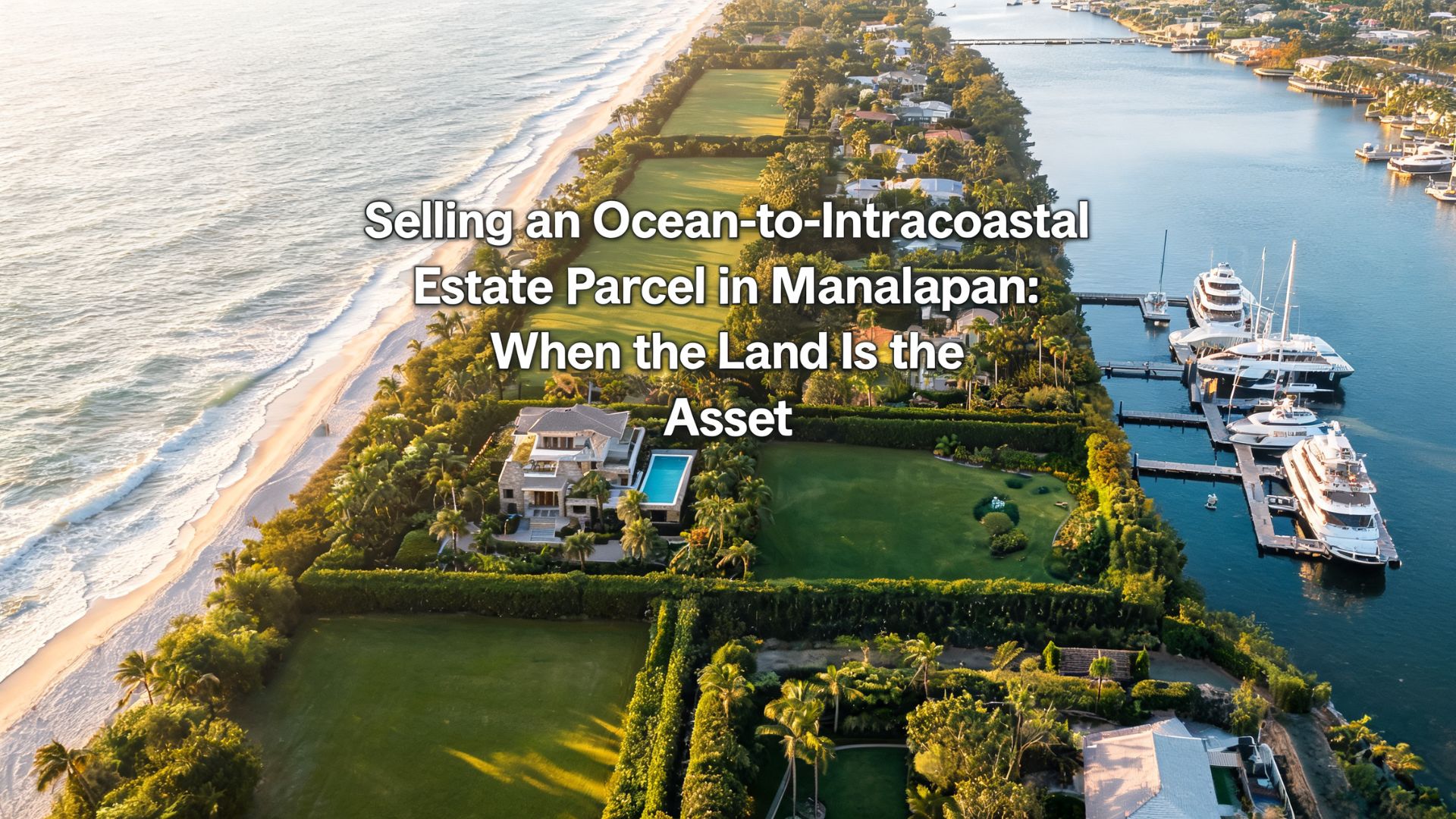
Selling an Ocean-to-Intracoastal Estate Parcel in Manalapan: When the Land Is the Asset
Most estate sales are sales of a residence situated on land. A small number are the reverse: sales of land that happens to have a residence on it, where the parcel’s geometry is so unusual that it, rather than the house, is what a purchaser is acquiring.
Manalapan contains a concentration of the second kind. The town occupies a narrow barrier island position between the Atlantic Ocean and the Intracoastal Waterway, and a number of its parcels extend across that width — carrying ocean frontage on one side and Intracoastal frontage on the other. A parcel like that is not a variation on waterfront property. It is a different asset class, with two separate regulatory regimes, two separate sets of infrastructure, two separate risk profiles, and a buyer pool measured in individuals rather than in market segments.
This article is written for owners of such parcels who are contemplating a sale, and for the small number of purchasers who evaluate them. It addresses how the land’s composition drives value, what each frontage requires in preparation and disclosure, how a seller documents a parcel whose worth is largely in its geometry, and how the negotiation differs when the buyer pool is genuinely tiny.
It contains no market statistics. Values and transaction pace for parcels of this kind are individual rather than statistical, and any figure offered without a current, identified source would be a fabrication dressed as analysis.
- Why Dual Frontage Is a Different Asset, Not a Better One
- Establishing What the Parcel Actually Is
- The Ocean Side: Coastal Regulation and What It Governs
- The Intracoastal Side: Dockage, Seawalls, and Navigability
- Privacy and the Value of Full-Width Position
- Pricing a Parcel With a Buyer Pool Measured in Individuals
- Public Exposure Versus Private Conversations for a Parcel of This Kind
- Preparing the Improvements When the Land Is the Product
- Insurance on a Parcel With Two Exposures
- Negotiating With a Purchaser Who Has Few Alternatives — and Knows You Do Too
- Ownership Structure, Coordination, and Getting to Closing
- Luxury Seller FAQ: Manalapan
- Luxury Buyer FAQ: Manalapan
Why Dual Frontage Is a Different Asset, Not a Better One
The instinct is to treat ocean-to-Intracoastal frontage as waterfront property with an additional feature. That framing understates what is actually happening.
The parcel delivers two entirely different relationships to water. Ocean frontage provides outlook, beach access, and exposure to the open Atlantic. Intracoastal frontage provides protected water, dockage potential, and navigational access to the waterway system. They are not variations on a theme; they are two different amenities that a single parcel happens to combine.
Each frontage carries its own regulatory framework. The rules governing construction, shoreline modification, and vegetation on the ocean side derive from coastal construction and beach management frameworks with their own control lines and permitting agencies. The rules governing docks, seawalls, and shoreline structures on the Intracoastal side involve different authorities and different standards. An owner or buyer dealing with both is dealing with two regulatory conversations, not one.
Each frontage carries its own infrastructure and its own maintenance obligation. Dune systems, beach access structures, and any coastal protection on one side; seawall, dock, lift, and shoreline stabilization on the other. Both age. Both require capital. Neither maintains the other.
Each frontage carries its own risk exposure. Ocean-side exposure to storm surge, wave action, erosion, and dune movement differs from Intracoastal-side exposure to water level, wake, and shoreline stability. Insurance analysis treats them differently.
And the buyer pool is defined by wanting both. A purchaser who wants only ocean, or only protected water and dockage, has less expensive alternatives. The buyer for a dual-frontage parcel is specifically someone who wants the combination and the privacy that the full-width position creates — which is a very particular purchaser.
The commercial implication for a seller: value here derives from scarcity of the configuration, not from square footage or finish. Marketing that leads with the residence rather than the parcel is addressing the wrong attribute.
Establishing What the Parcel Actually Is
Before a parcel of this kind is marketed, its physical and legal composition should be documented precisely. This is more work than a conventional listing requires and it is the single highest-return preparation available.
What should be established and documented:
A current survey, showing boundaries, dimensions, the location of all improvements, and the relationship of the parcel to applicable control lines and setbacks on both sides.
Total area and usable area, which are different numbers where portions of the parcel fall within regulated zones, easements, or areas where construction is constrained.
Ocean frontage width and the character of the shoreline, including dune configuration where present.
Intracoastal frontage width, water depth alongside at low water, and the configuration of the shoreline.
The position of applicable coastal control lines relative to existing improvements and to the remainder of the parcel, since these determine where and what may be built on the ocean side.
All easements, dedications, and restrictions affecting the parcel, including any access arrangements crossing it.
Elevation data across the parcel, which affects both construction requirements and insurance.
The permit and construction history of every improvement, including shoreline structures on both sides.
Why this matters commercially. A buyer evaluating a parcel of this kind is evaluating what they can do with it. Every question left unanswered becomes an assumption they must make conservatively, and conservative assumptions produce lower offers. A seller who has documented the parcel is selling a known quantity; a seller who has not is asking a buyer to price uncertainty.
The Ocean Side: Coastal Regulation and What It Governs
The ocean frontage is the more regulated of the two, and the frameworks governing it are the ones most likely to constrain what a buyer can do.
What an owner should establish:
The location of applicable coastal construction control lines relative to existing improvements and to any area a buyer might wish to build on. Construction seaward of such lines is typically subject to additional permitting with its own standards and agencies.
What existing improvements sit seaward of those lines, and under what authorization — including whether structures were permitted, whether the permits were closed out, and what rights exist to repair or replace them.
Whether any dune system, vegetation, or protected habitat exists on the parcel, and what frameworks govern its disturbance. Coastal vegetation and habitat protections can be significant constraints on both construction and landscape work.
What governs beach access structures — walkovers, stairs, decks — including permitted status and repair or replacement rights.
Elevation requirements applicable to new construction or substantial improvement in the relevant flood zone, which materially affect design.
Any history of erosion, accretion, or shoreline change affecting the parcel, and any renourishment or coastal management activity in the area.
What a seller should not do: characterize what would be approved. Coastal permitting involves discretionary review by agencies applying their own standards, and predictions about outcomes are not a seller’s or a representative’s to make. What can properly be provided is the factual record — what lines exist and where, what is permitted, what documentation supports it. The buyer’s own coastal engineering and land-use professionals form the judgments.
A note on the value of getting this right. For a purchaser intending to build, the ocean-side regulatory picture is frequently the determining factor in what the parcel is worth to them. An owner who has commissioned a professional analysis of the buildable envelope on both sides is providing the single most valuable piece of information in the transaction.
Documenting a parcel before it goes to market
For a property whose value rests on its land, the preparation that matters most is establishing precisely what the land is and what it permits. That work takes time and involves surveyors, coastal professionals, and land-use counsel — which is why it belongs well before a listing decision rather than during a contract. Jeannie Jacobson works with owners on sequencing that preparation. Request a private conversation about your property or arrange a time to discuss the process.
The Intracoastal Side: Dockage, Seawalls, and Navigability
The Intracoastal frontage carries its own diligence, and for many purchasers it carries a substantial part of the parcel’s practical value.
Dockage. What exists physically — length, configuration, depth alongside at low water, power and water service, lift presence and rated capacity — and, separately, what exists legally: whether the dock was permitted, whether it matches the permit, whether the permit was closed out, whether any portion requires authorization for use of submerged land, and what rights exist to repair, expand, or replace it. Structures built under earlier standards may exist in a status that constrains future work.
Seawall or shoreline stabilization. Age, construction type, visible condition, evidence of settlement on the landward side, repair history and its permit status, and — where age or condition warrants — an engineering assessment. A seawall is a structural asset with a finite service life and a substantial replacement cost, and its remaining life is a legitimate component of the parcel’s value.
Navigability. The route from the dock to the destinations a purchaser would care about: every fixed structure along it, the lowest vertical clearance, and the shallowest point at low water. These are permanent characteristics of the parcel that no construction can change, and they define which vessels the property can accommodate — which in turn defines part of the buyer pool.
Water depth and its stability. Charted depth, maintained depth, and actual measured depth at low water are three different numbers. Sediment moves. A measurement taken recently is worth considerably more than a recollection.
What a seller gains by documenting this. A purchaser who intends to keep a vessel is running a specific analysis about whether their boat fits. An owner who can answer it with measurements rather than adjectives removes the most common source of post-contract renegotiation on waterfront property.
Privacy and the Value of Full-Width Position
A parcel spanning the full width of a barrier island creates a privacy condition that partial-width parcels cannot replicate, and it is a genuine component of value worth understanding and presenting accurately.
What full-width position provides: no through-parcel neighbor, control of the land between the two waters, and the ability to configure improvements without an adjoining property immediately behind.
What it does not provide: invisibility. Ocean-facing and Intracoastal-facing elevations are observable from the water and from the air, and adjacent parcels remain adjacent. Any representation about privacy should be accurate about what is actually controlled.
How this affects marketing. Privacy is a legitimate attribute to describe factually — parcel width, the absence of a through-neighbor, distance to adjoining structures, and the character of existing screening are all objective facts. What should be avoided is language implying a degree of seclusion that the physical situation does not support, or any suggestion about who does or does not live nearby.
How it affects the sale process itself. Owners of prominent parcels frequently have privacy concerns about the marketing process. Those are addressed through a defined protocol — decisions about imagery including aerial and water-side views, qualification requirements before access, accompanied showings, and scheduling that avoids predictable patterns. What cannot be promised is that a sale remains unknown, since records become public and activity on a parcel of this kind is observable.
Qualification standards should be written, consistently applied, and used for every prospective purchaser without regard to any legally protected characteristic.
Pricing a Parcel With a Buyer Pool Measured in Individuals
Conventional pricing methodology assumes a market. For a dual-frontage estate parcel, the honest framing is that the relevant market may consist of a small number of people at any given time.
What that changes:
Comparable sales are of limited use. Transactions in similar configurations are infrequent, and each reflects the specific circumstances of one buyer and one seller rather than a market level.
Land analysis carries most of the weight. Frontage widths on both sides, total and usable area, position, orientation, elevation, and the buildable envelope established under current rules are the substance of the valuation.
Replacement reasoning has limited application to the land itself. The parcel cannot be replicated; what can be estimated is the cost of improvements, which establishes how much of any price is attributable to the residence versus the land.
Buyer-pool reasoning becomes central. How many purchasers plausibly exist who want this specific configuration, have the capacity, and are active? The answer is not precise, but the question is rigorous and it produces better decisions than a false-precision number.
The strategic consequences:
An owner without urgency has genuine optionality and can reasonably test a higher position, provided the exposure method limits accumulation of public marketing history.
An owner with a timeline should recognize that a small buyer pool may take time to produce a purchaser regardless of price, and that a price reduction does not summon a buyer who does not exist.
The response to silence should be decided in advance — including the possibility of withdrawing rather than entering a sequence of reductions that teaches the market to wait.
Public Exposure Versus Private Conversations for a Parcel of This Kind
The exposure decision has a particular character where the buyer pool is small.
The argument for broad exposure: when value is genuinely uncertain, wider exposure produces better price discovery. And when the buyer pool is small, missing part of it is proportionally more costly than it would be in a deep market.
The argument for a limited approach: a small number of purchasers may be identifiable and reachable through professional networks, reducing the value of broad exposure while preserving privacy and avoiding a public marketing history.
The honest assessment: neither argument is universally correct, and the right answer depends on how confident the owner is about value, how urgent the timeline is, how identifiable the plausible purchasers are, and how much the owner values discretion relative to price discovery.
What must be stated clearly: any approach must comply with current brokerage policy and applicable MLS rules, which govern how and when properties may be marketed and which change over time. The available options should be confirmed against current requirements rather than assumed from past practice. And no representation should be made that a sale can be conducted without visibility.
A sequenced approach — beginning narrowly and expanding based on response — is frequently the most defensible structure, because it preserves optionality. What matters is that the sequence and its triggers are decided deliberately at the outset.
Choosing how a distinctive parcel reaches its market
Where the plausible buyer pool is small, the exposure decision has more consequence than it does in a deep market — in both directions. It deserves an analysis of who the purchasers actually are, how they are reached, and what each path costs in information and in privacy. Jeannie Jacobson works through that with owners before any decision is made. Contact her for a confidential discussion, or read about her approach to luxury representation across Palm Beach County.
Preparing the Improvements When the Land Is the Product
Where a parcel’s value is dominated by its land, an owner faces a preparation question that differs from a conventional sale.
What generally does not return its cost: comprehensive cosmetic renovation aimed at contemporary taste, when the plausible purchaser may replace the residence entirely. Extensive landscape redesign. Kitchen and bath renovation intended to modernize.
What generally does return its cost:
Grounds condition and the general impression of stewardship, which on a large parcel meaningfully affects how the property is received.
Functional systems, so that nothing fails during a showing and raises questions disproportionate to its significance.
Documentation — the survey, permits, engineering assessments, and shoreline records described earlier — which is preparation of the asset rather than of the house.
Addressing shoreline structure conditions where they are at or near the end of service life, or at minimum obtaining an engineering assessment so that the condition is quantified rather than open-ended.
The strategic point. For a purchaser who intends to build, the residence is a demolition line item. For a purchaser who intends to keep it, condition matters. An owner who genuinely does not know which purchaser will appear is best served by presenting the property clean, functional, honestly described, and thoroughly documented — and by allowing the parcel’s own attributes to make the case.
Insurance on a Parcel With Two Exposures
Insurance for a dual-frontage estate parcel is more complex than for a conventional waterfront property, and it belongs in both the seller’s preparation and the buyer’s early analysis.
Why the analysis is layered. The residence and any structures are evaluated on construction type and era, roof age and condition, opening protection, and elevation. But a parcel with ocean frontage carries exposure characteristics that differ from Intracoastal frontage, and the property’s overall position relative to the coast affects how it is assessed. Wind, flood, and general hazard coverage are distinct products with distinct terms.
What tends to drive outcomes:
Roof age, material, and documented condition, which is among the most influential single factors.
Opening protection — whether impact glazing or shutters are present, rated, and documented.
Elevation relative to applicable flood zone requirements, established by an elevation certificate rather than by estimate.
Construction type and era, and whether the structure was built or updated to more recent standards.
Claims history on the property.
The presence, condition, and documentation of any coastal protection or shoreline structures.
Why a seller should have current information. A buyer will investigate insurance because it materially affects their carrying cost, and an unknown is priced conservatively. An owner who holds current documentation — elevation certificate, wind mitigation documentation where applicable, roof records, and current policy information — converts an open question into a known number. On a property of this scale, the difference can be substantial.
Why a buyer should investigate early. Insurance indication obtained during the inspection period allows real carrying cost to inform the offer. Obtained after, it informs regret. Where a property’s characteristics suggest that coverage may be difficult or expensive, that is precisely the kind of finding that should surface while contractual leverage still exists.
What no one can promise. Availability and terms change, and coastal insurance conditions have moved considerably over time. A quotation is a point-in-time indication rather than a commitment, and a qualified insurance professional evaluating the specific property is the appropriate source. Nothing here is insurance advice.
Negotiating With a Purchaser Who Has Few Alternatives — and Knows You Do Too
Negotiations for parcels of this kind have a distinctive dynamic: both parties often understand that substitutes are scarce on both sides.
The buyer’s position. A purchaser who has decided they want a dual-frontage parcel in this location has few alternatives, which is a strength for the seller. But they also know the seller’s buyer pool is small, which they will use.
Where value is created:
Non-price terms carry real weight. Closing timing, contingency scope and duration, deposit size and release conditions, and treatment of personal property all offer ways to bridge a price gap.
Deal certainty is worth money. In a market where the next qualified purchaser may be a long time appearing, an offer with narrow contingencies and demonstrated capacity may genuinely be worth more than a higher number with extensive conditions.
Approval contingencies deserve particular scrutiny. A purchaser intending to build may seek a contingency tied to obtaining coastal or land-use approvals. Such a contingency can function as an option on the property for an uncertain period. Whether to accept one, for how long, and on what terms is a decision to make with counsel.
Information discipline matters on both sides. A seller who reveals a deadline has weakened their position; a buyer who reveals that nothing else will do has weakened theirs.
Preparation is the strongest position available. A seller who can answer the buyer’s feasibility questions with documentation is negotiating from evidence. A seller who cannot is negotiating against the buyer’s most conservative assumptions.
Ownership Structure, Coordination, and Getting to Closing
Estate-scale parcels are frequently held in structures more complex than individual ownership, and these arrangements affect a transaction’s mechanics.
Matters that should be resolved before marketing:
Where the property is held in a trust or entity, who has authority to transact, what the governing instrument requires, and what documentation title and the buyer’s counsel will expect.
Where multiple owners or family interests exist, whether there is alignment on price, timing, and process.
Where estate or succession circumstances are involved, what additional process or documentation applies.
Where international ownership or residency factors are present, what additional documentation and withholding considerations arise at closing.
Coordination with the owner’s other professionals — attorney, accountant, and financial advisers — should occur during planning rather than after a contract, because the timing and structure of a disposition may interact with broader considerations that are not a real estate professional’s to advise on.
Post-contract execution deserves attention. Where financing is involved, appraisal of a parcel with no true comparables is genuinely difficult and represents a real transaction risk. Extensive diligence on shoreline structures and coastal regulation can extend timelines. Title matters on parcels with complex easement or access histories can surface late.
This article is not legal, tax, or estate-planning advice. The purpose of raising these matters is that identifying them early prevents a transaction from encountering an authority or documentation problem at the moment when leverage has already shifted.
Coordinating a sale that touches more than real estate
For estate-scale property, the transaction frequently intersects with ownership structures, family considerations, and planning matters that involve professionals beyond real estate. Identifying that early — and building the timeline around it — is what keeps a sale from stalling at the worst moment. Jeannie Jacobson is glad to think through the sequencing with you. Reach out privately or read more about her background and how she works.
Luxury Seller FAQ: Manalapan
Build the position from land analysis rather than from transaction comparison. The substance is frontage width on both sides, total and usable area, position and orientation, elevation, and — most importantly — the buildable envelope established under current coastal and land-use rules. Replacement cost reasoning can establish how much of any price is attributable to improvements versus land. Buyer-pool reasoning asks how many purchasers plausibly want this specific configuration and have the capacity to act. The output should be a reasoned range with an articulated rationale and a clear statement of what evidence would change it — not a single number presented with a precision the market cannot support.
For a parcel of this kind, frequently yes, and it is often the highest-return preparation available. The largest uncertainty for a purchaser is what may actually be built — where coastal control lines fall relative to the parcel, what elevation requirements apply, what setbacks and dimensional rules govern, and what constraints exist on both shorelines. A buyer who must answer those questions themselves prices conservatively while they do. A seller who has commissioned professional analysis is selling a known quantity. The work involves surveyors, coastal professionals, and land-use counsel and has a real cost, so the decision depends on the parcel — but where land dominates value, it usually pays for itself.
Quantify before deciding. Obtain an engineering assessment establishing condition and remaining service life, and obtain estimates for the work including the permitting timeline. Then evaluate: a well-defined, permitted, completed project removes uncertainty and can return its cost, while a large permitting-dependent project begun and not finished creates a worse impression than a documented, unaddressed condition. Where the permitting timeline is long relative to your intended marketing schedule, the assessment plus estimates may be more valuable than the work itself, because it converts an open-ended question into a known number that a buyer can price.
Provide the factual record and decline to predict outcomes. State where applicable control lines fall, what improvements exist seaward of them and under what authorization, what dune or vegetation conditions exist, what elevation data shows, and what professional analysis of the buildable envelope has established. What you must not do is characterize what a buyer “could” build or suggest that any approval would be forthcoming — coastal permitting is discretionary and involves agencies applying their own standards. Accurate documentation is far more persuasive to a sophisticated buyer than optimistic characterization, and it does not create the exposure that prediction does.
The answer depends on how confident you are about value, how urgent your timeline is, and how identifiable the plausible purchasers actually are. Broad exposure produces better price discovery, which matters most when value is uncertain — and with a small buyer pool, failing to reach part of it is proportionally costly. A limited approach preserves privacy and avoids a public marketing history, which has value if you may not transact. A sequenced approach that begins narrowly and expands on defined triggers is frequently the most defensible structure. Whatever you choose must comply with current brokerage policy and applicable MLS rules, which should be confirmed rather than assumed.
Understand precisely what you would be granting before you decide. An approval contingency in a discretionary permitting environment can run for an uncertain period, during which your property is effectively under option and off the market. If you consider one, work with counsel on duration, scope, what specific approvals are covered, what diligence the buyer must pursue and how promptly, what happens if approval is delayed rather than denied, and what deposit becomes non-refundable and when. A well-drafted, bounded contingency can be reasonable. An open-ended one transfers most of the risk to you without compensation.
Luxury Buyer FAQ: Manalapan
The regulatory picture on both shorelines, before spending on physical inspection. On the ocean side: where applicable coastal control lines fall relative to existing improvements and to anything you would want to build, what permitting applies seaward of them, what dune or habitat protections exist, and what elevation requirements govern new construction. On the Intracoastal side: the permitted status of the dock and seawall, what rights exist to repair or replace them, and the depth and clearance along your intended route. These questions determine what the parcel can become, and they are comparatively inexpensive to research relative to what they can save you.
Recognize that they deliver different things and carry different risks. Ocean frontage provides outlook and beach relationship, and carries exposure to storm surge, wave action, erosion, and the most restrictive regulatory framework on the parcel. Intracoastal frontage provides protected water and navigational access, and carries exposure to shoreline stability, seawall condition, and wake, with a different regulatory path governing docks and shoreline structures. Value each on its own terms, verify each with the appropriate professionals — coastal engineering on one side, marine and structural on the other — and do not assume that the diligence on one covers the other.
Primarily as a demolition line item and a source of information. Its condition matters mainly for the cost and process of clearing the site, including any materials requiring specialized handling. Where it has value is informational: the permit history of the existing improvements tells you what has been approved on this parcel before, the structure’s siting relative to control lines may indicate what was permissible at the time it was built, and any prior coastal or shoreline permits form part of the record. Ask for that documentation even if you intend to remove the building.
As a real, long-horizon variable rather than an abstraction, and as a question for coastal professionals rather than for inference. Establish what the historical record shows about shoreline position on and near this parcel, whether the area has been subject to renourishment or coastal management activity, what the current dune and beach configuration is, and what the applicable regulatory framework says about protection and modification. Then consider it in the context of your ownership horizon. No one can predict shoreline behavior with confidence, but the historical record and the professional assessment of current conditions are both knowable, and both should inform what you pay.
Control of the land between the two waters and the absence of a through-parcel neighbor, which together create a privacy condition that partial-width parcels cannot replicate. What it does not give you is invisibility: both elevations are observable from the water and from the air, and adjacent parcels remain adjacent. Evaluate the specific parcel — its width, the distance to adjoining structures, the character of existing screening, and the configuration of neighboring improvements — rather than treating full-width position as a general guarantee of seclusion.
Discuss it with your lender early, because appraisal is genuinely difficult where no true comparables exist and the outcome may not align with a negotiated price. That is a real transaction risk rather than a formality on a property of this kind. Understand in advance what your lender’s process involves, what happens if a valuation comes in below the contract price, and how your contract should address that possibility. This is a financing and legal matter for your lender and counsel — the point here is simply that it should be planned for at the outset rather than discovered during the contract period.
What an Owner of Such a Parcel Should Take Away
The value of an ocean-to-Intracoastal parcel in Manalapan rests on a configuration that cannot be created — a full-width position between two very different bodies of water, with the privacy and the dual amenity that only that geometry provides.
Because the value is in the land, the preparation that matters is documentation of the land: the survey, the control lines, the elevation data, the permitted status of shoreline structures on both sides, and — where it can be established — the buildable envelope under current rules. That work converts a parcel that a buyer must investigate into a parcel a buyer can evaluate, and the difference shows up in both price and speed.
Because the buyer pool is small, the exposure and pricing decisions carry more consequence than they would in a deeper market, and both deserve deliberate reasoning rather than default practice.
And because the transaction frequently touches ownership structures, coastal permitting, and financing complexity, the sequencing of professional involvement matters as much as the marketing.
If you own an estate parcel in Manalapan and are considering a sale — now or within a longer horizon — the documentation and positioning work is worth beginning early. Jeannie Jacobson works with owners of distinctive coastal property on land documentation, exposure strategy, and the negotiation dynamics particular to parcels with very small buyer pools. Conversations are private and carry no expectation of a decision.
Contact Jeannie Jacobson to discuss your property privately · Schedule a conversation
This article is informational and is not legal, tax, accounting, insurance, engineering, coastal, or land-use advice. Coastal control lines, permitting requirements, elevation determinations, shoreline conditions, insurance availability, and market circumstances vary by parcel and change over time, and must be verified for a specific property by professionals qualified to evaluate them. No representation is made regarding the outcome of any discretionary permitting or approval process.