

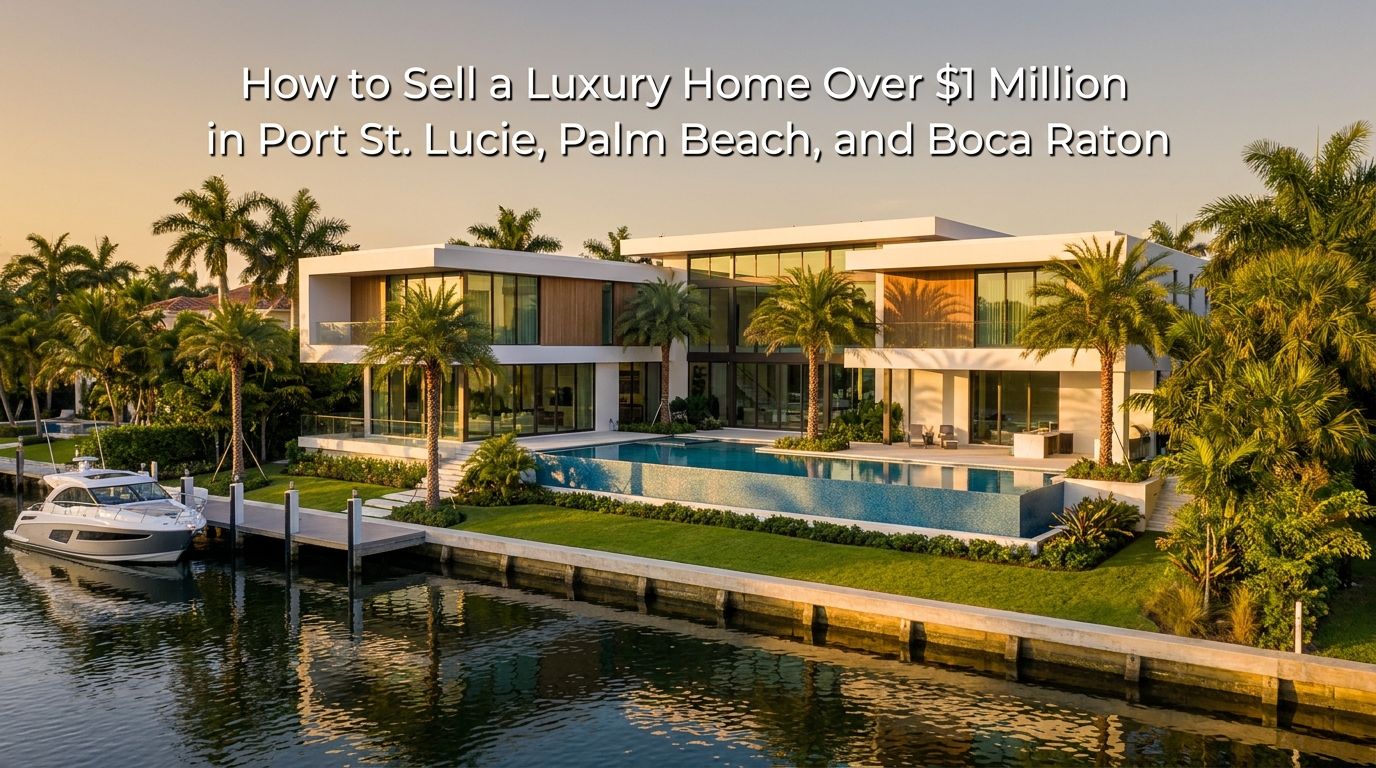
Luxury Seller Guide | Port St. Lucie · Palm Beach · Boca Raton
How to Sell a Luxury Home Over $1 Million in Port St. Lucie, Palm Beach, and Boca Raton
By Jeannie Jacobson, REALTOR® | RE/MAX Gold | Last reviewed September 2026
Above $1,000,000, the buyer pool narrows, cash becomes common, and documentation carries as much weight as presentation. These three Florida markets reward different strategies, and the gap between a prepared listing and an unprepared one is measured in months and in net proceeds.
Request a Luxury Home Valuation Schedule a Confidential Consultation
Quick Answer. Selling a $1 million-plus home in Port St. Lucie, Palm Beach, or Boca Raton turns on four levers: pricing from adjusted evidence rather than price per square foot, assembling a complete documentation package before launch, choosing exposure deliberately between full MLS marketing and an exempt listing, and qualifying buyers before private showings. Each market behaves differently, so the same strategy will not serve all three.
This guide is real estate education, not legal, tax, insurance, lending, appraisal, or investment advice. Market figures vary by source, reporting period, and geographic definition, and should be treated as directional. No specific price, timeline, appraisal value, insurance premium, or sale outcome can be guaranteed.
What This Guide Covers
- Why a $1 Million-Plus Sale Is a Different Transaction
- The 2026 Luxury Seller’s Market in All Three Cities
- How Do You Price a Luxury Home When Comparable Sales Are Thin?
- What Should Be in a Luxury Home’s Pre-Listing Documentation Package?
- How Luxury Homes Are Marketed in 2026
- Should You List Privately or on the MLS?
- How Do You Qualify Luxury Buyers and Protect the Property?
- What Florida Law Requires You to Disclose
- From Offer to Closing: Protecting Your Net
- FAQ: Selling a Luxury Home in Florida
- Conclusion
Before you set a number, two related guides are worth reading: what is my home worth in Port St. Lucie • what to do when a listing stalls
Why a $1 Million-Plus Sale Is a Different Transaction
A $1,000,000 sale is not a larger version of a $400,000 sale. It is a different transaction with a different buyer pool, a different financing profile, a different documentation burden, and materially higher stakes on disclosure and insurability.
Start with the arithmetic of scarcity. Fewer buyers can purchase at this level, so the pool that can transact is smaller and harder to reach. Those buyers tour more properties before committing, ask more technical questions, and frequently arrive with counsel, a wealth advisor, or a family office reviewing the file behind them. They also pay cash far more often than the general market does, which changes what a seller should optimize for. In Palm Beach County, 47.7 percent of all closed residential sales in July 2026 were cash transactions, according to BeachesMLS and Florida Realtors monthly statistics for the county — roughly double the national rate as of that period.
The three markets in this guide behave differently at the top. Palm Beach County’s $1 million-and-above segment has been expanding quickly: closings at $1,000,000 or more rose 36.5 percent year over year in July 2026, from 326 to 445, with combined dollar volume up 41.6 percent to $2.2 billion, per BeachesMLS and Florida Realtors county statistics. Boca Raton’s luxury tier has been tighter and faster than the county as a whole. Port St. Lucie’s $1 million-plus segment is genuinely small, concentrated in a handful of club and waterfront communities, which makes comparable sales scarce and pricing judgment more consequential than anywhere else in this article.
The documentation burden is the part long-time owners underestimate. Above $1,000,000, a buyer’s insurance carrier, lender, inspector, and attorney all generate questions that a listing either answers in advance or answers under time pressure during an inspection period. Roof age, wind mitigation status, flood zone and elevation, open permits, seawall and dock authorizations, association reserve funding, and milestone inspection status all surface. Every one of those is knowable before launch.
Disclosure obligations do not scale down because a property is expensive or because it is sold in its existing condition. Florida’s common-law duty from Johnson v. Davis applies to a $9,000,000 oceanfront estate exactly as it applies to a starter home, and the statutory flood disclosure under Fla. Stat. § 689.302 must be delivered at or before contract execution regardless of price.
Jeannie Jacobson is a Florida-licensed sales associate with RE/MAX Gold, based in Port St. Lucie, with a service area that runs from St. Lucie County south into Palm Beach County. She is ranked among the Top 1% of Realtors in the United States based on annual production, was voted the 2022 and 2023 “People’s Choice Award” for Treasure Coast Favorite Realtor®, and is fluent in English and Spanish. She hosts educational homebuyer events in Port St. Lucie, Palm Beach Gardens, and Boca Raton, which keeps her working in all three cities regularly. You can learn more about Jeannie’s background and approach before reading further.
Market Reality
The 2026 Luxury Seller’s Market in Port St. Lucie, Palm Beach, and Boca Raton
These three markets share a state and very little else at the luxury level. Palm Beach County’s high end is expanding on cash demand, Boca Raton’s luxury tier has been tightening, and Port St. Lucie’s $1 million-plus segment remains small enough that individual transactions move the averages.
What the $1 Million-Plus Numbers Say Right Now
The table below separates what is genuinely a luxury-segment figure from what describes an entire county. That distinction matters: a countywide median tells a $1,000,000 seller almost nothing about their own competition.
| Indicator | Port St. Lucie / St. Lucie County | Palm Beach County | Boca Raton (with Delray Beach) |
|---|---|---|---|
| $1M+ activity | No published county-level $1M+ count located; segment is small and concentrated | 445 closings at $1M+ in July 2026, up 36.5% from 326 | 155 luxury single-family sales in June 2026, up from 100 |
| Luxury median sale price | Not separately published | $1M+ dollar volume $2.2 billion in July 2026, up 41.6% | $2,300,000, up from $2,020,000 |
| Luxury days on market | Not separately published | 63 days to contract at $3M+ in July 2026, improved from 72 | 40 days, improved from 47 |
| Luxury supply | Not separately published | About 7.3 months at $3M+; about 13 months at $20M+ | 546 luxury listings, down 13% from 631 |
| Sale-to-list ratio | 96% of original list price, market-wide single-family | 93.5% of final asking price at $3M+ | 94.12%, up from 93.62% |
| Cash share | Not separately published for $1M+ | 47.7% of all closed sales; 41.2% of single-family | Not separately published |
| Market-wide context | Median single-family $410,000 in August 2026; 5.5 months supply | Single-family 3.8 months supply; 41 days to contract | Reported within Palm Beach County totals |
Sources and periods. Palm Beach County and St. Lucie County figures: BeachesMLS and Florida Realtors monthly county statistics, July and August 2026 reporting, accessed September 2026; St. Lucie single-family list-price and days figures from MIAMI REALTORS® + RWorld June 2026 county release. Palm Beach County $3M+ and supply figures: reported from Palm Beach County MLS data for July and August 2026, accessed September 2026. Boca Raton figures: Institute for Luxury Home Marketing July 2026 report reflecting June 2026 activity for the combined Boca Raton and Delray Beach market, where the single-family luxury threshold sat near $1,200,000. Figures differ by source, geographic definition, and reporting window. “Not separately published” means no luxury-segment breakout was located for that market, not that activity is absent.
Why Luxury Inventory Moves Differently From the Rest of the Market
Two forces separate the luxury tier from the broader market. The first is elasticity of demand: buyers at this level are less rate-sensitive because more of them pay cash, so luxury activity can rise while the financed middle of the market slows. The second is supply behavior: owners of high-value homes are rarely forced sellers, so inventory does not flood the market under pressure.
The consequence for a seller is counterintuitive. A luxury segment can be tightening at the same time the countywide market looks balanced or slow, and the reverse is equally possible. Palm Beach County illustrates the split precisely: as of mid-August 2026 the county carried roughly 7.3 months of supply at $3,000,000 and above, rising to about 13 months above $20,000,000. Those are two different markets inside one county line.
This is why a seller should never accept a countywide statistic as an answer. The relevant questions are how many homes comparable to yours are listed right now, how many sold in the last twelve months, and how long those took.
Port St. Lucie: A Newer-Construction and Value-Per-Square-Foot Story
Port St. Lucie’s luxury segment is the smallest of the three and the most concentrated. Recorded $1 million-plus activity clusters in club and waterfront settings: Tesoro Club and Astor Creek Golf and Country Club, the higher-priced Valencia communities within Riverland, PGA Village and PGA Village Verano, riverfront frontage along the North Fork of the St. Lucie River, and, in the surrounding county, Fort Pierce and South Hutchinson Island for Intracoastal and oceanfront property. All sit within St. Lucie County; Hutchinson Island addresses frequently carry Fort Pierce mailing designations.
Market-wide, St. Lucie County’s median single-family closing was $410,000 in August 2026, essentially flat year over year, with 5.5 months of single-family inventory as of September 15, 2026, per BeachesMLS data. That figure describes the county as a whole and should never be used to value a $1,000,000 home. It is useful only as context: it tells you that the luxury tier here sits several multiples above the local median, which is precisely why the comparable pool is thin.
One structural complication deserves attention. A meaningful share of high-end new construction in these communities is sold directly by builders and may never appear in the MLS as a closed sale available for comparison. A seller relying only on MLS comparables in Riverland or Astor Creek may be working from an incomplete picture, and public records research through the St. Lucie County Property Appraiser and the Clerk of the Circuit Court and Comptroller becomes part of the pricing work rather than an optional extra.
The positioning advantage is straightforward: newer construction, larger lots, and lower price per square foot than comparable product in Palm Beach County, with buyers frequently arriving from the south. Review current conditions on the Port St. Lucie market overview.
Palm Beach: Scarcity, Land Value, and Approval-Driven Timelines
The Town of Palm Beach is a separate incorporated municipality on the barrier island, roughly 4.2 square miles, and it is the apex of the county’s luxury market. Areas are commonly described as the North End, Midtown, the Estate Section, and the South End. On the island, land and location carry most of the value, replacement construction is constrained, and the Town maintains its own review bodies for architectural and landmark matters plus seasonal restrictions on construction activity. A seller planning improvements before listing should confirm current Town requirements and timing directly with the Town before committing to a schedule.
Cooperative ownership is common on the island and behaves unlike a condominium: the owner holds shares in a corporation plus a proprietary lease, and boards frequently require approval of a purchaser and may restrict financing. That single fact can shrink a buyer pool more than price does.
County-level luxury demand has been strong. Palm Beach County recorded 170 sales at $10,000,000 or more through August 2026, surpassing the previous full-year record of 169 set in 2025, according to MIAMI REALTORS® + RWorld August 2026 statistics. The same release noted the county’s heavy cash orientation.
When this guide refers to the mainland luxury corridor rather than the island, it names the municipality. That corridor includes Palm Beach Gardens country club communities, the North Palm Beach and Juno Beach waterfront, and West Palm Beach waterfront and historic districts. For those submarkets see the Palm Beach Gardens market overview and the West Palm Beach market overview.
Boca Raton: East Versus West, City Versus Unincorporated
Boca Raton requires a jurisdictional distinction before anything else. The City of Boca Raton covers the eastern portion including downtown, the Mizner Park area, the Intracoastal, and the oceanfront. West of the city, large gated communities use Boca Raton mailing addresses but sit in unincorporated Palm Beach County. Millage, permitting authority, and municipal services differ between the two, and a seller should state which applies to their property in the listing file.
Inside city limits, recorded $1 million-plus activity includes Royal Palm Yacht and Country Club, The Sanctuary, Golden Harbour, Boca Harbour, Por La Mar, and oceanfront and Intracoastal condominium buildings. West of the city, in unincorporated Palm Beach County, comparable activity appears in communities including St. Andrews Country Club, The Oaks at Boca Raton, Woodfield Country Club, Boca West, the Polo Club, Boca Bridges, and Stone Creek Ranch. Verify the jurisdiction of any specific address against Palm Beach County Property Appraiser records rather than assuming from the mailing address.
On the data: for the combined Boca Raton and Delray Beach luxury single-family market, the Institute for Luxury Home Marketing’s July 2026 report, reflecting June 2026 activity, recorded a median luxury sale price of $2,300,000 against $2,020,000 a year earlier, inventory of 546 against 631, median days on market of 40 against 47, and a sale-to-list ratio of 94.12 percent. The most active price band was $1,200,000 to $1,299,999. That report treats the top 10 percent of sales as luxury and combines two cities, so read it as directional for Boca Raton specifically.
For a longer view of the local trajectory, see the Boca Raton market overview and the site’s Boca Raton housing trends and forecast.
Who Is Buying: Feeder Markets and Cash Share
Cash is the defining characteristic of the Palm Beach County high end. Per BeachesMLS and Florida Realtors July 2026 county statistics, 47.7 percent of all closed sales were cash, including 41.2 percent of single-family and 57.2 percent of condominium transactions.
Feeder markets should be described as places rather than as categories of people. Buyers relocating from the Northeast and Midwest, buyers moving north from Palm Beach and Broward counties toward newer construction and larger lots, seasonal and second-home purchasers, and international buyers all participate. Jeannie has represented buyers from Canada, and published client reviews on the site reflect that international activity.
Keep exploring: Port St. Lucie market data for 2026 • read verified client reviews
Pricing
How Do You Price a Luxury Home When Comparable Sales Are Thin?
You price from adjusted evidence, not from a per-square-foot average. The method is to identify the smallest set of genuinely comparable transactions available, adjust each one for the specific features that drive value at this level, and test the result against what a buyer can purchase instead of your home today.
Thin comparable data is the defining pricing problem above $1,000,000, and it gets worse as price rises. A $3,500,000 home in a community that recorded four sales last year cannot be priced by averaging those four. It has to be priced by understanding what separated each of them.
Why Price Per Square Foot Misleads Above $1,000,000
Price per square foot is a useful sorting tool in a subdivision of similar homes. It becomes actively misleading in the luxury band because the components that carry value are not proportional to interior area.
Consider what actually differentiates two 5,000-square-foot homes on the same street: one has 100 feet of direct Intracoastal frontage with a permitted dock and documented water depth, the other faces a golf course. One was built in 2021 to current code with impact glass throughout, the other in 1998 with a roof approaching the end of its service life. One conveys an equity club membership, the other carries a waitlist. None of those differences appears in a price-per-square-foot calculation, and every one of them can move value by six figures.
The Institute for Luxury Home Marketing’s July 2026 data for the combined Boca Raton and Delray Beach luxury market showed sale price per square foot at $634 against $555 a year earlier. That is a useful trend indicator for the segment. It is not a valuation method for an individual property.
Building an Adjusted Comparative Market Analysis
A defensible luxury comparative market analysis draws on five categories of listing data, each answering a different question.
- Closed sales tell you what buyers actually paid. In a thin market, extend the window to twelve or even eighteen months and apply a market-condition adjustment rather than accepting a ninety-day window that returns two results.
- Pending sales indicate where demand is now rather than where it was, though terms are not yet public.
- Active listings are your competition. A buyer is choosing between your home and these, this weekend.
- Expired listings show precisely where the market declined to transact, which is often the most instructive category in a luxury analysis.
- Withdrawn listings may reflect a seller’s change of plan rather than a pricing failure, so they require interpretation rather than arithmetic.
The adjustments are where professional judgment lives. At this level they include lot size and position, water frontage type and linear feet, controlling depth at the dock and bridge clearance where boating access exists, view orientation, year built and code vintage, construction quality and materials, roof age and opening protection, elevation and flood zone, club or association membership structure and whether it conveys, and the condition and age of major systems. Each adjustment should be supported by a cost estimate, a documented feature, or a paired-sale comparison — not a percentage pulled from instinct.
The single most useful technique in a thin market is paired-sales analysis: finding two transactions that differ primarily in one variable and using the spread to quantify that variable. It will not always be available. When it is, it converts an argument into evidence.
When a Pre-Listing Appraisal Helps and When It Does Not
A pre-listing appraisal from a Florida-certified residential or general appraiser can be worth its cost when the property is genuinely unusual: a custom estate with no close comparables, a property with significant acreage, a home where a prior transaction was not arm’s length, or an estate or trust sale where a fiduciary needs documented support for the price.
It helps less when the community has adequate recent activity, because the appraiser is working from the same limited data you are. It also does not bind the buyer’s lender. An appraisal obtained by a seller has no effect on the appraisal a buyer’s lender will order. Treat it as internal evidence and as a negotiating document, not as a guarantee of value.
The Jumbo Appraisal Problem
Most financed purchases in this price band involve a jumbo loan — any mortgage above the FHFA conforming loan limit for the county. For 2026, the Federal Housing Finance Agency set the baseline conforming loan limit for a one-unit property at $832,750, effective January 1, 2026. Only Monroe County qualifies as a high-cost area in Florida, per Florida Realtors reporting of the FHFA announcement, so both Palm Beach County and St. Lucie County use the baseline figure. Any loan above $832,750 in these counties is a jumbo loan.
Jumbo underwriting is not dramatically stricter than conforming underwriting, but it is held on a lender’s balance sheet or sold to private investors rather than to Fannie Mae or Freddie Mac, so guidelines are set by the individual lender. Some lenders require a second appraisal above certain loan amounts. Because those thresholds vary by institution and change, a seller should ask the buyer’s loan originator directly what the lender’s requirements are rather than assuming.
What this means practically: an appraisal that comes in below the contract price on a financed luxury purchase forces a renegotiation, a larger down payment, or a termination depending on the contract’s appraisal provisions. A seller who has assembled a comparable package and property documentation gives the appraiser something to work with. Questions about a specific loan structure belong with a licensed mortgage loan originator; preliminary payment modeling is no substitute for that conversation.
Pricing to Search Thresholds
Buyers and their agents search in price brackets. A home priced at $2,025,000 is excluded from every search capped at $2,000,000, and it competes inside the bracket above with homes that may present better at that number. This is a mechanical consequence of how search filters work, not a claim about a measured price effect.
| Common search ceiling | A home listed just above it | What the seller gives up | Practical alternative |
|---|---|---|---|
| $1,000,000 | $1,025,000 | Every saved search and alert capped at $1,000,000 | List at $1,000,000 and negotiate from inside two brackets |
| $1,500,000 | $1,549,000 | Buyers whose ceiling is a round number, which is most of them | $1,500,000 captures both brackets |
| $2,000,000 | $2,075,000 | Visibility to the bracket below; competes against stronger inventory above | $1,995,000 or $2,000,000 depending on the comparable set |
| $3,000,000 | $3,150,000 | Exclusion from a bracket where supply conditions may differ materially | Test both brackets against active competition before deciding |
| $5,000,000 | $5,250,000 | A materially smaller buyer pool for a modest nominal gain | Weigh bracket visibility against the strength of the comparable support |
Illustration of a search mechanism. The dollar figures are examples, not measured outcomes, and the right choice depends on the comparable evidence for a specific property.
Setting Review Checkpoints Before Launch
Agree in writing, before the listing goes live, on what will trigger a pricing review. A workable structure names a showing threshold and a time threshold: for example, fewer than a defined number of showings by day 30, or no offer by day 60, prompts a formal review of price, presentation, and access.
Sellers who set that trigger in advance make calm decisions later; sellers who do not tend to make late ones. In a market where luxury properties in Boca Raton were reaching contract at a median of 40 days as of the June 2026 Institute for Luxury Home Marketing data, a listing sitting well past that figure is producing information worth acting on.
Expert Tip: carrying cost turns overpricing into a measurable loss. Illustration only. Assume a $2,500,000 home with annual property taxes, high-value homeowners and flood coverage, club or association dues, landscaping, pool service, and routine maintenance totaling $75,000 a year. That is $6,250 a month, or roughly $18,750 for a quarter. A seller who lists $200,000 above the supportable range, sits for three months, and then reduces has paid the carrying cost, absorbed the days-on-market signal, and arrived at the same price a defensible launch would have reached. Actual carrying costs vary widely by property, insurance program, and association; ask your tax professional and licensed insurance agent for figures specific to your home.
Keep exploring: request a luxury home valuation • review recent sales
Preparation
What Should Be in a Luxury Home’s Pre-Listing Documentation Package?
Above $1,000,000, documentation functions as marketing, because it answers the questions that otherwise stall insurance quotes, inspections, and lender approvals. A buyer’s agent who can answer a client’s technical questions the same day is far more likely to write an offer.
The package below is assembled before launch, not after a contract is signed. Every item in it is knowable in advance, and every item left unknown becomes a negotiating point for the buyer during the inspection period.
1. Permits and open-permit search. Request a permit history for the address from the municipal or county building department with jurisdiction — the City of Port St. Lucie Building Department, the City of Boca Raton development services, or the applicable Palm Beach County department. Open or expired permits on pools, generators, impact windows, additions, seawalls, and electrical work are common on older luxury properties and frequently surface during title work. Resolving one takes weeks; discovering one ten days before closing does not leave weeks.
2. Roof age, wind mitigation, and impact protection. Obtain a current wind mitigation inspection documented on the Florida Office of Insurance Regulation uniform mitigation verification form, along with the permit date for the roof and documentation of impact-rated windows, doors, or shutters. These records drive a buyer’s windstorm premium directly. Supplying them lets a buyer’s licensed insurance agent quote accurately instead of assuming the worst.
3. Flood zone, elevation certificate, and flood history. Identify the FEMA flood zone for the specific parcel — Zone A or AE, a coastal A zone, Zone V or VE, or Zone X. Locate an existing elevation certificate or have a Florida-licensed surveyor prepare one. Assemble any flood claim history and any governmental flood assistance records, which you will need for the statutory flood disclosure regardless.
4. Survey, title search, and easements. A current boundary survey showing structures, setbacks, easements, and, on waterfront property, the mean high water line prevents late surprises. Ask the title company or a Florida real estate attorney to run a preliminary search for liens, recorded easements, and restrictions. On estate and trust sales, confirm signature authority in this same step.
5. Association, club, and estoppel documents. Gather governing documents, current budget and financial statements, reserve information, rules on leasing and renovation, and details of any club membership including whether it conveys, whether it is equity or non-equity, and what approval or transfer requirements apply. Order the estoppel certificate early; associations use the full statutory window routinely.
6. Systems records. Age, service history, and warranty status for air conditioning, generator, pool and spa equipment, elevator, water treatment, irrigation, and any smart-home or security integration. Include the name of the integrator and whether the system requires a service contract to remain functional after closing. A buyer who inherits an unsupported proprietary system discovers it in month two and remembers who sold them the house.
Should You Order a Pre-Listing Inspection?
Often, yes, and the reason is control rather than disclosure avoidance. A pre-listing inspection lets you decide which items to repair, which to price for, and which to document, on your schedule and with contractors you select. It converts a reactive inspection-period negotiation into a planned one.
The obligation it creates is unavoidable and should be understood before ordering: anything the inspection reveals becomes a known material fact that you must disclose if it materially affects value and is not readily observable. That is not a reason to skip the inspection. It is a reason to plan the repairs. A seller who orders an inspection and then conceals its findings has created a far worse problem than the findings themselves.
Insurance History and Why a Buyer’s Carrier Asks About Prior Claims
Carriers evaluate a property’s loss history as part of underwriting, and a buyer’s ability to obtain coverage at a workable premium determines whether a financed purchase can close at all. Prior claims, particularly water and wind claims, affect that evaluation.
Florida’s insurance environment adds a further consideration at this price level. Citizens Property Insurance Corporation is the state-created insurer of last resort and applies eligibility rules including limits related to dwelling value; high-value homes are commonly insured instead through admitted carriers specializing in high-net-worth coverage or through the surplus lines market. Because Citizens eligibility rules and limits change, confirm current requirements with a licensed Florida insurance agent rather than relying on a general description.
Waterfront Add-Ons: Seawall, Dock, and Water Depth
Waterfront property carries a documentation layer that inland property does not, and buyers at this level know to ask for it.
Assemble permits and final approvals for the dock, boat lift, and seawall; the lift’s rated capacity; controlling water depth at the dock; vertical clearance of any fixed bridge between the property and open water; and any submerged land lease with its term and transferability. Marine construction in Florida typically involves the Florida Department of Environmental Protection, the U.S. Army Corps of Engineers, and local government, and approval from one does not substitute for another. Construction seaward of the coastal construction control line on sandy beaches requires a permit from the Florida Department of Environmental Protection under Fla. Stat. § 161.053.
For Port St. Lucie properties specifically, the site’s flood zone and insurance guide covers how zone designation interacts with coverage locally.
Condominium and Cooperative Sellers
Buildings three stories or taller carry obligations that now shape buyer behavior directly. Milestone inspections under Fla. Stat. § 553.899 and structural integrity reserve studies under Fla. Stat. § 718.112 apply to condominium and cooperative buildings at that height, and their results drive reserve funding decisions and special assessments.
A luxury condominium seller should be ready to produce the building’s milestone inspection status, the structural integrity reserve study and the association’s funding response to it, current reserve balances, and any assessment adopted or under discussion. Buyers at this level treat an association’s reserve position as part of the purchase price. Cooperative sellers on the island of Palm Beach face an additional step: board approval of the purchaser, governed by Chapter 719, which can extend a timeline and narrow the buyer pool regardless of price.
Keep exploring: seller resources and preparation checklists • how the selling process works step by step
Presentation
How Luxury Homes Are Marketed in 2026
Marketing a $1 million-plus home is an exercise in reaching a small, dispersed audience and giving it enough information to act. Most buyers at this level form their first impression on a screen, often from another state or country, before anyone requests a showing.
Photography, Video, Twilight Imagery, Floor Plans, and 3D Tours
Each format does a specific job, and skipping one leaves a question unanswered.
- Still photography carries the first impression and determines click-through from search results. Wide-angle interior work with balanced exposure for Florida’s bright exterior light is the baseline, not an upgrade.
- Video walkthrough establishes flow and scale, which photographs compress. For an out-of-area buyer deciding whether to book travel, this frequently converts interest into a showing request.
- Twilight imagery shows exterior lighting design, pool and water features, and view orientation. On waterfront and golf frontage with western exposure it is often the single most compelling image produced.
- Floor plans answer layout questions that generate showing requests from buyers who would otherwise pass, and reduce wasted showings from buyers whose requirements the plan does not meet.
- 3D tours let a distant buyer examine the property repeatedly without an appointment, which matters when the decision involves more than one person.
Aerial Imagery and the FAA Part 107 Requirement
Aerial photography and video are close to mandatory on waterfront, acreage, golf frontage, and any property whose value depends on its setting. A ground-level photograph cannot show 120 feet of Intracoastal frontage or a lot’s relationship to a preserve.
Commercial drone operation in the United States requires a remote pilot certificate under FAA Part 107. Marketing photography for a listing is commercial use. Confirm that whoever flies your property holds a current Part 107 certificate and carries appropriate insurance, and confirm any local restrictions that apply to the airspace over the address.
Staging a Vacant or Dated Luxury Home
Vacant luxury interiors photograph poorly and read smaller than they are, and buyers struggle to judge scale without reference objects. Physical staging of principal rooms — living areas, primary suite, and one or two secondary spaces — generally produces better results than staging an entire house.
Virtual staging is a legitimate lower-cost alternative with one firm condition: every virtually staged image must be clearly labeled as virtually staged. Under FREC advertising rules, real estate advertising must not be misleading, and an unlabeled rendering of furniture that does not exist fails that standard.
For a dated but structurally sound property, the higher-return work is usually paint in a neutral palette, updated lighting, refreshed landscaping and exterior pressure washing, and professional cleaning. Full kitchen or bathroom renovation immediately before listing rarely returns its cost at this level, because buyers at this price point have specific preferences and will renovate to them.
Writing the Listing Description
Luxury listing copy earns its keep through precision. Describe the property, never the people who might live in it.
Here is the distinction in practice.
| Non-compliant phrasing | Why it fails | Compliant rewrite |
|---|---|---|
| “Perfect for a growing family” | Describes who should live there; familial status is protected under the federal and Florida Fair Housing Acts | “Five bedrooms and a separate 400-square-foot flex room on the second floor, with a first-floor primary suite” |
| “Quiet, safe neighborhood” | “Safe” carries coded meaning and cannot be substantiated | “Interior cul-de-sac lot with no through traffic; gated community with staffed entry” |
| “Master bedroom suite” | Industry practice has moved away from the term | “Primary suite with dual closets and a spa bath” |
| “Walking distance to houses of worship” | Religious reference; religion is a protected class | “0.4 miles to the downtown commercial district” |
The same discipline improves the marketing. “Deep-water frontage” is a claim; “110 feet of frontage with a permitted 60-foot dock and a 24,000-pound lift” is a specification that pre-qualifies buyers and eliminates wasted showings.
Reaching Relocation and International Buyers
Because a large share of this buyer pool searches from outside Florida, syndication reach, video, floor plans, and complete listing data fields matter more than local print. Populate every MLS field a buyer might filter on: year built, lot size, water frontage, garage capacity, association fees, and construction type. An unpopulated field removes a property from searches entirely.
Jeannie is fluent in English and Spanish and can conduct showings, negotiations, and client communication in either language. Spanish-language outreach is offered in addition to full English-language marketing, never as a substitute for it, and every prospect receives the same property information and the same access.
Privacy and Security in Luxury Marketing
Certain marketing assets create risk and should be handled deliberately. Do not publish floor plans that identify security equipment locations, safe rooms, or alarm panel placement. Do not publish content that reveals occupancy patterns, travel schedules, or when a property is unoccupied. Consider limiting interior imagery of areas where valuables or art are displayed.
Showings should be accompanied and scheduled by appointment, with buyer identity and financial capacity verified in advance. Apply that verification uniformly to every prospect, both because inconsistent treatment creates fair housing exposure and because a protocol applied selectively is not a protocol.
Considering a sale and want the conversation kept private? An initial valuation and strategy discussion involves no public marketing, no sign, and no MLS entry. Request a confidential seller consultation to review your property, your timing, and your options before anything becomes visible.
Exposure Strategy
Should You List Privately or on the MLS?
Full MLS exposure reaches the largest number of qualified buyers and their agents, which is what produces competition and, usually, the strongest terms. A private or delayed listing trades some of that reach for control over who knows the property is available. The right choice depends on whether a specific, identifiable reason makes privacy worth reduced competition.
This decision changed in 2025, and many sellers are working from outdated assumptions about what is permitted.
Full MLS Exposure: How It Works and Why It Usually Produces the Most Competition
A listing entered into the MLS is distributed to every participating brokerage and, through IDX and syndication, to consumer portals. Every agent with a buyer in your price band receives it. Saved searches fire. The property enters the comparison set that buyers are actively reviewing.
That breadth is the mechanism by which competing interest becomes competing offers. A buyer who does not know a property is for sale cannot bid on it, and a seller who limits exposure has limited the number of people who can compete. Under NAR’s Clear Cooperation Policy, which remains in effect, an MLS participant who publicly markets a listing must submit it to the MLS within one business day.
Office Exclusive and Delayed Marketing Under Current MLS Rules
In March 2025, NAR adopted a policy called Multiple Listing Options for Sellers, which operates alongside the Clear Cooperation Policy. MLSs were given until September 30, 2025 to implement it. It created two distinct exempt categories.
An office exclusive listing is one the seller has directed not be disseminated through the MLS and not be publicly marketed. It is filed with the MLS but not distributed to other participants.
A delayed marketing exempt listing is filed with the MLS and visible to MLS participants, but without immediate public marketing through IDX and syndication. Each MLS sets the length of the delay period for its own market.
Both require a signed seller disclosure. Under the policy, that certification must include disclosure of the professional relationship between the MLS participant and the seller, the seller’s acknowledgment of the MLS benefits being waived or delayed — including broad and immediate exposure — and confirmation of the seller’s decision. NAR issued updated guidance in July 2026 reinforcing those broker duties and noting that local MLSs may impose additional requirements for “Coming Soon” and other pre-marketing statuses.
One mechanical point trips up sellers and agents alike: broker-to-broker, one-to-one communication about an exempt listing does not trigger Clear Cooperation requirements, but multi-brokerage communication does and is treated as public marketing. An email blast to a group of agents is not a private conversation.
Because the delay period and any additional disclosure requirements are set locally, and because the MLS serving this region has been through a significant structural change — MIAMI REALTORS® + RWorld announced that MIAMI MLS and BeachesMLS merged on May 11, 2026 — confirm current local rules with your listing professional before choosing this route.
When Privacy Is Worth the Trade-Off
NAR’s guidance frames this as the seller’s choice, based on the seller’s own interests, which may include health, safety, privacy, or other factors that outweigh broad exposure. Situations where that calculation commonly favors privacy include a seller whose identity or circumstances would attract attention, a household with genuine security concerns, a tenant-occupied property where disruption is a real cost, a separation or estate matter not yet resolved among the parties, and a property where preparation work is underway and a public launch would be premature.
What should not drive the decision is a belief that private listings achieve better prices. No study is cited here for that proposition because none is relied on. Treat privacy as a benefit you are purchasing with exposure, and decide whether you need it.
How to Test the Market Quietly Without Damaging the Public Launch
A delayed marketing period used deliberately can be productive: it puts the property in front of MLS participants and their existing buyers while photography, staging, and documentation are completed, so the public launch happens with the file finished.
What damages a launch is drift — a property quietly circulating for months, seen by much of the local agent population, then arriving publicly as something everyone has already declined. If you use a delayed or exclusive period, set its end date in advance and treat the public launch as the event.
Did you know? Under NAR’s Multiple Listing Options for Sellers policy, broker-to-broker communication about an exempt listing does not trigger Clear Cooperation requirements only when it is genuinely one-to-one. Multi-brokerage communication about an exempt listing is treated as public marketing and starts the one-business-day clock to submit the listing to the MLS. A message sent to a group of agents, a brokerage-wide email, or a post in a shared agent network is not a private conversation. Sellers choosing an exempt listing should confirm with their listing professional exactly how the property will be discussed while it is exempt.
| Option | Reach | Privacy | Likely buyer pool | Disclosure required | Typical use |
|---|---|---|---|---|---|
| Full MLS | Widest: all participants plus IDX and syndication | None | Largest available | Standard listing agreement | Default for most sellers seeking competition |
| Delayed marketing exempt | MLS participants only during the delay | Partial and time-limited | Agents with active buyers | Signed exempt listing disclosure | Finishing preparation before a public launch |
| Office exclusive | Listing brokerage only; filed but not disseminated | Highest | Smallest | Signed exempt listing disclosure | Documented privacy, safety, or security reasons |
| “Coming Soon” status | Varies by local MLS rules | Low to partial | Varies | Local MLS may add requirements | Building anticipation ahead of an active date |
Based on NAR’s Multiple Listing Options for Sellers policy and July 2026 NAR guidance. Availability, delay length, and additional disclosure requirements are set by the local MLS; confirm current rules before selecting an option.
Keep exploring: selling in Port St. Lucie
Showings
How Do You Qualify Luxury Buyers and Protect the Property During Showings?
Qualification at this level means confirming capacity before access, using a written standard applied to every prospect. Protection means accompanied, scheduled showings and sensible handling of valuables and security information.
Proof of Funds and Pre-Approval Letters: What Each Proves
These two documents answer different questions, and neither answers as much as sellers assume.
A proof of funds letter or recent account statement shows that liquid assets exist as of a date. It does not show that those funds are unencumbered, that they belong solely to the buyer, or that they will remain available. A statement dated four months ago proves very little.
A pre-approval letter indicates a lender has reviewed some level of documentation. Quality varies enormously: a letter generated from stated information differs from one issued after an underwriter reviewed tax returns, asset statements, and a credit report. Above the conforming limit the loan is a jumbo, underwritten to that lender’s own guidelines, so the identity of the lender and the depth of the review both matter.
The practical step is a brief call from the listing side to the loan originator, with the buyer’s permission, to ask what was verified and what conditions remain. That conversation takes ten minutes and routinely changes how an offer is evaluated. Jeannie works with Matt Weaver, described on this site as the Nation’s #1 Mortgage Originator for 2022 purchase units, as a working relationship; buyers are free to choose any lender they wish, and no referral is required or expected.
Showing Protocols
A workable luxury showing protocol includes appointment-only access with advance notice, accompanied showings rather than lockbox entry, verification of the showing agent’s license status, confirmation of buyer capacity before the appointment, and removal or secure storage of jewelry, medications, firearms, small art, and personal documents.
One requirement overrides convenience: the same protocol applies to every prospect without variation. Screening criteria applied differently to different buyers creates fair housing exposure under the federal Fair Housing Act and the Florida Fair Housing Act, Chapter 760, Part II. Write the protocol down, and apply it as written.
Written Buyer Agreements and How Compensation Is Now Negotiated
Since August 17, 2024, under the practice changes that followed the National Association of REALTORS® settlement, an MLS participant working with a buyer must have a written agreement with that buyer before touring a home, and offers of buyer-broker compensation are no longer communicated through the MLS.
Compensation is negotiable and is set by written agreement. It may be paid by the buyer, by the seller as a concession, or by a combination. No rate is standard, customary, or established by law. A seller’s options include offering a concession as part of the listing strategy, addressing compensation only when an offer arrives, or declining to contribute, with the trade-offs discussed in advance rather than at the negotiating table.
How a concession interacts with a buyer’s loan program is a question for the buyer’s licensed mortgage loan originator, since concession limits vary by program and loan-to-value.
Handling Unsolicited Offers and Investor Outreach
Owners of high-value Florida property receive unsolicited approaches: letters, calls, and off-market inquiries from buyers’ representatives. Some are genuine. The useful discipline is to treat an unsolicited offer as one data point rather than as a market test, and to verify the buyer’s capacity with the same documentation you would require from any other prospect.
If an unsolicited offer is attractive enough to consider seriously, that is information about the property’s value, and it is worth understanding what open-market exposure might produce before accepting. That comparison, documented, also protects a seller who is acting as a fiduciary for a trust or estate.
Did you know? Under Florida’s brokerage relationship duties in Fla. Stat. § 475.278, a licensee presents all offers and counteroffers in a timely manner unless a party has directed otherwise in writing. Florida presumes a transaction broker relationship — limited representation to one or both parties, with duties including honesty and fair dealing, skill, care and diligence, accounting for funds, disclosure of known facts materially affecting the value of residential property that are not readily observable, and limited confidentiality. A single agent relationship, with full fiduciary duties including loyalty and full confidentiality, requires a written statutory disclosure. Ask which relationship your listing agreement establishes.
Compliance
What Florida Law Requires You to Disclose When Selling a Luxury Home
Florida imposes a common-law disclosure duty on residential sellers plus several specific statutory notices, and none of them relaxes because a property is expensive or sold in its existing condition. The cost of getting this wrong is measured in post-closing litigation, which is why the documentation work in Section 3 pays for itself twice.
The Johnson v. Davis Duty in Plain English
Under Johnson v. Davis, decided by the Florida Supreme Court in 1985, a seller of residential property must disclose facts that materially affect the value of the property, are not readily observable, and are not known to the buyer.
Three conditions have to be met together. A cracked driveway a buyer can see is readily observable. A repaired roof leak behind a finished ceiling is not. The duty attaches to what you know, so the answer to an uncertain situation is disclosure plus documentation, never silence. If a prior repair was made, provide the invoice. If you do not know whether an issue was resolved, say so and provide what records exist.
The Flood Disclosure: Timing and Content
Under Fla. Stat. § 689.302, a seller of residential real property must complete and deliver a written flood disclosure to the buyer at or before the time the contract is executed. It is a standalone form, separate from the purchase contract.
The requirement was expanded effective October 1, 2025 by CS/CS/SB 948, Chapter 2025-166, Laws of Florida. The disclosure addresses whether the seller has filed a claim for flood damage on the property, whether the seller has received assistance for flood damage from any governmental source, and whether the seller has knowledge of flooding that damaged the property during the seller’s ownership.
Two practical notes. The disclosure is the seller’s to complete; a licensee identifies the requirement and supplies the form but does not fill it in for the client. And the form asks about the property’s history, not the flood zone — a property in Zone X with a documented prior flood requires disclosure just as a Zone VE property does.
Radon, HOA, Condominium, and Cooperative Notices
Several additional disclosures are triggered by property type or timing.
- Radon notification under Fla. Stat. § 404.056(5) must be provided at or before contract execution. It is a standard notice, not a test result.
- HOA disclosure summary under Fla. Stat. § 720.401 applies to property in a mandatory homeowners’ association. If the buyer does not receive it before executing the contract, the buyer has a statutory right to void within 3 days of receiving the summary, and that right ends at closing.
- Condominium resale disclosure under Fla. Stat. § 718.503 governs the documents a non-developer unit owner provides and the buyer’s related cancellation right.
- Cooperative approval packages under Chapter 719 apply to co-op sales, common on the island of Palm Beach, where the buyer purchases shares plus a proprietary lease and the board typically approves the purchaser.
- Estoppel certificates from the association — under Chapter 718 for condominiums and Fla. Stat. § 720.30851 for homeowners’ associations — state amounts owed and related matters, subject to statutory timing and fee rules.
- Lead-based paint federal disclosure applies to housing built before 1978, relevant to older estate properties.
Coastal Properties and the Coastal Construction Control Line
Construction seaward of the coastal construction control line on sandy beaches requires a permit from the Florida Department of Environmental Protection under Fla. Stat. § 161.053. For an oceanfront seller, buyers and their counsel will ask whether existing structures, pools, decks, and seawalls seaward of that line were permitted and whether any authorization remains open.
Gather those records before listing. The same applies to dock, lift, and seawall authorizations, which may involve the Florida Department of Environmental Protection, the U.S. Army Corps of Engineers, and local government independently.
“AS IS” Versus Standard Contract: Repairs Versus Disclosure
Florida Realtors and the Florida Bar publish the residential contract in a “Standard” version and an “AS IS” version. The practical difference concerns repairs: the AS IS version relieves the seller of a repair obligation while giving the buyer an inspection period with a right to cancel.
Selling “AS IS” limits your obligation to repair. It does not limit your obligation to disclose. That distinction is the single most common misunderstanding among Florida sellers at every price point, and the consequences scale with the transaction.
What You Are Not Required to Disclose
Under Fla. Stat. § 689.25, the fact that a property was the site of a homicide, suicide, or death is not a material fact that must be disclosed, and neither a seller nor a licensee has a duty to disclose it.
Candor still has value. Many sellers choose to answer honestly if asked directly, which is generally the sounder path both relationally and legally. Decide the approach with your attorney and apply it consistently rather than case by case.
Foreign Sellers and FIRPTA at the $1 Million-Plus Level
Under the Foreign Investment in Real Property Tax Act, when the seller is a foreign person the buyer generally must withhold 15 percent of the amount realized. A reduced 10 percent rate exists only for certain residence purchases at $1,000,000 or less, so it does not apply anywhere in this article’s price band. On a $3,000,000 sale, 15 percent of the amount realized is $450,000 withheld at closing.
Where the withholding would exceed the actual tax liability, the seller may apply for a withholding certificate on IRS Form 8288-B, which must be filed before closing to be useful. Determine the tax status of every seller on title at the start of the process, including where title is held by a trust or entity. These are tax questions; work them through with a CPA or tax advisor experienced in FIRPTA.
A related federal requirement now affects the closing table. FinCEN’s Residential Real Estate Rule took effect March 1, 2026, after an extension from December 1, 2025. It requires certain reporting persons — generally the closing or settlement agent — to file a Real Estate Report on non-financed transfers of residential real property to legal entities and applicable trusts. It does not apply to transfers to natural persons or to financed purchases through institutions with anti-money-laundering programs. Since entity and trust purchases are common at this price level, expect the closing agent to collect beneficial ownership information, and build that into the timeline.
Florida also restricts certain purchases by persons and entities tied to designated foreign countries of concern under Fla. Stat. §§ 692.201 through 692.205, with a buyer affidavit required at closing. The requirements are administered at closing by the closing agent; questions about their application belong with a Florida real estate attorney.
Moving Within Florida: Portability of the Save Our Homes Benefit
Florida’s Save Our Homes provision caps annual increases in a homestead’s assessed value at 3 percent or the change in the Consumer Price Index, whichever is lower. The homestead exemption under Article VII, Section 6 of the Florida Constitution is available to a Florida permanent resident on the property owned and occupied as a permanent residence as of January 1, applied for with the county property appraiser by March 1 on Form DR-501.
Portability allows a homestead owner to transfer accumulated Save Our Homes benefit — up to $500,000 — to a new Florida homestead, filed alongside the homestead application within the statutory window. Because that window has been amended in recent years, confirm the current deadline directly with the St. Lucie County or Palm Beach County Property Appraiser before relying on it. For a seller buying another Florida home, this is frequently worth thousands of dollars annually and is routinely missed.
Two related points. A purchase resets assessed value to just value as of the following January 1, so a buyer should never estimate taxes from your current bill. And voters will decide a homestead-related constitutional amendment at the November 3, 2026 general election; what it would change, and whether it is approved, is a matter for the ballot and the property appraiser rather than for prediction here.
One boundary worth stating plainly: Jeannie’s role is to identify which requirements apply and supply the correct forms. The seller completes their own disclosures, and legal questions go to a Florida real estate attorney. That division protects everyone in the transaction.
Closing
From Offer to Closing: Negotiating the Contract and Protecting Your Net
Price is one term among many, and at this level it is frequently not the term that determines the strongest outcome. Net proceeds and certainty of closing are what a seller actually receives.
How to Compare Offers
Evaluate every offer across the same set of variables rather than ranking by headline number.
- Price relative to your comparable evidence, not to your original list price.
- Deposit size and timing. A larger deposit, delivered promptly and held by a named title company or closing attorney, signals commitment. Who holds the deposit is a contract term; brokerage-held escrow is governed by Chapter 475 and Florida Real Estate Commission rules.
- Financing type. Cash removes appraisal and loan-approval risk. A financed offer should be assessed on lender quality and the depth of the pre-approval, not on the existence of a letter.
- Inspection period length and whether it is an AS IS right to cancel or a Standard repair-limit structure.
- Appraisal provisions. What happens on a low appraisal should be decided before you accept, not after.
- Closing date and whether it accommodates association approval, estoppel turnaround, and any board review.
- Leaseback requests. Post-closing occupancy is common when a seller is building or relocating; terms, insurance, and liability should be documented by an attorney rather than handled informally.
- Personal property requests. Furnishings, art, and equipment frequently appear in luxury negotiations and need separate treatment.
Inspection Negotiations at the Luxury Level: Credits Versus Repairs
Every property generates findings, and a fifty-page report on a 7,000-square-foot home is normal rather than alarming. Sort the findings into items that affect insurability or safety, items that are genuine deferred maintenance, and items that are cosmetic.
A credit generally serves both parties better than a seller-performed repair. The buyer controls contractor selection and quality; the seller avoids managing trades under a closing deadline and avoids warranty questions about work performed to a departing owner’s standard. Where a repair affects insurability — roof, electrical, plumbing — completing it before closing may be the faster path, because the buyer’s carrier has to bind coverage regardless.
Personal Property and Furnishings
Designer furnishings, art, rugs, and equipment are often part of a luxury negotiation. These belong on a separate bill of sale rather than inside the real property contract, for several reasons: lenders appraise real property and generally do not finance personal property, allocating value to personal property affects the amount subject to documentary stamp tax on the deed, and a clear inventory prevents disputes at the final walkthrough.
How the allocation is treated for tax purposes is a question for your CPA, and how it is documented at closing is a question for the closing agent. Do not improvise it in an addendum written the night before.
Seller Closing Cost Illustration
The table below shows how seller-side costs scale across the three markets. Illustration only; actual costs depend on the contract, county custom, and closing agent calculations.
| Seller-side item | $1,500,000 — Port St. Lucie example | $3,500,000 — Boca Raton example | $9,000,000 — Palm Beach example |
|---|---|---|---|
| Documentary stamp tax on the deed $0.70 per $100 of consideration |
$10,500 | $24,500 | $63,000 |
| Owner’s title insurance policy | Per promulgated rate and county custom; negotiable | Per promulgated rate and county custom; negotiable | Per promulgated rate and county custom; negotiable |
| Brokerage compensation | Per listing agreement (negotiable) | Per listing agreement (negotiable) | Per listing agreement (negotiable) |
| Buyer concession, if offered | Negotiated per contract; may be none | Negotiated per contract; may be none | Negotiated per contract; may be none |
| Property tax proration | Through the closing date; varies by assessment | Through the closing date; varies by assessment | Through the closing date; varies by assessment |
| Estoppel and association fees | If applicable; statutory fee limits apply | If applicable; club transfer fees may add | If applicable; co-op approval costs may add |
| Attorney and closing fees | Per engagement | Per engagement | Per engagement; counsel typical at this level |
| Municipal lien search and recording | Per closing agent schedule | Per closing agent schedule | Per closing agent schedule |
Illustration only; actual costs depend on the contract, county custom, and closing agent calculations. Documentary stamp tax on the deed is computed at $0.70 per $100 of consideration in counties other than Miami-Dade. Who pays the deed stamps and the owner’s title policy is a negotiable contract term and local custom differs between St. Lucie County and Palm Beach County; ask your closing agent for a written seller net sheet specific to your transaction.
The Six Stages From Accepted Offer to Possession
1
Accepted offer and deposit. The contract is fully executed and the escrow deposit is delivered by the contract deadline. Confirm in writing that the title company or closing attorney received it. Missing a deposit deadline can place a buyer in default on day two, and a seller should know whether that has happened rather than assume.
2
Inspection period. The buyer conducts general, four-point, wind mitigation, and any specialty inspections, and on waterfront property frequently a marine survey. Respond to findings with documentation from your pre-listing package rather than defensively. This is the window in which a prepared seller recovers the cost of preparation.
3
Appraisal and loan approval. On a financed purchase the lender orders the appraisal and underwriting issues conditions. Supply the appraiser with your comparable package and property documentation. Under TRID rules, the buyer must receive the Closing Disclosure at least three business days before consummation on most consumer mortgage loans, which sets a hard floor on the timeline.
4
Title, survey, and estoppel. Title search and municipal lien search proceed, the survey is reviewed against recorded easements and setbacks, and the association estoppel is ordered and delivered. Open permits and boundary issues surface here. Where the buyer is an entity or trust purchasing without financing, the closing agent’s FinCEN reporting obligations also arise at this stage.
5
Final walkthrough and closing documents. The buyer verifies condition and confirms that negotiated items and any personal property on the bill of sale remain in place. Keep insurance and utilities active through closing; closings at this level slip, and an uninsured vacant property during a Florida storm is a catastrophe a seller cannot undo.
6
Funding, recording, and possession. Funds are disbursed, the deed is recorded with the Clerk of the Circuit Court and Comptroller in the county where the property sits, and possession transfers per the contract or any agreed leaseback. Confirm your own proceeds wire instructions by phone before closing, using a number you already have.
Wire Fraud Prevention for Sellers Receiving Large Proceeds
Criminals target real estate closings by sending fraudulent wiring instructions that closely imitate legitimate ones, and seller proceeds at this level are a substantial target.
Verify wiring instructions by telephone with your closing agent, using a number you independently obtained, before any funds move in either direction. Never accept instructions or changes to instructions by email alone. Treat any last-minute change as fraudulent until you have confirmed it by voice with a person you know. This single habit prevents the largest avoidable loss in the transaction.
Capital Gains Basics for a Primary Residence
Under Internal Revenue Code Section 121, a taxpayer who has owned and used a home as a principal residence for periods aggregating at least two of the five years before the sale may generally exclude a limited amount of gain from income, with a larger amount available to qualifying married taxpayers filing jointly. At luxury price levels, gain frequently exceeds that exclusion.
Basis adjustments for capital improvements, selling expenses, prior depreciation if the property was ever rented, and any installment or exchange structure all affect the result. These are individualized tax questions. Work them through with a CPA or tax advisor before you sign a contract, not after closing, because some options are only available in advance. Florida imposes no state personal income tax under Article VII, Section 5 of the Florida Constitution, but that does not affect federal treatment.
Start with the number, then build the strategy around it. A luxury valuation that separates supportable price, competitive position, and projected net proceeds gives you something to decide from. Find out what your home is worth today and review it against any unsolicited offer you have received.
FAQ
FAQ: Selling a Luxury Home in Florida
How long does it take to sell a $1 million-plus home in Boca Raton, Palm Beach, or Port St. Lucie?
Timelines differ by market and by price band within each market. For the combined Boca Raton and Delray Beach luxury single-family market, the Institute for Luxury Home Marketing’s July 2026 report showed median days on market of 40, improved from 47 a year earlier. In Palm Beach County, properties at $3,000,000 and above reached contract at a median of 63 days in July 2026, improved from 72, while supply ran roughly 7.3 months at that level and about 13 months above $20,000,000. Port St. Lucie’s $1 million-plus segment is small enough that no reliable separate figure is published. Add 30 to 60 days from contract to closing. No specific timeline can be guaranteed.
How do you determine the listing price for a luxury home with few comparable sales?
You widen the evidence base and adjust it rather than averaging a small sample. Extend the closed-sale window to twelve or eighteen months with a market-condition adjustment, then add pending, active, expired, and withdrawn listings, because each answers a different question. Adjust every comparable for lot size and position, water frontage and depth, view, year built and code vintage, construction quality, roof age and opening protection, elevation and flood zone, and whether a club membership conveys. Where two sales differ in primarily one variable, paired-sales analysis converts an argument into evidence. Price per square foot is a trend indicator for a segment, not a valuation method for an individual property.
Should I sell my luxury home off-market or list it on the MLS?
Full MLS exposure reaches the most qualified buyers and their agents, which is what produces competing interest. Private options exist and are legitimate. Under NAR’s Multiple Listing Options for Sellers policy, an office exclusive listing is filed with the MLS but not disseminated or publicly marketed, while a delayed marketing exempt listing is visible to MLS participants without immediate IDX and syndication. Both require a signed seller disclosure covering the professional relationship, the MLS benefits being waived or delayed, and confirmation of the seller’s decision. Choose privacy when a specific reason such as safety, security, or tenancy makes it worth reduced competition, not on an assumption about price.
What does it cost to sell a $2 million home in Florida?
Seller-side costs vary by contract and county custom, so the honest answer is a list of components rather than a single percentage. Documentary stamp tax on the deed is computed at $0.70 per $100 of consideration in counties other than Miami-Dade, which is $14,000 on a $2,000,000 sale. Add the owner’s title insurance policy at the promulgated rate where local custom assigns it to the seller, brokerage compensation per your listing agreement, which is negotiable, any buyer concession you agree to, property tax prorations through closing, estoppel and association or club transfer fees, attorney and closing fees, and municipal lien search and recording costs. Request a written seller net sheet from your closing agent.
Do I need a pre-listing inspection before selling a luxury home?
Often it helps, and the benefit is control rather than avoiding disclosure. A pre-listing inspection lets you decide which items to repair, which to price for, and which to document, on your own schedule with contractors you select, instead of negotiating under time pressure during a buyer’s inspection period. Understand the obligation it creates: anything revealed becomes a known fact you must disclose if it materially affects value and is not readily observable. That is a reason to plan the repairs, not to skip the inspection. Concealing findings from an inspection you ordered creates a far larger problem than the findings themselves.
What must a Florida seller disclose, even when selling “as is”?
Under Johnson v. Davis, decided by the Florida Supreme Court in 1985, a seller of residential property must disclose facts that materially affect value, are not readily observable, and are not known to the buyer. All three conditions apply together. Selling under the “AS IS” version of the Florida Realtors and Florida Bar contract limits your obligation to make repairs; it does not limit your obligation to disclose. Separate statutory notices also apply regardless of contract form, including the flood disclosure under Fla. Stat. Section 689.302, the radon notification under Section 404.056(5), and association disclosures for property in a mandatory homeowners’ association or a condominium.
Is the flood disclosure required if my home has never flooded?
Yes. Under Fla. Stat. Section 689.302, a seller of residential real property must complete and deliver a written flood disclosure at or before the time the contract is executed, on a standalone form separate from the contract. The requirement applies regardless of whether flooding has occurred and regardless of flood zone. The disclosure was expanded effective October 1, 2025 by CS/CS/SB 948, Chapter 2025-166, Laws of Florida, and addresses whether the seller has filed a flood damage insurance claim, whether the seller received flood damage assistance from any governmental source, and whether the seller knows of flooding that damaged the property during their ownership. A property with no flood history simply answers accordingly.
How do luxury buyers prove they can afford my home before a private showing?
Through a recent proof of funds document for a cash purchase, or a pre-approval letter for a financed one, with the depth of that letter mattering more than its existence. A proof of funds statement shows liquid assets as of a date; it does not establish that they are unencumbered or will remain available, so recency matters. A pre-approval issued after an underwriter reviewed tax returns, asset statements, and credit differs substantially from one generated from stated information. A brief call to the loan originator, with the buyer’s permission, clarifies what was verified. Apply the same verification standard uniformly to every prospect.
Who pays the buyer’s agent now that the commission rules changed?
It is negotiated and set by written agreement. Since August 17, 2024, under the practice changes following the National Association of REALTORS settlement, an MLS participant working with a buyer must have a written agreement with that buyer before touring a home, and offers of buyer-broker compensation are no longer communicated through the MLS. Compensation may be paid by the buyer, by the seller as a concession, or by a combination. No rate is standard, customary, or set by law. As a seller you may offer a concession as part of your strategy, address it when an offer arrives, or decline. Ask your buyer’s loan originator how a concession interacts with their loan program.
Can I keep living in my home after closing?
Sometimes, through a post-closing occupancy arrangement often called a leaseback, and it is a negotiated term rather than a right. Sellers building a new home, relocating on a school or business calendar, or waiting on a closing elsewhere commonly request one. The terms that matter are the length of occupancy, the rent or fee if any, the security deposit, responsibility for utilities and maintenance, insurance coverage during the occupancy period, and the consequences of holding over. A buyer’s lender may also restrict post-closing occupancy on an owner-occupied loan. Have the arrangement documented by a Florida real estate attorney rather than handled by informal agreement.
What happens to my homestead benefits if I sell and buy another home in Florida?
Portability may allow you to transfer accumulated Save Our Homes benefit, up to $500,000, to a new Florida homestead. Save Our Homes caps annual increases in a homestead’s assessed value at 3 percent or the change in the Consumer Price Index, whichever is lower, and the homestead exemption is available to a Florida permanent resident on the property owned and occupied as a permanent residence as of January 1, applied for by March 1 on Form DR-501. Portability is filed alongside the homestead application within a statutory window that has been amended in recent years, so confirm the current deadline directly with your county property appraiser. This benefit is frequently overlooked.
Why work with Jeannie Jacobson to sell a luxury home from Port St. Lucie to Boca Raton?
Jeannie Jacobson is a Florida-licensed sales associate with RE/MAX Gold, based in Port St. Lucie, serving from St. Lucie County south into Palm Beach County. She is ranked among the Top 1% of Realtors in the United States based on annual production, was voted the 2022 and 2023 People’s Choice Award for Treasure Coast Favorite Realtor, has been mentored by Mike Ferry, and is fluent in English and Spanish. She hosts educational homebuyer events in Port St. Lucie, Palm Beach Gardens, and Boca Raton. Her process is documentation-first: assemble permits, insurance, flood, survey, and association records before launch, then price from adjusted evidence. Published client reviews are available on the site.
Conclusion: Three Markets, Three Emphases
To sell a luxury home in Port St. Lucie, Palm Beach, or Boca Raton for the strongest net result, the work is the same in structure and different in emphasis. Price from adjusted evidence rather than per-square-foot averages. Assemble the documentation package before launch, not during an inspection period. Choose exposure deliberately. Qualify buyers before they walk through the door, using one standard applied to everyone.
Where the three markets diverge is in what each one punishes. Port St. Lucie rewards precise comparison against Palm Beach County alternatives. The luxury segment here is small, builder sales may sit outside the MLS record, and a seller who cannot explain why the property is worth more than the county’s $410,000 market-wide median in credible, specific terms will struggle to hold a number.
Palm Beach rewards discretion and approval-aware timing. On the island, cooperative board approval, Town review bodies, and seasonal construction restrictions can govern a timeline more tightly than buyer demand does, and the cash share means appraisal risk matters less than transaction certainty. Name the municipality in every conversation, because “Palm Beach” and “Palm Beach County” are not the same market.
Boca Raton rewards clarity about jurisdiction, association, and club structure. Whether a property sits inside the City of Boca Raton or in unincorporated Palm Beach County affects millage, permitting, and services. Whether a club membership is equity or non-equity, conveys or does not, and carries approval requirements affects the buyer pool directly.
Across all three, the pattern from the 2026 data holds: prepared, correctly priced properties transact, and properties priced on hope accumulate market time that becomes a negotiating position for the buyer. The Institute for Luxury Home Marketing’s June 2026 Boca Raton figures showed luxury single-family homes reaching contract at a median of 40 days and closing near 94 percent of list price. Palm Beach County’s $1 million-plus closings rose 36.5 percent year over year in July 2026. Those are markets that pay for preparation.
If you own a home above $1,000,000 in any of these three markets and are considering a sale this year or next, the useful first step is a valuation and a documentation review, both of which happen privately and commit you to nothing.
Considering a $1 Million-Plus Sale?
Start with a private valuation and a review of what your file is missing — before anything becomes public.
This article is general real estate education reflecting information believed accurate as of September 2026. It is not legal, tax, financial, insurance, lending, appraisal, inspection, or accounting advice. Market figures vary by source, geographic definition, and reporting period, and are directional rather than definitive. Statutes, rules, MLS policies, loan limits, and federal reporting requirements change. Results vary by property, buyer demand, financing, competition, condition, and contract terms, and no specific price, timeline, appraisal value, insurance premium, loan approval, tax outcome, or sale result can be guaranteed. Real estate compensation is negotiable and set by written agreement; no rate is standard or established by law. Consult a Florida real estate attorney, a CPA or tax advisor, a licensed Florida insurance agent, and a licensed mortgage loan originator for guidance on your specific situation. Equal Housing Opportunity. We comply with the Federal Fair Housing Act and the Florida Fair Housing Act.
Jeannie Jacobson, REALTOR® | RE/MAX Gold | Ranked among the Top 1% of Realtors in the United States
Trusted Port St. Lucie / Port Saint Lucie Real Estate Agent ( Buyer’s & Listing Agent )
Treasure Coast Luxury Homes | Waterfront Homes | New Construction | Investment Properties | Relocation
Cell: 772-877-0268 | Office: 561-926-3551
jeanniemjacobson@gmail.com | jeanniehomesforsale.com | About | Reviews | Contact
10850 S US Hwy 1, Port St Lucie, FL 34952 | FL Lic #SL3516612
English | Español