

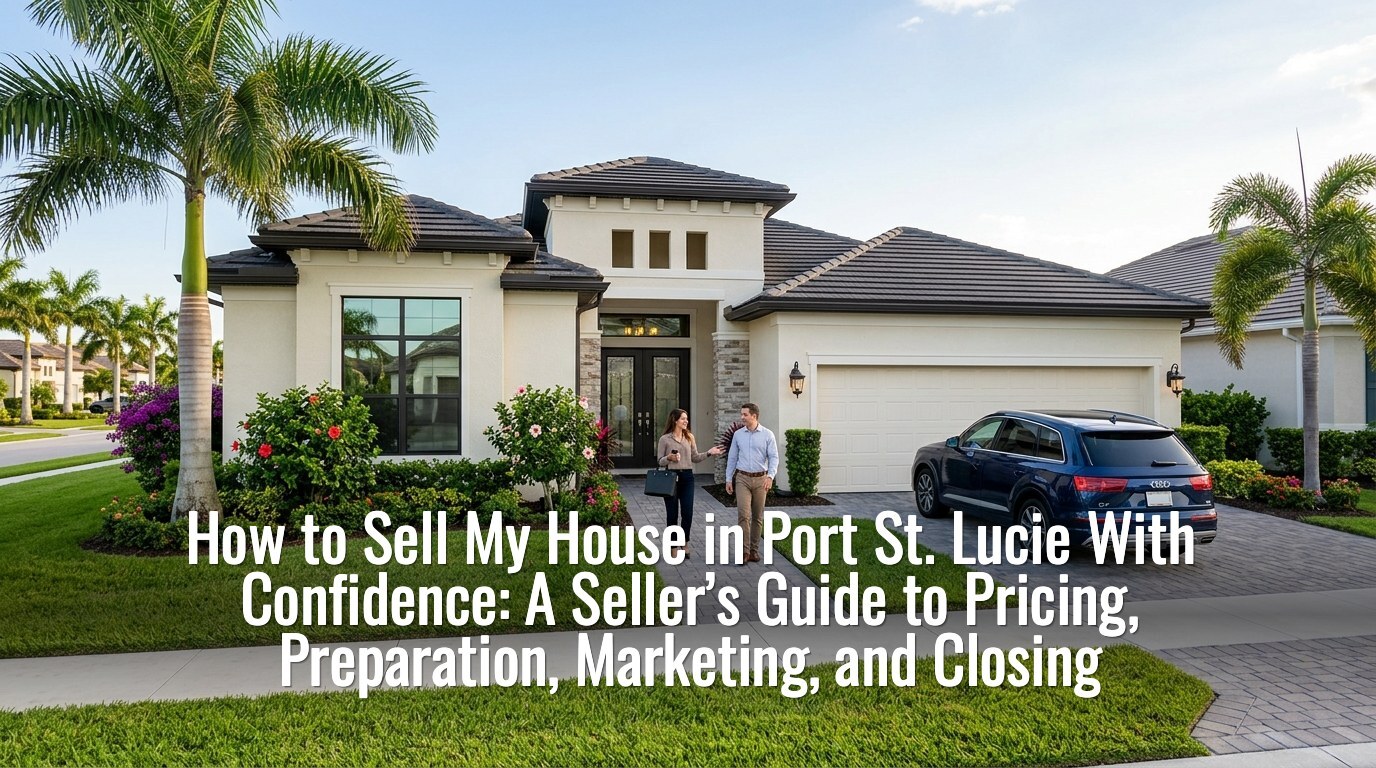
How to Sell My House in Port St. Lucie With Confidence
A seller’s guide to pricing, preparation, marketing, disclosures, offers, inspections, appraisals, title review, and closing — so you can list your Port St. Lucie home with clarity instead of guesswork.
Quick Answer: How Do I Sell My House in Port St. Lucie?
To sell my house in Port St. Lucie with confidence, start with a local home value review rather than an online estimate, then price to the real buyer pool, prepare the home (curb appeal, cleaning, decluttering, targeted repairs), market it with professional photography and clear local positioning, complete Florida seller disclosures including the required flood disclosure, and stay organized through inspection, appraisal, title, HOA, and closing deadlines. Preparation — not promises — is what creates a confident sale.
What This Guide Covers
- Why Selling Here Requires a Local Strategy
- The First Step to Selling Your House
- What Is My Port St. Lucie Home Worth?
- Why Overpricing Hurts Your Sale
- “Can’t We Start High?”
- What to Do Before Listing
- Should I Make Repairs First?
- How Marketing Sells Your Home
- What Buyers Look For
- How Showings Work
- Reviewing Offers & Inspections
- Appraisals, Title & HOA
- Special Situations
- Timeline, Mistakes & Closing
- Make the Home Easy to Show
- If You Are Not Getting Offers
- FAQ: Selling in Port St. Lucie
Why Selling a Home in Port St. Lucie Requires a Local Strategy
Selling a home in Port St. Lucie can feel exciting, emotional, and overwhelming at the same time. Maybe you are moving closer to family, downsizing, relocating out of Florida, selling an inherited property, moving from St. Lucie West to Tradition, or preparing to list near PGA Village, Becker Road, Torino, or Gatlin Boulevard.
Whatever your reason, one question usually comes first: “How do I sell my house in Port St. Lucie with confidence?” That question is about more than price. It is about knowing what steps to take, what mistakes to avoid, how to prepare your home, and how to move through the Florida real estate process without feeling lost.
A confident home sale does not happen by accident. It starts before the sign goes in the yard — with a clear selling strategy, accurate pricing, strong preparation, smart marketing, disclosure awareness, and guidance from a professional who understands the Port St. Lucie and Treasure Coast market.
Port St. Lucie is not a one-size-fits-all market. A homeowner in Tradition may have different HOA requirements than a seller in an older non-HOA neighborhood. A PGA Village seller may be marketing to golf, seasonal, or relocation buyers. A waterfront homeowner may need to consider insurance, flood zone awareness, dock and seawall condition, and buyer financing expectations. A St. Lucie West seller may compete with listings offering updated interiors, newer roofs, or move-in-ready features.
Your home is not just being compared to homes on your street — it may be compared across multiple nearby communities. A strong strategy should answer:
- What homes are buyers comparing mine against?
- How does my location affect value?
- What updates matter most to today’s buyers?
- How do roof age, HVAC age, insurance profile, HOA, lot size, or floor plan affect buyer interest?
- Should I make repairs before listing?
- What price range attracts the strongest buyer pool?
- How do we position the home online so buyers understand its value?
Online valuation tools can be a starting point, but they do not walk through your property, evaluate condition, understand upgrades, review competing listings in real time, or consider buyer objections. Two homes may have identical square footage, but one has a newer roof, updated kitchen, screened lanai, hurricane protection, or stronger curb appeal. Those differences affect pricing, marketing, negotiation, and time on market.
Buyers are careful today. They compare monthly payments, property taxes, HOA fees, insurance costs, inspection findings, and financing readiness. They may love your home and still need the numbers to make sense. When you understand how buyers think, you can prepare more effectively.
What Is the First Step to Selling My House in Port St. Lucie?
The first step is not choosing a random list price. It is not copying a neighbor’s price. It is not relying only on a website estimate. The first step is a home value review and selling consultation.
A home value review looks at your property through the lens of the current local market: recent comparable sales, active and pending listings, property condition, location, upgrades, lot features, HOA rules, buyer demand, and your personal timeline.
Your timeline matters. A seller who needs to move quickly may use a different strategy than one with flexibility. Relocating for work, selling after retirement, handling an inherited property, or coordinating a purchase and sale at the same time all call for a more detailed plan.
What to Discuss in a Selling Consultation
Your Goals
Ideal timeline, target sale price, mortgage payoff or equity expectations, and your next housing plan.
The Property
Known issues, repairs or improvements you are considering, HOA or community requirements, insurance concerns, and flood zone awareness.
Logistics
Showing preferences, occupancy status, and personal property that needs to be removed.
Ownership Status
Whether the home is owner-occupied, vacant, tenant-occupied, inherited, or part of an estate.
Disclosure awareness matters. Florida Realtors explains that under Johnson v. Davis, a seller who knows of facts materially affecting the value of a property that are not readily observable and not known to the buyer has a duty to disclose those facts. Florida licensees also have obligations regarding known material facts affecting residential real property.
That does not mean sellers should panic. It means being prepared, honest, and organized. If you know about a material issue, discuss it with your real estate professional and, when appropriate, a qualified attorney.
Before you choose a list price, schedule a Port St. Lucie home value review with Jeannie Jacobson. A local consultation helps you understand your home’s position, your likely buyer pool, and the steps to take before you list.
How Do I Know What My Port St. Lucie Home Is Worth?
Your home’s value is influenced by what buyers are willing to pay in the current market — but that number is shaped by many details. A strong pricing review looks at homes that are truly comparable: similar size, age, condition, location, features, and community characteristics.
| Category | What Influences Value |
|---|---|
| Size & Layout | Square footage, bedroom and bathroom count, lot size, garage size, floor plan |
| Age & Systems | Year built, roof age, HVAC age, impact windows or hurricane shutters |
| Condition & Updates | Kitchen and bathroom updates, flooring condition, outdoor living space, pool |
| Location & View | Waterfront, preserve, lake, or golf course view; proximity to I-95, the Turnpike, beaches, shopping, medical care; school zones when relevant |
| Community | HOA fees and restrictions, neighborhood demand, active competition |
| Market Factors | Recent nearby sales, buyer financing conditions, insurance considerations, flood zone awareness |
Many sellers focus only on the highest recent sale nearby. That can be risky — it may have had upgrades your home does not have, sold during a different market moment, or included concessions and unique terms. A better approach is to understand a range.
Your pricing strategy should consider the realistic market value range, the price that attracts qualified buyers, the price that causes buyers to skip the listing, likely appraisal risk if the buyer is financing, condition issues that may surface at inspection, the competition in your bracket, and the urgency of your timeline.
In Port St. Lucie, buyers may compare resale homes against new construction. If a buyer can purchase a newer home with builder incentives, your resale home may need to compete through location, lot size, upgrades, move-in readiness, lower fees, mature landscaping, or features new construction does not offer. That does not mean resale cannot compete — it means the listing must be positioned clearly. Pricing is not just math. It is strategy.
Why Overpricing Can Hurt a Port St. Lucie Home Sale
Many sellers naturally want to test the market. Your home may hold years of memories and improvements. But buyers are not pricing your home based on memories — they are comparing it against other options.
When a home is priced too high, several things can happen:
- Buyers skip it online
- Agents may not recommend it
- Showings are limited
- The home sits longer than expected
- Price reductions become necessary
- Buyers wonder what is wrong with the property
- Negotiating leverage weakens over time
The strongest activity often happens when a listing first enters the market. If the price misses the buyer pool at launch, the listing may lose momentum. A later reduction can help, but it may not recreate the same energy as a strong first impression.
The goal is not to underprice your home. The goal is to position it where serious buyers see value, schedule showings, and feel motivated to act.
Pricing should also consider appraisal expectations. If the buyer is financing, the lender may require an appraisal. If the appraised value comes in lower than the contract price, the transaction may need to be renegotiated depending on contract terms, financing structure, the appraisal contingency, and the buyer’s ability to cover any gap. Run your numbers with the mortgage calculators before you set expectations.
Unsure where your home should be priced? Talk with Jeannie Jacobson about a pricing strategy that considers Port St. Lucie comparable sales, buyer demand, property condition, appraisal considerations, and your timeline.
“Can’t We Start High and Reduce It Later?”
You can change a listing price at any time. What you cannot do is recreate the first day on the market.
Buyers and agents watch new listings closely — that early window is when your home gets its most concentrated attention. When a home enters the market above what comparable properties support, qualified buyers may skip it entirely, wait for a reduction, or simply choose a competing home that is priced where the evidence points.
A later price reduction can generate activity — but by then the listing has accumulated market time, and buyers start asking a different question: “Why hasn’t this sold?” You end up negotiating against your own days-on-market instead of against other homes.
The better approach is to look at the evidence first. Review the comparable sales, discuss your financial and timing goals honestly, and then choose a strategy on purpose — rather than testing a number and hoping.
What Should I Do Before Listing My Home for Sale?
Buyers often make quick judgments based on photos, curb appeal, smell, lighting, cleanliness, and condition. Before listing, focus on the basics first.
Start with curb appeal — the outside sets the tone before a buyer walks through the door. Trim landscaping, clean the driveway, refresh mulch, pressure wash where appropriate, and make the home feel cared for. Inside, focus on cleaning, decluttering, and creating space so buyers can imagine themselves living there.
- Deep cleaning and removing excess personal items
- Touching up paint and replacing burned-out bulbs
- Cleaning windows, grout, and flooring
- Repairing obvious damage; servicing HVAC if needed
- Checking doors, locks, and handles
- Organizing closets and storage areas
- Removing pet odors and freshening landscaping
- Preparing the garage and clearing countertops
- Making outdoor spaces inviting
You do not need to renovate everything. Some improvements may not provide the return you expect. Painting a dark room a lighter neutral may help buyers see the space. Replacing worn carpet may matter if it creates a strong negative impression. Fixing a broken door, damaged screen, or leaky faucet prevents buyers from assuming the home was poorly maintained. A full kitchen renovation right before listing, however, is not always necessary — that decision depends on your timeline, budget, value, and local competition.
Should I Make Repairs Before Selling My Home in Florida?
The answer depends on the repair, your timeline, your budget, and how the issue may affect buyer confidence, financing, insurance, or inspections.
Cosmetic Items
Paint, landscaping, minor drywall touch-ups, outdated fixtures, cabinet hardware, basic cleaning. These influence first impressions but are rarely deal breakers.
More Serious Concerns
Roof condition, plumbing leaks, electrical issues, HVAC problems, water intrusion, structural or mold concerns, window damage, pool equipment, unpermitted work — these can affect financing, insurance, and closing timelines.
In Florida, insurance considerations can be especially important. Buyers may ask about roof age, wind mitigation features, flood zone information, claims history, and insurability. Sellers should avoid guessing and direct buyers to qualified insurance professionals.
Flood disclosure is required. Florida Statute 689.302 requires a seller to complete and provide a flood disclosure to a purchaser of residential real property at or before the time the sales contract is executed. The required language tells buyers that homeowners insurance does not include flood damage coverage and encourages them to discuss separate flood insurance with an insurance agent.
That does not mean every home has the same flood risk — it means flood-related disclosure is a real part of the Florida contract process. If you know about water intrusion, prior flood claims, federal flood assistance, or drainage issues, discuss those facts with your real estate professional and consult qualified professionals when needed.
A pre-listing inspection may help some sellers identify issues before buyers do, but it can also create additional disclosure considerations. This is a decision to discuss carefully. The goal is not to make your home perfect — it is to reduce surprises, improve buyer confidence, and prepare for negotiation.
Not sure what to fix before listing? Ask Jeannie Jacobson for a pre-listing walk-through to identify which preparation steps matter most for buyers in your Port St. Lucie price range.
Four questions to ask before approving any repair or improvement:
Is it likely to concern buyers?
If a buyer would notice it on a walkthrough and hesitate, it matters.
Could it affect financing, insurance, inspection, or appraisal?
In Florida this is the decisive question — roof age and major systems can affect whether a buyer can insure or finance the home at all.
Will completing it make the property easier to market?
Some fixes change the photographs and the showing experience. Others are invisible.
Is the likely benefit worth the cost and the delay?
Time on the market has a cost too. A three-week project must earn its three weeks.
Not every repair produces an equal return. The goal is to separate necessary maintenance from presentation improvements, optional upgrades, and work that simply is not financially justified for your property and price point.
How Does Marketing Help Sell a Port St. Lucie Home?
Today’s buyers meet your home online before they ever visit in person. Your photos, description, listing presentation, and digital visibility matter. Strong marketing should do more than say “beautiful home” — it should tell buyers why the home matters.
- Professional photography and clear property descriptions
- Strong listing headlines and accurate feature highlights
- Local lifestyle positioning and neighborhood context
- MLS exposure and real estate portal visibility
- Google Business Profile content and social media marketing
- Email outreach and agent-to-agent promotion
- Open house strategy and video content when useful
Marketing should match the buyer profile. A Tradition home may appeal to buyers wanting planned-community amenities and lifestyle convenience. A St. Lucie West home may appeal to buyers who want access to I-95, medical facilities, and retail. A PGA Village home may appeal to golf buyers, seasonal residents, and retirees. A non-HOA home may appeal to buyers who want fewer restrictions or room for a boat or RV where allowed.
Your description should connect features to benefits. Instead of only saying “screened lanai,” explain how it creates comfortable outdoor living for morning coffee or weekend entertaining. Instead of only saying “large yard,” explain the potential for pets, gardening, or privacy — while avoiding unsupported promises about future use.
Why Photography and First Impressions Matter
Photos are often the first showing. If they are dark, cluttered, or incomplete, buyers move on. Before photography: open blinds, turn on lights, clear countertops, remove trash cans, hide cords, make beds, put away bathroom items, clean mirrors, clear the refrigerator, stage outdoor spaces, move vehicles from the driveway, and secure pets.
Accuracy matters. Florida’s advertising rule requires real estate advertising to be clear that the public is dealing with a real estate licensee, and ads must include the licensed name of the brokerage firm. Ads may not be fraudulent, false, deceptive, or misleading. If a feature is uncertain, verify it before advertising. Square footage, lot size, HOA, and school information should be checked against reliable sources. Strong marketing creates attention. Accurate marketing protects trust.
Want your listing to stand out online? Contact Jeannie Jacobson to discuss photography preparation, local positioning, listing copy, and digital marketing.
What Do Buyers Look for When Purchasing in Port St. Lucie?
Most buyers are not only asking “Do I like this house?” They are also asking: Can I afford the monthly payment? Will it pass inspection? Will insurance be available and affordable? Is the roof acceptable? Does it need immediate repairs? How does it compare to other homes? Are there HOA fees? Is it in a flood zone? Will it appraise? Can I see myself living here?
Buyers here include local move-up buyers, first-time buyers, retirees, snowbirds, relocation buyers, investors, downsizers, and families moving from other Florida cities or out of state.
Relocation buyers may need more education. They may compare Port St. Lucie to Stuart, Palm City, and Jensen Beach, Fort Pierce, Vero Beach, or West Palm Beach. They may not understand the difference between Tradition, St. Lucie West, Torino, Sandpiper Bay, and PGA Village. A strong listing helps them understand.
Buyers also care about condition. A clean, well-maintained home creates confidence; visible deferred maintenance makes buyers wonder what else has not been cared for. That does not mean every home must be fully updated — but the price should reflect the condition, and the marketing should position the home honestly.
How Do Showings Work When Selling a Home?
Showings are where online interest becomes real buyer feedback. Your strategy should make the home as accessible as possible while respecting your schedule, privacy, pets, security, and household needs.
Consider how much notice you need, whether pets must be secured, whether the home will be vacant or occupied, how to handle valuables, medication, and documents, which times are unavailable, and how feedback will be collected.
Buyers usually prefer to tour without the seller present so they can speak freely and imagine themselves in the space. If you are home during showings, buyers may feel rushed or uncomfortable.
A Simple Pre-Showing Routine
- Turn on lights and open blinds
- Set a comfortable temperature
- Clear dishes and put away laundry
- Secure pets and take out trash
- Make beds and close toilet lids
- Leave the home if possible
Feedback may not always be detailed, but patterns matter. If several buyers say the home feels dark, smells musty, or seems overpriced compared to others, consider that seriously. If buyers love the layout but hesitate over roof age or insurance concerns, that may shape negotiation strategy. Selling with confidence means listening to the market, not taking every comment personally.
Showings feel stressful when you still live in the home. Jeannie Jacobson can help you build a practical showing plan that respects your schedule while keeping the home market-ready.
What Happens When I Receive an Offer?
An offer is exciting, but the highest price is not always the strongest offer. When reviewing offers, look at the complete picture.
| Offer Term | Why It Matters |
|---|---|
| Purchase price | The headline number — but only part of your net result |
| Financing type & strength | Cash vs. financed; proof of funds or lender documentation |
| Earnest money deposit | Signals buyer commitment |
| Inspection period | Length affects your risk window |
| Appraisal & financing contingencies | Determine what happens if value or loan falls short |
| Closing date | Must fit your timeline and next move |
| Seller concessions | Directly reduces your net proceeds |
| Personal property requests | What the buyer expects to stay |
| HOA/condo document review | Timelines when applicable |
| Buyer home-sale contingency | Adds dependency on another transaction |
A buyer offering a high price with weak financing, a long inspection period, a low deposit, or uncertain terms may not be as strong as a slightly lower offer with cleaner terms. That does not mean you should automatically reject one — it means the full offer should be reviewed carefully.
Pre-approval is not a loan guarantee. The lender may still need to review income, credit, assets, appraisal, title, insurance, and property condition. Cash offers should be verified through proof of funds; a cash buyer still requires title review, contract compliance, and closing coordination.
How Do Inspection Periods Affect a Florida Home Sale?
The inspection period is one of the most important parts of the contract timeline. During this period the buyer may inspect the property and decide how to proceed based on the contract terms. The exact rights and deadlines depend on the contract used and the negotiated terms.
Inspection issues may include roof condition, electrical, plumbing, HVAC, appliances, water heater, windows and doors, foundation or structural concerns, drainage, pool and equipment, irrigation, pest or termite concerns, mold or moisture, seawall or dock components, safety items, and insurance-related concerns.
Inspection findings do not automatically mean a deal will fall apart. Many issues can be discussed, negotiated, credited, repaired, or accepted depending on the buyer, property condition, contract terms, and market dynamics. But surprises create stress — which is why preparation and disclosure awareness matter before listing.
Florida Realtors notes that contract timing and deadlines are important parts of Florida transactions. Inspection deadlines, financing deadlines, appraisal deadlines, HOA review periods, title matters, and closing dates can all affect the transaction. A confident sale requires organization.
What If the Buyer Requests Repairs or Credits?
Repair requests are common and do not always mean the buyer is being difficult. A buyer may request specific repairs, a seller credit, a price reduction, replacement of defective items, licensed contractor evaluation, additional inspections, documentation of past repairs, or closing cost assistance.
Avoid reacting emotionally — evaluate strategically. Ask: Is the issue legitimate? Was it already disclosed? Is the request reasonable for the property age and price? Could it affect financing or insurance? Would another buyer likely raise the same concern? Is a credit simpler than a repair? Would a repair delay closing?
Sometimes a repair is worth doing. Sometimes a credit is cleaner. Sometimes a seller may decline. The best decision depends on leverage, contract terms, risk, cost, timeline, and your goal. If repairs are agreed to, documentation matters — receipts, permits when required, licensed contractor information, and completion evidence. Do not make promises you cannot keep before closing.
When offers and inspection timelines begin, details matter. Work with Jeannie Jacobson to review offer terms, inspection expectations, contract deadlines, and negotiation options before you respond.
How Do Appraisals Affect Selling My House?
If the buyer is financing, the lender may order an appraisal. If it supports the contract price, the transaction usually moves forward. If it comes in lower, several outcomes may be possible depending on contract terms: the buyer brings additional cash, the seller reduces the price, the parties renegotiate or split the difference, the buyer cancels if permitted, or the transaction fails.
Appraisal risk varies. Unique homes, highly upgraded homes, waterfront or golf course homes, or neighborhoods with few recent comparable sales require careful pricing support. Accurate MLS information, clear upgrade descriptions, quality photos, and documentation of improvements can help support the file — though the appraiser makes an independent determination.
What Role Does Title Review Play?
The title company or closing agent typically reviews ownership, liens, mortgages, judgments, taxes, and legal description so title can transfer according to the contract. Potential issues include unreleased prior mortgages, code or municipal liens, open permits, probate or estate matters, divorce-related ownership issues, name discrepancies, trust ownership questions, deed errors, boundary or survey concerns, and HOA estoppel issues.
A title issue does not always prevent a sale, but it can delay closing if not handled early. Gather documents before listing: mortgage payoff information, HOA contacts, prior survey, permit records, receipts for major improvements, roof replacement documentation, HVAC service records, warranties, solar documents, lease documents if tenant-occupied, and trust or estate documents reviewed by qualified professionals.
How Do HOA Rules Affect Selling in Port St. Lucie?
Many Port St. Lucie communities have HOAs; others do not. Buyers will want to understand fees, rules, restrictions, application process, approval timeline, amenities, leasing rules, pet rules, parking rules, and architectural guidelines. Neither HOA nor non-HOA is automatically better — the key is transparency.
If your home is in an HOA, gather the current fee amount, association contact, rules and regulations, application requirements and approval timeline, transfer fees and capital contributions, pet and lease restrictions, architectural guidelines, amenity details, pending assessments, and budget documents when available. Avoid making unsupported statements about what the HOA will or will not approve.
Selling with HOA documents, estate questions, open permits, or title concerns? Talk with Jeannie Jacobson early so the right professionals are involved before the listing goes live.
Seller Concessions, Buyer Agreements & Net Proceeds
The National Association of REALTORS explains that, as of August 17, 2024, an MLS participant working with a buyer must enter into a written agreement with the buyer before touring a home, including live virtual tours. For sellers, this means buyers may be more aware of agency relationships, compensation, and services — and offers may include requests related to buyer broker compensation, concessions, or closing costs.
This does not mean a seller must agree to every request. Commissions and compensation are negotiable and should be discussed clearly with your real estate professional.
A seller concession is something the seller agrees to contribute toward the buyer’s costs, subject to contract terms and financing limits — buyer closing costs, prepaid expenses, interest rate buydowns, repair credits, HOA fees, or other negotiated costs allowed by the buyer’s loan program.
Look beyond the headline price. An offer of $450,000 with significant concessions may not produce a better net result than a lower offer with cleaner terms. Concessions may also affect appraisal considerations and lender approval — lenders have rules about allowable concessions.
Do not evaluate an offer by price alone. Jeannie Jacobson can help you compare net proceeds, seller concessions, inspection terms, financing strength, appraisal considerations, and closing timelines before you decide.
Selling While Buying, Inherited Property & Homes That Need Work
How Can I Sell My House While Buying Another Home?
Many Port St. Lucie sellers are also buyers — purchasing in Palm City, Stuart, Jensen Beach, Fort Pierce, Vero Beach, elsewhere in South Florida, or out of state. This adds complexity: sale proceeds, mortgage payoff, new loan approval, temporary housing, moving dates, back-to-back closings, contingency terms, post-closing occupancy, inspection and appraisal timelines, title timelines, utility transfers, and school or job schedules.
Plan the sale-and-purchase strategy before listing. If you need the proceeds from your sale to buy the next home, your listing strategy, offer review, and closing timeline should reflect that. Some sellers can move before listing; others need to stay until closing or negotiate a post-closing occupancy agreement. Post-closing occupancy should be documented properly — discuss risks, insurance, deposits, liability, and maintenance responsibilities with qualified professionals.
What If I Am Selling an Inherited or Probate Property?
Inherited sales can be emotional and complex. Families may be dealing with grief, legal authority, probate, heirs, personal property, repairs, title issues, taxes, and family communication. If the property is part of an estate or probate process, consult a qualified Florida probate attorney, tax professional, and title professional before listing or signing documents.
Key questions: Who has legal authority to sell? Is probate required? Are all heirs in agreement? Is the property in a trust? Are there liens or unpaid taxes? Is there a mortgage? Is the home vacant? Are utilities active? Is insurance in place? Are there open permits? What personal property remains?
A real estate professional can help with valuation, preparation, listing strategy, buyer communication, and sale coordination — but legal authority and estate questions belong with qualified professionals. Early organization reduces stress: start with documents, keys, access, utilities, property condition, and professional guidance.
What If My Home Needs Work?
Not every home is move-in ready. You can still sell a home that needs work — the strategy just differs. Options include making repairs before listing, selling as-is with clear disclosure awareness, pricing according to condition, marketing to buyers comfortable with projects, offering credits, getting estimates before listing, completing safety or financing-related repairs, or selling to cash buyers if condition limits financing.
An as-is sale does not remove disclosure obligations. Sellers should still be prepared to disclose known material facts that are not readily observable and that materially affect value. The key is not to hide it — it is to position it honestly and strategically. Some buyers want a project; others will only consider move-in-ready properties. Your pricing and marketing should target the most realistic buyer pool.
Home needs repairs or updates? Ask Jeannie Jacobson for guidance before spending money. A local strategy session helps you decide what to fix, what to disclose, and how to position the home.
How Do Insurance and Flood Zone Awareness Affect Sellers?
Florida buyers are often sensitive to insurance-related questions. Be prepared for buyers to ask about roof age and permits, wind mitigation reports, four-point inspection issues, flood zone information, prior flood-related claims, water intrusion history, hurricane shutters or impact windows, electrical panel type, plumbing materials, HVAC age, and insurance availability.
Sellers should not make insurance promises. Eligibility, coverage, and premiums should be reviewed by licensed insurance professionals. The Florida flood disclosure statute requires a seller to provide a flood disclosure at or before contract execution for residential real property. That does not mean sellers give insurance advice — it means being prepared to complete required disclosures and direct buyers to appropriate professionals.
If you have roof permits, elevation certificates, wind mitigation reports, or insurance-related records, discuss with your real estate professional whether they may be useful during listing.
How Long Does It Take to Sell a House in Port St. Lucie?
There is no guaranteed timeline. Time on market depends on pricing, condition, location, buyer demand, interest rates, competition, marketing, showing access, and contract terms. The process generally includes pre-listing preparation, photography and launch, showings, offer negotiation, inspection period, appraisal if financed, financing review, title review, HOA approval if applicable, and closing coordination.
Some homes go under contract quickly; others take longer. No agent can ethically guarantee a specific sale timeline or final price. Instead of focusing only on speed, focus on readiness — a pricing strategy, a prepared home, completed disclosures, HOA information gathered, repair documents organized, a showing plan, a marketing plan, an offer review strategy, contract timeline awareness, and a closing coordination plan. Confidence comes from preparation, not promises.
Common Mistakes Sellers Should Avoid
- Overpricing based on emotion
- Ignoring needed preparation and using poor listing photos
- Hiding known issues or misunderstanding disclosure obligations
- Making unsupported claims in marketing
- Limiting showing availability too much
- Rejecting feedback too quickly
- Focusing only on offer price; ignoring buyer financing strength
- Missing contract deadlines
- Not preparing HOA documents or addressing title issues early
- Making repairs without documentation
- Waiting too long to ask questions
Another mistake is assuming all advice applies equally to every home. A luxury home, waterfront home, inherited property, 55+ community home, golf course home, and starter home may each require different strategies. Your strategy should match your property.
How Does Closing Work for a Port St. Lucie Seller?
Before closing, the parties may need to complete inspection negotiations, repair agreements, appraisal, loan approval, title review, HOA estoppel or approval, survey review, final walkthrough, closing disclosure review, payoff statements, signing, funding, recording, and key transfer.
Confirm your utilities transfer plan, moving schedule, property condition requirements, what stays and what goes, keys, remotes, access cards, mailbox keys, gate devices, appliance manuals, warranty documents, repair receipts, forwarding address, and final cleaning expectations. The buyer may complete a final walkthrough to confirm condition and that agreed repairs are done. After closing, the deed is recorded and funds are disbursed. A smooth closing depends on communication.
Avoid costly listing mistakes by planning early. Contact Jeannie Jacobson to talk through pricing, preparation, marketing, disclosure awareness, offer review, and closing coordination before your home goes live.
Why Work With a Local Port St. Lucie Realtor?
Selling involves pricing, preparation, marketing, disclosure awareness, buyer communication, offer review, negotiation, inspection timelines, appraisal considerations, HOA details, title coordination, and closing deadlines. A local Realtor helps you understand how your home compares to nearby listings, which features buyers value most, what preparation helps, how to position the listing online, how to review offers beyond price, how to navigate inspection requests, and how to coordinate with title, lenders, and HOA contacts.
Jeannie Jacobson serves buyers and sellers in Port St. Lucie, St. Lucie West, Tradition, PGA Village, Palm City, Stuart, Jensen Beach, Fort Pierce, and surrounding Treasure Coast and South Florida markets. You can read what past clients say or explore the Port St. Lucie market report.
If you are asking, “How do I sell my house in Port St. Lucie?” the best next step is a local conversation about your specific property. Not a generic answer. Not an online guess. A real strategy.
Make the Home Easy to Show
Restrictive showing instructions quietly reduce your opportunities. Every barrier between a qualified buyer and your front door is a showing that may never happen — and buyers on a limited schedule rarely reschedule.
The goal is balance: your convenience, privacy, security, pets, work schedule, and family needs on one side; the reality of buyer availability on the other. Decide these before you list, not in the middle of a showing request:
- How much notice is required, and which days and times are available
- How pets will be handled, and whether the property is occupied
- How access will be secured, and who approves appointments
- Whether cameras or recording devices are present on the property
- How showing feedback will be collected and reviewed
A good showing plan protects the seller while still giving serious buyers reasonable access. If your instructions would discourage you as a buyer, they will discourage buyers.
What If the Home Is Not Receiving Offers?
A lack of offers does not automatically mean price is the only problem. Cutting the price is the fastest response, not always the right one. Before adjusting anything, look at where buyers are actually dropping off:
| What to review | What it may be telling you |
|---|---|
| Online engagement, but few showings | The photography, listing description, or price positioning is not converting interest into visits |
| Showings, but no offers | Something in person is not matching the online impression — condition, layout, smells, noise, or price relative to what buyers see |
| Neither views nor showings | Price positioning, presentation, or exposure — start at the top of the funnel |
| Buyer and agent feedback | The most direct evidence you have. Patterns matter more than any single comment |
| Showing restrictions | Whether access itself is the bottleneck |
| Competing inventory and new comparable sales | Whether the market moved after you listed |
The response may be a pricing adjustment — or improved presentation, expanded access, updated marketing, or a combination. Diagnose before you discount.
Short on time? The costly mistakes selling a house in Port St. Lucie is the quick companion to this guide — nine avoidable errors in pricing, preparation, showings, offers, and inspections, each with the specific fix.
Wondering what the sale will actually cost? How much it costs to sell a house in Port St. Lucie breaks down documentary stamp tax, title insurance, estoppel caps, prorations, and a worked $400,000 net sheet.
Have solar panels? Selling a Port St. Lucie home with solar panels walks through owned versus leased systems, the lien that can stall your closing, and the documents to gather before listing.
FAQ: Selling a House in Port St. Lucie
These are the questions Port St. Lucie sellers ask most. Tap any question to expand the answer.
The first step is scheduling a home value review and seller consultation. This helps you understand your home’s likely market position, local comparable sales, property condition, buyer demand, and preparation needs before choosing a list price.
Your home’s value depends on location, condition, recent comparable sales, upgrades, buyer demand, competition, HOA details, roof age, insurance considerations, and market timing. A local pricing review is more useful than relying only on an online estimate.
Focus first on issues that affect buyer confidence, safety, financing, insurance, or inspections — roof concerns, leaks, HVAC issues, electrical problems, plumbing, damaged flooring, curb appeal, cleaning, and obvious maintenance items. Speak with a local Realtor before spending money on major updates.
Florida sellers should be aware of disclosure obligations involving known facts that materially affect residential property value and are not readily observable to buyers. Discuss disclosure questions with your real estate professional and consult a qualified attorney when legal guidance is needed.
Florida law requires sellers of residential real property to complete and provide a flood disclosure to the buyer at or before the time the sales contract is executed. Buyers should speak with a licensed insurance professional about flood insurance and coverage questions.
Selling as-is may be an option if you do not want to make repairs before listing. However, as-is does not remove disclosure awareness. Pricing, marketing, buyer expectations, and inspection negotiations should all be considered before choosing this strategy.
Very important — most buyers see your home online first. Strong photos can increase interest, improve first impressions, and help buyers understand the layout and features before scheduling a showing.
The buyer may accept the property, request repairs, ask for a credit, renegotiate, or cancel if allowed by the contract terms. The outcome depends on the findings, the contract, the buyer’s concerns, and the negotiation between the parties.
If the buyer is financing and the appraisal is lower than the contract price, the parties may need to renegotiate depending on contract terms. Options may include a price adjustment, the buyer bringing additional cash, a shared compromise, or cancellation if permitted.
Yes. Jeannie Jacobson can help Port St. Lucie sellers with pricing strategy, home preparation, marketing, offer review, inspection negotiations, contract timeline awareness, and closing coordination. Contact Jeannie to discuss your selling goals.
You can change a listing price at any time, but you cannot recreate the first day on the market. New listings get the most concentrated attention from buyers and agents, and a home priced above what comparable sales support may be skipped entirely. A later reduction can generate activity, but the listing has accumulated market time by then — and buyers begin asking why it has not sold. Look at the evidence first and choose a strategy on purpose.
Do not assume price is the only problem. Look at where buyers are dropping off: online engagement without showings usually points to photography, description, or price positioning; showings without offers suggests something in person is not matching the online impression; neither views nor showings points to positioning or exposure. Also review buyer feedback, showing restrictions, competing inventory, and any new comparable sales. Diagnose before you discount.
Every barrier between a qualified buyer and your front door is a showing that may never happen, and buyers on a limited schedule rarely reschedule. Balance your privacy, security, pets, work schedule, and family needs against buyer availability — and decide the notice required, available days and times, pet handling, access method, who approves appointments, and whether cameras are present before you list rather than mid-request.
Final Thoughts: Selling With Confidence
If you are thinking, “How do I sell my house in Port St. Lucie with confidence?” the best next step is a personal strategy conversation. Before you list, talk with Jeannie Jacobson about your home’s value, your timeline, your preparation options, your disclosure awareness, and your local marketing plan.
Ready to Sell Your Port St. Lucie Home?
Schedule a home value review and take the next step toward selling with clarity and confidence — from a licensed Florida real estate professional who lives and works on the Treasure Coast.
Disclaimer: This article is for general educational purposes only and is not legal, tax, probate, financial, insurance, investment, title, or lending advice. Real estate laws, insurance rules, and market conditions can change. Sellers should consult qualified professionals — including licensed attorneys, tax professionals, lenders, insurance agents, HOA representatives, and title professionals — for guidance specific to their transaction. All information is deemed reliable but not guaranteed and should be independently verified. Jeannie Jacobson is a Licensed Florida Real Estate Professional with RE/MAX Gold. Equal Housing Opportunity.