

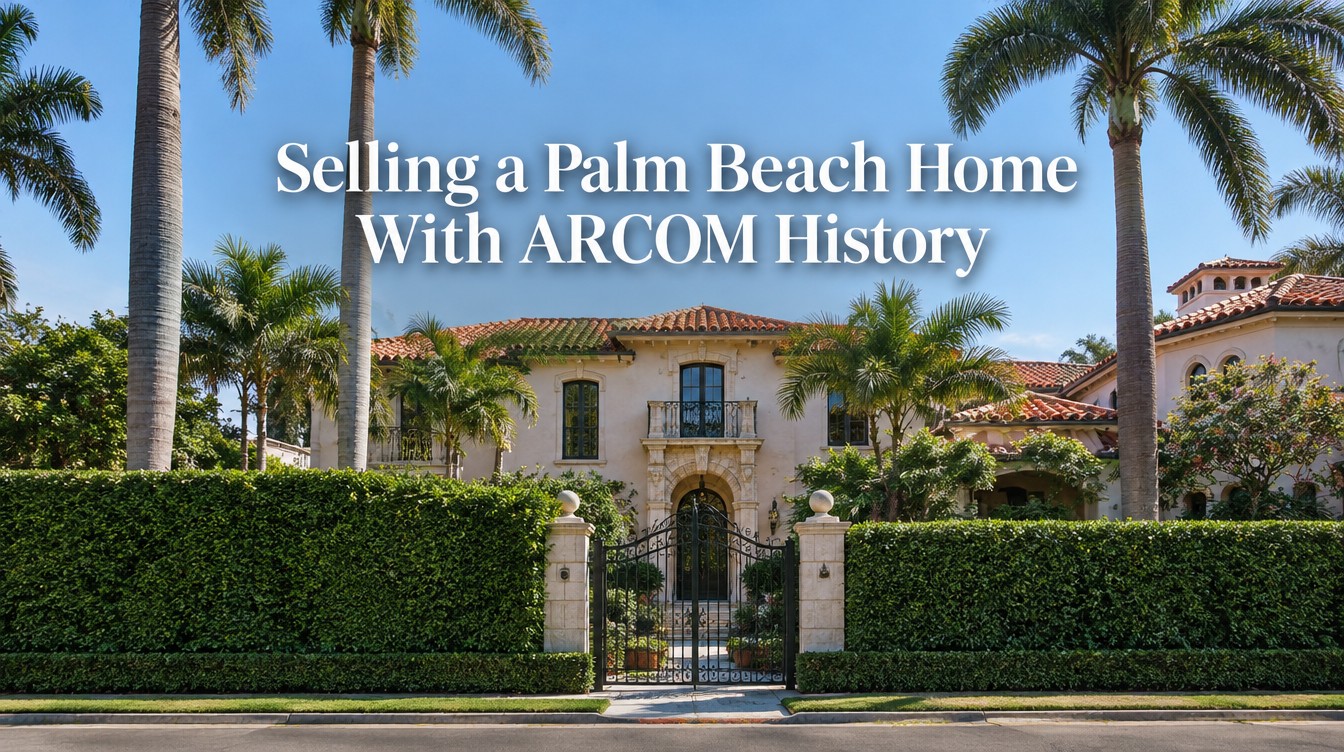
Selling a Palm Beach Home With ARCOM or Landmarks History
In the Town of Palm Beach, a buyer is often paying for two things at once: the house, and the right to change it. If your property has gone before the Architectural Commission or the Landmarks Preservation Commission, or might, that history belongs in the listing file. This guide explains what the Town Code says about approvals, expirations, designation and demolition, and which records to pull before a buyer asks.
Seller Answer in Brief
Before listing a Palm Beach home with ARCOM or Landmarks history, gather the written development orders, the approved plan set, any extension or deferral record, building permit status, and any recorded landmark certificate or tax exemption covenant. Under the Town Code, an approval expires 24 months after the written decision unless a building permit is obtained. Buyers price that clock, so document it rather than describe it.
- ARCOM and Landmarks approvals both expire 24 months from the rendered development order unless a building permit has been obtained, with one extension of up to one year available only if requested before expiration (Town Code Secs. 18-203 and 54-94, as amended by Ord. Nos. 012-2024, 011-2024 and 014‑2025).
- Properties that are landmarked, under consideration, or in a historic district are reviewed by the Landmarks Preservation Commission, not ARCOM (Sec. 18‑175(c)(2)).
- Landmark designation hearings, and hearings on demolishing more than half of a landmarked structure, are held only from November through April (Secs. 54-164(b) and 54‑125(e)).
- Demolition permits are not issued from November 1 through April 30 (Sec. 18-112, as amended by Ord. No. 15‑2026).
- A ratified landmark designation is recorded in the county public records, and a historic tax exemption covenant binds later owners (Secs. 54-164(a)(12) and 54‑200).
In this guide
- Which board has jurisdiction over your Palm Beach property
- Why Palm Beach buyers price the approval history
- An approved plan in Palm Beach is not a permit to build
- Can a buyer use the seller’s ARCOM or Landmarks approval
- Listing while an application is pending
- Landmark designation, pending designation and the recorded certificate
- Demolition rules and the season
- Building permits, construction clocks and stop work orders
- The approval record checklist by type of project
- The records request order with the Town and the County
- The historic tax exemption covenant, and turning the record into price and terms
- Frequently asked questions
Which Board Has Jurisdiction Over Your Palm Beach Property
Start with a plain question, because the answer changes every document you will gather: does your property answer to the Architectural Commission, to the Landmarks Preservation Commission, or only to staff?
The Town Code splits the work. Chapter 18, Article III creates the Architectural Commission, which everyone in town calls ARCOM, and requires its approval before permits issue for new buildings, building and landscape plans, elevations, and alterations, including reroofing that significantly changes materials or appearance (Town of Palm Beach Code, ch. 18, art. III, Sec. 18-175). Chapter 54 creates the Landmarks Preservation Commission and requires a certificate of appropriateness before any landmark, or any building or site feature on a landmark site or in a historic district, is erected, altered, restored, moved or demolished. The code lists landscaping, garden walls, pools and fountains as site features (Town of Palm Beach Code, ch. 54, Sec. 54‑71).
The two boards do not overlap on the same property. Section 18-175(c)(2) states that individual structures or properties that have been designated, are under consideration, or sit in a historic district are subject to review by the Landmarks Preservation Commission and are not subject to ARCOM review. So a landmarked house on a Palm Beach street answers to one commission, and the non-landmarked house next door answers to the other.
The third category: historically significant buildings
Since 2020 the Town Code has also recognized historic conservation districts and historically significant buildings (Town of Palm Beach Code, ch. 18, art. VI). A historically significant building must be at least 50 years old, sit inside a conservation district the Town Council has adopted by resolution, and meet one of four criteria as determined by a Town expert in historic preservation. It may not rise to the level of a landmark. Alterations to these buildings are reviewed by that Town expert and, if the building qualifies, processed under the Chapter 54 certificate of appropriateness procedure (Sec. 18-306). The status matters to a seller in Palm Beach for one practical reason: the definition in Sec. 18-302 ties it to an exception from flood hazard area requirements under the Florida Building Code, Existing Building, Chapter 12, Historic Buildings. A buyer who plans to renovate rather than rebuild may value that exception, and a buyer who plans to demolish will note that it ends if the building is completely demolished (Sec. 18‑306).
Staff-level review
Not every change goes to a public hearing. For ARCOM, the Planning, Zoning and Building Department director may issue a permit without architectural review when the work is minimal and is not listed in the ARCOM Project Designation Manual (Sec. 18-175(c)(1)). For landmarks, a minor exterior change, defined as one costing no more than $2,000 and not materially affecting the exterior, can have the certificate requirement waived by the landmarks project coordinator with the chair’s concurrence (Secs. 54-2 and 54-71(e)). In December 2025 the Town added an LPC Approval Guide, a matrix adopted by Town Council resolution that sorts alterations into staff, chair or full commission review (Ord. No. 29-2025, amending Secs. 54-2, 54-71 and 54‑121).
For a seller, this means the paper trail varies. A gate approved at a full ARCOM hearing leaves a development order and a meeting record. A window swap cleared by staff may leave only a permit. Both are part of the history a buyer’s architect will want, and the first step is knowing which kind you have.
Why Palm Beach Buyers Price the Approval History
Buyers at the top of the Palm Beach market rarely buy a house exactly as it stands. Many plan an addition, a new pool, a reworked loggia, new gates, or a full replacement. Each of those plans runs through ARCOM or the Landmarks Preservation Commission, and each review has its own notice period, hearing calendar and approval clock. The buyer’s question is less “what is this house” than “what will the Town let me do here, and how long will it take.”
That is why the approval record carries price weight. A property with a recent, unexpired approval for work the buyer wants is a different asset from one with no history, which in turn is different from one with a denied application, because Secs. 18-203(3) and 54-94(3) bar a substantially similar application for 12 months after a denial. A buyer who learns of a denial late in due diligence has to either accept the design that was refused or wait out the bar, and either answer usually comes back to the seller as a price request.
Designation status works the same way. The purpose clause of Chapter 54 lists stabilizing and improving property values among its aims (Sec. 54-1). Whether designation raises or lowers a particular property’s value is a market question, and the answer depends on what the buyer pool for that property wants to do with it. The site’s existing guide to selling an architecturally significant residence in Palm Beach covers that fork between preservation buyers and redevelopment buyers. This article stays with the step before it: making sure every buyer, of either kind, can see exactly what the Town has already decided about the property.
| Status in the file | What a buyer reads into it | What the seller should have ready |
|---|---|---|
| Unexpired ARCOM or LPC approval, no building permit yet | A design path that already passed a public hearing, with a deadline | Written development order, its date, approved plan set, conditions, and the calculated expiration date under Sec. 18-203 or 54‑94 |
| Approval with building permit issued | Work underway or ready to start, with a construction time limit | Permit number, issue date, inspection history, and the maximum completion time under Sec. 18-237 or 18‑238 |
| Approval that expired | No live approval; the design would be filed again as a new project | The old order and plans, labeled as expired, so nobody assumes they are current |
| Denied application within the last 12 months | A design the Town refused, and a waiting period on a similar one | The written determination and the denial date (Secs. 18-203(3), 54‑94(3)) |
| Pending application or deferral | An open question that may be decided during the contract period | Case number, hearing date, deferral history, and notice proof |
| Landmark, or under consideration | Exterior changes need a certificate of appropriateness; demolition is restricted | Ratifying resolution, recorded certificate of notification, and any restrictive covenant |
The table is a framework built from the Town Code text, not a measurement of how buyers have behaved in recorded Palm Beach sales. No sales data is presented here, because none was available from an official source for this guide.
An Approved Plan in Palm Beach Is Not a Permit to Build
The most common misunderstanding about Palm Beach approvals is that an ARCOM or Landmarks approval is the same as permission to start work. It is not. The commission approval clears the design. The building permit, issued by the building division, authorizes construction. The Town Code connects the two with a deadline.
Under Sec. 18-203(1) for ARCOM and Sec. 54-94(1) for Landmarks, the applicant’s approval expires 24 months from the date of the rendered development order or written decision unless a building permit has been obtained. If the building permit later expires or is voided, the commission approval becomes void as well. Once void, the project must be filed again “in the same form and manner as if submitted as a new project” (Town of Palm Beach Code, Sec. 18-203; Sec. 54‑94).
Extensions are limited
The Town tightened extensions in 2024. Ordinance Nos. 012-2024 and 011-2024, adopted May 14, 2024, amended the ARCOM and Landmarks sections, and Ordinance No. 014-2025 amended them again on October 15, 2025 (Town Council Development Review agenda, May 15, 2024). The current text allows two things:
- A 30-day administrative extension, which the director of Planning, Zoning and Building may grant for demonstrated good cause.
- A single extension of up to one year from the original expiration date, which the commission may grant or deny for just cause. The request must reach the Planning, Zoning and Building Department before the expiration date.
One extension, not a series. A seller who received an approval in, say, spring 2025 and never pulled a permit should calculate the date now, because an approval that expires during a listing cannot be revived by a later request.
When an approval actually takes effect
Two more dates belong in the file. First, an ARCOM decision does not become effective until ten working days after the ruling (Sec. 18-205(c)). Second, any applicant or interested party may appeal an ARCOM or Landmarks decision to the Town Council within 30 calendar days of the rendered development order, and the filing of an appeal suspends any building permit issued under that ruling until the Council decides (Secs. 18-177 and 54-41, as amended by Ord. No. 013-2025). The Council must decide within 45 calendar days unless the applicant consents to more time. ARCOM major projects, as defined in the Project Designation Manual, also go to the Town Council at its next regular meeting after the commission acts (Sec. 18‑177).
So the approval date printed on a letter is not the whole story. A buyer’s attorney will want to know whether the appeal window closed without a filing, and a seller can answer that only by checking the record. If you are holding an approval and thinking about selling, the timeline and the price conversation are linked, and it helps to look at both before the property goes live.
Can a Buyer Use the Seller’s ARCOM or Landmarks Approval
Sellers ask this more than any other question about Palm Beach approvals, and the honest answer has two parts: what the code says, and what it leaves to the Town and to counsel.
What the code says is about who may apply. An ARCOM application is filed with the director of Planning, Zoning and Building by the property owner or by a designee, agent or representative authorized by a power of attorney filed with the director (Sec. 18-202(a)). For a certificate of appropriateness, the Chapter 54 definition of “applicant” includes the record owner, the owner’s authorized agent, or “a person holding a bona fide contract to purchase” who applies “joined by the owner of record” (Sec. 54-2). In other words, on a landmarked Palm Beach property, a buyer under contract can file for a certificate of appropriateness, but only with the seller joining the application.
What the code does not contain is a section titled transfer of approval. The approval attaches to an application for a specific design on a specific property, carries written conditions, and runs on the 24-month clock described above. Whether a new owner can build an existing approved design without a new application, and what happens if the buyer wants to change it, are questions to put to the Planning, Zoning and Building Department in writing and to review with a land use attorney. Section 18-203(5) and Sec. 54-94(5) do provide a clarification hearing when a question arises about compliance with conditions, which can be requested by the applicant or by the director.
Three situations sellers face
The buyer wants exactly what you had approved
This is the strongest case for marketing the approval. Provide the full approved plan set, the written order, the conditions, and the expiration date. Ask the Town, in writing, what the buyer would need to do to proceed under that order after closing, and give the buyer the Town’s answer rather than your own interpretation.
The buyer wants something different
The approval still has value as evidence of what the commission accepted on this lot, its massing, its relationship to neighbors within 200 feet under the ARCOM criteria in Sec. 18-205(a)(5) and (6), and the conditions imposed. A buyer’s architect can use it as a starting point. Price it as information, not as a permit.
The approval will expire before the buyer can act
If the expiration falls inside a normal contract and closing period, the seller has a choice: request the single extension before the deadline, pull a building permit, or let it lapse and say so. Each option has costs and conditions that a land use attorney should review with you, and the choice should be made before listing, not after a buyer’s attorney raises it.
One caution. Some sellers describe an expired or conditional approval in marketing as if it were a ready-to-build entitlement. That creates disclosure risk and tends to collapse in due diligence. The site’s guide to seller disclosure requirements explains the general duty; in Palm Beach the practical rule is to hand over the documents and let the dates speak.
Listing While an Application Is Pending
A pending ARCOM or Landmarks application during a listing is common in Palm Beach and not a problem in itself. The problem is a pending application nobody has explained. Buyers see the public notice, or their agent finds the item on an agenda, and the first conversation about it happens under pressure.
Public hearings for ARCOM major projects and Landmarks certificates of appropriateness require three kinds of notice at least 30 days before the hearing: a newspaper advertisement placed by Town staff, a mailed notice from the applicant to owners of record within 300 feet, and a posting in Town Hall (Secs. 18-202(d) and 54-93(4)). ARCOM minor projects with notice require mailing only to adjacent owners and those across the street. The director publishes a yearly schedule of meetings and submittal deadlines on the Town website (Sec. 18-202(c)), and ARCOM meets monthly (Sec. 18‑174).
In practice this means a pending application has a visible public footprint. ARCOM agendas identify items by case number and address, using numbers in the form ARC-24-0144 for architectural review and ARCS for certain smaller applications, and they flag “COMBO” items that also need zoning relief from the Town Council, paired with a ZON case number (ARCOM agenda, March 26, 2025). That same agenda shows items deferred from one month to the next.
Deferrals have limits too
Deferral is a tool sellers sometimes use to hold an application while they test the market. The code limits it. Deferrals for a specific application cannot exceed one year cumulatively, or the application is deemed null and void. A first deferral request received more than seven days before the hearing may be granted for one month. Later requests must be made in person at the meeting, and a third request is denied unless the applicant shows a compelling reason (Secs. 18-203(6)-(7) and 54‑94(6)‑(7)).
Finish, pause or withdraw
There is no single right answer, but there is a right order for deciding:
- Identify which buyers are likely for this property and lot. A buyer looking for a finished house may see a pending major project as noise. A buyer planning their own design may see an approval for someone else’s design as irrelevant.
- Ask your architect where the application stands: sufficiency review, scheduled hearing, deferred, or awaiting the Town Council on zoning relief.
- Check the deferral count and the cumulative time used against the one-year limit.
- Decide whether a decision during the listing period helps or hurts the likely buyer, and review that choice with a land use attorney.
- Put the status in writing for the listing file, with the case number, so every buyer receives the same information.
For a landmarked property, remember that a buyer under contract can file a certificate of appropriateness joined by the owner (Sec. 54-2). Some sellers prefer to let the buyer carry the design risk under that structure rather than finishing their own application. That is a contract term to negotiate with counsel, and it should be decided before the first offer arrives.
Landmark Designation, Pending Designation and the Recorded Certificate
Landmark status in Palm Beach is created by a two-step public process, and both steps leave records a buyer will find.
The Landmarks Preservation Commission considers designation of any property proposed by the owner of record or by a commission member (Sec. 54-164(a)(1)). A landmark must meet at least one of four criteria in Sec. 54-161: reflecting broad cultural, political, economic or social history; association with historic persons or events; embodying distinguishing characteristics of an architectural type, period, style or method of construction; or representing the notable work of a master builder, designer or architect. The owner receives notice by certified mail at least 30 days before the commission’s public hearing, and has the right to present evidence, to be represented by counsel, and to cross-examine witnesses (Sec. 54-164(a)(2), (6), (7)). The commission must render a written decision within 30 days after the hearing.
The designation does not take effect until the Town Council ratifies it at a public hearing held within 90 days of the commission’s decision (Secs. 54-163(1) and 54-164(a)(11)). Within 30 days of ratification, the commission files a certificate of notification in the county public records, and it stays there until the designation is withdrawn by the same procedure (Sec. 54-164(a)(12) and (c)).
The calendar and the owner’s position
Designation and undesignation hearings before the commission are held only in November, December, January, February, March and April (Sec. 54-164(b)). That overlaps with the months many Palm Beach owners consider prime listing months, which matters if a designation question is open when the property goes on the market.
Designation can proceed over the owner’s objection. A Town Council Development Review agenda for April 9, 2025 carried Resolution No. 005-2025, to ratify the commission’s finding that 1250 North Ocean Boulevard met the designation criteria; the agenda item records that the commission voted 7-0 for landmarking, that the property owner opposed the designation, and that the matter had been deferred from the January 15, 2025 meeting and then twice more at the applicant’s request (Town Council agenda item, Resolution No. 005-2025). The point for sellers is procedural: designation is a public, recorded matter with its own timetable, and a buyer can read the whole history.
The freeze while a property is under consideration
One rule surprises owners more than any other. Once a property is under consideration for landmark designation, the commission may prohibit the issuance of building, exterior remodeling or demolition permits without a certificate of appropriateness, for as long as the commission and Town Council need to reach final action; it does this by furnishing the building official a list of properties under consideration (Sec. 54-163(8)). Section 54-95 repeats the requirement for exterior changes. A seller whose property appears on that list has, in effect, a landmark review requirement before the designation is final, and a buyer planning exterior work will treat it that way.
If you are not sure whether your property is designated, under consideration, or treated as a historically significant building, ask the Planning, Zoning and Building Department for written confirmation before listing. The Town has published a landmark property list, but a list can lag a recent vote, and a written answer from staff is better evidence for a buyer.
Demolition Rules and the Season
For many Palm Beach buyers the first approval question is whether the existing house can come down, and when. The Town Code answers the “when” part in three separate places, and a buyer’s schedule depends on all three.
First, the Town does not issue demolition permits from November 1 through April 30, and demolition of structures is prohibited during that period. Interior demolition is allowed in those months only if the work and debris removal are finished in three days or less, and the Town Council may grant exceptions for accessory structures or emergencies after 45 days’ notice and notice to owners within 300 feet (Town of Palm Beach Code, Sec. 18-112, as amended by Ord. No. 15-2026, May 2026).
Second, for a landmarked structure, an application to demolish more than 50 percent of its cubic footage is heard by the Landmarks Preservation Commission only from November through April (Sec. 54-125(e)). Put the two rules side by side: the hearing window for major landmark demolition falls inside the months when demolition permits are not issued. A buyer who closes in late spring on a landmarked property and wants to remove most of the structure is looking at a hearing the following winter and, if approved, a demolition the following May at the earliest.
Third, winter construction hours apply from November 1 to April 30, with no construction work on weekends, Town-observed holidays, the days before and after Thanksgiving, or from December 24 through January 1, and heavy equipment such as jackhammers and hammer-driven pile drivers prohibited for that whole period (Town of Palm Beach Code, Secs. 42-198 and 42-199, as amended by Ord. No. 18-2026, July 2026). The series guide to Palm Beach season construction rules for sellers covers how those rules affect showings and pre-listing work.
When demolition is denied on a landmark
The commission may deny a certificate of appropriateness for demolition of a landmark for one year, must cooperate with the owner during that year to look for alternative economic uses, and reviews the denial annually at a public hearing (Sec. 54-163(5)-(7)). An owner may then claim extreme economic hardship, and the evidence the commission considers includes the marketability of the property: any listing for sale within the previous two years, the price asked, offers received, the brokers engaged, advertisements placed, and contracts submitted (Sec. 54‑125(c)(2)).
That last provision has a direct consequence for sellers of landmarked Palm Beach property. A listing is not only a marketing event; it can become part of a hardship record. Pricing, the offers received and the marketing materials may later be examined by a public body. Keep a clean, dated file of every price change, every written offer and every advertisement. If hardship might ever be part of your plan, discuss the listing strategy with a land use attorney first.
Non-landmark demolition conditions
For a property that is not a landmark, a demolition permit is granted when the conditions in Sec. 18-113 are met, including preserving perimeter landscaping the Town considers worth saving, sodding and irrigating the lot if construction will not begin within 30 days, and a written agreement with a $250 per day charge for each violation of the conditions. Section 18-114 adds a cash bond or irrevocable letter of credit, an erosion control and parking plan, a construction screening plan, a truck logistics plan, and an affidavit that owners within 300 feet were notified 14 to 30 days before demolition. A buyer pricing a teardown is pricing these steps and their timing.
Building Permits, Construction Clocks and Stop Work Orders
If an approval led to a building permit, the file now includes a second clock, and it is the one buyers’ lenders and insurers ask about.
Section 18-237 sets an agreed maximum time for completing major construction, calculated from commencement and scaled by square footage under roof in Table 1. The maximum time is a condition of the permit, accepted by the applicant and owner when the permit is accepted, and failure to finish within it is prima facie evidence that the project has been suspended or abandoned (Town of Palm Beach Code, Sec. 18-237). Extensions are decided by the Town Council for good cause. The contractor and owner must file at least 30 calendar days before the permit expiration date with a revised schedule, nuisance mitigation measures, and proof of first-class mailed notice to neighbors within 300 feet at least 25 days before the meeting. If the Council grants the extension, Sec. 18-240 adds a fee of one percent of the value of the remaining, unfinished construction.
Work that is not major construction must pass final inspection within 12 months of issuance (for single-family dwellings, 12 months or until the next edition of the Florida Building Code takes effect, whichever is later). The building official may grant extensions of up to 90 days if the request is filed at least 15 calendar days before the completion date; otherwise the permit is revoked and the failure becomes a code enforcement matter (Sec. 18-238, as amended by Ord. No. 19-2026, July 2026).
Two more provisions belong in a Palm Beach seller’s file. If work does not follow the approved plan, the building official issues a stop work order (Secs. 18-204 and 54-98). And for major ARCOM projects, and many major Landmarks projects, a construction screening plan must be approved, permitted, installed, inspected and closed out before the building permit for the main work is issued (Secs. 18-201 and 54‑99).
Why buyers care about a half-finished project
A seller who lists mid-construction is handing the buyer an open permit, a running completion deadline, possibly an extension history with a Council fee, and conditions from the original approval. Each has to be either closed before closing or assumed by the buyer in writing. The site’s guide to open permits when selling a house covers the general mechanics. In Palm Beach, the added step is matching each permit back to its ARCOM or Landmarks approval and its conditions, because the inspector closing the permit will be checking the work against that approved design.
Archaeological review is the last item many owners forget. For sites on the Town’s archaeological map, an assessment report must reach the Planning, Zoning and Building Department before permits issue for below-ground demolition, excavation, tree removal or other ground disturbance, and monitoring or further testing may follow (Town of Palm Beach Code, Sec. 18-1020). If your property’s file includes an assessment, include it. A buyer planning a pool or a new foundation will need it.
The Approval Record Checklist by Type of Project
The table below organizes the Palm Beach approval record by project type. It is built from the Town Code sections cited in this guide, as published on Municode in October 2026. Use it to see what exists for your property and what is missing before a buyer’s architect or attorney asks.
| Project type | Who decides | Records to pull | What a buyer will ask |
|---|---|---|---|
| New house or major renovation on a non-landmark lot | ARCOM; Town Council for major projects and zoning relief (Secs. 18-175, 18‑177) | Application, written development order, approved plans, conditions, hearing minutes, any ZON case, screening plan permit | Is the approval unexpired? Has a building permit been issued? Were any appeals filed? |
| Minor ARCOM work (gates, windows, landscape, hardscape) | ARCOM, or staff if not listed in the Project Designation Manual (Sec. 18‑175(c)(1)) | Written approval or staff sign-off, permit, final inspection | Was the installed work the approved work? Is the permit closed? |
| Exterior change to a landmark or a building in a historic district | Landmarks Preservation Commission, chair or staff per the LPC Approval Guide (Secs. 54-71, 54‑121) | Certificate of appropriateness, approved drawings, conditions, or the minor exterior change waiver | What else would need a certificate? What did the commission refuse? |
| Alteration to a historically significant building | Town expert in historic preservation, then the Chapter 54 process (Sec. 18‑306) | Expert review, certificate, permit, flood regulation file under ch. 50 | Does the flood exception still apply after the planned renovation? |
| Landmark designation | LPC, ratified by Town Council (Secs. 54-163, 54‑164) | Commission decision, ratifying resolution, recorded certificate of notification, any voluntary restrictive covenant (Sec. 54‑165) | What can and cannot change? Is there a recorded covenant? |
| Demolition, non‑landmark | Building official under ARCOM conditions (Secs. 18-113, 18‑114) | Demolition agreement, bond or letter of credit, logistics and screening plans, neighbor notice affidavit | Can it be demolished, and in which months? |
| Demolition of a landmark | LPC, November to April for more than half the structure (Sec. 54‑125) | Certificate or denial, annual review records, any hardship filing | Was demolition ever denied? Is there an open hardship record? |
| Construction underway | Building official; Town Council for extensions (Secs. 18-237 to 18‑240) | Permit, inspection history, maximum time schedule, extension approvals and fees | When is the completion deadline? Who pays to finish? |
| Ground disturbance on a mapped site | Planning, Zoning and Building director (Sec. 18‑1020) | Phase I report, any monitoring or Phase II results | Will a pool or new foundation trigger further testing? |
| Historic tax exemption | Town Council on LPC recommendation (Secs. 54-196 to 54‑202) | Approving resolution or ordinance, recorded covenant, expiration date | What must be maintained, and until when? |
Two notes on using the checklist. First, it is a records list, not a legal opinion; a land use attorney should review anything that affects what a buyer can build. Second, the gaps are as important as the documents. If an approval letter exists but the hearing minutes cannot be found, write that down. A buyer who is told about a gap early usually treats it as a task. A buyer who finds it late tends to treat it as a reason to renegotiate.
The Records Request Order With the Town and the County
Pulling a Palm Beach approval history touches four offices. Doing it in the right order saves weeks, because each step tells you what to ask for in the next one.
Start with your own architect and attorney files
The architect of record usually holds the submitted plan sets, the Town’s sufficiency comments, the hearing presentation and the written determination. Collect these first. They give you case numbers and dates, which make every later request faster.
Confirm status with the Planning, Zoning and Building Department
Ask in writing whether the property is a landmark, under consideration for designation, in a historic district, or a historically significant building in a conservation district, and whether any ARCOM or Landmarks application is open. The department handles both commissions’ applications (Secs. 18-202 and 54-93). The Town lists the department’s main line as 561-838-5430 (Town of Palm Beach FAQ).
Pull the permit history
The Town directs the public to its EPL (Enterprise, Permitting and Licensing) platform to look up permits (Town of Palm Beach FAQ). Match each permit to an approval, note open or expired permits, and print the inspection history. The Palm Beach County Property Appraiser’s municipal permit directory also links to the Town’s permit department and is a useful cross-check that the parcel is inside the Town.
Read the meeting record
ARCOM, Landmarks Preservation Commission and Town Council Development Review agendas and items are published on the Town’s meeting portal (Town of Palm Beach meeting portal). Records of all ARCOM proceedings and the basis for findings are public under Sec. 18-173. Search by address and by case number, and save the agenda, the item, and any deferral.
Submit a public records request for anything missing
For written determinations, development orders or correspondence you cannot find, use the Town’s public records request link on its website, or contact the Town Clerk’s office, which the Town lists at 561-838-5416. Florida’s public records law, Chapter 119 of the Florida Statutes, governs the request (Fla. Stat. Sec. 119.07). Ask for the file by case number where you have one.
Search the county official records
Recorded documents live with the Palm Beach County Clerk of the Circuit Court and Comptroller, not with the Town. Search the official records for a certificate of notification of landmark designation (Sec. 54-164(a)(12)), any voluntary restrictive covenant (Sec. 54-165), and any historic tax exemption covenant (Sec. 54-200). The Clerk’s site explains how to request records it holds (Clerk of the Circuit Court and Comptroller, Palm Beach County). Your title company will search these too, but finding them before listing lets you explain them on your terms.
Assemble one dated binder
Put everything in chronological order, with a one-page summary on top: current status, every approval and its expiration date, every permit and its completion deadline, and every recorded document. Mark anything expired as expired. Share the same binder with every serious buyer.
This order is a practical sequence built from where each record is kept under the Town Code and Florida law. It is not a Town-published procedure, and office contacts can change, so confirm them on the Town’s website before you start.
The Historic Tax Exemption Covenant, and Turning the Record Into Price and Terms
If your landmarked Palm Beach property received a historic preservation tax exemption, that exemption comes with obligations a buyer will inherit.
Chapter 54, Article V lets the Town Council exempt 100 percent of the assessed value of improvements that result from restoration, renovation or rehabilitation of a qualifying historic property. The exemption applies only to taxes levied by the Town, not to county or school taxes, and not to bond debt or voter-approved levies (Sec. 54-196). It lasts ten years as specified in the approving ordinance, regardless of changes in ownership, as long as the historic character and the qualifying improvements are maintained (Sec. 54-197). To qualify, the owner signs a covenant with the Town that binds “transferees, and their heirs, successors, or assigns.” If the covenant is violated, the owner at that time owes the difference between the taxes that would have been due and the taxes paid in each prior year of the covenant, plus interest (Sec. 54‑200).
For a seller, three facts belong in the file: the date the exemption took effect (the January 1 after substantial completion, under Sec. 54-202), the expiration date stated in the Town’s approving resolution or ordinance, and the recorded covenant. A buyer planning changes needs to know what the covenant requires them to keep. A buyer reviewing the tax bill needs to know when the Town portion of the exemption ends.
From records to price
Once the record is complete, it changes the pricing conversation in specific ways.
- Live approval for the right design. The approval can be marketed as documented evidence of what the Town accepted, with its expiration date stated plainly. Its value to a buyer falls as the expiration approaches, so the listing date should be set with that date in view.
- Expired or denied history. Disclose it with the documents. The buyer’s cost is a new application and, after a denial, a 12-month wait on a similar design. Price with that in mind rather than waiting for the buyer to ask for a credit.
- Landmark status. The buyer pool narrows to people who want to keep the exterior largely as it is, or who are willing to go through the certificate process. The guide to pricing a Palm Beach home by section addresses how location within the Town affects comparables.
- Timing. If a buyer’s plan depends on a November to April hearing or a May to October demolition, the closing date and any approval contingency should be built around those windows.
Contract terms do some of this work. An approval contingency, a seller’s agreement to join a certificate application under Sec. 54-2, or a stated plan for an expiring approval all reduce the uncertainty that buyers otherwise turn into a discount. These are terms to draft with a real estate attorney and, where approvals are involved, a land use attorney. Listing compensation and buyer agent compensation are negotiable and are not part of this analysis.
The site’s guide to selling a luxury home in Port St. Lucie, Palm Beach and Boca Raton covers pricing and preparation steps that apply beyond the approval record, and the Palm Beach County luxury listing page describes the listing services available.
What Sellers Say About Working With Jeannie Jacobson
These reviews come from sellers in other markets and do not describe Palm Beach properties. They speak to pricing guidance and communication during a sale.
“Jeannie was wonderful! She helped us determine the right price to list the house based on the market. She explained the process and kept me informed every step of the way. Once we received an offer she made sure the process went smoothly and efficiently…”
Carrie Wiley, Port Saint Lucie, FL, March 26, 2022, Verified review
“Jeannie was wonderful! She quided us in pricing, staging, and the actual selling process. Needless to say, our house was sold in record time! Her continuous contact with us, allowed us to know how things were going throughout the wait time between contract an closing, was great!…”
Diane, Delray Beach, FL, June 22, 2023, Verified review
This guide is general information about the Town of Palm Beach Code of Ordinances as published in October 2026. It is not legal, tax or financial advice. Town rules, ordinances, fees and procedures change, and the effect of an approval, designation or covenant on a specific property depends on its records. Consult a land use attorney about approvals and designation, a real estate attorney about contracts and disclosure, and a tax professional about exemptions before acting.
Frequently Asked Questions
It depends on designation status. Under Town Code Sec. 18-175(c)(2), properties that are landmarked, under consideration for designation, or in a historic district are reviewed by the Landmarks Preservation Commission and not by ARCOM. Other properties go to ARCOM, or to staff when the work is minimal and not listed in the ARCOM Project Designation Manual. Historically significant buildings in a conservation district follow a separate path under Chapter 18, Article VI. Ask the Planning, Zoning and Building Department for written confirmation before listing.
No. ARCOM or Landmarks approval clears the design; the building division issues the permit that allows construction. The two are linked by Secs. 18-203 and 54-94: if a building permit is not obtained within 24 months of the written decision, or if the permit later expires or is voided, the commission approval becomes void and the project must be filed again as new. Marketing an approval as permission to build overstates it.
The approval expires 24 months from the date of the rendered development order or written decision unless a building permit has been obtained. The director of Planning, Zoning and Building may grant a 30-day administrative extension for good cause, and the commission may grant one extension of up to one year from the original expiration date if the request is filed before that date. The 2024 and 2025 amendments limit the commission extension to a single request.
The Town Code does not include a section on transferring approvals. An approval covers a specific design and conditions and runs on a 24-month clock. Ask the Planning, Zoning and Building Department in writing what a new owner would need to do to proceed under it, and have a land use attorney review the answer. For landmarked property, Sec. 54-2 allows a buyer under contract to apply for a certificate of appropriateness if the owner of record joins the application.
Not automatically. A pending application is publicly noticed at least 30 days before a hearing and appears on agendas by case number, so buyers will see it. Decide based on whether a decision helps your likely buyer, how much of the one-year cumulative deferral limit you have used, and whether the buyer might prefer to file their own design. Put the status in writing for every buyer, and review the choice with a land use attorney before the listing starts.
Designation can be proposed by the owner or by a commission member, and Town Council agendas show designations moving forward over owner objections. Designation hearings are held only from November through April, the owner gets certified-mail notice at least 30 days before the hearing, and the designation is effective only after Town Council ratification. While a property is under consideration, the commission may block building, exterior remodeling and demolition permits without a certificate of appropriateness under Sec. 54‑163(8).
A careful buyer checks the Town’s meeting portal for ARCOM, Landmarks and Town Council items by address, the Town’s EPL platform for permits and inspections, the Planning, Zoning and Building Department for designation status, and the Palm Beach County Clerk’s official records for recorded landmark certificates and covenants. Gathering the same records before listing, in that order, lets a seller answer questions with documents instead of recollection.
Demolition permits are not issued from November 1 through April 30 under Sec. 18-112, apart from short interior demolition and Council exceptions. For a landmark, an application to demolish more than half of the structure’s cubic footage is heard only from November through April under Sec. 54-125(e), and the commission may deny it for one year with annual review. Non-landmark demolition also requires a bond or letter of credit, logistics and screening plans, and neighbor notice.
Yes, within limits. Under Secs. 54-196 to 54-200, the exemption covers Town taxes on qualifying improvements for ten years regardless of ownership changes, and the required covenant binds transferees. If the historic character or qualifying improvements are not maintained, the owner at that time can owe the difference in taxes for prior covenant years plus interest. Provide the approving resolution, the expiration date and the recorded covenant in the listing file.
It can become evidence. When an owner claims extreme economic hardship after a landmark demolition denial, Sec. 54-125(c)(2) lets the commission consider listings within the previous two years, the price asked, offers received, brokers engaged, advertisements and contracts submitted. If hardship could ever be part of your plan, keep dated records of every price change, offer and advertisement, and discuss listing strategy with a land use attorney first.
Assemble the Approval History Before You Set a Listing Date
The useful first step is a single conversation about your Palm Beach property’s records: which commission has jurisdiction, what was approved or denied, when each approval and permit expires, and what is recorded against the title. From there, a written pricing analysis and pre-listing plan can be built around dates you have confirmed.
Jeannie Jacobson, REALTOR®, RE/MAX Gold, (772) 877-0268, English and Spanish
Sources
- Town of Palm Beach Code of Ordinances, Chapter 18, Article III, Architectural Review (Secs. 18-146 to 18-208), Municode, Supp. No. 30, Update 2, https://library.municode.com/fl/palm_beach/codes/code_of_ordinances?nodeId=PTIICOOR_CH18BUBURE_ARTIIIARRE (accessed October 2026)
- Town of Palm Beach Code of Ordinances, Chapter 54, Historical Preservation (Secs. 54-1 to 54-202), Municode, https://library.municode.com/fl/palm_beach/codes/code_of_ordinances?nodeId=PTIICOOR_CH54HIPR (accessed October 2026)
- Town of Palm Beach Code of Ordinances, Chapter 18, Article II, Administration of Planning, Zoning and Building (Secs. 18-112 to 18-114), Municode, https://library.municode.com/fl/palm_beach/codes/code_of_ordinances?nodeId=PTIICOOR_CH18BUBURE_ARTIIADPLZOBU (accessed October 2026)
- Town of Palm Beach Code of Ordinances, Chapter 18, Article IV, Florida Building Code (Secs. 18-237 to 18-240), Municode, https://library.municode.com/fl/palm_beach/codes/code_of_ordinances?nodeId=PTIICOOR_CH18BUBURE_ARTIVFLBUCO (accessed October 2026)
- Town of Palm Beach Code of Ordinances, Chapter 18, Article VI, Historic Conservation Districts (Secs. 18-301 to 18-308), Municode, https://library.municode.com/fl/palm_beach/codes/code_of_ordinances?nodeId=PTIICOOR_CH18BUBURE_ARTVIHICODI (accessed October 2026)
- Town of Palm Beach Code of Ordinances, Chapter 18, Article XVIII, Archaeological Review (Sec. 18-1020), Municode, https://library.municode.com/fl/palm_beach/codes/code_of_ordinances?nodeId=PTIICOOR_CH18BUBURE_ARTXVIIIARRE (accessed October 2026)
- Town of Palm Beach Code of Ordinances, Chapter 42, Article V, Noise (Secs. 42-198 and 42-199), Municode, https://library.municode.com/fl/palm_beach/codes/code_of_ordinances?nodeId=PTIICOOR_CH42EN_ARTVNO (accessed October 2026)
- Town of Palm Beach, Town Council Development Review, May 15, 2024, Agenda Item 4, Ordinance No. 012-2024, limiting time extensions, https://townofpalmbeach.granicusideas.com/meetings/1515-town-council-development-review/agenda_items/663a66e7f395e720ef0002ea-4-proposed-ordinance-to-limit-time-extensions-ma (accessed October 2026)
- Town of Palm Beach, Town Council Development Review, April 9, 2025, Resolution No. 005-2025, 1250 North Ocean Boulevard, https://townofpalmbeach.granicusideas.com/meetings/1593-town-council-development-review/agenda_items/67ed543af395e7cb09017afe-b-resolution-no-005-2025-a-resolution-of-the (accessed October 2026)
- Town of Palm Beach, Architectural Commission (ARCOM) agenda, March 26, 2025, https://townofpalmbeach.granicusideas.com/meetings/1595-architectural-commission-arcom/agenda_items?page=3 (accessed October 2026)
- Town of Palm Beach, Frequently Asked Questions, https://townofpalmbeach.com/faq (accessed October 2026)
- Palm Beach County Property Appraiser, Municipal Permit Departments, https://pbcpao.gov/muni-permit-departments.htm (accessed October 2026)
- Clerk of the Circuit Court and Comptroller, Palm Beach County, Public Records Requests, https://www.mypalmbeachclerk.com/records/public-records-requests (accessed October 2026)
- Florida Statutes, Section 119.07, Inspection and copying of records, https://www.flsenate.gov/Laws/Statutes/2025/119.07 (accessed October 2026)