

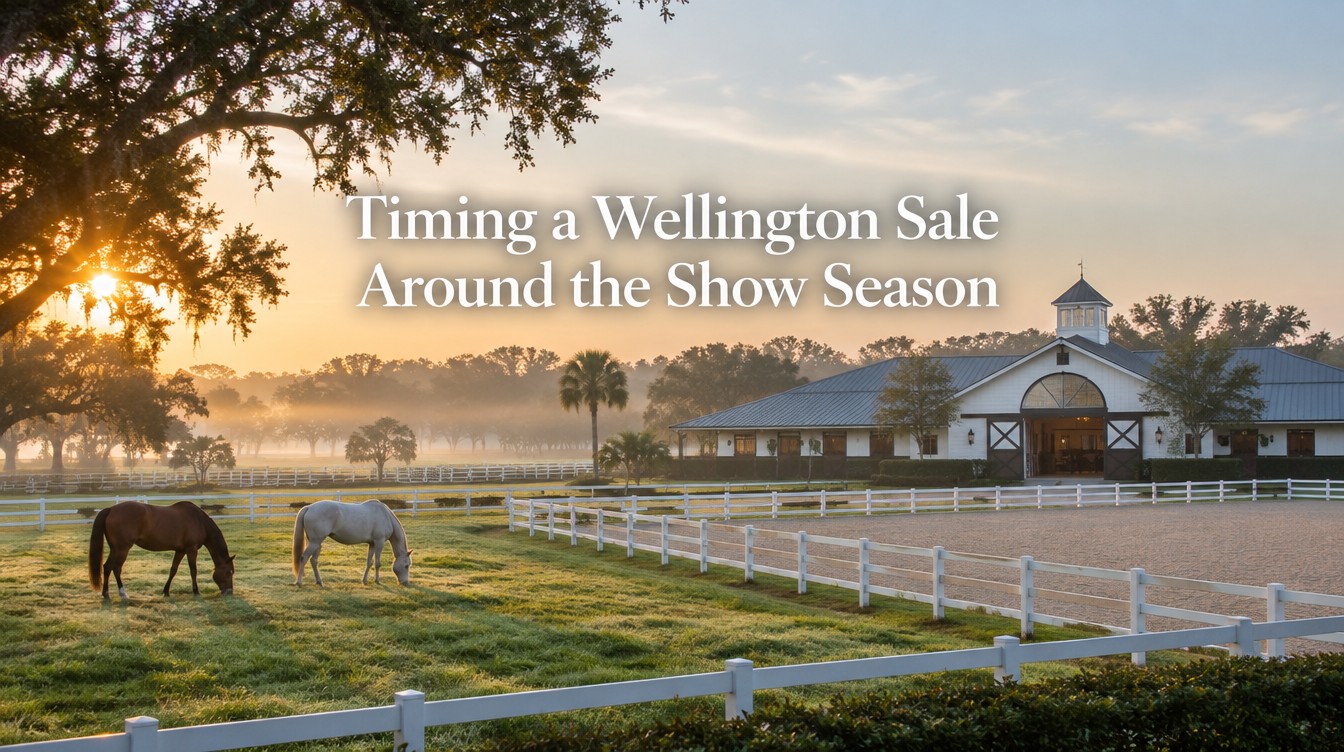
Timing a Wellington Sale Around the Equestrian Season
The 2027 Winter Equestrian Festival is scheduled to open at Wellington International on January 6 and run to April 4. For an owner of a farm, a barn property or a high-value home in Wellington, the question is not whether buyers come for the equestrian season. They do. The question is which week your listing should be ready for them, and how much of the season you are willing to spend on inspections, surveys and lease logistics instead of showings.
Seller Answer in Brief
For most Wellington equestrian and high-value properties, the strongest launch is complete and on the market before the season opens, roughly November into the first days of January, not in the middle of it. Wellington International has scheduled the 2027 Winter Equestrian Festival for January 6 to April 4. A buyer who finds the property in January still has time for barn, arena and permit due diligence and a closing before horses ship out in spring. A February or March launch compresses all of that.
- Wellington International has scheduled the 2027 Winter Equestrian Festival for January 6 to April 4, 2027, at 3400 Equestrian Club Drive (Wellington International, accessed October 2026).
- The Annual Series of shows runs April through December, so the showgrounds are active well beyond the winter festival (Wellington International).
- Development in the roughly 9,000 acre Equestrian Preserve Area is governed by the Equestrian Overlay Zoning District, adopted in 2003 (Village of Wellington).
- The Village requires a rental Business Tax Receipt for residential leases of any duration, and Palm Beach County charges a 6% Tourist Development Tax on rentals of six months or less (Village of Wellington; Palm Beach County Tax Collector).
- Palm Beach County property tax bills go out by November 1 and become delinquent April 1, which matters when a season sale closes in March or April (Palm Beach County Tax Collector).
- Palm Beach County Property Appraiser records show 147 qualified Wellington sales of $3,000,000 or more from October 2023 through September 2026, and 62 of them, 42%, carry an April, May or June sale date. Contract dates are not public, so ask for an MLS contract-date report before you set the date.
In this guide
- What the 2027 Wellington season calendar actually says
- When buyers for Wellington equestrian property are in town
- Why mid-season is usually not the best listing date
- Five listing windows in Wellington, compared
- Seasonal leases and the sale date
- Equestrian due diligence sets the real deadline
- Showing a working barn during show weeks
- Property taxes, proration and the closing month
- Summer, hurricane season and the Annual Series
- A launch calendar working back from January 6, 2027
- Reading the results and planning for April
- Frequently asked questions
What the 2027 Wellington Equestrian Season Calendar Actually Says
Most owners in Wellington talk about “the season” as if it were one block of time. On paper it is several overlapping calendars, and each one brings a different group of horse owners, riders, trainers and grooms into the village at a different moment. A launch date that ignores those differences can land a listing in front of the wrong part of the market.
The anchor is the Winter Equestrian Festival. Wellington International, which runs the showgrounds at 3400 Equestrian Club Drive, has scheduled the 2027 festival for January 6 through April 4, 2027 (Wellington International). The venue describes the festival as 12 weeks of FEI-sanctioned international show jumping running from January through April. The 2026 edition ran January 7 to March 29, 2026, so the 2027 calendar finishes about a week later than last year’s (WFLX, January 2026). That extra week in early April is relevant to sellers, because it keeps competitors and their teams in town a little longer before horses move north.
Dressage has its own season. Wellington International describes the Adequan Global Dressage Festival as a 10 week season, historically held at Equestrian Village, 13500 South Shore Boulevard. In past years it opened in the second week of January and ended in late March. The venue’s new Wellington International South showgrounds are described as the future home of that festival, with a completed covered arena, a main arena and 256 new permanent stalls as of August 2026 (Horse Sport, August 21, 2026). Wellington International had not published the 2027 dressage dates when this guide was reviewed in October 2026. If your farm is built around a full-size dressage arena, check the venue’s schedule before you fix a launch date, because the opening week tells you when those buyers will be in town to see property.
Polo runs on a longer clock. Discover The Palm Beaches, the county’s tourism office, lists the 2026 to 2027 Palm Beach polo season at the National Polo Center, 3667 120th Avenue South, from December 27, 2026 to May 2, 2027 (Discover The Palm Beaches). The 2027 dates for the high-goal tournaments, including the U.S. Open Polo Championship, are set by the United States Polo Association and the National Polo Center. Check their published calendar before you agree to a closing date for a property near the fields, because a buyer who plays high-goal polo will plan inspections and moving around those matches. Owners near the polo fields, including those in Palm Beach Polo and the communities along 120th Avenue South, should read the polo calendar alongside the show calendar, because the polo season, as listed, runs into May.
Then there is the part of the calendar most sellers forget. Wellington International states that its Annual Series of horse shows, including Spring, Summer, Fall and Holiday series events, runs from April through December. In October 2026 alone, the venue lists an October Horse Show starting October 2 and Fall Circuit I, II and III shows starting October 8, 15 and 22 at Equestrian Village, followed by a Fall Circuit Finale on October 28 at Wellington International. November lists a Pre-Charity CSI3* show starting November 11 and a Holiday and Horses CSI4* show starting November 25, and December lists holiday festival weeks starting December 9 and December 16 (Wellington International, upcoming events, accessed October 2026).
| Period | Published activity in Wellington | Venue | What it means for a seller |
|---|---|---|---|
| October 2026 | October Horse Show, Fall Circuit I to III, Fall Circuit Finale | Equestrian Village; Wellington International | Trainers and year-round barns are back. Good window for photography, records and pricing. |
| November 2026 | Pre-Charity CSI3* (from Nov 11), Holiday and Horses CSI4* (from Nov 25) | Wellington International | Early arrivals scout barns and leases. A listing that is live now is seen before decisions on the season are made. |
| December 2026 | Holiday festival weeks from Dec 9 and Dec 16; polo season listed from Dec 27 | Wellington International; National Polo Center | Many seasonal teams arrive. Showings compete with move-in logistics. |
| January 6 to April 4, 2027 | Winter Equestrian Festival, 12 weeks | Wellington International, 3400 Equestrian Club Drive | Peak buyer presence. Peak occupancy of leased farms. Limited time for buyers to inspect and close. |
| January to March 2027 | Adequan Global Dressage Festival, 10 weeks (2027 dates not yet published) | Equestrian Village or Wellington International South | Dressage buyers often look at different farm layouts and arena sizes than jumper buyers. |
| Late December 2026 to May 2, 2027 | Palm Beach polo season | National Polo Center, 3667 120th Avenue South | Polo buyers may stay longer, which extends the useful window for properties near the polo fields. |
| April to December 2027 | Annual Series: Spring, Summer, Fall and Holiday shows | Wellington International; Equestrian Village | Year-round trainers and local buyers keep the off-season market active, at a smaller scale. |
Two practical points come out of this table. First, the market does not switch on in January. A listing that goes live after the opening week of the Winter Equestrian Festival has already missed the weeks when many buyers and their trainers decide where they will base horses for the season. Second, the season ends in stages. Show jumping wraps up April 4, dressage likely earlier, polo later. A buyer who signs a contract in late March is often closing after their horses have left.
When Buyers for Wellington Equestrian Property Are Actually in Town
The short answer: the buyers who pay for barns, arenas, paddocks and stall counts are physically present in Wellington from roughly December through April, but many of them make their shortlist before they arrive. The decision to buy a farm in Wellington is usually connected to a decision about where the horses will live next season, and that decision is often made in the fall.
That pattern follows from how the season works. Competitors who show for 12 weeks need stalls, turnout, a ring to school in and housing for staff. Wellington International’s own figures for the new South showgrounds, 256 new permanent stalls with 64 more under construction, show how much of the season revolves around stabling (Horse Sport, August 2026). A buyer who has been leasing a farm each winter and decides to own instead tends to start looking when the lease renewal comes up, which for many leases is before the season, not during it.
Not every Wellington buyer is a competitor. Owners of high-value homes in gated communities without barns see a different pattern, closer to the general Palm Beach County winter market, with seasonal residents arriving after the holidays. But even there, the overlap with the show calendar matters, because many buyers in the higher price tiers are in Wellington because of horses, even when the house they buy has none.
What buyers do with their time during show weeks
Wellington International lists spectator days for the Winter Equestrian Festival as Wednesday through Sunday, with Saturday Night Lights grand prix classes in the evening, gates at 6:00 p.m. and competition at 7:00 p.m., later for the final three weeks (Discover The Palm Beaches, WEF 2027 listing). A rider or owner competing that week is at the showgrounds most of the day. The realistic showing windows for those buyers are early mornings, Mondays and Tuesdays, and the hours between their classes.
That has two consequences. A listing that launches mid-season competes for very few hours of a buyer’s week. And a buyer who sees a property in February has less time to bring a barn inspector, an arena contractor, a surveyor and a veterinarian or farm manager back to it than a buyer who saw it in November.
Who signs the contract
For equestrian property, the person walking the barn is not always the person signing. Trainers, barn managers and family office representatives frequently preview properties for a principal who arrives later. A launch in November gives those representatives time to preview, report and arrange a second visit once the principal is in town in January. The Wellington equestrian property guide on this site explains what those representatives check on the parcel itself.
Why Mid-Season Is Usually Not the Best Listing Date in Wellington
A common belief among Wellington owners is that the best time to list is February, when the village is busiest and every buyer is in town. The traffic on South Shore Boulevard and Pierson Road in February supports the feeling. The calendar and the due diligence process mostly do not.
Here is the problem in plain terms. A February listing has about eight weeks of Winter Equestrian Festival left before April 4. Within that time a buyer needs to find the property, schedule a second showing around competition days, negotiate, and then complete an inspection period that, on an equestrian property, typically involves more than a home inspection: barn and stall condition, arena footing and drainage, fencing, wells and septic capacity, permits for the barn, arena and any groom’s quarters, and a survey. Each of those requires a professional who is also in high demand during the same weeks.
The result is that a contract signed in March often closes in April or May, after the buyer’s horses have shipped out. That is not fatal, but it changes the buyer’s motivation. A buyer who wanted the farm to stable horses this season has lost that reason. Some will still close. Others will ask for a longer timeline, a lower price to reflect a year of carrying cost before they use the property, or a lease-back of some kind.
Three further points weaken the mid-season idea in Wellington specifically:
- Leased inventory is occupied. Many farms that will eventually sell are leased for the season. While leased, they cannot be shown freely, so a buyer comparing options in February sees fewer of them than in October or November. That sounds like an advantage for your listing. In practice it means the buyer is comparing your property with farms they saw last fall.
- Photographs taken mid-season show the operation, not the property. Temporary tents, show trailers, a full barn and staff vehicles can obscure the layout a buyer is paying for. Fall photography usually shows the parcel more clearly.
- Price changes during the season are visible to a small, connected group. In a market where trainers talk to each other daily, a reduction in March tends to be read as weakness rather than an adjustment.
None of this means a February listing cannot sell. It means the risk is weighted in one direction. A seller who lists in late fall can still adjust in January with most of the season ahead. A seller who lists in February has little room to adjust before the season ends.
What recorded sales show about Wellington timing
No public Wellington report publishes contract dates by month. The Palm Beach County Property Appraiser does publish recorded sales, and those show when top-tier Wellington sales close. The table below comes from the Palm Beach County Property Appraiser, Advanced Sales Search, queried October 8, 2026, with these filters: municipality Wellington, qualified sales only, sale price $3,000,000 and up, sale dates October 1, 2023 through September 30, 2026. The search was run twice, once for property use code 0100 (single family) and once for use code 6800 (agricultural classification, equestrian). Ten transactions conveyed two or more parcels for one price to one buyer, and each is counted once. That leaves 147 transactions. A sale that included at least one parcel coded 6800 is counted as equestrian.
| Month of recorded sale | Qualified sales of $3,000,000 or more | Equestrian (use code 6800) | Single family (use code 0100) | Share of the 147 sales |
|---|---|---|---|---|
| October to November | 20 | 10 | 10 | 14% |
| December to January | 19 | 6 | 13 | 13% |
| February to March | 22 | 7 | 15 | 15% |
| April to May | 40 | 17 | 23 | 27% |
| June to September | 46 | 14 | 32 | 31% |
| Total, October 2023 to September 2026 | 147 | 54 | 93 | 100% |
Read the table as closings, not decisions. The busiest single months were May with 23 sales and June with 22, and April, May and June together account for 62 of the 147. In each of the three seasons, more of these sales recorded from April through September than from October through March. On farm property a closing follows the contract by weeks or months, so that pattern fits contracts agreed during the winter festival and closed after it, which is the situation described above: a buyer who agrees in February or March most often takes title after the horses have shipped out. The records cannot show when the buyer decided. One more detail is worth a look. October and November 2025 recorded 12 of these sales, against 3 and 5 in the same months of the two earlier seasons, so the fall is not a dead period at this price level.
The figures that would settle the timing question for your property sit only in the MLS: the list date, the contract date, days from list to contract, days from contract to closing, the sale-to-list ratio and price reductions, each by month. Ask your listing agent for that report for Wellington sales of $3,000,000 or more over the same three seasons, and for farms inside the Equestrian Overlay Zoning District, which can be matched by parcel against the Village’s published EOZD map layer. If contracts cluster in December and January, the case for a pre-season launch is strong for your segment. If they spread across February and March with short contract-to-closing times, a January launch is reasonable. If April and May contracts hold a meaningful share, the post-season window deserves a real look. The sale-to-list ratio by month tells you whether the in-season buyer pays more or simply buys sooner, which is the question behind every launch date.
Five Listing Windows in Wellington, Compared
There are five realistic launch windows for a Wellington property tied to the equestrian calendar. Each has a different buyer pool, a different level of competing inventory and a different risk to the closing date. The table below lays them out using the 2026 to 2027 published calendar.
| Launch window | Calendar context | Strengths | Risks | Suits |
|---|---|---|---|---|
| Early fall: September to mid October | Annual Series fall shows from October 2 at Equestrian Village | Longest runway to the season; time for a buyer’s full due diligence; clean photography | Fewer seasonal buyers physically present; listing ages before they arrive | Larger farms with complex permits, wells, septic or survey questions |
| Pre-season: late October to mid December | Fall Circuit Finale Oct 28; CSI3* from Nov 11; CSI4* from Nov 25 | Seen by trainers and early arrivals; buyer can close and stable horses for the 2027 season | Some buyers wait to see the whole market in January | Most equestrian properties and high-value homes with barns |
| Season opening: late December to January 6 | Polo season from Dec 27; WEF opens Jan 6, 2027 | Maximum fresh attention in the first weeks | Holiday weeks reduce early showings; inspection time squeezed toward March | Turnkey properties with complete records and recent inspections |
| Mid season: February to March | WEF weeks 5 to 12 | Buyers are in town | Little time to inspect and close before horses ship; price changes are highly visible | Properties that were leased until a set date, or sellers with no earlier option |
| Post season: April to June | WEF ends April 4; polo listed to May 2; Annual Series continues | Less competing inventory; buyers who missed out in season remain active | Smaller buyer pool; hurricane season starts June 1 | Homes near the polo fields, year-round properties, or after a lease ends March 31 |
A few clarifications. “Pre-season” does not mean listing in September and waiting. A listing that has been on the market for 90 days by the time most seasonal buyers arrive looks stale in a market where trainers talk to each other. The pre-season window works best when everything is ready, records, survey, inspections and photography, and the property goes live in the second half of October or in November.
The post-season window is underrated for some Wellington property types. Properties near the National Polo Center can benefit from polo running into May, and buyers who rented for the season and decided to own often start looking seriously once their lease ends. Those buyers have just spent a season in Wellington and know which roads, venues and barns they want to be near.
The window you pick also controls how you approach the price. A pre-season launch can be priced to compete with the farms that will become available in January, and adjusted once with most of the season ahead. A mid-season launch has to be priced to sell in the remaining weeks, because the next real chance is the following fall.
Seasonal Leases and the Sale Date
Many Wellington owners lease their farm or home for the season, and many sellers who decide to sell already have a lease signed. A lease does not prevent a sale, but it fixes some dates for you. The lease, not your preference, often decides your launch window.
Start with what the Village requires. The Village of Wellington says property owners who lease or rent residential dwelling units for any duration must obtain a valid rental Business Tax Receipt, and that the application and fees must be completed before renting or leasing (Village of Wellington, Rental Properties). The checklist includes proof of ownership from the Palm Beach County Property Appraiser website for each property rented. Applications go to the Business Tax Receipt office at Village Hall, 12300 Forest Hill Boulevard. Florida law sets the same cycle for every local business tax receipt: receipts are due by September 30 and expire on September 30 of the following year (Section 205.053, Florida Statutes). A receipt that lapsed at the end of September while a lease for January was already signed is easy to fix before listing and awkward to explain once a buyer’s attorney finds it.
Most seasonal leases in Wellington are for months, not nights, so the Village’s separate vacation rental permit usually does not apply. The Village requires that permit for properties rented more than three times a calendar year for periods of less than 30 days or one calendar month. It is a one-time permit of $600 per unit, and it does not transfer to a buyer (Village of Wellington, Vacation Rentals). If your property has been used for short stays during show weeks, a buyer who intends to continue that use will need a new permit, which is worth knowing before you advertise rental history.
At the county level, the Palm Beach County Tax Collector applies a 6% Tourist Development Tax to rentals of six months or less, on top of state sales tax, and the host is responsible for collecting and remitting it (Palm Beach County Tax Collector, Tourist Development Tax). A typical January through March season lease falls inside that six month limit. Buyers who plan to keep leasing will ask whether the property’s account is current, and a sale is a natural point at which a buyer’s attorney asks for that record.
How the lease shapes the listing
The timing options with a lease in place come down to three:
- List before the tenant arrives, disclosing the signed lease and the showing terms it allows. Some buyers want the lease income. Others want possession and will not buy until April.
- List during the lease with showings limited by its terms. This works when the lease allows reasonable notice showings and the tenant cooperates. It rarely works well for a competitor whose horses and staff are in the barn every day.
- List when the lease ends. If the lease runs to March 31, a launch in early April catches the post-season window. That is the clean option, and the slow one.
Read the lease for showing rights, notice periods and what happens if the property sells. A real estate attorney should review those clauses before you set a date. The guide to selling a Wellington property with a seasonal lease covers the lease itself in more depth, including assignment and possession questions.
Equestrian Due Diligence Sets the Real Deadline
On a Wellington farm, the inspection period is where a season sale is most likely to stall. The work that buyers and their advisors do on barns, arenas and land takes longer than a home inspection, and it involves Village records that you can collect in advance. Collecting them in the summer and fall is the single most useful thing a seller can do to protect a January or February contract.
Most of Wellington’s equestrian land sits within the Equestrian Preserve Area, which the Village describes as about 9,000 acres in the western and southern parts of Wellington. Development there is governed by the Equestrian Overlay Zoning District in the Village’s Land Development Regulations, adopted by the Village Council in 2003 to regulate development and activities in the preserve area (Village of Wellington, EOZD FAQ). The district is mapped by sub-area in the Village’s GIS service (Village of Wellington, EOZD layer), and the rules for stables, arenas, setbacks and accessory structures depend on the sub-area. A buyer’s attorney will ask which sub-area applies and whether the structures on the parcel match it.
The Village also has an Equestrian Preserve Committee, seven members who advise the Planning, Zoning and Adjustment Board on land development regulations and land use decisions within the preserve area. The committee meets on the first Wednesday of every month (Village of Wellington, Equestrian Preserve Committee). If your property needs any approval that goes through that committee, the meeting schedule alone can add a month or more. That is a reason to deal with open items before the season, not during it.
Records to assemble before you list
| Item | Where it comes from | Why the timing matters |
|---|---|---|
| Permit history for the house, barn, covered arena, groom’s quarters, pool and fencing | Village of Wellington Planning, Zoning and Building, online records portal or Village Hall | Open or expired permits found in February may take longer to close than the season leaves |
| EOZD sub-area and any prior approvals or variances | Village EOZD map layer; Planning and Zoning | A buyer planning more stalls or a covered arena checks this first |
| Current boundary survey showing structures, easements and trail connections | Licensed surveyor | Surveyors are in demand in season; a survey ordered in January can delay closing |
| Well, septic and drainage records | Seller’s files; licensed contractors; Florida Department of Health in Palm Beach County for septic | Stall count and staff housing put load on septic capacity, which buyers test |
| Proof of ownership and assessment data | Palm Beach County Property Appraiser | Needed for rental Business Tax Receipt files and for the buyer’s tax estimate |
| Lease, rental Business Tax Receipt and Tourist Development Tax account records | Village BTR office; Palm Beach County Tax Collector | Buyers who intend to lease ask for them early |
| HOA or club documents, if the property is in a governed community | Association management or club office | Approval and estoppel timelines can be longer during season |
Nothing in that table is unusual. What changes in Wellington is the cost of discovering a problem late. A barn built without a final inspection, an arena cover that never got a permit, or groom’s quarters that do not match the approved plans can each take weeks to resolve with the Village. In October, those weeks cost very little. In March, they can cost the buyer.
For the full list of what buyers evaluate on the land and structures, see the guide to Wellington equestrian property beyond the residence.
Showing a Working Barn During Show Weeks
Showing a Wellington farm in January is not like showing a house. The barn is full, staff are working, horses are going in and out to the showgrounds, and the buyer may be a competitor with classes that afternoon. The logistics deserve a written plan before the listing goes live.
Start with the competition schedule. Wellington International lists Winter Equestrian Festival spectator days as Wednesday through Sunday, with Saturday Night Lights grand prix classes in the evening. Mondays and Tuesdays are the quietest days at the showgrounds, which makes them the most practical days to schedule second showings and inspections with buyers who are competing. Early mornings before horses are worked are often the next best option.
Then consider the physical setting. Wellington International sits at 3400 Equestrian Club Drive, and Equestrian Village at 13500 South Shore Boulevard. Traffic on the roads between the showgrounds, the National Polo Center on 120th Avenue South and the farms in the preserve area increases during the season. A buyer moving between a 9:00 a.m. class and a showing will judge a property partly by how long it takes to get there. Sellers should be ready to describe the route and drive time to each venue, measured with a mapping service, rather than describing the property as close.
A showing plan for an occupied barn
Set fixed showing blocks
Pick two or three windows a week that fit the barn’s routine, typically early mornings and Monday or Tuesday afternoons. Publish them to buyer agents so requests fit the routine instead of interrupting it.
Agree on biosecurity rules
Visitors who have been in other barns that day should follow the barn manager’s rules on footwear, hand washing and contact with horses. Write them down and send them with the showing confirmation.
Prepare a records binder on site
Keep a copy of the survey, permit history, stall count, arena dimensions and footing information, and utility details in the barn office. Representatives previewing for a principal will photograph it.
Brief the staff
Grooms and managers will be asked questions. Agree in advance which questions go to the listing agent, especially anything about the property’s history, permits, flooding or price.
Plan for inspections
Inspectors need access to the barn, arena, wells, septic and staff quarters. Schedule them for the same low-activity windows and allow extra time if horses must be moved.
If the property is leased to someone else for the season, every one of those steps depends on the tenant’s cooperation and the lease terms. That is one more reason many sellers of leased farms launch either before the tenant arrives or after the lease ends.
Property Taxes, Proration and the Closing Month
The Palm Beach County tax calendar runs alongside the Wellington season, and it affects what changes hands at closing. It does not usually decide the listing date by itself, but it explains several line items on a settlement statement for a winter sale.
The Palm Beach County Tax Collector mails property tax bills by November 1. Taxes are payable from November 1 through March 31, with a 4% discount for payment in November, 3% in December, 2% in January and 1% in February, and no discount in March. Taxes become delinquent on April 1 and are subject to penalties and interest (Palm Beach County Tax Collector, Property Tax).
Florida property taxes are paid in arrears for the calendar year, so a sale during the season closes in the year after the bill you have just received, and the current year’s tax is prorated between seller and buyer at closing based on an estimate. Most Florida contracts use the prior year’s bill for that estimate, adjusted for any discount available at the time of closing. The exact method is set by the contract you sign, so your attorney or closing agent should confirm it.
Why a Wellington buyer’s tax estimate differs from yours
If you hold a homestead exemption, your assessed value may be well below market value because of the Save Our Homes cap. Under Florida law, a change of ownership causes the property to be reassessed at just value as of the next January 1 (Section 193.155, Florida Statutes). A buyer who closes in February 2027 pays taxes based on your assessment for 2027, through the proration, and then a reset assessment from January 1, 2028.
For marketing, that means the listing should not present your current tax bill as the buyer’s future cost. Buyers of Wellington farms often own multiple properties and are careful about carrying cost, and an estimate based on market value avoids a dispute late in the process. The Palm Beach County Property Appraiser publishes assessment data for each parcel, which is the starting point for that estimate.
If the property is a seasonal rental, the Tourist Development Tax account and the rental Business Tax Receipt also need attention at closing. Taxes owed on rental income through the closing date are the seller’s to file and pay. A tax professional should confirm how your final returns are handled.
Summer, Hurricane Season and the Annual Series
Some Wellington owners can only sell in summer, because of a lease, an estate, a move or a decision made late. Summer is a thinner market for equestrian property, but it is not empty, and it has a few specific risks to plan for.
The Atlantic hurricane season runs June 1 through November 30 (National Hurricane Center). For a Wellington sale, the season matters most at two points. Buyers need homeowners insurance bound before closing, and insurers commonly stop binding new policies in an area while a named storm watch or warning is in effect. A closing scheduled in August or September should have a contract clause that addresses a delay for that reason. And a storm between contract and closing can trigger a re-inspection of the barn, fencing and roofs, so the contract’s risk of loss terms should be clear.
The Annual Series keeps the showgrounds active through the summer. Wellington International lists Spring, Summer, Fall and Holiday series shows from April through December. Year-round trainers, local riders and owners who keep horses in Wellington all year are part of the buyer pool in those months, and they are often the buyers for smaller farms and homes with a few stalls.
A summer listing can also be a deliberate first step toward a pre-season launch. Listing in July with full records and a price set for the market at that moment allows a seller to learn from showings and feedback before the stronger fall window, without a mid-season price change. The risk is days on market. A property listed in July and still available in January carries a history that buyers will see.
A middle path many sellers choose: do all the preparation in summer, survey, permits, inspections, photography in good light with the grass recovered from the dry season, and hold the launch for October or November.
A Launch Calendar Working Back From January 6, 2027
The most reliable way to set a Wellington launch date is to start with the opening of the Winter Equestrian Festival and work backward. The schedule below assumes a property with a barn and arena, no lease in place for the 2027 season, and a target of a contract by late January. Adjust the dates if your property has a lease, a pending Village approval or a governed community with its own approval process.
August to early September: records and open permits
Request the permit history from the Village of Wellington for every structure on the parcel. Identify any open or expired permits and anything built without one. Confirm the EOZD sub-area from the Village’s map layer. If anything needs a Village approval that could go through the Equestrian Preserve Committee, note that it meets on the first Wednesday of each month and plan around that.
September: survey, wells, septic and pre-listing inspections
Order a current boundary survey and pre-listing inspections of the house, barn, arena drainage and septic. Contractors and surveyors have more availability before the season than during it. Fix the items a buyer’s inspector would flag, or document them and price around them.
Late September to mid October: pricing
Price the property against competing farms that are on the market now and those likely to come available in January, including farms whose leases end in spring. Ask for an MLS report of contract dates and closed sales in the EOZD over the last three seasons, and compare it with the recorded sales in section 3. Jeannie Jacobson provides a written pricing analysis and a pre-listing plan as part of her listing service.
October: photography, video and drone
Shoot the property while it reflects the parcel rather than the season’s operation. Make sure the barn aisle, stalls, arena, paddocks and any trail connections are clean and unobstructed. Plan aerial images that show the layout and its relationship to roads, without claiming distances you have not measured.
Late October to mid November: launch
Go live during the Fall Circuit Finale or the first November weeks, when trainers and early arrivals are back. The Pre-Charity CSI3* show starts November 11 and Holiday and Horses CSI4* on November 25, according to Wellington International. A listing that is live before those weeks is seen by the people who preview for principals.
December: second showings and pre-season review
Hold second showings for representatives and principals arriving early. Before the holidays, review activity and feedback with your agent. If a price adjustment is needed, this is the moment, with the full Winter Equestrian Festival still ahead.
January 6 to early February: peak exposure and contracts
The festival opens January 6. Keep showing blocks to Mondays, Tuesdays and early mornings. A contract signed by late January leaves time for a full inspection period and a closing in March, while the buyer can still use the property for part of the season.
February to April 4: inspections, approvals and closing
Complete the buyer’s due diligence, title work and any association approvals. Coordinate tax proration with the closing agent using the Palm Beach County Tax Collector’s discount schedule, and close before the festival ends if possible.
If the property is leased for the 2027 season, move steps 1 to 4 to the same months but set step 5 to either early November with disclosed lease terms or the first week after the lease ends. If the property sits within a club or community that requires its own approval, add that timeline to step 8. The guide to selling a home in Palm Beach Polo and Country Club covers that situation for one of Wellington’s governed communities.
Reading the Results and Planning for April
Even with a good launch, a Wellington listing may reach mid-February without a contract. What happens next should be decided before the listing goes live, not under pressure in March.
The first question is what the market has told you. Showings by trainers and representatives without second visits usually point to the property itself: layout, stall count, arena size or footing, or the price relative to what was seen in the fall. Second visits without offers often point to price or to an unresolved question from the records, such as a permit or a survey issue. Very few showings at all, in a season with buyers in town, usually mean the price or the marketing has not reached the right buyers.
The second question is how much season is left. By mid-February, there are about seven weeks of show jumping before April 4, and the dressage season likely ends earlier. A price adjustment at that point gives buyers enough time to act only if the records are ready for a quick inspection period.
The third question is what you will do in April. The realistic options are:
- Stay on the market into the post-season. Reasonable for properties near the National Polo Center, where the polo season runs to early May, and for homes that suit year-round buyers.
- Withdraw and relaunch in the fall. This resets the listing history for the next season. It works best when the reasons for the lack of a contract can be fixed over the summer.
- Lease for the next season and sell with the lease in place. Possible, but it narrows the buyer pool to those who accept a tenant or a later possession date.
Whichever you choose, keep the data in view. The recorded sales in section 3 show when top-tier Wellington sales close, and an MLS contract-date report shows when they were agreed. Together they are the best check on whether your property type sells in season, after it or before it. Repeat both after the season ends to see where 2027 contracts actually fell, and set the next launch from that, not from the feeling of a crowded February.
For the general steps of selling in the village, from disclosures to closing, the Wellington seller guide covers what this article does not.
What Sellers Say About Working With Jeannie Jacobson
The reviews below come from sellers and owners who considered selling. None of them describes a sale in Wellington.
“Jeanie is not only a lovely person but a knowledgeable and experienced realtor. She was there to answer any questions or concerns we had even though we decided to hold off on listing our house temporarily. She is so generous with her time and has been consistent in reaching out to check on us during the whole process…”
G D, 13 Jan 2025, Google review
“Jeannie was wonderful! She quided us in pricing, staging, and the actual selling process. Needless to say, our house was sold in record time! Her continuous contact with us, allowed us to know how things were going throughout the wait time between contract an closing, was great!…”
Diane, Delray Beach, FL, June 22, 2023, Verified review
“I recently had the pleasure of working with Jeannie to sell my house and I couldn't be happier with the experience… She kept me informed every step of the way, explaining the process clearly and patiently answering all of my questions, no matter how big or small…”
Sim Miller, 4 Feb 2025, Google review
This guide is general information about timing a sale in the Village of Wellington. It is not legal, tax or financial advice. Show dates, Village rules, permit requirements, tax rates and fees change, and several 2027 event dates had not been published when this guide was reviewed. Confirm show dates with Wellington International, zoning and permit questions with the Village of Wellington Planning, Zoning and Building staff, tax questions with the Palm Beach County Tax Collector or a tax professional, and lease and contract terms with a Florida real estate attorney.
Frequently Asked Questions
Wellington International has scheduled the 2027 Winter Equestrian Festival for January 6 to April 4, 2027, at 3400 Equestrian Club Drive. The Adequan Global Dressage Festival has run about 10 weeks in roughly the same months in past seasons, and its 2027 dates had not been published in October 2026, and Discover The Palm Beaches lists the polo season at the National Polo Center from December 27, 2026 to May 2, 2027. Smaller Annual Series shows continue from April through December, so the showgrounds are never fully quiet.
Many start before they arrive. Decisions about where horses will be stabled for the season are often made in the fall, and trainers or representatives preview properties for owners who come later. That is why listings that are live in late October and November are seen by more of the eventual buyer pool than listings that appear after the festival opens on January 6. Owners of homes without barns may see a later pattern.
Usually not for properties with barns and arenas. A February listing leaves about eight weeks of the Winter Equestrian Festival for a buyer to find the property, negotiate and complete inspections, a survey and a permit review. Contracts signed in March often close after horses ship out, which weakens the buyer’s reason to buy now. Test it for your segment with contract dates from an authorized MLS export.
Start in August or early September. Request permit history from the Village of Wellington, confirm the Equestrian Overlay Zoning District sub-area, and order a survey and pre-listing inspections while contractors are available. Pricing follows in late September and October, photography in October, and the launch in late October or November, ahead of the Pre-Charity CSI3* and Holiday and Horses CSI4* shows.
Yes, but the lease sets the terms for showings and possession. Some buyers value the lease income, others will wait until the tenant leaves. The Village requires a rental Business Tax Receipt for leases of any duration, and Palm Beach County applies a 6% Tourist Development Tax to rentals of six months or less. Have an attorney review the showing and sale clauses before setting a date.
They check permits and final inspections for the house, barn, covered arena, groom’s quarters and pool, the Equestrian Overlay Zoning District sub-area and any approvals or variances, plus survey, well and septic records. Items needing Village review may involve the Equestrian Preserve Committee, which meets on the first Wednesday of each month, so open items found during the season can delay a closing.
Plan fixed showing blocks. Winter Equestrian Festival spectator days are Wednesday through Sunday, so Mondays, Tuesdays and early mornings fit buyers who are competing. Agree on biosecurity rules with the barn manager, keep a records binder in the barn office, and decide which questions staff should refer to the listing agent. Inspections need the same planning, especially if horses must be moved.
Palm Beach County bills go out by November 1, with discounts of 4% in November down to 1% in February, and become delinquent April 1. At closing, the current year’s tax is prorated between seller and buyer, usually from the prior year’s bill under the contract’s terms. A buyer’s assessment resets to just value the January 1 after the sale, so do not market your homestead tax bill as the buyer’s cost.
Not necessarily. The Annual Series keeps Wellington International active from April through December, and year-round trainers and local riders buy smaller farms. The risks are a thinner buyer pool, hurricane season from June 1 to November 30, which can delay insurance binding before closing, and a listing that ages before the season. Many sellers prepare in summer and launch in October or November instead.
Decide this before launch. Options are to stay on the market into the post-season, which suits homes near the National Polo Center and year-round properties, to withdraw and relaunch in the fall after fixing what showings revealed, or to lease for the next season and sell with the lease disclosed. Review the showing feedback and a fresh contract-date export before choosing.
Put a Date on Your Wellington Launch
The 2027 Winter Equestrian Festival opens January 6. If you are considering a sale in Wellington this season, the useful next step is a written pricing analysis and a pre-listing plan that sets the launch date against the show calendar, your lease and the Village records your buyer will ask for.
Jeannie Jacobson, REALTOR®, RE/MAX Gold, (772) 877-0268, English and Spanish
Sources
- Wellington International, home page and upcoming events, Wellington International, https://www.wellingtoninternational.com/ (accessed October 2026)
- Winter Equestrian Festival, Wellington International, https://www.wellingtoninternational.com/winter-equestrian-festival/ (accessed October 2026)
- Winter Equestrian Festival 2027, Wellington International listing, Discover The Palm Beaches, https://www.thepalmbeaches.com/top-event/winter-equestrian-festival (accessed October 2026)
- Palm Beach Polo Season 2026 to 2027, Discover The Palm Beaches, https://www.thepalmbeaches.com/top-event/palm-beach-international-polo-season (accessed October 2026)
- Wellington International South Nears Completion, Horse Sport, August 21, 2026, https://horsesport.com/horse-news/wellington-international-south-nears-completion/ (accessed October 2026, secondary)
- Wellington International kicks off 2026 equestrian season, WFLX, January 14, 2026, https://www.wflx.com/2026/01/14/wellington-international-kicks-off-2026-equestrian-season (accessed October 2026, secondary)
- What is the Equestrian Overlay Zoning District?, Village of Wellington FAQ, https://www.wellingtonfl.gov/Faq.aspx?QID=142 (accessed October 2026)
- Equestrian Overlay Zoning District map layer, Village of Wellington GIS, https://gis01.wellingtonfl.gov/arcgis/rest/services/Services/PlanningZoningBuilding/MapServer/3 (accessed October 2026)
- Equestrian Preserve Committee, Village of Wellington, https://www.wellingtonfl.gov/331/Equestrian-Preserve-Committee (accessed October 2026)
- Rental Properties, Village of Wellington, https://www.wellingtonfl.gov/1046/Rental-Properties (accessed October 2026)
- Vacation Rentals, Village of Wellington, https://www.wellingtonfl.gov/2133/Vacation-Rentals (accessed October 2026)
- Who is Required to Obtain a Vacation Rental Permit?, Village of Wellington FAQ, https://www.wellingtonfl.gov/FAQ.aspx?QID=409 (accessed October 2026)
- Tourist Development Tax, Palm Beach County Tax Collector, https://pbctax.gov/taxes/tourist-development-tax/ (accessed October 2026)
- Property Tax, Palm Beach County Tax Collector, https://pbctax.gov/taxes/property-tax/ (accessed October 2026)
- Section 193.155, Florida Statutes, Homestead assessments, Florida Legislature, http://www.leg.state.fl.us/statutes/index.cfm?App_mode=Display_Statute&URL=0100-0199/0193/Sections/0193.155.html (accessed October 2026)
- National Hurricane Center, NOAA, https://www.nhc.noaa.gov/ (accessed October 2026)
- Advanced Sales Search, Palm Beach County Property Appraiser, https://pbcpao.gov/AdvSearch/SalesSearch (queried October 8, 2026: municipality Wellington, qualified sales only, $3,000,000 and up, October 1, 2023 to September 30, 2026, use codes 0100 and 6800)
- Section 205.053, Business tax receipts; sale; due dates; delinquency; transfers, Florida Statutes, Florida Legislature, http://www.leg.state.fl.us/statutes/index.cfm?App_mode=Display_Statute&URL=0200-0299/0205/Sections/0205.053.html (accessed October 2026)