

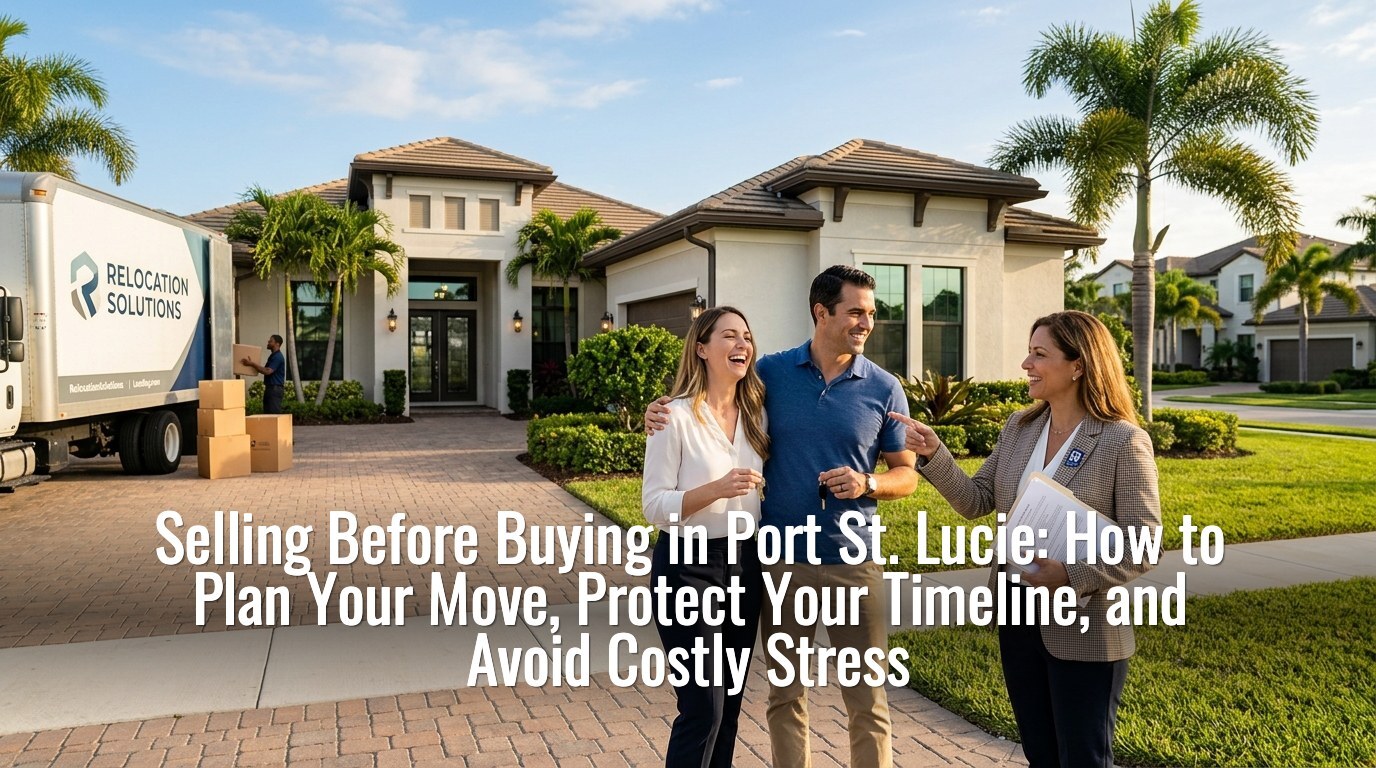
Selling Before Buying in Port St. Lucie: What to Know
How to plan your move, protect your timeline, and avoid costly stress — pricing, contingencies, financing readiness, leasebacks, inspections, appraisal, and closing coordination when your sale and your purchase depend on each other.
Quick Answer: How Do I Sell Before Buying Without the Chaos?
Selling before buying in Port St. Lucie works when you plan in the right order: review your home value and marketability first, speak with a lender to learn whether you must sell before you can qualify, prepare the home before your next-home search becomes urgent, then decide which timing tool fits — back-to-back closings, a home sale contingency, a post-closing occupancy (leaseback), or temporary housing. Price to your timeline, not just your wish, and track deadlines on both transactions. The most common mistake is starting too late — shopping first, falling in love with a home, then discovering your current home is not ready to list.
What This Guide Covers
- Should I Sell Before Buying?
- The First Step
- Is My Home Ready to Sell?
- Should I Look Before Listing?
- Can I Buy Contingent on Selling?
- Risks: Selling First vs. Buying First
- Coordinating Closing Dates
- Post-Closing Occupancy (Leaseback)
- Pricing & Prep for a Timed Move
- Financing Readiness
- Inspections & Appraisals on Both Sides
- HOA, Flood Zone & Insurance
- Title Review & Inherited Property
- The Five Paths, Compared
- “What If I Cannot Find the Next Home?”
- Temporary Housing & Avoiding the Rush
- Mistakes & the 10-Step Strategy
- FAQ: Selling Before Buying
Should I Sell My Home Before Buying Another One?
Selling your current home before buying the next can feel like solving two major life decisions at once. Where will I go if my home sells quickly? Can I make an offer before mine sells? What if I find the perfect home but mine is not under contract? Should I list first, buy first, or both?
For many homeowners, selling before buying is not just a preference — it may be necessary. You may need the proceeds to purchase the next home, or need to pay off your current mortgage to qualify for a new loan. You may be downsizing, relocating, moving closer to family, transitioning into a 55+ community, selling a waterfront property, or moving into something easier to maintain.
Sell First IfYou Need Clarity
You need the proceeds to buy. You want to avoid two mortgages. You need to know your net proceeds before offering. You are downsizing and want financial clarity. You are relocating and need a clean transition. Your home needs preparation first. You want to negotiate from a stronger position.
Buy First IfYou Have Flexibility
You have enough cash or financing strength. You want to avoid temporary housing or moving twice. You are searching for a very specific property type. You can comfortably carry both homes. Your current home is highly marketable when priced correctly.
There is no single right answer. A homeowner selling in Tradition may have different options than a seller in an older Port St. Lucie neighborhood. Moving from St. Lucie West to Palm City is different from relocating out of state. Moving from a waterfront home into a 55+ community means thinking through insurance, HOA timelines, title review, financing readiness, and possession dates carefully.
This article is educational only. It does not provide legal, tax, probate, financial, insurance, title, lending, or investment advice. Speak with qualified professionals — an attorney, tax professional, lender, insurance agent, HOA representative, or title professional — when those issues apply.
What Is the First Step When Selling Before Buying?
The first step is understanding your current home’s likely value, marketability, and realistic selling timeline — before you start touring homes.
- What your Port St. Lucie home may be worth
- How your home compares to active listings
- What repairs or preparation may be needed
- How quickly similar homes are attracting buyers
- What your estimated net proceeds may look like
- Whether you need proceeds to qualify for your next purchase
- Whether HOA, title, flood, insurance, or condition issues should be addressed early
- What timeline would make the move manageable
A home value review is especially important here because your next purchase may depend on your sale proceeds. Overestimate your value and you shop in the wrong price range. Underestimate it and you limit your options. List too high and the home sits — making your buying timeline stressful. The goal is not just to sell. The goal is to sell in a way that supports your next move.
Planning to sell and buy at the same time? Talk with Jeannie Jacobson before listing so you understand your value, timeline, and options before making a move.
How Do I Know If My Home Is Ready to Sell?
Your current home’s readiness affects your entire buying timeline. If it is clean, well-maintained, priced properly, and easy to show, you have more flexibility. If it needs repairs, updates, cleanout, landscaping, paint, or documentation, your timeline needs to start earlier.
A pre-listing review should consider curb appeal, interior cleanliness, decluttering, paint and flooring condition, roof age, HVAC age, plumbing and electrical concerns, pool condition, appliances, windows and doors, landscaping, pet or smoke odor, garage and storage, HOA documents, flood zone awareness, insurance-related documents, open permits or title issues, and seller disclosure awareness.
Why this matters more when selling first: if you find a home you want to buy but your current property still needs work, you may be forced to rush. Rushing leads to weak preparation, poor photos, pricing mistakes, and stressful negotiation. Prepare your current home before your next home search becomes urgent.
Should I Start Looking for My Next Home Before Listing Mine?
You can begin researching before listing — but be careful about getting emotionally attached before you understand your selling position. Exploring neighborhoods, price ranges, property types, and lifestyle needs is helpful. You may compare Tradition, St. Lucie West, PGA Village, Palm City, Stuart and Jensen Beach, or Fort Pierce, and decide whether you prefer a gated community, 55+ community, golf home, waterfront, single-story, lower-maintenance, or non-HOA neighborhood.
But before you write an offer, understand whether you can qualify before selling, whether your lender requires your current home to sell first, whether you have enough funds for deposit, inspections, appraisal, insurance, closing costs, and moving, whether your offer needs a home sale contingency, whether the next seller is likely to consider one, your current home’s status, and whether you need temporary housing or a post-closing occupancy.
The National Association of REALTORS states that, as of August 17, 2024, an MLS participant working with a buyer must enter into a written agreement with the buyer before touring a home, including in-person and live virtual tours. For homeowners selling and buying at once, this means understanding both sides of representation before touring or making offers.
Before you tour your next home, speak with Jeannie Jacobson about how your sale and purchase timelines connect — so you avoid shopping in the wrong order or deciding under pressure.
Can I Buy a Home Contingent on Selling Mine?
Yes — in some situations. Whether it works depends on the market, the seller’s motivation, the strength of your offer, your current home’s status, and the terms you propose. A home sale contingency generally means your purchase depends on the sale of your current property. If your home does not sell within the agreed timeline, the contract may allow certain options depending on the negotiated terms.
A seller may be more open if your current home is already under contract, priced realistically, or in a desirable market position. A seller may be less open if your home is not listed yet, overpriced, in poor condition, or uncertain.
What Your Realtor Should Evaluate
- Is your current home listed? Under contract?
- Has the inspection period passed?
- Has the buyer’s financing been reviewed?
- Has the appraisal been completed?
- Are there title or HOA issues?
- What is your expected closing date?
- How strong is your purchase offer aside from the contingency?
- Will the seller have backup offer rights?
- What happens if your sale falls through?
A contingent offer can work, but it must be structured carefully and realistically. Sellers receiving multiple offers may prefer a non-contingent buyer, especially for an attractive, well-priced home in a high-demand area. This is why preparing and pricing your current home well matters — your ability to buy may depend on how strong your sale looks to the next seller.
The Risks of Each Path
| Risks of Selling First | Risks of Buying First |
|---|---|
| Home sells before you find the next one | Carrying two mortgages, utilities, insurance policies, and tax obligations |
| Temporary housing costs; possibly moving twice | Pressure to sell quickly after closing |
| Pressure to buy something that is not the right fit | Risky if you need sale proceeds for the down payment |
| Storage and moving expenses | Risky if you must pay off your current mortgage to qualify |
| Interest rate or price changes in the next market | Risky if you are unsure what your home will sell for |
| Limited inventory in your target area | Risky if your home needs repairs or may take longer to sell |
| Buyer, inspection, appraisal, title, or HOA issues on your sale | You may feel pressured to accept a weaker offer |
These risks do not mean you should avoid selling first. They simply mean you need a plan — prepare your home early, get a realistic value review, speak with a lender before listing, research your next market, identify temporary housing options, discuss leaseback possibilities, understand contingency options, review contract timelines, and build a moving calendar. The goal is to reduce surprises.
Not sure whether to sell first or buy first? Jeannie Jacobson can help you review the local real estate side, while your lender and financial professionals help you understand financing and affordability.
How Do I Coordinate Closing Dates in Florida?
If your sale and purchase are connected, closing dates must be planned carefully — a delay on one side can affect the other. Your buyer’s loan may take longer than expected. Their appraisal may be delayed. They may request repairs after inspection. Your title company may need additional documents. Your HOA may need time for estoppel or approval. Your next purchase may have its own inspection or appraisal issue. The new home’s seller may need extra time to move.
Common Timing Options
Sell First, Buy Later
Maximum financial clarity; may require temporary housing.
Back-to-Back Closings
Can work, but requires strong coordination among agents, lenders, title companies, buyers, and sellers — especially if sale funds are needed for the purchase.
Post-Closing Occupancy
Sell, then stay briefly while your next purchase closes.
Home Sale Contingency
Buy contingent on your sale — strongest when your home is already under contract.
Avoid assuming everything will happen perfectly on the same day without planning. Discuss legal questions about contract terms, possession, occupancy, default, and liability with qualified professionals. Your Realtor coordinates the transaction; legal advice comes from an attorney.
What Is a Post-Closing Occupancy or Leaseback?
A post-closing occupancy arrangement — casually called a leaseback — may allow the seller to remain in the home for a period after closing. This can be useful when you sell before your next home is ready. For example, you may close on your Port St. Lucie sale but need one or two weeks before closing on your next purchase in Stuart, Palm City, or Tradition.
This is not something to treat casually. Important issues include length of occupancy, daily occupancy cost or rent, security deposit, insurance considerations, utilities, maintenance responsibilities, damage responsibility, final move-out date, access rights, default terms, buyer lender restrictions, and HOA rules. It should be documented properly, with legal and insurance questions reviewed by qualified professionals.
Some buyers agree to post-closing occupancy. Others will not — especially if they need to move in immediately or their lender has restrictions. Discuss this option early, not after the offer is accepted.
Need time after closing to move into your next home? Talk with Jeannie Jacobson before listing so your timeline, occupancy needs, and negotiation options are on the table from the start.
How Does Pricing Affect Selling Before Buying?
Pricing is critical when your sale and purchase are connected. Price too high and your home sits — delaying your purchase. Price too low without a clear strategy and you may leave behind equity that could have supported your next move.
A strong strategy considers recent comparable sales, active competition, condition, location, upgrades, roof age, HOA fees, flood zone awareness, insurance considerations, buyer demand, appraisal support, your moving timeline, and your next purchase goals.
When selling before buying, pricing is not just about what you want — it is about what your timeline requires. If you need to be under contract quickly to make an offer on your next home, pricing may need to be competitive. If you have flexibility, you may have more time — but the price should still be supported by data.
The wrong price creates a chain reaction. A slow sale may cause you to miss the next home. A weak contract creates uncertainty. A price the appraisal cannot support causes renegotiation. A buyer who is not financially ready delays closing.
How Should I Prepare If I Need to Sell Quickly?
Focus on practical improvements that help buyers feel confident: decluttering, deep cleaning, curb appeal, fresh paint where needed, lighting, odor removal, minor repairs, pool cleaning, landscape cleanup, pressure washing, organizing closets and garage, removing excess furniture, preparing for professional photography, and gathering documents.
Do not start major renovations without a strategy. Some improvements may not justify the time and cost; others delay your listing unnecessarily. A Tradition home may need to compete with newer construction, so move-in readiness matters. A St. Lucie West home may highlight convenience and condition. A PGA Village home benefits from lifestyle-focused presentation. A waterfront home may need documentation on flood zone awareness, insurance, dock or seawall condition, and outdoor features.
Need to sell before buying? Schedule a pre-listing walk-through with Jeannie Jacobson to identify the preparation steps that matter most before your home goes live.
How Does Financing Readiness Affect Selling and Buying at the Same Time?
Before you list or shop seriously, speak with a qualified lender. Your lender can help you understand whether you need to sell first, how much you may qualify for, whether your current mortgage affects your buying power, and what funds you need for down payment, closing costs, inspections, insurance, and moving expenses.
Questions to Ask Your Lender
- Do I need to sell my current home before buying?
- Can I qualify while still owning my current home?
- How much equity do I need from my sale?
- Can I use a bridge loan or similar product?
- What happens if my sale is delayed?
- What down payment options do I have?
- How will my debt-to-income ratio be reviewed?
- How does homeowners insurance affect my loan approval?
- What documents should I prepare now?
From a real estate strategy perspective, financing readiness affects your ability to make a strong offer. If you need a home sale contingency, your offer may be viewed differently than a non-contingent offer. Sellers of the home you want may ask whether your current home is listed, under contract, through inspections, or close to closing. The stronger your current sale looks, the stronger your purchase offer feels. Model your numbers with the mortgage calculators.
This blog does not provide financial or lending advice. A lender should guide financing decisions.
How Do Inspections and Appraisals Affect Both Sides?
When selling and buying at once, you may face inspection periods on both properties — and the timelines may overlap. On the sale side, your buyer may inspect and request repairs, credits, or concessions. On the purchase side, you may inspect and discover issues that affect your decision.
Inspection concerns on your sale may affect your proceeds. Concerns on your purchase may affect whether you still want the next home. If either side becomes uncertain, the whole move can feel unstable. Common issues: roof, HVAC, plumbing, electrical, water intrusion, pool equipment, appliances, windows and doors, drainage, pest or termite, safety items, and insurance-related concerns.
Disclosure awareness also matters. Florida Realtors explains that under Johnson v. Davis, a seller who knows facts materially affecting the property’s value that are not readily observable and not known to the buyer has a duty to disclose those facts. A smoother move begins with fewer surprises — which is why pre-listing preparation and honest disclosure awareness matter before you accept an offer.
How Do Appraisals Affect a Sell-Before-Buy Move?
There are two possible appraisal points in your timeline. If your buyer is financing your current home, their lender may require an appraisal. If you are financing your next purchase, your lender may order one too.
On your sale, a low appraisal may affect your proceeds or closing confidence. On your purchase, it may affect your loan, cash needs, or negotiation. No Realtor can guarantee an appraisal outcome — but a strong pricing strategy reduces appraisal risk through relevant comparable sales, accurate property information, and realistic positioning. If your sale price changes, your available funds change too. Do not build your plan around unsupported assumptions.
Inspection timelines can overlap. Work with Jeannie Jacobson to prepare your current home, understand buyer expectations, and keep both sides organized.
HOA, Flood Zone & Insurance on Both Sides of Your Move
How Do HOA Rules Affect Selling and Buying at the Same Time?
HOA rules can affect both transactions. If your current home is in an HOA, the buyer may need to review documents, understand fees, follow application procedures, and receive approval if required. If you are buying in an HOA community, you may need to review rules, restrictions, fees, application timelines, pet rules, leasing restrictions, parking rules, and amenities.
HOA timing can affect closing. A buyer purchasing your home in Tradition, St. Lucie West, or PGA Village may need approval before closing — if that takes longer than expected, closing may be delayed. Buying into a 55+ community, gated community, golf community, or condo association can be even more specific.
Before listing or buying, gather HOA contact information, fees, application requirements, approval timelines, transfer fees, capital contributions, rules and regulations, pet and leasing restrictions, parking rules, architectural guidelines, known special assessments, and age restrictions if applicable. Sellers should avoid unsupported statements about what an HOA will approve or allow.
How Does Flood Zone Awareness Affect a Move in Florida?
On your sale, buyers may ask about flood zones, prior flooding, drainage, insurance, storm protection, roof age, wind mitigation, or four-point inspection concerns. On your purchase, you should also review flood zone information and speak with a licensed insurance professional about coverage, premiums, and flood insurance needs.
Florida law requires a seller to complete and provide a flood disclosure to a purchaser of residential real property at or before the time the sales contract is executed. The statutory disclosure also tells buyers that homeowners insurance does not include coverage for flood damage and encourages them to discuss separate flood insurance with an insurance agent.
This is not a reason to panic. It is a reason to prepare.
How Does Insurance Affect Selling Before Buying?
When you sell, buyers may ask about roof age, wind mitigation, four-point items, prior claims, flood zone status, impact windows, shutters, plumbing, electrical, and HVAC age. When you buy, you may need insurance quotes before closing — your lender may require acceptable coverage, and premiums can affect your monthly cost and approval.
Gather roof permits and replacement records, wind mitigation and four-point reports if available, HVAC service records, water heater information, impact window or shutter documentation, elevation certificate, and flood-related documents. A delay securing insurance on the next home can delay your purchase closing; buyer insurance concerns on your current home can affect your sale. Sellers should not make insurance promises or guarantee insurability.
Title Review and Inherited Property
Title review matters in every sale — but even more when your sale proceeds are needed for your next purchase. If a title issue delays your sale, it may affect your ability to close on your next home.
Potential issues: open permits, liens, code violations, unreleased mortgages, mortgage payoff issues, estate or probate concerns, trust ownership questions, multiple owners, name discrepancies, divorce-related ownership issues, boundary or survey issues, and HOA estoppel delays. If you suspect any title issue, address it before listing — especially for an inherited, probate, trust-owned, tenant-occupied property, or one with prior unpermitted work.
Selling an Inherited Property Before Buying Another Home
Before listing, you may need to determine who has legal authority to sell, whether probate is required, whether all heirs agree, whether there are liens or unpaid taxes, and whether title can transfer properly. Do not assume you can sell immediately without confirming authority and title status.
Consult a qualified Florida attorney, tax professional, and title professional before listing or signing documents. A Realtor can help with market value, preparation, listing strategy, buyer communication, offer review, transaction coordination, and local positioning — but legal authority, probate, tax consequences, and ownership questions require qualified professional guidance. Inherited sales may also involve cleanout, repairs, utilities, insurance, security, family communication, and emotional decision-making. If you plan to use the proceeds to buy another home, address these early.
Title concerns, open permits, estate issues, or HOA questions? Talk with Jeannie Jacobson before listing so the right professionals are involved early.
The Five Paths, Compared in One View
A move-up is not just a sale. It is a sequence — and most homeowners are choosing between the same five paths without ever seeing them next to each other. Here they are.
| Path | What it gives you | What it costs you |
|---|---|---|
| 1. Sell first | Certainty. You know your actual proceeds before you shop, and you buy as a non-contingent buyer | You need somewhere to go — temporary housing, a longer closing, or negotiated occupancy after closing |
| 2. Buy first | No pressure on the purchase. The next home is secured before the current one sells | Financial exposure. Not every owner can or wants to carry both — review with qualified lending and financial professionals |
| 3. Home-sale contingency | Protection if your current home does not sell | A weaker offer. Not every seller accepts contingent offers, and strength depends on how far along your sale is |
| 4. Coordinate both closings | The cleanest outcome when it works — one move, no interim housing | Every party must hold the date: two lenders, two title companies, both sets of buyers and sellers, and the movers |
| 5. Post-closing occupancy | Breathing room. You close, then stay for a negotiated period | It is a real agreement with real terms — rent, insurance, utilities, condition, and move-out obligations to document |
There is no universally correct path. The right one depends on your equity, your financing, your risk tolerance, current inventory in the area you are buying into, and how much disruption you can absorb. That last one is personal, and it belongs in the decision as much as the numbers do.
“What If I Sell and Cannot Find the Next Home?”
This is the fear that stalls most move-up sellers — and the mirror version stalls the rest: what if I buy and then struggle to sell?
The fear is reasonable. Both scenarios happen, and neither is pleasant. But the answer is not to avoid planning until the market forces a decision. The answer is to build the plan before the pressure starts — because every one of the five paths above becomes harder to execute once you are already under contract on one side.
What a plan actually looks like: a realistic estimate of your current home’s sale timeline, a clear picture of your net proceeds, a defined search so you recognise the right home quickly, agreement on which path you prefer and which is your fallback, and a decision in advance about what you would do if the timing slips. Sellers who decide these things early make calm choices. Sellers who do not make late ones.
This matters most when the two homes sit in different submarkets. Moving from St. Lucie West to Palm City, for example, means selling into one buyer pool and buying into another — different price points, different inventory levels, different pace. Your sale timeline and your search timeline are not automatically the same, and planning should assume they are not.
Temporary Housing and How to Avoid Feeling Rushed
Temporary housing may not be your first choice, but it can protect you from rushing into the wrong purchase. If you sell first and have not found your next home, it may give you time to make a better decision.
Options include a short-term rental, staying with family, extended-stay housing, a seasonal rental, negotiated post-closing occupancy, moving into a second home if available, or storage plus a temporary living arrangement. If temporary housing is part of your plan, consider pet needs, school schedules, work commute, storage costs, furniture logistics, lease terms, utility transfers, moving company availability, insurance questions, and mail forwarding.
Temporary housing is not a failure. It is one possible strategy for protecting your long-term decision — instead of buying a home that does not fit because you feel rushed.
How Do I Avoid Being Rushed Into the Wrong Home?
Define your next-home criteria before your current home goes under contract: ideal location, maximum comfortable budget, must-haves, nice-to-haves, deal breakers, HOA preferences, commute needs, school or lifestyle priorities, single-story vs. two-story, maintenance tolerance, insurance comfort level, flood zone concerns, community amenities, and timeline flexibility.
If you are downsizing, be realistic about storage, furniture, garage space, and guest rooms. Moving into a 55+ community? Review rules, fees, amenities, and age restrictions. Buying waterfront? Speak with insurance professionals and review flood questions early. Moving to Palm City, Stuart, Jensen Beach, or Fort Pierce? Compare market differences carefully. The clearer you are before selling, the less likely you are to panic after accepting an offer.
How Can a Realtor Help Coordinate Selling and Buying?
A Realtor helps you connect the moving pieces: current home value review, pre-listing preparation, pricing strategy, marketing plan, showing coordination, offer review, home sale contingency planning, purchase search strategy, written buyer agreement conversation, buyer consultation, financing coordination with your lender, inspection timeline tracking, appraisal planning, HOA document coordination, title and closing communication, possession and moving timeline planning, and problem-solving when deadlines overlap.
The Realtor’s role is not to replace your lender, attorney, insurance agent, tax professional, title professional, or HOA representative. It is to coordinate the real estate strategy and keep the transaction organized. Local knowledge helps both sides: selling in St. Lucie West and buying in Tradition is different from selling in PGA Village and buying in Palm City. Moving from a waterfront home to a 55+ community is a different conversation than moving from a starter home into a larger family home.
Common Mistakes When Selling Before Buying
The most common mistake is starting too late. Many homeowners shop first, fall in love with a home, then realize their current home is not ready to list — creating pressure and rushed decisions.
- Relying only on an online estimate
- Overpricing the current home
- Underestimating preparation time
- Not speaking with a lender early
- Ignoring inspection concerns
- Failing to gather HOA documents
- Forgetting flood zone or insurance questions
- Assuming a contingent offer will always be accepted
- Not planning temporary housing
- Ignoring title issues until under contract
- Not reviewing net proceeds
- Focusing only on purchase price instead of contract terms
- Choosing a closing date without enough coordination
A move with two transactions requires planning. The earlier you prepare, the more options you may have.
The Best Strategy for Selling Before Buying in Port St. Lucie
The best strategy depends on your finances, home value, timeline, next-home goals, and risk tolerance. A strong plan usually follows this order:
Review your current home value and marketability
Start with a local home value review — not an online estimate. Understand your likely range, your competition, and your realistic timeline.
Speak with a lender
Learn your buying power and whether you must sell first. Ask about bridge options, debt-to-income, and what happens if your sale is delayed.
Prepare your home before listing
Cleaning, decluttering, curb appeal, minor repairs, documents. Prepare before your next-home search becomes urgent.
Research your next market and priorities
Define location, budget, must-haves, deal breakers, HOA preferences, and maintenance tolerance.
Decide your timing tool
Temporary housing, a leaseback (post-closing occupancy), or a home sale contingency — chosen deliberately, not in a panic.
List with a strategy that supports your timeline
Pricing and marketing built around when you need to be under contract, not just the number you hope for.
Review offers carefully
Inspection period, financing readiness, appraisal terms, seller concessions, closing date — and your net proceeds, not just price.
Coordinate your purchase to the strength of your sale
A sale that is under contract and past inspections makes your purchase offer far more credible.
Monitor deadlines on both transactions
Inspection, financing, appraisal, title, HOA, and closing dates — on the sale and the purchase.
Work closely with your professional team
Realtor, lender, title company, insurance agent, attorney, and HOA as needed.
This planning does not remove every risk — but it helps you move forward with more confidence and fewer surprises.
A coordinated move requires more than a listing. It requires a timeline, pricing strategy, buying plan, and closing coordination. Contact Jeannie Jacobson before you sell and buy in the Port St. Lucie or Treasure Coast market.
Chosen your path and need the sequence? See buying and selling at the same time — the financial questions to answer first, the decision deadlines behind each closing date, and how to protect your negotiating leverage on both sides.
FAQ: Selling Before Buying in Port St. Lucie
Tap any question to expand the answer.
Selling before buying can make sense if you need your sale proceeds to purchase the next home, want to avoid carrying two mortgages, or need financial clarity before making an offer. The right decision depends on your financing, timeline, home value, and next-home goals.
Yes, some buyers make offers contingent on selling their current home. Whether a seller accepts depends on the strength of your offer, whether your current home is listed or under contract, market conditions, and the terms of the contingency.
Coordinating closing dates requires communication among Realtors, lenders, title companies, buyers, sellers, and other professionals. You may use back-to-back closings, temporary housing, post-closing occupancy, or other negotiated timing strategies.
A post-closing occupancy agreement may allow a seller to remain in the home after closing for an agreed period. It should be documented carefully, and legal, insurance, lender, and HOA questions should be reviewed with qualified professionals.
You can research your next home before listing, but it is wise to understand your current home’s value, marketability, and financing position before getting serious about offers. Your sale may affect your buying power.
Your purchase options may be affected. Depending on the situation, you may need to adjust pricing, renegotiate timelines, use temporary housing, revise your financing plan, or pause your purchase search.
Your lender can help determine whether you need to sell first, whether you can qualify while owning your current home, and how your sale proceeds affect your next purchase. Speak with a qualified lender early.
Yes. Inspection issues on your sale or purchase can lead to repairs, credits, renegotiation, cancellation rights, or delays depending on contract terms. Preparing your current home before listing helps reduce surprises.
Yes. If your buyer’s lender or your own lender requires an appraisal, a low appraisal can affect the sale price, loan approval, cash needed, or negotiation. Appraisal risk should be considered when pricing and reviewing offers.
Yes. Jeannie Jacobson can help Port St. Lucie homeowners plan a coordinated selling and buying strategy, including pricing, preparation, marketing, offer review, inspection timelines, appraisal considerations, and closing coordination.
It is the fear that stalls most move-up sellers, and it is reasonable — but the answer is planning rather than delay. A plan may include temporary housing, a negotiated post-closing occupancy so you stay after closing, a longer closing period, adjusted search timing, or a contingency approach. Every one of those options is harder to arrange once you are already under contract, which is why the decision belongs before the pressure starts.
There is no universally correct answer. Selling first gives certainty about proceeds and makes you a non-contingent buyer, but you need somewhere to go. Buying first removes purchase pressure but creates financial exposure. A contingency protects you but weakens the offer, and not every seller accepts one. The right path depends on your equity, financing, risk tolerance, current inventory, and how much disruption you can absorb.
It can. If you are selling in one submarket and buying in another — St. Lucie West to Palm City, for example — you are selling into one buyer pool and buying into another, with different price points, inventory levels, and pace. Your sale timeline and your search timeline are not automatically the same, and the plan should assume they are not.
Often, yes. For a move-up seller the closing date can be worth as much as the price, because it determines whether the two transactions align. Financing strength, appraisal risk, inspection period, deposit, post-closing occupancy, and buyer flexibility all shape whether the sale supports your purchase — a slightly lower offer with workable timing is sometimes the better outcome.
Final Thoughts: It Does Not Have to Feel Chaotic
With the right plan, you can understand your home’s value, prepare your listing, speak with your lender, research your next home, evaluate timing options, and move through both transactions with more clarity. Before you list your current home or start making offers on the next one, talk with Jeannie Jacobson about your timeline, your property, your goals, and your local options.
Plan Your Move Before You List
Selling and buying in Port St. Lucie, Tradition, St. Lucie West, PGA Village, Palm City, Stuart, Jensen Beach, Fort Pierce, or the surrounding Treasure Coast? Build the plan first.
Disclaimer: This article is for general educational purposes only and is not legal, tax, probate, financial, insurance, investment, title, HOA, contract, or lending advice. Real estate laws, insurance rules, and market conditions can change. Buyers and sellers should consult qualified professionals — including licensed attorneys, tax professionals, lenders, insurance agents, HOA representatives, and title professionals — for guidance specific to their transaction. All information is deemed reliable but not guaranteed and should be independently verified. Jeannie Jacobson is a Licensed Florida Real Estate Professional with RE/MAX Gold. Equal Housing Opportunity.