

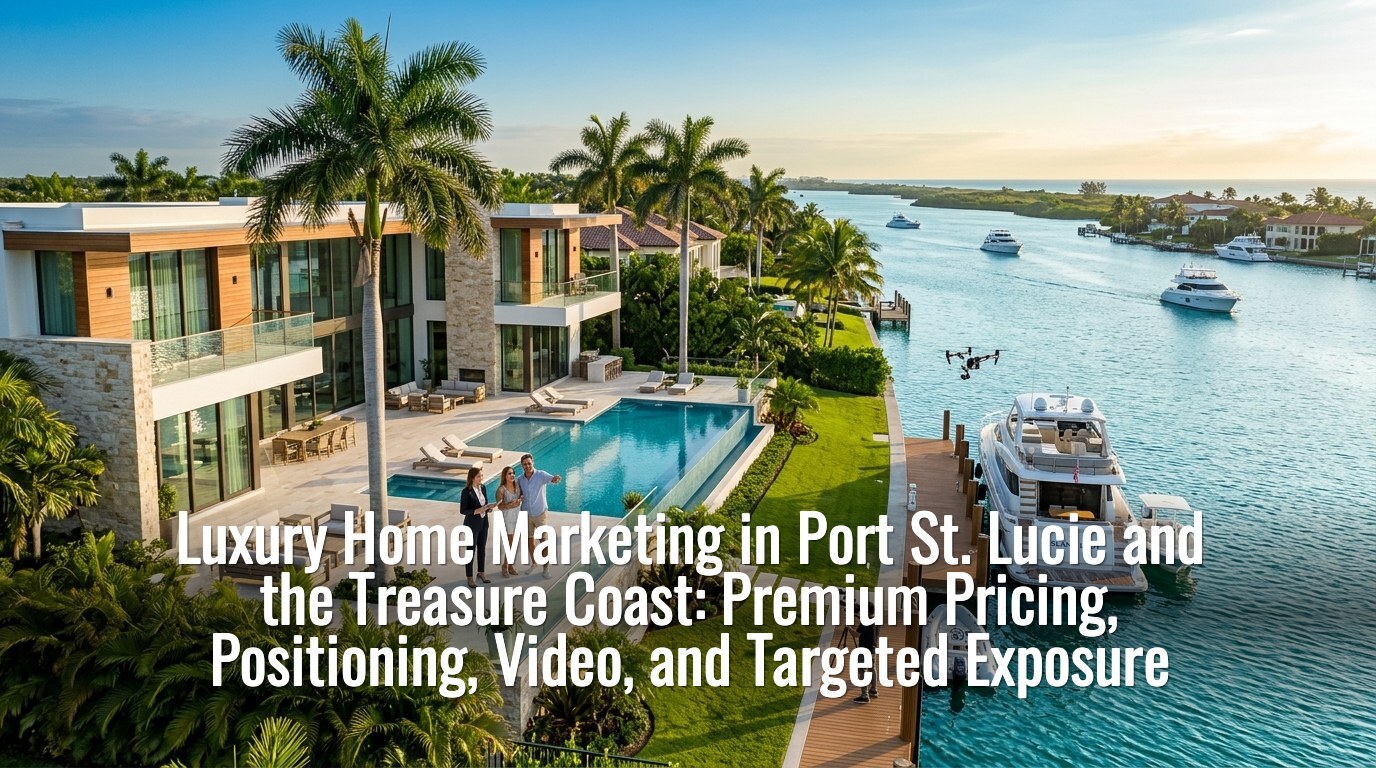
Luxury Home Marketing in Port St. Lucie and the Treasure Coast
Premium pricing, positioning, video, and targeted exposure — how high-end homes are actually marketed, and what luxury sellers should know before a waterfront, golf course, or custom estate goes live.
Request a Luxury Listing ConsultationGet a Property Value Review
Quick Answer: How Do You Market a Luxury Home?
Luxury home marketing in Port St. Lucie works when presentation, positioning, and pricing align. Start with a precise pricing review (luxury comparables are limited and must be interpreted, not copied), prepare the home to a detailed standard, then invest in premium photography, video and drone content, and a property description that explains how the home lives — not just how many bedrooms it has. Identify the single strongest buyer profile (waterfront, golf, relocation, downsizer) and speak directly to it through MLS, local search visibility, social, and agent networks. Keep every claim verified and compliant. Luxury marketing should feel elevated — never inflated.
Educational only. This content does not provide legal, tax, financial, insurance, title, HOA, lending, investment, or appraisal advice. Luxury sellers should consult qualified professionals for legal, tax, insurance, financing, flood coverage, HOA, title, estate, or investment questions.
What This Guide Covers
- Why Luxury Needs a Different Strategy
- What Makes a Home “Luxury” Here
- Pricing & Why Comparables Are Harder
- Premium Photography
- Video & Drone Marketing
- Writing the Property Description
- SEO, GEO & AEO Visibility
- Buyer Positioning & Agent Networks
- Preparation & Showings
- Compliance-Aware Advertising
- Disclosure Awareness
- Waterfront, Flood Zone & Insurance
- Offers, Inspections & Appraisals
- Common Mistakes & How Jeannie Helps
- FAQ: Luxury Home Marketing
Why Luxury Homes Need a Different Marketing Strategy
Selling a luxury home is different from selling a traditional property. The price point is higher. The buyer pool is more selective. Expectations are elevated. The marketing needs to feel polished, intentional, accurate, and compelling from the very first impression.
Your property is not just rooms and square footage. It may represent privacy, waterfront living, golf course lifestyle, custom architecture, outdoor entertaining, upgraded finishes, generous space, a premium lot, or a specific way of living buyers cannot find everywhere.
At a higher price point, buyers are not only asking “How many bedrooms does it have?” They are asking, “Does this home feel worth the price?” That means the marketing must do more than list features. It should communicate the lifestyle, the setting and location, the quality of finishes, the flow of the floor plan, the outdoor living experience, privacy and views, community amenities, nearby conveniences, architectural details, condition, and buyer benefits.
A standard listing says: “4 bedrooms, 3 bathrooms, pool home.”
A luxury listing goes deeper — it helps the buyer understand how the home lives.
If a home in PGA Village overlooks a golf course, the listing should describe waking up to open views, outdoor living, and proximity to golf and community amenities. If a Palm City home offers privacy and a larger lot, speak to space, quiet, and room to entertain. If a waterfront home near Stuart or Jensen Beach offers views, boating access, or outdoor entertaining, present those features with accuracy and care.
Luxury marketing is not about exaggeration. It is about clarity, polish, and positioning.
What Makes a Home “Luxury” in Port St. Lucie and the Treasure Coast?
Luxury is not defined only by price. Price matters, but luxury is also shaped by location, privacy, architecture, finishes, land, views, water access, golf setting, custom design, amenities, and lifestyle.
Luxury homes here may include waterfront homes, golf course homes, custom-built estates, large-lot properties, gated community homes, premium outdoor living, upgraded pool homes, high-end kitchens and baths, properties near boating or beaches, homes with preserve/lake/river/golf views, sought-after communities, multigenerational designs, and homes with smart technology and upgraded systems.
Tradition
Luxury tied to newer construction, planned-community amenities, stylish finishes, and lifestyle convenience.
St. Lucie West
Location, space, upgrades, and access to shopping, dining, medical services, and I-95.
PGA Village
Golf, views, club lifestyle, privacy, and community character.
Palm City · Stuart · Jensen Beach
Waterfront access, larger lots, boating lifestyle, coastal proximity, or custom architecture.
It is not enough to say the home is luxury. The marketing should show why.
Thinking about selling a luxury home? Schedule a luxury listing consultation with Jeannie Jacobson to discuss your property’s unique features, buyer profile, pricing strategy, and marketing plan.
How Do You Price a Luxury Home?
Luxury pricing requires precision, patience, and local market knowledge — and it is more complex than standard pricing because comparable sales may be limited. Each high-end home may have unique features that make direct comparison difficult.
A luxury pricing review considers recent luxury sales, active luxury competition, pending high-end listings, condition, architectural quality, lot size, waterfront/lake/preserve/golf views, outdoor living features, pool design, interior finishes, renovation quality, roof age, HVAC and major systems, impact windows or storm protection, smart home features, privacy, gated community value, HOA rules and fees, flood zone awareness, insurance considerations, buyer demand, appraisal considerations, and the seller timeline.
Luxury pricing should also consider what buyers can choose at similar price points. A buyer looking in Port St. Lucie may also compare Palm City, Stuart, Jensen Beach, Fort Pierce, Vero Beach, Jupiter, or Boca Raton. That does not mean every market is the same — it means higher-end buyers compare lifestyle, value, location, and quality across a wider area.
Why Luxury Comparables Are More Complicated
In a traditional neighborhood, several similar homes may have sold recently. Luxury homes are often different. One has a larger lot. Another a newer roof. One a custom pool; another direct water views. One high-end renovations; another original finishes. One gated; another non-HOA with more privacy. One golf frontage; another a preserve view. These differences matter — luxury comparables should be reviewed carefully, not copied blindly.
| Question | Why It Matters |
|---|---|
| Which recent sales are most relevant? | Not every nearby sale is a valid comparable |
| How does condition and finish level compare? | Renovation quality can move value significantly |
| Is the lot, view, and community comparable? | Premiums vary by setting |
| Were there seller concessions? | Headline price may not reflect net |
| Did the home sell quickly or sit? | Signals pricing accuracy |
| Cash or financed? Any appraisal issues? | Affects how the sale should be weighted |
If priced too high without market support, qualified buyers hesitate. If priced too low without a clear strategy, the seller is not protecting value. For luxury sellers, pricing is both data and interpretation. The goal is not to guess high and hope — it is to understand where the property fits within the current buyer pool. See the home value framework.
Before listing a high-end property, talk with Jeannie Jacobson about luxury pricing — balancing confidence, market support, and buyer appeal.
Why Premium Photography Is Essential
Most buyers see a home online before deciding whether to schedule a showing. That first impression determines whether they pause, click, save, inquire — or move on. For luxury, photography should feel intentional and polished: it should show more than rooms. It should show space, flow, light, finishes, setting, and lifestyle.
- Wide-angle interior images and detail shots of finishes
- Kitchen and bath photography
- Outdoor living, pool, and patio images
- View-focused images
- Twilight photography
- Drone photography when appropriate
- Community or lifestyle imagery when allowed and accurate
- Curb appeal and natural light photography
A luxury buyer should understand the home before stepping inside — how the main living areas connect, the outdoor space, the scale of the rooms, the quality of the finishes, and the setting.
Poor photography makes an expensive home feel ordinary. Dark rooms, clutter, awkward angles, or missing exterior shots reduce buyer interest. Preparation before photography is critical: clean, decluttered, well-lit, and photo-ready; outdoor areas staged; pool clean; landscaping maintained; personal items minimized. Luxury buyers notice details.
Do Luxury Homes Need Video Marketing?
Photography captures moments. Video shows movement, flow, and lifestyle — helping buyers understand how spaces connect and how indoor and outdoor areas work together.
Video marketing may include a property walk-through, lifestyle video, drone video, community-focused video, short-form social clips, twilight or golden-hour footage, outdoor living video, and feature-focused segments. For a Treasure Coast luxury home, video can communicate the setting — a long driveway, golf course view, waterfront perspective, pool area, summer kitchen, screened lanai, grand entry, or custom layout.
Video is especially useful for relocation buyers. A buyer moving from another state may not be able to visit immediately. High-quality video helps them decide whether the home is worth a private showing — or a trip to the area.
Video should be polished, but also accurate. It should not misrepresent the home’s condition, views, boundaries, amenities, or features. The goal is to attract serious buyers with a clear, compelling presentation.
A luxury listing deserves more than basic photos. Ask Jeannie Jacobson how professional photography, video, drone content, and property storytelling can present your home at the level it deserves.
How Should a Luxury Property Description Be Written?
It should feel polished, specific, and buyer-focused — never generic. It should not rely on empty phrases like “must see” or “beautiful home” without explaining what actually makes the property special.
Highlight location, architecture, floor plan, natural light, kitchen features, primary suite, guest spaces, outdoor living, pool or spa, views, privacy, lot features, community amenities, lifestyle benefits, nearby conveniences, and accurate property details. The writing should help buyers imagine the experience of living in the home.
WeakGeneric Phrases
“Nice backyard.” “Great location.” “Luxury finishes throughout.” — tells the buyer nothing verifiable.
StrongSpecific & Accurate
“A private outdoor living area with space for dining, relaxing, and entertaining near the pool.” “Near Tradition’s shopping and dining.” Name specific finishes when verified.
Elegant but not exaggerated — accurate, compliant, and grounded in real features.
How Do SEO, GEO, and AEO Help Luxury Home Marketing?
Luxury marketing is not only MLS exposure — it is digital visibility. SEO helps content appear in relevant search results. GEO connects the property to local search terms and communities. AEO helps content answer buyer questions clearly for AI search, voice search, and platforms that summarize information.
For Port St. Lucie and the Treasure Coast, this may include natural use of terms such as luxury home in Port St. Lucie, Treasure Coast luxury real estate, PGA Village golf course home, waterfront home in Stuart, luxury home near Tradition, St. Lucie West upgraded home, Palm City estate property, Jensen Beach luxury home, Fort Pierce waterfront property, and South Florida luxury real estate. These terms should be used naturally, not stuffed into the content.
AEO-style content also answers real buyer questions: How do you market a luxury home? What makes luxury pricing different? Do luxury homes need video? How do waterfront features affect value? What should sellers do before listing a high-end home? How do inspections and appraisals work on luxury homes?
Luxury buyers often begin online. Contact Jeannie Jacobson to discuss how SEO, local positioning, search-friendly property descriptions, and buyer-focused content can support your luxury marketing strategy.
Positioning for the Right Buyer & Agent Networks
Luxury marketing should begin with one question: Who is the most likely buyer for this home? A waterfront home attracts a different buyer than a golf course home. A newer home in Tradition appeals to a different audience than a custom home in Palm City.
Potential luxury buyer profiles: local move-up buyers, retirees, snowbirds, relocation buyers, executives, golf lifestyle buyers, waterfront and boating-focused buyers, downsizers seeking quality, multigenerational families, buyers seeking privacy, and buyers leaving higher-cost South Florida markets.
Once the profile is clear, the marketing should speak to that buyer’s priorities. A golf buyer cares about views, community, club access, and proximity to courses. A waterfront buyer cares about view, access, insurance, flood zone awareness, dock or seawall condition, and outdoor living. A relocation buyer cares about community, healthcare access, commute routes, airports, beaches, and lifestyle. A downsizer cares about single-level living, low maintenance, HOA services, and comfort.
Luxury marketing should not try to appeal to everyone equally. It should identify the strongest audience and present the property in a way that resonates with that audience.
How Do Agent Networks Help?
Luxury buyers are not always found through public search alone. Agents often know buyers searching for specific property types — waterfront, golf course, larger lot, gated, or high-end. A plan may include MLS exposure, agent-to-agent outreach, brokerage network promotion, local agent communication, targeted buyer agent updates, private showing coordination, open house strategy when appropriate, digital property materials, and follow-up with interested agents.
Not every luxury home needs the same outreach. Some sellers want broad exposure; others prefer a more discreet approach. Privacy, security, showing access, and seller preferences all matter. Luxury homes often require more qualified showing coordination — sellers may want proof of funds or lender documentation before private showings. This should be handled carefully, consistently, and in compliance with fair housing and professional standards.
Preparing a Luxury Home and Handling Showings
How Should Sellers Prepare Before Listing?
Walk through the property with a buyer’s eye. What will buyers notice first? What feels impressive? What feels dated? Preparation may include deep cleaning, decluttering, professional staging or a staging consultation, landscape refresh, pool service, outdoor furniture arrangement, window cleaning, pressure washing, paint touch-ups, lighting updates, minor repairs, garage and closet organization, luxury detail cleaning, odor removal, and photography, drone, and video preparation.
Documents Worth Gathering
- Survey and floor plan if available
- HOA documents and upgrade list
- Roof records and HVAC service records
- Appliance warranties and pool service records
- Impact window or shutter documentation
- Smart home system details
- Insurance-related documents when appropriate
- Elevation certificate if available
- Dock or seawall records when applicable
- Permit records
Luxury buyers ask detailed questions. Being prepared creates confidence.
How Should Showings Be Handled?
Luxury showings should be organized, respectful, and intentional. High-end buyers expect privacy, convenience, and a professional experience — and sellers need to protect their privacy, valuables, security, and schedule.
Before showings begin, discuss showing notice requirements, proof of funds or pre-approval expectations when appropriate, security procedures, valuable item removal, confidential documents, pet plans, lighting and temperature, access instructions, seller privacy, showing feedback, and agent accompaniment when needed.
The home should be show-ready for every appointment. If the property has special features, the showing experience should help buyers understand them — feature sheets, upgrade lists, floor plans, community information, HOA documents, or property brochures. A luxury showing is not just access. It is presentation.
Before investing in staging, landscaping, repairs, or luxury photography, schedule a pre-listing consultation with Jeannie Jacobson to identify which steps matter most for your property and buyer pool.
Why Compliance-Aware Advertising Matters for Luxury Listings
Luxury marketing should be polished — but it must also be accurate. Florida rules require advertising to be presented so reasonable people know they are dealing with a real estate licensee, require ads to include the licensed name of the brokerage firm, and prohibit anything fraudulent, false, deceptive, or misleading.
Luxury listings often include high-value features that should be verified before advertising: square footage, lot size, waterfront access, dock or seawall condition, golf course frontage, HOA fees, community amenities, age restrictions, renovation claims, roof age, impact window claims, smart home features, appliance brands, pool features, guest house or suite use, rental possibilities, zoning or use claims, flood zone statements, and property boundaries.
Instead of “the best luxury home on the Treasure Coast,” describe accurate features: verified water views, custom finishes, an outdoor living area, a premium lot, a private setting, a gourmet-style kitchen, a golf course view, or proximity to community amenities.
Strong advertising builds interest. Accurate advertising protects trust.
What Should Luxury Sellers Know About Disclosure Awareness?
Luxury homes may have complex features, systems, improvements, and conditions. Florida Realtors explains that under Johnson v. Davis, a seller who knows facts materially affecting the property’s value that are not readily observable and not known to the buyer has a duty to disclose them.
For luxury sellers, known material facts may involve water intrusion, roof issues, structural concerns, mold, major system defects, pool or spa defects, unpermitted improvements, drainage problems, dock or seawall concerns, prior flood-related issues, HVAC or electrical issues, smart home system defects, generator issues, or elevator issues.
Luxury does not eliminate disclosure responsibilities. In fact, higher-value properties often have more features and systems for buyers to inspect. Disclosure awareness should not be treated as a negative — it is part of a responsible and transparent sale.
Luxury buyers ask detailed questions. Work with Jeannie Jacobson to prepare accurate property information, organize documents, and understand how disclosure awareness fits your listing strategy.
Waterfront, Flood Zone & Insurance in Luxury Marketing
Waterfront and water-view properties are among the most desirable luxury homes on the Treasure Coast — and they require careful marketing and due diligence. If a home has a lake view, river access, canal frontage, dock, seawall, boat lift, or other water feature, the listing should describe it accurately. Buyers may verify access, restrictions, water depth, maintenance requirements, permits, insurance needs, and flood zone information.
Florida law requires sellers to complete and provide a flood disclosure to buyers of residential real property at or before the sales contract is executed. The statutory disclosure also notes that homeowners insurance does not include coverage for flood damage and encourages buyers to discuss separate flood insurance with an insurance agent.
Luxury sellers should not provide insurance advice unless properly licensed. Buyers should speak with licensed insurance professionals about coverage, flood insurance, premiums, and insurability.
For waterfront or flood-sensitive properties, gather: elevation certificate, flood insurance information, prior flood-related records, dock permits or documentation, seawall records, drainage information, storm protection documentation, roof records, wind mitigation report, and insurance-related documents. These help answer buyer questions and reduce uncertainty — they do not replace buyer due diligence or professional advice.
How Do HOA Rules Affect Luxury Homes?
Many luxury properties here are in HOA or gated communities — and HOA details influence value, buyer interest, showing expectations, offer terms, and closing timelines. Gather HOA fees, application requirements, approval timelines, transfer fees, capital contributions, rules and regulations, architectural guidelines, pet and leasing restrictions, parking rules, golf or club membership information when applicable, amenity details, known special assessments, gate access procedures, and community contact information.
In luxury communities, HOA amenities may be part of the lifestyle story — gated access, clubhouses, golf, fitness centers, pools, tennis, pickleball, walking trails, and community events. However, these should be described accurately and verified. Sellers should avoid unsupported statements about what the HOA will approve or allow.
Luxury home in an HOA, gated, golf, or waterfront community? Talk with Jeannie Jacobson about how community features, rules, fees, and approval timelines should be handled in your listing strategy.
Offers, Inspections, Appraisals & Closing
How Should Offers Be Reviewed on a Luxury Home?
Luxury offer review goes beyond the purchase price. At higher price points, financing, proof of funds, appraisal terms, contingencies, inspection periods, concessions, closing dates, and possession terms all affect offer strength.
Review purchase price, cash or financing, proof of funds, lender documentation, earnest money deposit, inspection period, appraisal terms, financing contingency, seller concessions, closing date, personal property requests, HOA approval timeline, title review, buyer flexibility, net proceeds, and post-closing occupancy requests.
A cash offer may appeal, but still needs proof of funds and clear terms. A financed offer may be strong if the buyer is well-prepared, though appraisal and underwriting timelines matter. A high offer with a long inspection period, large concessions, or uncertain financing may not be as strong as it first appears.
Personal property becomes part of the conversation in luxury. Buyers may ask for furniture, artwork, outdoor furniture, appliances, or equipment. Be clear about what stays and what does not.
The National Association of REALTORS states that, as of August 17, 2024, an MLS participant working with a buyer must enter into a written agreement with the buyer before touring a home, including in-person and live virtual tours. For sellers, this may show up through compensation requests, concessions, or closing cost requests. Review the full financial structure, not just the headline price. Commissions are negotiable.
How Do Inspections Work for Luxury Homes?
Luxury inspections are more detailed because high-end homes have more systems. Beyond standard items, buyers may inspect the pool and spa, outdoor kitchen, irrigation, smart home systems, generator, impact windows or shutters, dock or seawall, elevator, security systems, drainage, moisture, structural elements, and pest concerns.
Luxury buyers may bring specialized inspectors or contractors — a waterfront buyer may want dock or seawall review; an estate buyer may want roof, pool, or structural specialists. Prepare by gathering documentation and addressing known concerns before listing when appropriate.
How Do Appraisals Affect Luxury Sales?
Appraisals are more complex for luxury because comparable sales may be limited. Challenges may involve few recent comps, unique custom features, waterfront or golf premiums, major renovations, large lots, gated communities, high-end outdoor living, distinct architecture, a limited buyer pool, and different nearby market comparisons.
A Realtor cannot guarantee an appraisal result. But a strong luxury strategy organizes property details, upgrade lists, relevant comparable sales, and accurate feature descriptions. Appraisal considerations should be discussed during pricing and offer review — not after the contract is already under stress.
Title Review & Closing Coordination
Luxury transactions involve more documents and coordination. Title review may include ownership verification, mortgage payoff, liens or judgments, trust ownership questions, estate issues, open permits, boundary or survey concerns, HOA estoppel, code issues, name discrepancies, homestead questions, and prior unrecorded matters. If the property is owned by a trust, estate, business entity, or multiple owners, involve legal and title professionals early.
Closing coordination may involve HOA approval, gate access transfer, keys and remotes, security codes, smart home transfer, pool and equipment instructions, appliance warranties, generator information, dock or boat lift records, utility transfer, final walkthrough, and repair documentation. Buyers at this level expect detailed information and smooth communication.
When offers come in on a luxury property, details matter. Jeannie Jacobson can help you compare price, terms, buyer strength, contingencies, inspection periods, appraisal considerations, concessions, and closing timelines.
Common Mistakes in Luxury Home Marketing
- Overpricing without market support
- Using basic or poor photography
- Skipping video when the property needs lifestyle presentation
- Writing generic listing descriptions
- Ignoring the buyer profile
- Failing to prepare the home before photos
- Not highlighting outdoor living
- Not documenting upgrades
- Misrepresenting features
- Ignoring HOA documents
- Overlooking flood zone awareness
- Not preparing for insurance questions
- Failing to review inspection risks
- Not considering appraisal support
- Not verifying advertising claims
- Making unsupported guarantees
- Limiting showing access too much
- Treating luxury buyers like standard buyers
Luxury marketing should feel elevated, but not inflated. Polished, accurate, and strategic — the goal is to help qualified buyers understand why the property deserves attention.
How Can Jeannie Jacobson Help Market a Luxury Home?
A luxury listing consultation may include property value review, luxury comparable sales review, active competition analysis, buyer profile discussion, pre-listing preparation guidance, photography and video planning, drone and lifestyle content discussion, property description strategy, local SEO and GEO positioning, AEO-friendly content planning, showing strategy, offer review, inspection period planning, appraisal consideration review, HOA document coordination, flood zone and insurance question awareness, and title and closing coordination.
Jeannie helps sellers in Port St. Lucie, St. Lucie West, Tradition, PGA Village, Palm City, Stuart, Jensen Beach, Fort Pierce, and nearby South Florida markets. Selling luxury real estate is not about simply listing at a higher price — it is about understanding the home’s story, presenting it professionally, reaching the right buyers, and managing the transaction carefully from first consultation to closing.
Selling waterfront specifically? See Selling a Waterfront Home on the Treasure Coast for dock, seawall, flood awareness, and view-focused pricing and marketing.
Choosing who will list your luxury home? This guide covers the marketing campaign itself. For what a luxury listing agent in Port St. Lucie should bring to the table — concierge listing preparation, disclosure awareness, inspection and appraisal planning, HOA coordination, and closing — see the luxury seller’s guide.
Selling above $2 million? The high end works differently — a much smaller buyer pool, thinner comparables, and an expectation of discretion. See positioning a $2M+ Treasure Coast property for qualified buyers.
Related: the Treasure Coast luxury homes guide.
FAQ: Luxury Home Marketing
Tap any question to expand the answer.
A luxury home should be marketed with strategic pricing, professional photography, polished property descriptions, video when appropriate, drone content when useful, local SEO, social media exposure, agent networking, targeted buyer positioning, and accurate advertising.
Luxury homes are often harder to compare because each property may have unique features, views, finishes, lot size, architecture, or community amenities. Pricing should consider recent luxury sales, current competition, condition, location, buyer demand, and appraisal considerations.
Video is highly useful for many luxury homes because it shows layout, flow, outdoor living, views, and lifestyle. It can be especially helpful for relocation buyers who want to understand the property before visiting in person.
Professional photography creates the first impression online. Luxury buyers expect polished visuals that show the home’s space, lighting, finishes, setting, outdoor living, and unique features clearly.
With accurate descriptions of views, outdoor living, water-related features, and lifestyle benefits. Sellers should also prepare for buyer questions about flood zone awareness, insurance, permits, docks, seawalls, and maintenance.
HOA rules, fees, amenities, approval timelines, transfer fees, pet restrictions, leasing rules, and architectural guidelines can affect buyer interest and closing coordination. Sellers should gather HOA information early.
Staging or presentation guidance helps luxury buyers understand the home’s scale, flow, and lifestyle. Some homes benefit from full staging, while others may only need decluttering, furniture editing, cleaning, and visual preparation.
By purchase price, proof of funds, financing readiness, earnest money, inspection period, appraisal terms, concessions, closing date, contingencies, and net proceeds. The highest price is not always the strongest offer.
Yes. Luxury homes may have limited comparable sales or unique features, which can make appraisal review more complex. A strong pricing strategy and accurate documentation help support the process, but no appraisal outcome can be guaranteed.
Yes. Jeannie Jacobson can help luxury sellers in Port St. Lucie and the Treasure Coast with pricing, preparation, professional marketing, buyer positioning, offer review, inspection planning, appraisal considerations, and closing coordination.
Final Thoughts: More Than a Sign and a Few Photos
Selling a luxury home in Port St. Lucie or the Treasure Coast takes more than a sign, a listing, and a few photos. Your property deserves a marketing strategy that reflects its value, lifestyle, location, architecture, condition, and buyer appeal — from pricing and preparation to premium photography, video, local search visibility, buyer targeting, offer review, inspection periods, appraisal considerations, and closing coordination. Every detail matters.
Selling a Luxury Home on the Treasure Coast?
Port St. Lucie, St. Lucie West, Tradition, PGA Village, Palm City, Stuart, Jensen Beach, Fort Pierce — let’s position your property before it goes on the market.
Disclaimer: This article is for general educational purposes only and is not legal, tax, probate, estate, financial, insurance, investment, title, HOA, appraisal, contract, or lending advice. Real estate laws, insurance rules, and market conditions can change. Sellers should consult qualified professionals — including licensed attorneys, tax professionals, lenders, insurance agents, HOA representatives, title professionals, and appraisers — for guidance specific to their transaction. All information is deemed reliable but not guaranteed and should be independently verified. Jeannie Jacobson is a Licensed Florida Real Estate Professional with RE/MAX Gold. Equal Housing Opportunity.