

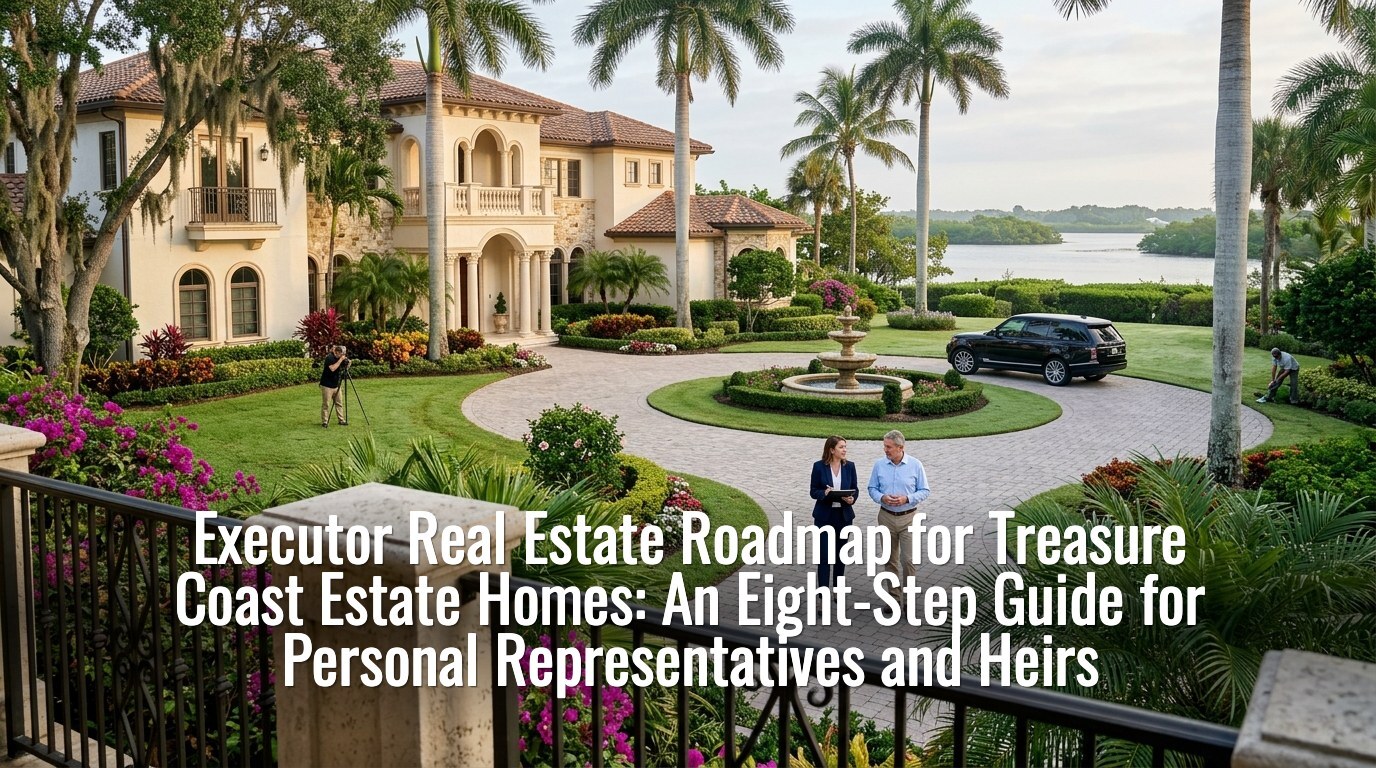
Executor Real Estate Roadmap for Treasure Coast Estate Homes
A careful, step-by-step planning guide for executors, personal representatives, and heirs preparing to sell estate property — in the order the decisions actually arrive.
Quick Answer: What Should an Executor Do First?
Selling an estate property is different from a typical home sale — there may be family emotions, legal steps, personal belongings, property maintenance, title questions, and several people involved in every decision. An executor real estate roadmap creates order by putting those decisions in sequence. Confirm who has authority before anything else. Secure and maintain the property. Gather what documentation exists. Handle belongings carefully. Evaluate condition before spending estate funds. Price objectively. Agree how the family will communicate. Then choose a marketing strategy that fits the home and the timeline.
Educational only. This article is for general real estate information. It is not legal, tax, financial, probate, estate, insurance, or accounting advice. Probate requirements, authority to act, and timelines vary by estate and by circumstance. Families should consult a qualified Florida probate attorney, tax professional, and other appropriate advisors for guidance specific to their situation.
The Eight-Step Roadmap
- Confirm Who Can Make Decisions
- Secure the Property
- Build a Property Access Plan
- Gather Property Information
- Decide About Personal Belongings
- Evaluate Condition Before Spending
- Price Objectively
- Create a Communication Plan
- Choose a Real Estate Strategy
- Review Offer Terms, Not Just Price
- FAQ: Executors & Estate Homes
Related reading: selling an inherited home covers the sale itself in depth, working with a probate Realtor covers attorney coordination and closing, and common mistakes covers what to avoid. This guide is the sequence — what to do first, second, and third.
Secure the Property
Estate homes often sit vacant or receive limited attention, sometimes for months. Security and maintenance should be addressed early — a vacant Florida home can develop problems quickly, and those problems reduce value before anyone has priced anything.
Access & Security
Locks, who holds keys, gate or community access, and valuable belongings still inside.
Utilities
Whether power and water stay on. In Florida, air conditioning matters — a closed, unconditioned house invites humidity and mold.
Insurance
Vacant property may be treated differently by insurers. Confirm coverage status with a licensed insurance professional rather than assuming an existing policy still applies.
Grounds & Pool
Lawn care, pool service if applicable, and pest concerns. Neglected grounds also signal vacancy to the neighborhood.
Water & Storm
Leaks, drainage, and storm preparation — an unoccupied home has no one to notice a slow leak or shutter a window.
Collect or forward it. Accumulating mail is both a security signal and a source of documents you may need.
A secure, maintained property is easier to evaluate, show, and sell — and easier to insure while the estate process runs its course.
Build a Property Access Plan Early
Estate homes often have missing keys, old locks, security concerns, or family members unsure who should be entering the property. Access confusion is one of the most preventable causes of delay in an estate sale — and it stalls almost everything at once:
Marketing
Photography and video cannot be scheduled around a key nobody can find.
Showings
A buyer who cannot get in this week often buys something else next week.
Vendors
Cleanout crews, landscapers, and repair vendors each need a confirmed way in.
Due Diligence
Inspections and appraisals run on deadlines set by contract — a missed entry can cost a contingency period.
Decide three things before the first visit: who holds keys and codes, who may authorize access, and how the property gets re-secured after every visit. Write it down — in an estate with several heirs, a plan that lives in one person’s memory is not a plan.
Gather Property Information
Collect what you can, as early as you can. Buyers ask these questions eventually, and an executor who can answer them keeps the transaction moving:
- Mortgage information and any liens
- HOA or condo documents, fees, and rules
- Utility history
- Repair records and service history
- Roof age and major system information
- Warranties still in effect
- Keys, remotes, gate codes, and amenity passes
- Insurance details and any prior claims
- Surveys or permits, if available
- Appliance information
Not every family will have every document. That is normal. The goal is to organize what exists rather than to reconstruct what does not — and to know in advance which questions you will not be able to answer, so they do not surprise you mid-transaction.
Decide About Personal Belongings
This step is usually the most emotional and the most time-consuming, and it is where estate timelines most often slip.
Families may need to identify sentimental items, locate important paperwork, coordinate donations, arrange an estate sale, or hire cleanout help. Starting early helps, because a home that is too full is difficult for buyers to evaluate — they cannot see the space, and clutter reads as neglect even when the home is sound.
But do not move too fast either. Avoid removing items while ownership or sentimental value is still unclear — an item disposed of quickly can become a lasting family conflict, and some belongings may be part of the estate rather than the executor’s to distribute. When in doubt, document it and ask the attorney.
Evaluate Condition Before Spending Estate Funds
Some estate homes benefit from basic cleaning and small repairs. Others need significant work. Some are best sold as-is. The decision should come before the spending, not after.
| Weigh | Against |
|---|---|
| Property condition and repair cost | Carrying costs while the work happens — taxes, insurance, utilities, HOA |
| Buyer expectations in this price range | What the market will actually credit back |
| The estate’s timeline and legal process | How long the work realistically takes |
| Family goals and agreement | Whether everyone supports spending estate funds on it |
Not every repair produces a return, and estate funds spent on the wrong improvement cannot be recovered at closing. A local real estate review can help identify what preparation is worth doing — and what is not.
Price Objectively
Estate homes carry deep emotional value. Buyers do not price emotion. They evaluate condition, location, updates, square footage, lot features, and the competing listings available to them right now across Port St. Lucie, Stuart, Jensen Beach, Fort Pierce, Palm City, and the broader Treasure Coast.
An objective pricing conversation does more than set a number — it reduces conflict among heirs. When the price is supported by comparable sales and documented condition, the discussion shifts from what the home meant to what the market will support, and that is a far easier conversation for a family to have. See how a home value review works and the Port St. Lucie market guide for current local context.
Create a Communication Plan
Estate sales almost always involve more than one person. Without a plan, confusion compounds quickly — and confusion between heirs is what turns a straightforward sale into a stalled one.
Decide, in advance and in writing where possible:
- Who receives updates, and how often
- Who reviews offers, and who has final say
- Who approves repairs and expenditures
- Who communicates with the attorney
- How quickly decisions can realistically be made
- What timeline everyone has agreed to
Clear communication prevents small issues from becoming larger ones. An offer with a 48-hour response window does not wait for a family that has not decided who answers it.
Choose a Real Estate Strategy
Not every estate home should be marketed the same way. Some need broad public exposure. Some need a targeted as-is strategy. Some benefit from preparation before listing. Some appeal most to investors; others to owner-occupants or buyers specifically looking for a property to update.
The right approach depends on the home’s condition, the family’s goals, the legal timeline, and local buyer demand — and those four rarely point in exactly the same direction, which is why the strategy is a decision rather than a default.
Jeannie Jacobson can help with the real estate side — condition assessment, preparation guidance, pricing, marketing, showings, offer review, and closing coordination — while your attorney, tax professional, and other advisors handle the legal, probate, and tax questions that belong to them.
Review Offer Terms, Not Just the Price
A high offer can look attractive, but price is only one part of the decision — and in an estate sale, an offer that falls apart in week three can cost the family more than the difference it promised.
| Review | Why it matters to an estate |
|---|---|
| Financing type and buyer reliability | A financed offer that cannot close restarts a process the family has already lived through once |
| Deposit amount | What the buyer actually has at risk if they walk |
| Inspection period | An older or vacant home invites more findings — and more renegotiation |
| Appraisal risk | Estate homes are often unique or dated, which can make comparables thinner |
| Closing date | Whether it fits the legal timeline, not just the family’s preference |
| Contingencies and concessions | Each one is another point where the sale can pause |
| As-is language where applicable | What the estate is and is not agreeing to repair |
| Attorney or court timing where applicable | An offer that ignores the legal process is not actually faster |
A slightly lower offer with stronger terms is sometimes the better outcome for an estate. Cash can help — but cash alone does not guarantee a smooth closing, and title, HOA, inspection, and access questions still apply. For how offers are evaluated generally, see reviewing offers on price versus terms.
Deciding how much to spend on repairs? See preparing an inherited home before selling — the four levels of preparation, the numbers to compare before committing estate funds, and who has to approve the spend.
New to probate? Start with how probate home sales work in Florida — what probate is, whether every inherited home needs it, who has authority to sell, and how long it takes.
FAQ: Executors, Personal Representatives & Estate Homes
That depends on the estate, the authority granted, and the legal process involved. It is not a question a Realtor can answer for you — speak with a qualified Florida probate attorney before listing, because acting without confirmed authority can create delays that cost more time than confirming it would have.
Confirm who has legal authority to make decisions, then secure and maintain the property. Cleaning, repairs, photography, and listing all come after those two steps. A vacant Florida home can develop problems quickly, so utilities, insurance status, grounds, and access deserve attention early.
Sometimes, but not always. Weigh repair cost and timeline against carrying costs, buyer expectations in that price range, the estate’s legal timeline, and what the market will credit back. Not every repair produces a return, and estate funds spent on the wrong improvement cannot be recovered at closing.
It can. Vacant property may be treated differently by insurers, and an existing policy may not apply the way the family assumes. Confirm coverage status with a licensed insurance professional early rather than discovering a gap after a loss.
Start early, because a home that is too full is difficult for buyers to evaluate — but do not move too fast. Avoid removing items while ownership or sentimental value is unclear, since some belongings may be part of the estate rather than the executor’s to distribute. Document what you can and ask the attorney when uncertain.
With evidence rather than opinion. Buyers evaluate condition, location, updates, size, lot features, and competing listings — not what the home meant to the family. An objective pricing review supported by comparable sales tends to move the discussion from sentiment to market reality, which is usually an easier conversation for a family to have.
A Realtor handles the real estate side: condition assessment, preparation guidance, pricing, marketing, showings, offer review, and closing coordination. Legal authority, probate procedure, tax questions, and title matters belong to the attorney, tax professional, and title professional.
Clear property information reduces buyer uncertainty, supports the price, and prevents delays. Mortgage details, HOA documents, roof and system ages, repair records, permits, and warranties all get asked about eventually — and an executor who can answer keeps the transaction moving.
Some delays are legal or procedural and must follow the proper process. Others are practical and largely preventable: unclear authority to act, property access confusion, deferred maintenance discovered late, pricing disagreements among heirs, belongings that take longer to sort than expected, missing property documentation, offers accepted on price without reviewing terms, and poor communication between the parties involved.
Yes, and it is usually the single best way to compress the timeline. Families can often begin organizing property information, sorting belongings, addressing maintenance and security, and discussing real estate questions while the legal process runs — as long as they are not taking actions that require authority they do not yet have. Confirm the boundary with the attorney.
Not necessarily. Cash can help by removing lender underwriting and appraisal from the equation, but it does not guarantee a smooth closing — title, HOA, inspection, and access questions still apply, and a cash offer without proof of funds is not stronger than a well-documented financed one. Price, terms, timeline, and buyer reliability all matter.
Decide it deliberately rather than by default: who holds keys and access codes, who may authorize entry, and how the property is re-secured after each visit. Access confusion stalls photography, showings, vendors, inspections, and appraisals all at once — and in an estate with several heirs, a plan that lives in one person’s memory is not a plan.
Managing an Estate Home on the Treasure Coast?
If you are an executor, personal representative, or heir preparing to sell estate property, let’s talk before the preparation starts — condition, timing, pricing, family coordination, and the strategy that fits the home.
Request an Estate Property ConsultationContact Jeannie
Jeannie Jacobson · Licensed Florida Real Estate Professional · RE/MAX Gold · Port St. Lucie & the Treasure Coast
This article provides general real estate information only. It is not legal, tax, financial, probate, estate, insurance, title, appraisal, or accounting advice. Probate requirements, authority to act, court procedures, insurance treatment of vacant property, and timelines vary by estate and circumstance and can change. Consult qualified professionals — including a Florida probate attorney, tax professional, licensed insurance agent, title professional, and inspector — for guidance specific to your situation. No outcome, timeline, or price can be guaranteed.