

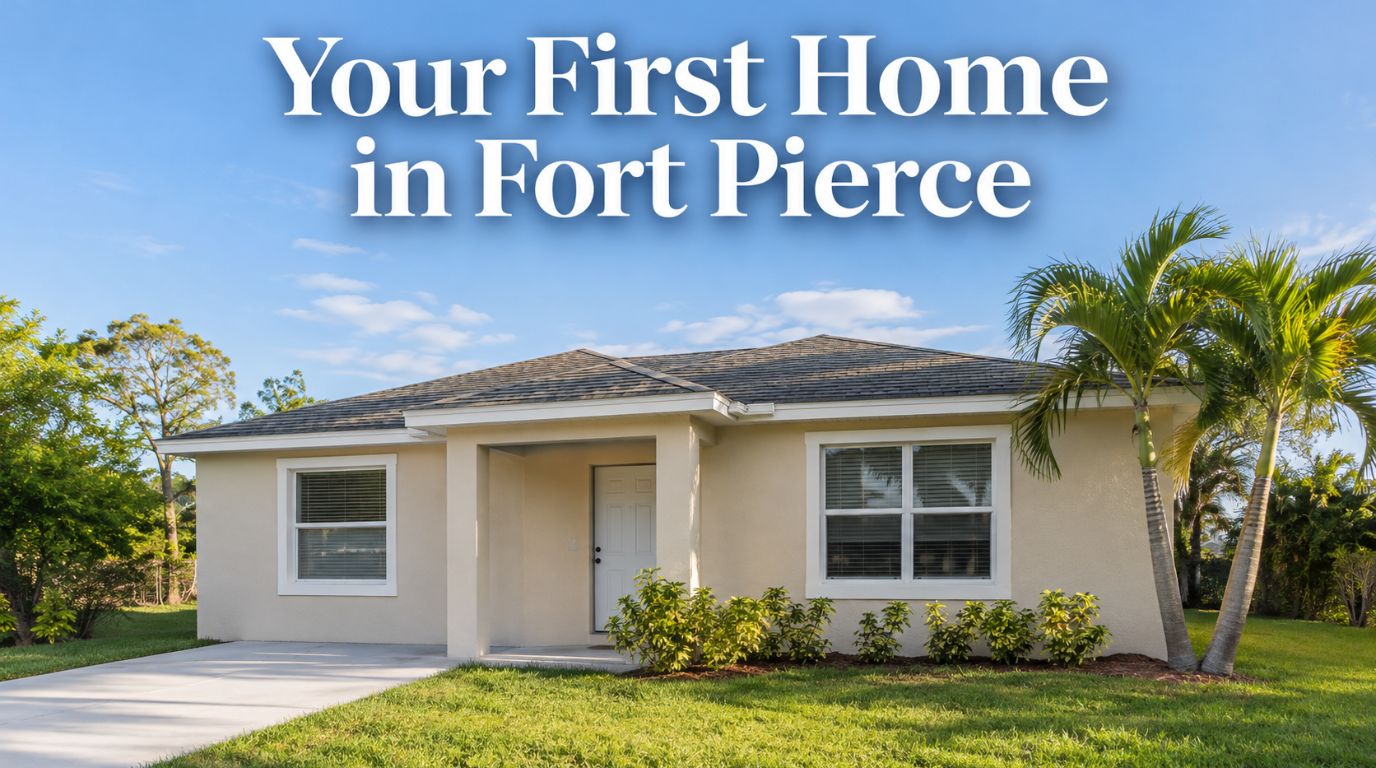
First-Time Home Buyer in Fort Pierce: Programs and First Steps
As a first-time home buyer in Fort Pierce, you can draw on three layers of help: a city program for homes inside the city limits, state programs from Florida Housing, and the federal loan programs every buyer uses. Here is who qualifies, what each one costs and the order of the first steps.
This guide is general information as of November 2026. It is not lending, credit, tax or legal advice, and Jeannie Jacobson is a real estate agent, not a lender or a program administrator. Assistance programs open and close in funding rounds, and their limits and terms change. Approval depends on your full application. Confirm current terms with the City of Fort Pierce, Florida Housing, a participating lender and the official pages cited here before you sign a contract.
The Short Answer
A first-time home buyer in Fort Pierce usually means no owned and occupied home in the last three years. Inside the city limits, the City of Fort Pierce offers purchase help in funding rounds. Statewide, Florida Housing offers Florida Assist, HLP, PLUS and Hometown Heroes through approved lenders, with a 640 minimum credit score.
- Florida Housing uses the IRS definition of a first-time homebuyer: you have not owned and lived in your primary residence in the three years before the purchase.
- Florida Assist offers up to $10,000 as a 0% deferred second mortgage that is repaid when you sell, refinance or move out. It is not forgivable.
- For fiscal year 2026-27, the City of Fort Pierce set aside $322,514 in State Housing Initiatives Partnership funds for its home purchase and home repair programs, with applications from October 1, 2026 (WQCS, July 14, 2026).
- The city program applies only to homes inside the Fort Pierce city limits, and a Fort Pierce mailing address does not prove that.
- Jeannie Jacobson, REALTOR® with RE/MAX Gold, works with first-time buyers across St. Lucie, Martin and Indian River counties, in English and Spanish.
In this guide
- Who counts as a first-time buyer
- The programs at a glance
- The City of Fort Pierce purchase program
- Florida Housing programs
- Choosing the first mortgage
- Cash you need to close
- Checking an older home
- A condo as a first home
- After closing: homestead
- Your first steps, in order
- Frequently asked questions
Who counts as a first-time home buyer?
The label is broader than most people expect. Florida Housing uses the IRS definition: you qualify if you have not owned and occupied your primary residence at any time in the three years before the purchase. Someone who sold a home four years ago and has rented since can count as a first-time buyer again.
A few practical points about the definition:
- Every program writes its own rule. Local programs paid for with State Housing Initiatives Partnership money, called SHIP, set their own definition in the local housing plan. Most use the same three-year test, but read the guidelines of the specific program before you assume.
- Owning land or a rental is a different question. The test is about a home you owned and lived in. If you own other property, ask the program or the lender how it treats it.
- Veterans and service members. Some programs treat military buyers differently, so ask a participating lender how the rule applies to you before you rule a program out.
- Federal loans do not care. FHA, VA, USDA and most conventional loans do not require you to be a first-time buyer. Some conventional 3% down options do require at least one first-time buyer on the loan.
Being a first-time buyer opens doors to assistance, but the programs also look at household income, the purchase price, your credit score and the home itself. Each layer below has its own tests.
What programs can a first-time home buyer in Fort Pierce use?
Think of the help in three layers. You need a first mortgage in every case. Assistance from the city or the state sits on top of that mortgage as a second loan, and it never replaces it.
| Layer | Program | Where it applies | How you get it |
|---|---|---|---|
| City | City of Fort Pierce Home Purchase Assistance Program, funded by SHIP | Homes inside the Fort Pierce city limits | Application to the city’s Grants Administration Division, after a mandatory orientation |
| County | St. Lucie County housing programs | Addresses outside the city limits, including many with a Fort Pierce mailing address | St. Lucie County’s housing office, when a round is open |
| State | Florida Assist, FL HLP, PLUS and Florida Hometown Heroes | Anywhere in Florida | A lender approved by Florida Housing, paired with a Florida Housing first mortgage |
| Federal | FHA, VA, USDA and conventional first mortgages | Anywhere, subject to each program’s rules | Any lender that offers the program |
Two limits apply across the board. First, most programs do not combine freely. Florida Housing pairs each of its second mortgages with its own first mortgage, and a city program may limit what else you can add. Second, money runs out. City and state programs open in funding rounds, and past rounds have closed early when demand was high.
If you are an eligible full-time worker for a Florida employer, a service member or a veteran, read our Florida Hometown Heroes page before you pick a program, because it can offer more than the other state options.
How does the City of Fort Pierce purchase assistance program work?
The City of Fort Pierce runs a Home Purchase Assistance Program for income-eligible buyers purchasing a home inside the city limits. It is funded mainly with SHIP money, which the State of Florida sends to counties and eligible cities under the State Housing Initiatives Partnership Act (sections 420.907 to 420.9079, Florida Statutes).
Here is what the city announced for the current round, as reported by WQCS on July 14, 2026:
- Funding: $322,514 in SHIP funds for fiscal year 2026-27, shared between the home purchase program and the residential rehabilitation program for owner-occupied homes.
- Opening date: applications opened at 8 a.m. on October 1, 2026, and are accepted until the money runs out.
- Order: files are processed on a first-submitted, first-qualified, first-served basis.
- Orientation: attendance at a mandatory orientation is required before you apply, and applications without proof of attendance are not reviewed. The purchase program sessions for this round were held on September 3 and September 17, 2026.
The maximum assistance per household, the income limits and the loan terms are set in the program guidelines on the city’s Grants Administration page. SHIP purchase help is usually written as a deferred second mortgage on the home, and SHIP serves households up to moderate income, which Florida law defines as up to 120% of the area median income (section 420.9071, Florida Statutes). Ask the city for the current guidelines, and ask whether funds remain in this round, before you plan around it.
Check the city limits first. Many homes with a Fort Pierce mailing address sit in unincorporated St. Lucie County, outside the city. The city program does not cover them. The parcel record on the St. Lucie County Property Appraiser site shows the taxing district for any address, so look it up before you fall for a house that the program cannot fund. For homes outside the city limits, ask St. Lucie County’s housing office what it has open.
Timing matters too. A city program adds its own review on top of the lender’s underwriting, so the contract needs a closing date with room for it. Tell the seller’s agent up front which program you are using.
What do Florida Housing programs offer first-time buyers?
Florida Housing Finance Corporation runs the statewide homebuyer programs. They work only through approved lenders, and each assistance loan comes with a Florida Housing first mortgage. The common requirements are a minimum credit score of 640, an approved homebuyer education course and the first-time buyer test, along with income and purchase price limits set by county.
| Program | Amount | Terms | Monthly payment? |
|---|---|---|---|
| Florida Assist | Up to $10,000 | 0% deferred second mortgage, repaid on sale, refinance, transfer or when you stop living in the home; not forgivable | No |
| FL HLP second mortgage | $12,500 | 3% fully amortizing second mortgage over 30 years | Yes, and it counts in your debt ratio |
| PLUS second mortgage | 3%, 4% or 5% of the first mortgage | Forgiven at 20% a year over 5 years; only with certain conventional first mortgages | No |
| Florida Hometown Heroes | 5% of the first mortgage, from $10,000 to $35,000 | 0% deferred second mortgage over 30 years, due on sale, refinance or transfer; not forgivable | No |
A quick example. On a $300,000 home with an FHA first mortgage and 3.5% down, the base loan is $289,500. A Hometown Heroes loan at 5% of that amount would be $14,475, which falls inside the $10,000 to $35,000 range. Florida Assist on the same home would be up to $10,000.
For 2026, Florida Housing limits Hometown Heroes to first-time, income-qualified buyers who work full time for a Florida employer in an eligible field, such as health care, school staff, first responders, public safety or courts and child care, plus active service members and veterans working full time for a Florida employer. The current income and loan limits by county are in the program’s 2026 limits document.
The deferred loans feel free, but they are not. You repay them when you sell or refinance, so a buyer who expects to move in a few years should count that payoff in the plan.
Which first mortgage fits a first purchase in Fort Pierce?
The assistance gets the attention, but the first mortgage decides most of your monthly payment. These are the main options, each with its own minimums:
- FHA: 3.5% down with a credit score of 580 or higher, plus an upfront premium of 1.75% and an annual premium paid monthly. Our FHA loan guide walks through the premiums and the property standards.
- Conventional: some programs allow 3% down, with private mortgage insurance that can be removed later.
- VA: no down payment for eligible veterans and service members with full entitlement, and no monthly mortgage insurance.
- USDA: no down payment for moderate incomes at addresses USDA treats as rural. Check the exact address, because many parts of Fort Pierce will not qualify.
A Florida Housing program also narrows the choice, because the assistance only comes with its own first mortgage, and its participating lender sets the rate. Ask the lender to price the program loan next to a plain FHA or conventional loan without assistance. Sometimes the lower rate on a loan without help saves more over time than the assistance gives up front.
Our side by side of home loans in St. Lucie County compares down payment, mortgage insurance and seller help for all four loan types.
How much cash does a first-time buyer need to close?
Down payment help covers part of the bill, not all of it. Plan for these costs on a typical first purchase:
- Earnest money deposit, held in escrow when the contract is signed and credited to you at closing.
- Home inspection and any specialty reports, paid before closing, often a wind mitigation report and a 4-point inspection on an older home for insurance.
- Appraisal, ordered by the lender.
- Florida taxes on the loan: documentary stamp tax on the note of 35 cents per $100 (section 201.08, Florida Statutes) and an intangible tax of 2 mills, or 0.2% of the loan (section 199.133, Florida Statutes).
- Homeowners insurance for the first year and an escrow deposit for taxes and insurance.
- Lender and title charges, which appear on your Loan Estimate.
Here is how the two state taxes work on the example loan from above:
| Item | Rate | On a $289,500 loan |
|---|---|---|
| Documentary stamp tax on the note | $0.35 per $100 | About $1,013 |
| Intangible tax on the mortgage | 0.2% | $579 |
A seller credit can cover closing costs and prepaid items, within the cap of your loan program, but never the down payment itself. Every lender must give you a Loan Estimate within three business days of your application, and the Consumer Financial Protection Bureau explains how to read and compare them.
Keep a cushion after closing. A first home in Florida often needs a repair or two in the first year, and assistance money cannot be used for that.
What should you check on an older Fort Pierce home?
First-time buyers in Fort Pierce often look at older homes because the prices fit. Older homes can be a good buy, but they bring checks that newer homes in western Port St. Lucie usually do not.
- Lead-based paint. For homes built before 1978, federal law requires the seller to disclose known lead-based paint and give you an EPA pamphlet, and you get up to 10 days to test unless you waive it. The EPA real estate disclosure page explains the rule.
- Roof and insurance. Insurers look at the roof age and the electrical, plumbing and heating systems. A 4-point inspection shows those, and a wind mitigation report can lower the premium, since Florida law requires insurers to offer discounts for features that reduce wind loss (section 627.0629, Florida Statutes). Get an insurance quote during the inspection period.
- Flood zone. Parts of Fort Pierce sit near the Indian River Lagoon and other low areas. Check the address on the FEMA Flood Map Service Center. A home in a special flood hazard area needs flood insurance for most loans, and that premium changes the payment.
- Septic or sewer, and the utility. Ask whether the home is on sewer or septic and which utility serves it, because some city addresses are served by the Fort Pierce Utilities Authority and others by different providers. Call the utility for deposit rules and the average bill at the address.
- Permits. Additions, enclosed porches and garage conversions should show up in the permit history. Unpermitted work can affect insurance and the appraisal.
Program rules add a layer. FHA, VA and USDA appraisers check minimum property standards, and city purchase programs often require the home to pass their own inspection. A home that needs major repairs may fit a renovation loan better than a standard first mortgage.
Can a first home be a condo on Hutchinson Island?
Yes, and some first-time buyers start there because a condo can cost less than a house. It brings its own checks, though, and they matter more on the barrier island.
- Project approval. The lender reviews the whole condo project, not only your unit. FHA generally needs the project on HUD’s approved list, VA keeps its own list, and conventional lenders review the budget, insurance and any litigation.
- Building safety rules. Florida requires milestone inspections and structural reserve studies for condo buildings three stories or taller (sections 553.899 and 718.112, Florida Statutes). Ask for the latest inspection, the reserve study and any planned special assessments.
- Program limits. Assistance programs may restrict condos or require the project to meet the first mortgage rules. Ask before you make an offer.
- Insurance and flood. You will usually carry your own condo policy on top of the association’s master policy, and many island buildings sit in flood zones.
Count the monthly association dues in the payment from day one, because lenders count them when they decide how much you can borrow.
What do you need to do after closing on your first home?
The most valuable step after closing costs nothing: file for the homestead exemption with the St. Lucie County Property Appraiser. In Florida, the application is due by March 1 of the tax year (section 196.011, Florida Statutes), so a home bought and lived in by January 1 can qualify that same year.
- The exemption. Homestead takes up to $50,000 off the assessed value. The first $25,000 applies to all property taxes, and the second $25,000 applies to the assessed value between $50,000 and $75,000 and does not apply to school taxes (section 196.031, Florida Statutes).
- The cap. Once you have homestead, the Save Our Homes rule limits yearly increases in the assessed value to 3% or the change in the consumer price index, whichever is lower (section 193.155, Florida Statutes).
- Your first tax bill. The seller’s homestead does not carry over to you, so the first bill after a sale is often higher than the one you saw on the listing. Our St. Lucie County property tax estimate guide shows how to estimate it before you buy.
If you used a city or state program, keep the closing papers for the second mortgage. They spell out what happens if you sell, refinance or rent the home out, and the payoff will show up at that time.
What are the first steps, in order?
Most problems on a first purchase come from doing the steps out of order. This sequence keeps the program, the loan and the house lined up:
- Pull your credit and gather documents. Two years of income records, recent pay stubs, bank statements and identification. If your score is under 640, the Florida Housing programs are out of reach for now, so start there.
- Talk to a participating lender and a second lender. Ask one approved by Florida Housing and one that is not, and compare the two Loan Estimates.
- Take homebuyer education early. State programs require an approved course, and finishing it before you shop removes one item from the closing checklist.
- Check program rounds. If you hope to use the City of Fort Pierce program, ask the Grants Administration Division whether funds remain and when the next orientation is.
- Set your search area by the program. City program means inside the city limits. A USDA loan means an eligible address. Check each home before you tour.
- Get preapproved with the program named on the letter. Sellers take an offer more seriously when the financing is clear.
- Write the offer with realistic dates for inspection, appraisal, program review and closing.
- Inspect, insure and file. Inspect during the inspection period, get the insurance quote before it ends, and file for homestead after you move in.
Our Fort Pierce homebuyer guide covers areas and the local market for all buyers, and our Fort Pierce page lists homes and community details.
What First-Time Buyers in Fort Pierce Say About Jeannie Jacobson
“As a new home buyer I was very nervous and had many questions. Jeannie was amazing at answering all of my questions and easing my concerns. She was always available and able to answer all of my questions. Buying my first home was such an easy experience with Jeannie and could not have gotten through it without her!”
Jheri, Fort Pierce, FL, verified review, August 30, 2022
“I had the wonderful pleasure of working with Jeannie. She never made me feel uncomfortable and helped me every step of the way!”
Jeanette, Fort Pierce, FL, verified review, April 20, 2022
Frequently Asked Questions
Florida Housing uses the IRS definition: you have not owned and lived in your primary residence during the three years before the purchase. Local programs set their own definition, and most use the same three-year test, so read the guidelines of each program you plan to use.
Yes. The City of Fort Pierce runs a Home Purchase Assistance Program for income-eligible buyers of homes inside the city limits, funded mainly with SHIP money. For 2026-27 the city set aside $322,514 for its purchase and repair programs, with applications from October 1, 2026, until funds run out.
Only if the home is inside the city limits. Many Fort Pierce mailing addresses are in unincorporated St. Lucie County. Check the taxing district on the parcel record at the St. Lucie County Property Appraiser site, and ask the county’s housing office about homes outside the city.
Florida Housing lists a minimum credit score of 640, along with an approved homebuyer education course, the first-time buyer test and income and price limits by county. A participating lender can add stricter requirements.
Usually, yes. Florida Assist and Hometown Heroes are 0% deferred second mortgages repaid when you sell, refinance, transfer the deed or stop living in the home. The PLUS second mortgage is forgiven at 20% a year over five years. City program terms are set in its guidelines.
Sometimes, but do not assume it. Florida Housing ties each of its second mortgages to its own first mortgage, and the city program guidelines may limit other assistance. Ask the city and a Florida Housing participating lender to confirm a combination before you sign a contract.
Start Your First Purchase With a Plan
The right mix of program, loan and house depends on your income, your credit and where the home sits in or around Fort Pierce. Jeannie works with first-time buyers across Fort Pierce, Port St. Lucie and the Treasure Coast, in English and Spanish, and can help you check each home against your program before you make an offer.
Jeannie Jacobson, REALTOR®, RE/MAX Gold, (772) 877-0268, English and Spanish
Sources
- Florida Housing Finance Corporation, Homebuyer programs overview (first-time homebuyer definition, 640 minimum credit score, Florida Assist, FL HLP and PLUS), https://www.floridahousing.org/programs/homebuyer-overview-page (accessed November 2026)
- Florida Housing Finance Corporation, Florida Hometown Heroes program terms and 2026 income and loan limits, https://www.floridahousing.org/programs/homebuyer-overview-page/hometown-heroes (accessed November 2026)
- WQCS, Fort Pierce opens applications for homebuyer, home repair assistance programs in October, July 14, 2026, https://www.wqcs.org/wqcs-news/2026-07-14/fort-pierce-opens-applications-for-homebuyer-home-repair-assistance-programs-in-october (accessed November 2026)
- City of Fort Pierce, Grants Administration Division, program guidelines for the Home Purchase Assistance Program, https://www.cityoffortpierce.com/ (accessed November 2026; the site did not respond to automated access, so confirm the guidelines there)
- Florida Statutes 2026, sections 420.907 to 420.9079 (State Housing Initiatives Partnership), 420.9071, 201.08, 199.133, 627.0629, 553.899, 718.112, 196.011, 196.031 and 193.155, http://www.leg.state.fl.us/statutes/ (accessed November 2026)
- St. Lucie County Property Appraiser, parcel search and homestead exemption, https://www.paslc.gov/ (accessed November 2026; the site may block automated access, so confirm there)
- U.S. Environmental Protection Agency, Real Estate Disclosures about Potential Lead Hazards, https://www.epa.gov/lead/real-estate-disclosure (accessed November 2026)
- FEMA Flood Map Service Center, https://msc.fema.gov/portal/search (accessed November 2026)
- Consumer Financial Protection Bureau, Owning a Home and the Loan Estimate, https://www.consumerfinance.gov/owning-a-home/ (accessed November 2026)
- HUD Single Family Housing Policy Handbook 4000.1, https://www.hud.gov/hud-partners/single-family-handbook-4000-1 (accessed November 2026; the site may block automated access, so confirm there)