

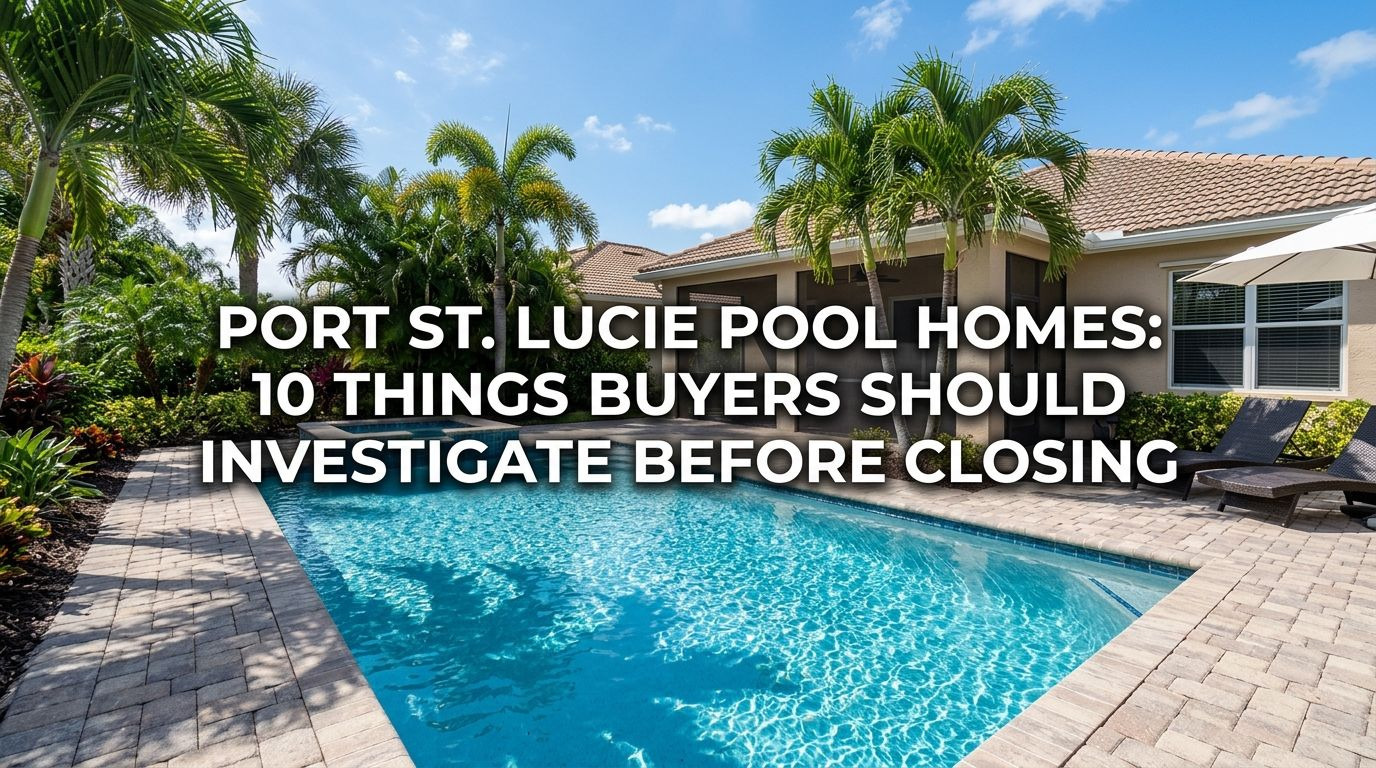
Port St. Lucie Pool Homes: 10 Things Buyers Should Investigate Before Closing
The pool inspection Port St. Lucie buyers actually need: equipment, surface, deck, enclosure, heater, safety features, insurance, permits and written repair estimates — checked before the contract deadlines pass, not after.
A pool can be one of the reasons you choose one Port St. Lucie home over another. It can also be one of the more expensive property systems you inherit without realising how much work is coming — and that difference is rarely obvious during a 30-minute showing.
Fresh blue water makes an aging pool look excellent. A clean deck distracts from worn equipment. A newly painted pump may still be old. A screen enclosure can look intact from the patio while fasteners and structural members deserve attention. A heater can turn on during the showing and still be near the end of its service life. And the issues that matter most cannot be evaluated visually at all: was it permitted, is the safety system functional, what will your insurer require, and are you looking at cosmetic wear or a coming renovation?
One legal point needs careful handling in 2026. Florida legislators considered proposals that would have required older pools to meet current safety-feature requirements whenever residential property sold after October 1, 2026 — those bills died in committee and did not become law. So ignore any article claiming every older Florida pool must automatically be upgraded at resale. But the opposite assumption is equally weak: you still need to verify the property’s actual safety features, permits, condition and insurance before closing.
Quick Answer: What Should a Pool Inspection Port St. Lucie Buyers Order Actually Cover?
Inspect the pool as a separate property system, not backyard decoration. Before closing, verify the pump, filter, plumbing, sanitation equipment, pool finish, tile, coping, deck, screen enclosure, heater, safety features, permits and insurance. Search the property’s pool-related permits, confirm whether major additions were approved, obtain a dedicated pool evaluation when appropriate, and get written repair estimates for material defects.
Do not assume clean water means a healthy pool. Water can be chemically balanced on inspection day while equipment, finish, deck or enclosure problems remain.
Educational information only. This article is not legal, engineering, pool-contractor, electrical, structural, insurance or inspection advice. Conditions, local requirements, insurance rules and permit records vary by property. Verify material issues with the City of Port St. Lucie or St. Lucie County as applicable, your insurer, lender, home inspector, licensed pool contractor, enclosure contractor and attorney when appropriate. Verified August 2026.
What This Guide Covers
- Pump, Filter and Circulation Equipment
- Surface, Tile and Coping
- Deck, Pavers and Drainage
- Screen Enclosure
- Heater, Spa and Water Features
- Safety Features and the 2026 Law Correction
- Insurance Before Deadlines
- Permit and Inspection History
- The Professional Evaluation and Negotiation
- The Comparison Matrix and Neighbourhood Notes
- FAQ
Where this fits. Our companion guide, buying a pool home in Port St. Lucie, covers the ownership decision — costs, insurance and safety law in overview. This page is the inspection playbook: what to test, what to search, and how to turn findings into a negotiation.
Pump, Filter and Circulation Equipment
The equipment pad is where many expensive pool problems begin. You do not need to understand every valve — you need to know what exists and whether it appears to function.
The pump
Ask: how old, variable-speed or single-speed, does it start reliably, is it unusually noisy, are there visible leaks, does it maintain prime, are valves working, are connections dry? A pump that technically turns on is not necessarily operating correctly. Grinding or screeching bearing noise deserves attention — flag it for a qualified pool professional rather than diagnosing from sound alone. And look underneath everything: persistent water beneath the pump, filter, heater or piping can indicate a failed seal, cracked housing or plumbing damage. Do not estimate the repair from appearance.
The filter and sanitation
Identify the type — cartridge, sand or DE — and ask for model, approximate age and replacement history. The question is not “which type is best?” but “what does this property have, in what condition, and what will I maintain?” A dirty cartridge is routine; a cracked filter housing is a different level of issue. If the pool uses a saltwater chlorine generator, remember it is still a chlorinated pool — ask the age of the salt cell and controller, and whether it is producing. Salt does not eliminate chemical maintenance.
Automation and electrical
Have the seller demonstrate any automation — wall controller, app, remote, schedules. If the seller “doesn’t remember the password,” get that resolved before closing; you should not inherit a system you cannot administer. Electrical concerns — grounding, bonding, GFCI protection — belong to qualified inspectors and contractors under the Florida Building Code framework. Do not remove panels or test wiring yourself.
Request the equipment list, manuals, invoices, warranties and automation credentials. The older the equipment, the more useful the record. And when comparing two homes, compare whole systems: a newer pump beside an older heater and an unknown-age salt cell is not automatically “better equipment” than an older pump with documented everything.
Surface, Tile and Coping
Look through the water, not just at it. A plaster or aggregate finish ages: staining, etching, roughness, exposed aggregate, delamination, hollow areas, cracks. Not every mark means resurfacing — but visible deterioration deserves professional evaluation, and “when was it last resurfaced?” deserves an invoice, contractor name, permit where applicable and warranty, not a guess.
Walk the perimeter slowly. At the tile line: missing, cracked or loose tile, grout deterioration, separation. At the coping — the material capping the shell’s top edge: movement, cracking, loose pieces, uneven sections. A loose coping stone is a localised repair; widespread movement deserves deeper evaluation.
Cracks and water loss
Cracks are the easiest thing for a buyer to misinterpret: a superficial finish crack is not structural shell movement, and neither can be diagnosed from a photograph. Ask the professional whether it appears cosmetic, finish-related or structural. Then ask about water loss — level changes come from evaporation, splash-out and backwashing as well as leaks, so do not assume every low pool is leaking, but do not ignore repeated topping-off either. A leak-detection specialist exists for exactly this question. Newly patched areas are not automatically problems — ask what was repaired, why, by whom, and whether it held.
Why this check matters most financially. You need to know whether the pool is in normal-maintenance condition or approaching a substantial renovation — and the dollar figure should come from a property-specific contractor quote, not a national resurfacing average.
Deck, Pavers and Drainage
A pool deck has to stay usable, drain water and interact properly with the pool and the house. Walk every section: cracked concrete, loose pavers, settlement, uneven transitions, trip hazards, separated coping, failing grout, slippery coatings — especially around the pool edge, enclosure posts, deck drains and door thresholds.
Watch where water should go. A deck gets wet by design; the question is what happens next. Check slope, drains, and the relationship to the house threshold — stand at the patio door and ask: is the deck higher than the interior floor? Where would a major rain event send water? Does the threshold show staining? The City’s residential pool review addresses site drainage during construction precisely because runoff is a design consideration, not landscaping. Deck settlement can also affect enclosure anchors and doors — an enclosure contractor may need to evaluate.
Two habits worth keeping: look under outdoor rugs and furniture (they hide stains, cracks and patches — good practice, not an accusation), and treat deck expansions as a permit question — “we added all these pavers five years ago” should be checkable in the City or County record.
The Screen Enclosure Is a Separate Structure — Inspect It Like One
Look past the mesh. A few torn panels are routine maintenance; widespread deterioration means broader rescreening. The structure matters more: framing, connections, fasteners, corrosion, base plates, anchors, doors, bracing and evidence of movement — outdoor aluminium and steel fasteners live in a humid, salty environment, and significant deterioration is not cosmetic. The City lists aluminium and screen-enclosure work among its regulated permit categories, so the enclosure has its own permit history to check.
Test the doors: do they close, latch, bind, drag? A door that no longer closes is a maintenance issue — and potentially a safety issue, depending on the pool’s barrier configuration. Which raises a distinction buyers miss: a screen enclosure and a pool safety barrier are not automatically the same thing. An enclosure may participate in the property’s safety arrangement, but confirm the actual approved configuration rather than assuming any cage satisfies every requirement.
Hurricane coverage is not automatic. Florida’s Insurance Consumer Advocate notes that coverage for features such as pool cages can depend on the specific policy and endorsements. Ask: is the cage covered, under which coverage, for which causes of loss, at what limit and deductible? “My dwelling policy replaces the enclosure after a storm” is an assumption, not an answer.
Heater, Spa and Water Features
Identify the heater type — electric heat pump, gas, or solar — and have it tested when practical: startup, controls, error codes, noises, leaks. “Seller says it works” is not a test. Request model, serial number, invoice and repair history, and resist assigning a generic lifespan — actual service life depends on installation, maintenance and exposure. Port St. Lucie maintains a specific pool-heater permit category, so a heater that looks newer than the pool should have a searchable record.
If there is an integrated spa: test valves, jets, blower, heater, controls, spillover and lighting — spa mode exposes plumbing and automation problems that normal circulation hides. Run every waterfall, deck jet and fountain: a decorative feature left off for years may be off for a reason. As for heating cost — it depends on heater type, temperature, volume, season and rates; no honest article gives every buyer one monthly number. Ask for actual bills and estimate your own intended use.
Safety Features — and the 2026 Law Correction Buyers Should Know
Current Florida Statute §515.27 requires a new residential pool to have at least one qualifying safety feature before final inspection: a compliant barrier, an approved safety cover, qualifying exit alarms on doors and windows with direct pool access, qualifying self-closing self-latching doors, or a qualifying pool alarm. When the feature is a barrier, §515.29 requires at least four feet of outside height, no climbable gaps, and pool-access gates that open outward, self-close and self-latch.
The 2026 correction. Bills in this year’s session — SB 244 and its House companion — would have required pools of any age to meet current safety-feature requirements when property sold on or after the effective date. They died in committee on March 13, 2026, and did not become law. As of August 2026 there is no newly enacted statewide resale-upgrade mandate from those bills — so distrust articles that turned the proposal into a fake current requirement. A similar measure could return in a future session.
The failure of that proposal does not make safety optional. Port St. Lucie’s code-compliance guidance says residential pools must be maintained and secured through a qualifying enclosure or barrier, referencing four-foot barriers and self-closing, self-latching mechanisms. Test every represented device before closing — door alarms, self-latching gates, pool alarm, safety cover, and every section, pole and anchor of any removable safety fence stored in the garage. A device approved years ago that no longer functions should not be assumed adequate. And note the scope of §515.33: it requires pool contractors and builders in new-construction transactions to furnish statutory safety information — it is not a universal resale disclosure law, and should not be described as one.
One more principle: safety requirements are property and regulatory questions, not predictions about who will live in the house. A household with no children does not make the barrier question disappear.
Insurance Before the Inspection Period Ends
Florida’s Insurance Consumer Advocate tells consumers to ask directly whether a policy covers a swimming pool, hot tub or trampoline — because treatment is policy-specific. Give your agent the exact address and ask: is the pool acceptable, does the carrier require a fence or barrier or specific gate conditions, is the cage covered, is equipment covered, does a slide or diving board affect eligibility, what liability limit should I consider, and what hurricane deductible applies?
Three cautions: do not rely on the seller’s premium (carrier, coverage, deductibles, claims history and replacement cost all differ); do not accept a quote built on incomplete property information and assume it survives underwriting photos; and remember the pool joins the roof, electrical and plumbing in one insurance package — understand the whole package before deciding the monthly cost fits. How much liability coverage is appropriate is a personal insurance decision for the licensed professional, not a real estate opinion.
Permit and Inspection History: The Pool Inspection Port St. Lucie Records Make Possible
A pool that physically exists does not prove every component was permitted. Port St. Lucie buyers have genuinely useful public tools: the City’s Building Department provides a property search covering current and past permits with permit and inspection status — including specific categories for pools, pool heaters and aluminium enclosures.
Search for the original swimming-pool permit and its final inspection, plus spa, heater, electrical, gas, screen enclosure, deck renovation, fence or barrier, and major modifications. Finding a permit number is useful; knowing whether it was completed is the real question — an old permit with no final deserves clarification, and our guide to open permits in Port St. Lucie explains why.
- Consumer search ≠ title search. The City’s own site notes that formal title and open-permit searches go through its Lien Services Division — your lookup is good due diligence, not a substitute for the closing professional’s work.
- Jurisdiction first. A “Port St. Lucie” mailing address does not determine the permit agency — County-jurisdiction properties use St. Lucie County’s separate system, which includes pool-safety documentation.
- No permit found ≠ illegal pool. Older records, search limitations, address mismatches and jurisdiction all explain gaps. Ask the building department and closing professional to investigate — and if work truly appears unpermitted, the building official, title professional, attorney and licensed contractor determine what it means, not a guess.
- Renovations may matter more than the original date. Resurfacing, heater, enclosure, deck and electrical work each leave their own trail.
The Professional Evaluation — and Turning Findings Into a Decision
Tell your general home inspector the pool matters to your decision and ask exactly what the inspection covers — not every package evaluates the shell, underground plumbing, automation, heater, screen structure or leak detection. Consider a dedicated pool-contractor inspection when the finish looks worn, equipment is old, the heater does not run, water loss is suspected or automation misbehaves. Florida DBPR licenses pool contractors — a licensed residential pool/spa contractor’s regulated scope includes repairs to pools, equipment, interior finishes, heaters and piping — and provides the official licence-verification portal. Verify there, not from a business card.
Ask for prioritised findings
- Immediate safety issues — missing barrier component, nonfunctioning gate, exposed electrical concern
- Active defects — leaking pump, failed heater, damaged filter housing
- Near-term capital items — deteriorating finish, aging enclosure components
- Routine maintenance — filter cleaning, chemistry, a minor screen patch
That hierarchy keeps a $100 maintenance item and a five-figure renovation from carrying the same emotional weight — and the numbers come from actual bids, not a generic article.
Negotiate from evidence
“Licensed pool contractor estimates $X to replace the failed heater” beats “Google says heaters cost about $X, so we want $10,000.” The structures available — seller repairs, seller credit subject to loan rules, price adjustment, buyer accepts — depend on the contract, lender, repair and both parties’ positions. Ask your lender before assuming a credit is usable, and remember material issues belong in negotiation while routine maintenance normally does not. The purpose of the inspection is to understand the pool you are buying — not to demand the seller deliver a brand-new one.
The Comparison Matrix — and Neighbourhood Notes
| Issue | Lower concern | Higher concern | Buyer action |
|---|---|---|---|
| Pump | Recent, documented, dry | Loud, leaking, unknown age | Pool contractor evaluation |
| Filter | Clean, stable pressure | Cracked or leaking housing | Repair quote |
| Finish | Minor cosmetic wear | Widespread roughness or delamination | Resurfacing opinion |
| Tile / coping | Intact | Loose or cracked sections | Repair evaluation |
| Deck | Drains well | Settlement, trip hazards | Deck or pool contractor |
| Screen | Isolated tear | Corrosion, structural issues | Enclosure contractor |
| Heater | Tested, documented | No start, error codes | Heater evaluation |
| Safety | Functional documented feature | Gate or alarm not working | Correct before closing |
| Permits | Original and final found | Missing, open or unclear | City, County, title review |
| Insurance | Carrier accepts | Underwriting questions | Resolve before deadlines |
Sandpiper Bay, Floresta, Tradition and St. Lucie West
Sandpiper Bay: established inventory means pools installed and renovated at different times — a 1980s house can carry a much newer pool system, and a newer-looking pool can hide older underground components. Permit history is your friend. Floresta: established homes where decks, enclosures and pavers have been modified over the years — search the exact property and watch drainage, because deck, home, yard and stormwater grading operate together. Tradition: builder-installed and owner-added pools coexist, and HOA approval is not the same as a City building permit — verify both where applicable. St. Lucie West: a wide range of ages, equipment packages and finishes — mature landscaping does not mean original pool systems. In every case: the pool is evaluated property by property, never by neighbourhood name.
FAQ: Pool Inspection Port St. Lucie Buyers Ask About
A dedicated pool evaluation can be worthwhile, especially when the pool is older, equipment condition is unclear, leaks are suspected, or the heater and automation are complex. Ask your general home inspector exactly what the inspection covers — many packages do not evaluate the shell, underground plumbing, automation or screen structure in depth. Florida DBPR licenses pool contractors and provides a public verification portal; a licensed residential pool/spa contractor can evaluate and repair equipment, finishes, heaters and piping within the regulated scope.
Use the City of Port St. Lucie’s property permit search for City-jurisdiction properties — it covers current and past permits with permit and inspection status. Search for the original pool permit and its final inspection, plus heater, enclosure, electrical and renovation permits. County-jurisdiction properties use St. Lucie County’s separate system. Note the City distinguishes the public consumer search from a formal title or open-permit search handled through its Lien Services Division — your lookup is due diligence, not a substitute for the closing professional’s work.
No. Bills in the 2026 session — SB 244 and its House companion — would have required residential pools of any age to have a qualifying safety feature when property sold on or after the effective date, and both died in committee on March 13, 2026, without becoming law. Existing safety requirements and local codes still need to be verified for the specific property, and a similar measure could return in a future legislative session.
For new residential pools, §515.27 requires at least one qualifying feature before final inspection: an approved barrier, an approved safety cover, qualifying exit alarms on doors and windows with direct pool access, qualifying self-closing self-latching doors, or a qualifying pool alarm. When the feature is a barrier, §515.29 requires at least four feet of outside height, no climbable openings, and pool-access gates that open outward, self-close and self-latch. Local requirements should also be checked for the exact property.
Not automatically. An enclosure may participate in the property’s approved safety configuration, but the buyer should confirm the actual arrangement rather than assuming any cage satisfies every requirement — especially if an enclosure door no longer closes or latches. Florida’s barrier statute has specific height, opening and gate requirements when a barrier is the qualifying Chapter 515 feature, and Port St. Lucie’s code-compliance guidance requires pools to be secured through a qualifying enclosure or barrier.
Look for significant roughness, widespread staining, delamination, exposed aggregate and cracking — then have a qualified pool contractor determine whether the condition is cosmetic, repairable or approaching a full resurfacing project, with a written estimate. Do not diagnose from appearance alone, and do not predict remaining life from a generic internet lifespan: water chemistry, installation quality, material and use all matter for the specific pool.
No. Cracking can occur in the surface finish, tile, coping, deck or the pool structure itself — and these are not equivalent. A superficial finish crack is not shell movement, and neither can be diagnosed from a photograph. A qualified professional should determine the source and seriousness. Do not negotiate from the assumption that every visible crack means the shell has failed — and do not dismiss repeated unexplained water loss either.
The City of Port St. Lucie’s current permit resources include a specific pool-heater permit category, and pool heaters appear among its inspection services. If the heater looks newer than the pool, search the permit record — and request the model, serial number, installation invoice and repair history while you are at it. For county-jurisdiction properties, check St. Lucie County’s system instead.
Yes, and the effect is carrier- and property-specific. Florida’s Insurance Consumer Advocate tells homeowners to ask whether the policy covers a swimming pool, hot tub or trampoline. Ask about pool eligibility, barrier requirements, cage coverage, equipment, hurricane deductibles and liability limits — and do not use the seller’s premium as a forecast, because carrier, coverage, deductibles, claims history and underwriting differ between owners.
Do not assume so. Florida’s Insurance Consumer Advocate notes that some endorsements can add coverage for pool cages damaged in hurricanes where the base policy does not already provide it. Ask your agent for the exact treatment: which coverage applies, for which causes of loss, at what limit and deductible. Resolve the answer during the inspection period, while the contract still gives you options.
There is no honest single monthly number for every property — cost depends on size, equipment, sanitation system, professional versus owner service, heating and repairs. For a purchase decision, obtain a current local service quote for the specific pool and review the seller’s maintenance and utility records. Budget reserves for capital items too: if the pump, heater, screen and finish are all older, several non-monthly expenses can arrive even though the water is clean on closing day.
Potentially, depending on the contract and negotiation. Document the defect, obtain a written estimate from a qualified local contractor, and ask your lender whether a seller credit is permissible and usable under your loan before proposing a number — then compare repair versus credit versus price adjustment. Property-specific evidence is more defensible than an internet average, and material defects belong in negotiation while routine maintenance items normally do not.
Buy the Pool You Inspected, Not the Pool in the Listing Photos
The useful question before closing is not “does the house have a pool?” It is “what exactly am I buying along with it?” — the shell, finish, tile, coping, deck, drainage, pump, filter, plumbing, sanitation, automation, heater, enclosure, safety system, permits and the ongoing maintenance responsibility. Those components do not age at the same rate, do not fail at once, and cannot be judged from clean water and attractive photographs.
The process is straightforward: search the permits, inspect the physical pool, test the equipment, evaluate the safety system, check the enclosure and deck, get your insurance quote, review maintenance records, bring in a licensed professional when condition deserves it, and obtain written estimates for material defects. Then decide whether the property still works at the negotiated price. Avoid both extremes — “it’s Florida, every pool is fine” and “it’s older, so it must be a money pit.” The answer is in the condition and documentation of the specific property.
Jeannie Jacobson is a licensed Florida real estate sales associate with RE/MAX Gold serving Port St. Lucie and the Treasure Coast. This article provides general real estate education and is not legal, engineering, pool-contractor, electrical, structural, insurance or inspection advice. Property conditions, local requirements, insurance rules and permit records vary. Verify material issues with the City of Port St. Lucie or St. Lucie County as applicable, your insurer, lender, home inspector, licensed pool contractor, enclosure contractor, electrician, engineer, attorney or other qualified professional. Information verified August 2026.