

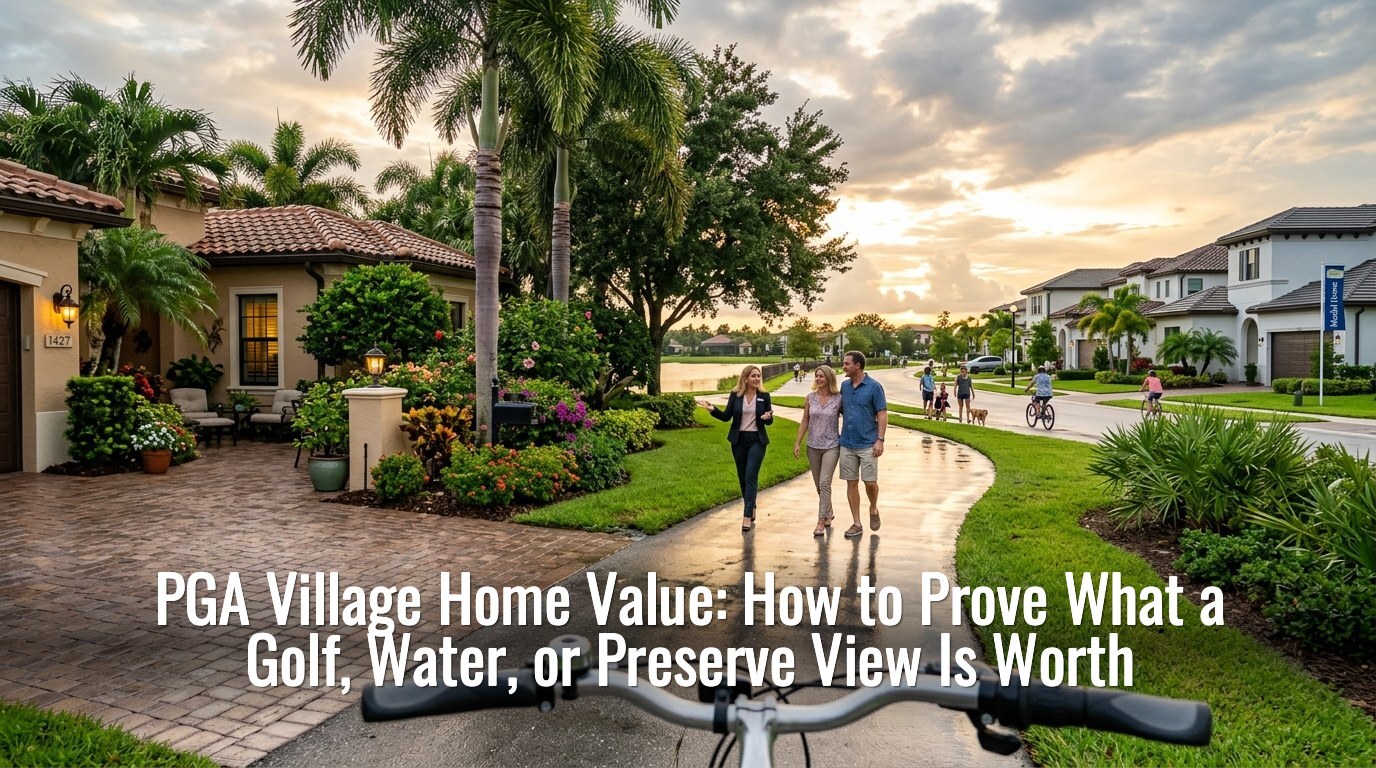
PGA Village Home Value: How to Prove What a Golf, Water, or Preserve View Is Worth
Classify the view, document the lot honestly, photograph from the buyer’s decision points, and price the whole package — not the community name.
Quick Answer: What Makes One PGA Village Home Value Higher Than Another?
A PGA Village home should not be marketed as valuable simply because it sits near a golf course. Buyers look closer than that. PGA Village home value depends on what can actually be seen from the property, how private the outdoor areas feel, the direction the home faces, how the lot relates to neighbouring homes and the cart path, whether the outlook is visible from the rooms people live in, and what ownership costs come with the community. Start with a view and lot analysis — not a lifestyle paragraph.
Educational only. This article provides general real estate information. It is not legal, tax, financial, insurance, appraisal, inspection, or membership advice. Property values, association information, membership structures, fees, rules, insurance considerations, and market conditions can change. Material information should be verified through current documents and qualified professionals. No price, buyer, appraisal, timeline, or closing can be guaranteed.
What This Guide Covers
Selling in PGA Village generally? See selling a golf course home in PGA Village for the full seller process. This guide is the property-specific analysis that comes before pricing and photography.
Classify the Property Before Comparing Sales
PGA Village includes different property types, lot positions, ages, sizes, and sub-community structures. A seller should not treat every nearby sale as equally relevant — two homes on the same street can carry very different value for reasons that never appear in a square-footage comparison.
| Classify | Options to identify honestly |
|---|---|
| View type | Direct golf frontage · angled golf exposure · lake or water · preserve or landscaping · interior community · a combination of two |
| Lot relationship | Corner or interior · cul-de-sac · distance from neighbouring homes · rear exposure · road influence · cart-path position · elevation differences · shape and usable yard |
| Property profile | Living area · floor plan · bed and bath count · garage · pool and enclosure · renovation level · roof and systems · outdoor living · functional condition · accessibility |
Only after the property is classified should the conversation move to comparable sales. A direct-frontage home on a cul-de-sac and an angled-exposure home beside a cart path are not the same product, even at identical square footage — and pricing them as though they were is how a listing ends up defending a number it cannot support.
Document the View Honestly
A listing should explain the actual experience rather than lean on phrases like “premium golf lifestyle” or “spectacular views.” Answer these before writing a word of description:
- Which rooms actually face the view — kitchen, living room, primary suite, or only the patio?
- Is morning or afternoon sun more prominent, and does afternoon heat limit outdoor use?
- Does landscaping create privacy, or is the outdoor area exposed?
- Can golfers see directly into the outdoor living space?
- Is a cart path nearby, and how close?
- Are maintenance vehicles visible or audible at certain hours?
- Is the water view direct, or partially screened?
- Is the setting quiet at the times buyers are likely to visit?
- Does the view change seasonally as vegetation fills in or thins?
- Is there meaningful golf-ball exposure to the yard, screen, or windows?
The strongest marketing does not hide trade-offs. It gives the right buyer enough accurate information to understand why the property fits their preferences. A buyer who discovers the cart path during the second showing is a buyer you have lost — one who knew about it beforehand and came anyway is a buyer who is ready to write.
Prepare the Sightline
When the lot and view carry the listing, preparation starts outside. Review window cleanliness, screen condition, patio and paver condition, pool clarity and equipment appearance, exterior lighting, outdoor furniture placement, landscaping that blocks important sightlines, dead or overgrown vegetation, visible hoses and tools and pool equipment, fence or enclosure condition, and any drainage or standing-water concerns.
Alter landscaping only where permitted. Association rules may govern what can be trimmed or removed, and professional guidance may be relevant — particularly near preserve areas. The goal is not an unrealistic image. It is removing the distractions that stop a buyer from understanding the setting.
Photograph From the Buyer’s Decision Points
A wide aerial is attractive, but it does not show what the resident actually sees. A buyer does not live in a drone shot. Document the six perspectives that decide the showing:
From the Main Living Area
The view as experienced from where people spend their evenings — the single most important frame in the set.
The Interior-to-Patio Transition
How the indoor space opens to the outdoor space, because that connection is much of what a view lot is worth.
The Outdoor Seating Perspective
Sitting height, not standing height. This is where a buyer imagines a morning coffee.
Pool and View Together
How the water feature and the outlook relate — they either compound each other or compete.
Lot Depth and Privacy
The distance and screening between the outdoor area and whoever is on the other side of it.
Position Within the Setting
Where the home sits in the wider community — the frame where drone footage genuinely helps.
Drone footage should establish location and scale — never misrepresent proximity, privacy, property boundaries, community access, or features that do not belong to the property. Photography and video should also avoid publishing unnecessary detail about security systems or personal property.
Verify Community and Membership Information
Buyers will ask about HOA or association fees and what they include, community approval procedures, membership options, whether golf membership is required, amenity access, leasing restrictions, pet and vehicle rules, exterior-maintenance responsibilities, capital contributions, pending or recent assessments, and community rules generally.
These details can change and may differ by property or association. Do not rely on memory, old marketing materials, or what was true for another PGA Village property. Use current official documents where available, and let buyers independently verify anything material to their decision. Membership requirements and options are governed by the club — not by the home sale.
Compare the Buyer’s Full Alternatives
Your competition is not only other PGA Village listings. A buyer considering your home may also be weighing PGA Village Verano, other gated Port St. Lucie communities, new construction, active-adult communities, non-golf homes with lower fees, waterfront properties, homes in Palm City or Stuart, renovated properties with no view at all, and larger homes on interior lots.
The listing has to answer why this home deserves consideration against those — which may be a stronger view, greater privacy, a completed pool, a more established location, immediate occupancy, renovated interiors, a larger lot, a particular floor plan, lower preparation needs, or different community characteristics.
The argument must be property-specific and verifiable. “Best value in PGA Village” is not an argument. “Direct lake frontage, no cart path, pool and screen replaced in 2024, visible from the kitchen and primary suite” is one.
Price the Combined Package
A golf or water view should not be assigned an arbitrary premium. PGA Village home value comes from the whole package: view quality, lot placement, interior condition, renovations, roof and systems, pool condition, community costs, current competition, buyer demand, accessibility, and genuinely relevant recent sales.
A home with a strong view but substantial deferred maintenance competes differently from a renovated interior-lot property. Buyers evaluate the home they will actually own — as a whole, not as a view with a house attached. See how a home value review is built.
Prepare for the Practical Questions
Lifestyle attracts the showing. Practical questions decide whether the buyer proceeds. Be ready with documentation or the right referral for roof age, insurance considerations, hurricane protection, HOA information, pool and screen condition, prior permits, membership and amenity questions, property boundaries, any view protections that exist, maintenance responsibilities, and known material facts.
Statements about future views, neighbouring land, golf access, or permanent privacy should not be made without reliable support. A preserve can be replanted; a fairway can be redesigned; a vacant parcel can be built on. If nobody can document that a view is protected, the listing should not imply that it is.
FAQ: PGA Village Home Value, View, and Lot Position
No. A view can influence interest and value, but the result depends on privacy, orientation, distance from the fairway, cart-path position, condition, community fees, competition, and buyer demand. Two homes with the same square footage and the same general outlook can be worth meaningfully different amounts.
Whether the outlook is golf, water, preserve, landscaping, or another residence; the width and depth of what is visible; distance from the fairway or water; privacy from golfers, paths, roads, and neighbours; sun direction and afternoon heat; usability of the outdoor space; landscaping and screen condition; golf-ball exposure; noise and maintenance activity; and whether the view is visible from the rooms people actually live in.
It depends on the home’s orientation, interior light, the view, and the outdoor areas — there is no universal answer. The objective is accurate and appealing representation. More important than the hour is photographing from the buyer’s decision points: the main living area, the interior-to-patio transition, seated outdoor height, pool and view together, lot depth, and position within the setting.
Membership requirements and options can vary and are governed by the club rather than by the home sale. Sellers and listings should never imply that membership or course access transfers with the property. Buyers should consult current official information for the specific property and the relevant organisation.
There is no universal answer. Different buyers weigh outdoor living, view, renovations, privacy, fees, and floor plan differently — which is exactly why identifying the likely buyer matters before pricing. A pool and a view often compound each other; occasionally they compete for the same outdoor space.
Seasonal demand is one consideration, but not the only one. Weigh it against current competition, the time preparation will take, carrying costs while you wait, your personal goals, and present buyer activity. Waiting for a season while carrying an empty house has a cost of its own.
Only with reliable support. A preserve can be replanted, a fairway redesigned, and a vacant parcel developed. Statements about future views, neighbouring land, golf access, or permanent privacy should not be made without documentation — and buyers should verify anything material to their decision independently.
Create Your PGA Village Selling Plan
A PGA Village home should not be marketed on community name recognition alone. Let’s classify the view and lot, review current competition, verify community information, and build the pricing and marketing around what genuinely distinguishes your property.
Request a Positioning ReviewGet Your Home Value
Jeannie Jacobson · Licensed Florida Real Estate Professional · RE/MAX Gold · Port St. Lucie & the Treasure Coast
This article provides general real estate information only. It is not legal, tax, financial, insurance, appraisal, inspection, HOA, or golf membership advice. Property values, association information, membership structures, fees, rules, amenity access, insurance considerations, and market conditions can change and should be verified through current official documents and qualified professionals. Club access and membership are governed by the club, not by the home sale. No price, buyer, appraisal, timeline, or closing can be guaranteed.