

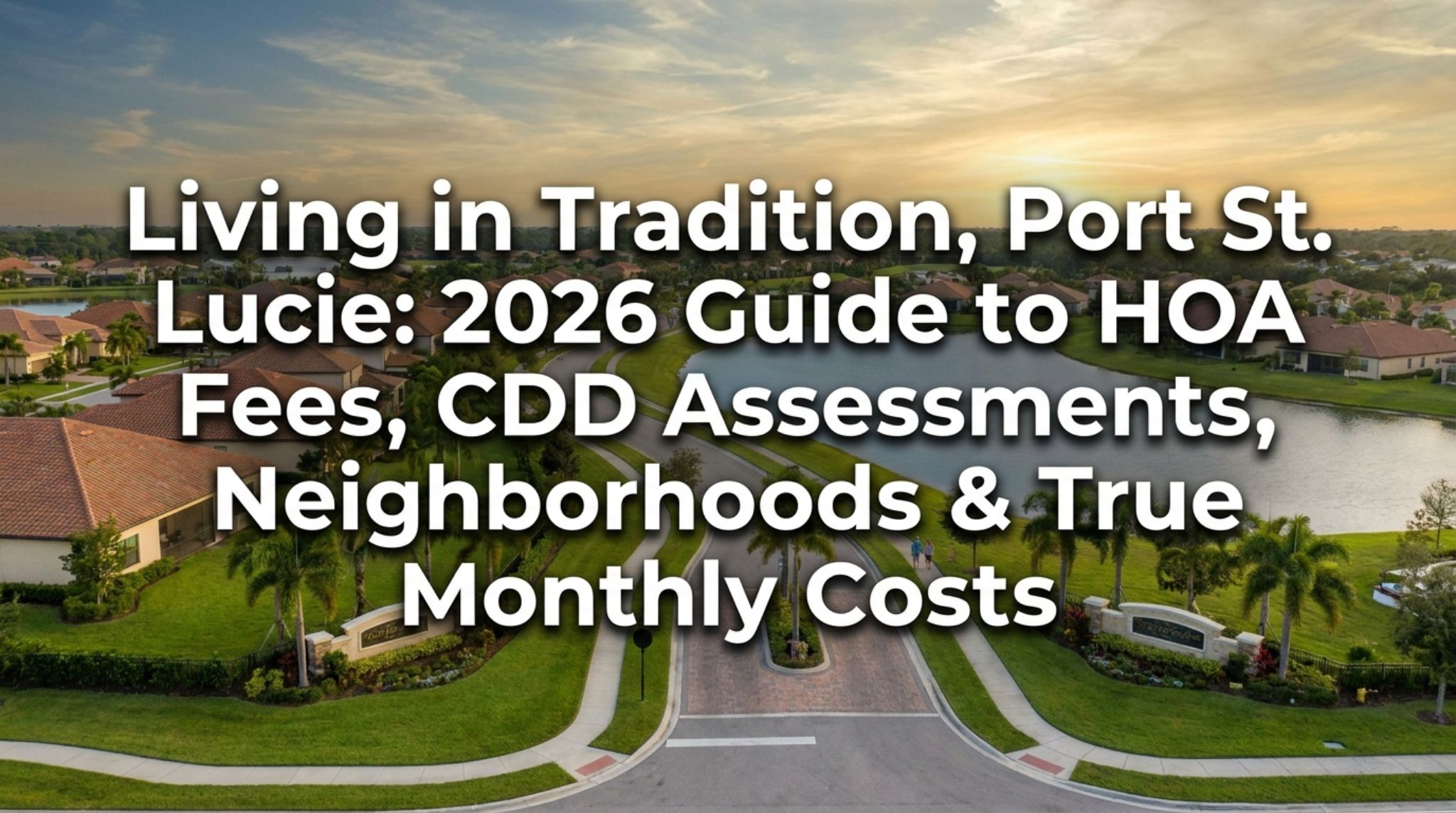
Living in Tradition, Port St. Lucie: The True Monthly Cost of a Tradition Home in 2026
There is no single “Tradition fee.” There are multiple districts, multiple associations and a monthly number that only appears once you add all six lines together. This is the arithmetic, and the questions that produce each figure.
Quick Answer: What Does a Tradition Home Really Cost per Month?
Purchase price plus HOA plus the annual CDD assessment divided by twelve plus projected post-purchase taxes plus insurance plus a maintenance reserve. Many Tradition neighborhoods have an HOA, and much of the broader area is served by Community Development Districts — but there is no universal “Tradition CDD fee.” Tradition has multiple CDDs, and assessments differ by district and property type. District budgets are adopted by fiscal year and split assessments into operations-and-maintenance and debt components, so the operations portion can change even after a bond is retired. Most CDD assessments are collected as non-ad valorem lines on the property-tax bill. The biggest mistake buyers make is comparing prices without comparing the entire fee stack.
What This Guide Covers
What Is Tradition?
Tradition is one of the most recognizable master-planned areas in Port St. Lucie, but buyers often discover that its financial structure is more complicated than its streetscape. The phrase “How much are the Tradition fees?” sounds simple. It is not.
A property may involve a neighborhood HOA, a community development district assessment, property taxes and other recurring obligations. Another property a few minutes away can have a different combination. The solution is not to avoid Tradition. The solution is to compare it correctly.
Tradition is a large master-planned section of western Port St. Lucie containing multiple residential communities, commercial areas, parks, health-care facilities and continued development. The city’s 2026 planning materials report approximately 104,982 housing units citywide and another 36,450 approved units that had not yet been built as of February 2026.
That pipeline helps explain why buyers in Tradition encounter completed resale communities, newer resale homes, active builder phases, age-restricted neighborhoods, all-age neighborhoods, villas, townhomes and detached homes — often within a few minutes of each other.
The First Rule: There Is No Single “Tradition Fee”
This deserves to be stated clearly.
Tradition Community Development District No. 1’s financial page explains that each district budget contains assessments levied against property and separates them into operations-and-maintenance and debt components. Budgets are adopted for fiscal years running October 1 through September 30.
Official 2026 budget-workshop materials for Tradition CDDs 1 through 11 also show different assessment categories and levels for different districts and land-use types.
A generic internet answer claiming “the Tradition CDD is $X” is not reliable enough for a real purchase decision. For the fee mechanics in isolation, see the guides on HOA and CDD fees in Tradition and the 2026 Tradition assessment figures. This page is about assembling them into one monthly number.
What Is a CDD?
A Community Development District is a special-purpose governmental entity used in many Florida master-planned developments to finance or manage qualifying infrastructure and community improvements. For a homebuyer, the practical issue is the assessment, which has two parts:
- Debt service — associated with bonds used to finance infrastructure.
- Operations and maintenance — funds ongoing district functions.
The two should not be casually combined without understanding the parcel. A buyer should ask which CDD the property is in, what the current annual assessment is, how much is O&M and how much is debt, whether there is an applicable bond maturity date, whether future assessment changes are under consideration, and whether the quoted number comes from the current fiscal year.
What Do Official 2026 Tradition Documents Show?
At a June 2026 budget workshop, district materials reported proposed assessment breakdowns for multiple Tradition CDDs.
For example, the workshop materials listed a grossed-up single-family assessment figure of approximately $439.51 for certain non-TIM and non-WG irrigation CDD categories, compared with a then-current fiscal-year 2026 figure of $455.16 for that category. The same document contains different calculations for other districts and uses.
That example is not the total CDD cost for every house in Tradition. Its value is that it demonstrates exactly why property-specific verification is necessary. Official budgets contain multiple revenue and assessment lines, and the applicable amount depends on district and parcel classification.
What Is an HOA, Then?
An HOA is different from the CDD. The neighborhood association may handle gated access, landscaping, common areas, amenities, community management, architectural standards, lawn maintenance, cable or internet in some cases, and other neighborhood services.
A buyer in Tradition can therefore have both HOA and CDD obligations. When a listing advertises an HOA amount, do not assume it includes every community charge.
How to Calculate the True Monthly Cost of a Tradition Home
Use this formula:
Mortgage principal and interest
+ projected property tax
+ homeowners insurance
+ flood insurance if applicable
+ HOA
+ annual CDD divided by 12
+ other mandatory fees
+ maintenance reserve
= approximate monthly ownership cost
That final number is more useful than purchase price alone.
A worked example
| Home A | Home B | |
|---|---|---|
| Price | $450,000 | $460,000 |
| HOA | $250/month | $150/month |
| CDD | $2,000/year | $900/year |
| HOA + CDD annually | $5,000 | $2,700 |
Ignoring financing differences, Home A carries $2,300 more per year in the HOA and CDD combination. But suppose Home A’s HOA includes lawn care, internet and another service Home B does not. The buyer needs to value those inclusions before deciding which cost structure is preferable.
Property Taxes in Tradition
Do not base your projected taxes on the seller’s current bill.
The St. Lucie County Property Appraiser explains that qualifying homesteaded owners can accumulate a Save Our Homes assessment difference, and that eligible owners moving from another Florida homestead may be able to transfer some or all of that benefit, subject to state rules. A new buyer’s taxable situation may therefore differ substantially from the seller’s.
The county offers a tax estimator, which is a better starting point than copying the seller’s existing payment. The full workflow is in the St. Lucie County property tax estimate guide.
Tradition New Construction Versus Resale
This is one of the most important decisions in the area.
New construction may offer current floor plans, newer building standards, builder warranty coverage, finish selection, lower immediate maintenance and builder financing incentives.
Resale may offer established landscaping, a mature neighborhood environment, completed improvements, pools or upgrades already installed, known resale comparables and potentially more negotiable pricing.
The key is to compare finished price. A builder’s advertised base price may not include the lot premium, structural options, design choices and post-closing improvements the buyer actually wants. A resale asking price generally includes the improvements physically present. See what a new-construction base price does not include.
Why builder incentives distort the comparison
Suppose a builder sells a new home for $500,000 with a financing incentive, and a resale seller lists a similar property at $485,000. The resale appears cheaper, but a financed buyer may care more about monthly payment. Conversely, the resale may include a pool, fenced yard, window coverings, upgraded lighting and mature landscaping that would cost tens of thousands of dollars to reproduce.
The correct comparison is not list price versus builder base price. It is all-in economic package versus all-in economic package.
Lifestyle should still matter
Financial analysis should not reduce the home search to a spreadsheet. Tradition’s appeal for many buyers is its master-planned environment, nearby services and continued development. But even within the same master plan, buyers can have very different experiences depending on age restrictions, amenities, housing density, lot size, gate structure, walking access, construction activity, HOA responsibility and neighborhood maturity.
A buyer who wants an active-adult lifestyle should not be comparing the same communities as a household prioritizing different housing needs.
How to Read a Tradition Listing
When you see a listing, identify six separate numbers:
- asking price;
- HOA;
- CDD or non-ad valorem assessment;
- projected taxes after purchase;
- insurance estimate;
- immediate capital costs.
If any one of those is unknown, the financial picture is incomplete.
Questions to Ask Before Signing a New-Construction Contract
- What is the base home price, and what is the exact homesite premium?
- Which structural and design upgrades are included?
- What is the current HOA, and the current CDD assessment for this lot?
- Which portions can change?
- What are the current property taxes on a completed home at this price?
- What closing costs does the builder expect the buyer to pay?
- Is the incentive tied to the affiliated lender or title company?
- What happens if construction is delayed?
- Can I conduct independent inspections?
- What is covered by the warranty?
- Are amenities complete, and what future development is planned around the lot?
Questions before buying a Tradition resale
- What is the current HOA, and are increases approved?
- Is there a pending assessment?
- What CDD applies, and what does the latest tax bill show?
- Is a bond component outstanding?
- How old are the roof and the HVAC?
- Is there a pool, and what upgrades were permitted?
- What is included in the sale?
- How does this price compare with builder inventory?
FAQ: Tradition Port St. Lucie Cost Questions
There is no single valid figure for all of Tradition. Multiple CDDs exist, and official district documents show that assessments differ by district and classification. Verify the parcel and the current fiscal-year budget.
Many do. The HOA and the CDD serve different functions: the association handles neighborhood services and standards, while the district finances or maintains qualifying infrastructure.
Do not assume a simple expiration date without reviewing the specific district debt obligations and the ongoing operations-and-maintenance component. Even when a particular bond is retired, district operating assessments can remain.
Many CDD assessments are collected as non-ad valorem assessments on the tax bill. Buyers should verify the exact parcel rather than assuming.
Yes. District budgets are adopted by fiscal year, and operations and maintenance assessments can change. Debt components depend on the applicable bond structure.
It can be, and several communities are specifically designed around active-adult living. Buyers should compare age restrictions, costs, amenities, maintenance responsibility and resale inventory.
Neither is automatically better. Compare all-in cost, financing, upgrades, lot, construction timeline, fees and maintenance.
Comparing home prices without comparing the entire fee stack: HOA plus CDD plus taxes plus insurance plus optional or mandatory services.
Compare Tradition Homes Before You Buy
The most valuable part of a Tradition home search is identifying the true ownership cost before the emotional decision is made.
Jeannie Jacobson can help buyers compare Tradition resale homes, builder opportunities, neighborhood HOA structures, applicable district assessments and comparable sales on a property-by-property basis.