

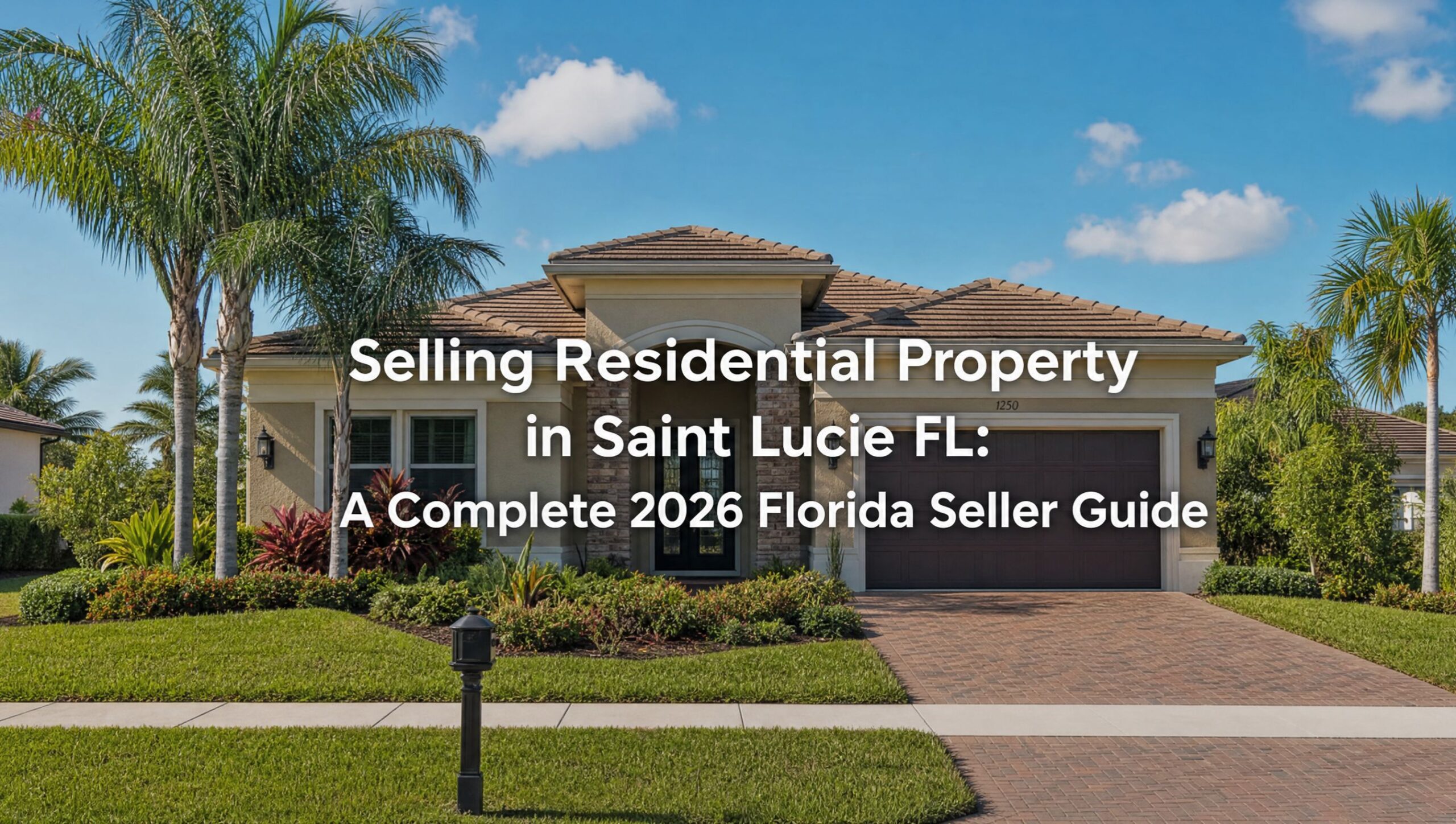
Selling Residential Property in Saint Lucie FL: A Complete 2026 Florida Seller Guide
From Port St. Lucie and Tradition to Fort Pierce, St. Lucie West, and Hutchinson Island — here is the complete Florida home-selling process for Saint Lucie FL in 2026: pricing strategy, preparation, disclosures, flood and insurance, HOA documents, marketing, offers, inspections, appraisal, title, and closing, explained step by step.
Quick Answer: How Do You Sell a Home in Saint Lucie FL in 2026?
Selling in Saint Lucie FL — the broader St. Lucie County market spanning Port St. Lucie, Fort Pierce, Tradition, St. Lucie West, Lakewood Park, White City, and Hutchinson Island areas — is a series of steps, not one event: price with local data, prepare and document the home, disclose known material facts, handle flood and HOA paperwork up front, launch with professional marketing, manage showings, review offers on net proceeds and certainty (not just price), then navigate inspections, appraisal, title, and closing. The 2026 market is more balanced than the recent boom, so accurate pricing and clean presentation matter more than ever — the first two weeks on market are critical, and most financed closings take about 30 to 45 days. This guide walks through every step.
Why Selling a Home in Saint Lucie FL Requires the Right Strategy
Selling residential property in Saint Lucie FL can be a great opportunity, but it is not the kind of market where homeowners should rely on luck, old pricing habits, or a few phone photos online. Today’s buyers are more careful. They compare homes closely. They study insurance costs, roof age, flood zones, HOA fees, inspection reports, mortgage payments, and neighborhood value. They are not just asking, “Is this house nice?” They are asking, “Does this home make sense?”
That matters in Saint Lucie FL because the local market is full of variety. A seller in Tradition is competing differently than a seller in Fort Pierce. A home in St. Lucie West attracts a different buyer pool than a property near Hutchinson Island. A no-HOA home in Port St. Lucie may appeal to buyers who want flexibility, while a newer gated community may attract buyers focused on amenities, security, and low-maintenance living.
Saint Lucie FL sellers also need to understand Florida-specific selling rules. You do not need to become a lawyer, but you do need to know what buyers expect and what the contract process requires. Disclosures, flood information, HOA documents, title issues, inspections, property taxes, homestead exemption timing, and closing paperwork can all affect your sale.
The good news is that sellers who prepare properly can stand out. A clean, well-priced, well-marketed home with clear documentation can still attract serious buyers. The key is to avoid the common mistake of treating selling as one big event — it is really a series of steps: preparation, pricing, marketing, showings, negotiation, inspections, appraisal, title work, closing, and post-sale planning.
This guide walks you through the complete Florida home-selling process with a specific focus on Saint Lucie FL. If you are thinking, “How do I sell my home in Saint Lucie FL without stress?” or “What do Florida sellers need to disclose in 2026?” this article is designed for you. When you are ready to compare your options, start with Jeannie Jacobson’s local resource for selling your home in Saint Lucie FL.
Curious what your home could sell for today? Start with a free, no-obligation home valuation, then review the broader Florida 2026 seller guide for the statewide essentials. This page focuses on what is specific to selling in Saint Lucie FL.
What’s Your Saint Lucie FL Home Worth in 2026?
Pricing is the foundation of a smooth sale. Get a local, data-backed valuation based on real comparable sales, your neighborhood, and current competition — not an online guess.
Request a Free Home Valuation Talk to JeannieUnderstanding the Saint Lucie FL Selling Market
Saint Lucie FL is best understood as the broader St. Lucie County market, including Port St. Lucie, Fort Pierce, St. Lucie Village, Tradition, St. Lucie West, Lakewood Park, White City, Hutchinson Island areas, and nearby Treasure Coast communities. That is important because local buyers do not all search the same way. Some search “Saint Lucie FL homes.” Others search “Port St. Lucie homes for sale,” “Fort Pierce homes near the beach,” “Tradition homes,” “St. Lucie West gated communities,” “Hutchinson Island condos,” or “homes with no HOA in Port St. Lucie.” A strong selling strategy should speak to the exact buyer your property is most likely to attract. Explore the area on Jeannie’s Saint Lucie FL community page.
Why Buyers Choose Saint Lucie FL
Saint Lucie FL appeals to buyers for several reasons: more space compared with many South Florida markets, newer homes in Port St. Lucie and Tradition, waterfront/beach/marina access near Fort Pierce and Hutchinson Island, master-planned communities with amenities, no-HOA neighborhoods for flexibility, gated and 55+ options, proximity to I-95 and Florida’s Turnpike, access to parks, schools, shopping, medical care, golf, and recreation, and relative value compared with Palm Beach County. That buyer interest is real, but buyers have become more selective — they are watching monthly payments, insurance, and home condition carefully, so sellers need to present value clearly from day one.
Port St. Lucie Sellers
Port St. Lucie is one of the largest residential anchors in the Saint Lucie FL market, and sellers here often compete with both resale homes and new construction — so pricing and presentation matter. If your home is in Tradition, St. Lucie West, Torino, Southbend, Becker Road, Floresta, Bayshore, or another PSL neighborhood, buyers will compare your home against similar floor plans, newer builds, builder incentives, HOA fees, commute routes, and property condition. A resale home can absolutely compete, but it needs a clear reason for buyers to choose it — location, lot size, upgrades, mature landscaping, a screened pool, lower HOA, faster move-in timeline, better price, or a stronger neighborhood feel. For a deeper local look, review Jeannie’s Port St. Lucie real estate market report for 2026.
Fort Pierce Sellers
Fort Pierce has a different buyer profile — historic character, downtown access, waterfront lifestyle, marina proximity, beach condos, investment potential, and more affordable Treasure Coast options. If you are selling in Fort Pierce, your marketing should highlight lifestyle and location clearly. A home near downtown, Indian River Drive, Hutchinson Island, Lakewood Park, White City, or Fort Pierce South should not be described generically — buyers want to know what makes the location special. Fort Pierce sellers also need to pay attention to flood zones, roof age, older-home inspections, insurance, permits, and buyer financing, since those details can affect both pricing and negotiation. Start with the Fort Pierce community page.
Tradition, St. Lucie West & Gated Community Sellers
Tradition and St. Lucie West buyers often care about lifestyle, amenities, convenience, and community. Sellers in these areas should be ready to explain HOA fees, what the community includes, nearby shopping, medical access, golf, parks, commute routes, and neighborhood rules. Buyers in gated or master-planned communities usually review HOA dues, capital contributions, rental restrictions, pet rules, parking rules, age restrictions if applicable, lawn-care responsibilities, clubhouse and amenity access, pending assessments, and community reserves. A home in a strong community can command attention, but vague marketing is not enough — buyers need to see the value of both the home and the community.
What Makes the 2026 Saint Lucie FL Market Different
The Saint Lucie FL market is more balanced than the frantic seller markets of a few years ago. Many sellers can still achieve strong results, but buyers now expect accurate pricing, clean presentation, and reasonable negotiation. Homes that are priced correctly tend to get the most serious attention early; homes that start too high often sit, collect days on market, and eventually need price reductions. Online buyers track market time closely — a home active for 60, 90, or 120 days may make buyers wonder what is wrong, even if the only issue was the original price. In 2026, the strongest sellers understand three things:
- Buyers are payment-sensitive.
- Insurance and condition influence offers.
- The first two weeks on market are critical.
That does not mean you underprice your home. It means you price with strategy, support the price with data, prepare the property properly, and launch with strong marketing. Jeannie’s Saint Lucie FL seller resource is built around that kind of practical, local selling plan.
The Saint Lucie FL Home-Selling Process: Steps 1–7
From pricing and preparation to disclosures and your marketing launch, here is how the first half of a Florida home sale unfolds.
Start With a Local Pricing Strategy
Pricing is the foundation of your sale. In Saint Lucie FL, a good pricing strategy is not based on what your neighbor hopes to get, what you need to net, or what an online estimate says — it should be based on current local data, active competition, pending sales, closed comparable properties, property condition, location, buyer demand, insurance factors, and market timing. A real pricing review should consider recent comparable sales within your micro-market, active listings buyers will compare against, pending sales where available, price per square foot used carefully, lot size and view, pool/garage/upgrades/outdoor living, roof age and major systems, HOA fees and amenities, flood zone and insurance considerations, days-on-market trends, and builder competition (especially in Port St. Lucie and Tradition).
Price too high and you may lose the most motivated buyers. Price too low without strategy and you may leave money on the table. The goal is to position the home where buyers see value and feel urgency — a professional home valuation is the right starting point.
Prepare the Home Before It Hits the Market
The best time to fix presentation problems is before your home goes live. Buyers form opinions quickly online and in person, and in a market with more inventory, small issues can cause them to move on. Start with the basics: deep clean throughout; remove clutter from counters, closets, garages, and spare rooms; touch up paint; replace burned-out bulbs; repair loose handles, doors, screens, and fixtures; pressure-wash driveways, walkways, and patios; refresh landscaping; clean windows and sliders; remove pet odors; organize storage; and make the entry feel welcoming.
In Florida, think beyond cosmetics — buyers and inspectors pay close attention to the roof, HVAC, water heater, electrical panel, plumbing, windows, drainage, irrigation, pool equipment, and any signs of moisture. If you know an issue exists, address it early or prepare to disclose and price accordingly. Surprises during inspection often create more stress than issues handled upfront. Jeannie’s seller resources can help you think through preparation, equity, timing, and your next move.
Gather Seller Documents Early
A smooth sale often depends on documentation. Before listing, gather anything that may help buyers feel confident: a survey if available, roof permits and roof-age information, HVAC service records, water heater age, appliance manuals or warranties, a wind mitigation report, a four-point inspection if available, HOA or condo documents, a flood elevation certificate if available, receipts for major improvements, pool service records, pest treatment records, solar documents if applicable, open permit information, and insurance claim history if relevant. Florida buyers are asking more questions — if you can answer quickly and clearly, you reduce uncertainty. Uncertainty slows sales; clarity builds confidence.
Understand Florida Seller Disclosures
Florida sellers generally need to disclose known facts that materially affect the value of the property when those facts are not readily observable and are not already known to the buyer. In plain English, if you know about a serious issue that could affect the buyer’s decision, do not hide it. Common examples may include roof leaks, water intrusion, mold history, foundation or structural issues, unpermitted work, boundary disputes, plumbing problems, electrical issues, HVAC defects, termite or wood-destroying-organism issues, drainage problems, prior insurance claims, open permits or code violations, and material HOA or condo issues.
A seller disclosure is not meant to scare buyers away — it creates transparency and reduces the chance of conflict later. In Saint Lucie FL, disclosure can be especially important for older Fort Pierce homes, properties near waterways, homes with prior roof or storm claims, homes with additions, pool homes, waterfront properties, and houses where improvements were completed over time. The best approach is simple: disclose known material issues clearly, price honestly, and let the property compete on its real strengths.
Handle Flood Zone and Insurance Questions Before Buyers Ask
Florida sellers in 2026 must be prepared for flood disclosure and insurance questions. In Saint Lucie FL, flood risk varies by address — a property near Hutchinson Island, the Indian River Lagoon, canals, drainage corridors, low-lying areas, or certain waterfront pockets will be viewed differently than an inland property. Sellers should know whether the home is in a FEMA flood zone, whether flood insurance is currently carried, whether the lender required it, whether there has been known flood damage, whether there are prior flood claims, whether an elevation certificate exists, whether drainage issues have occurred, and whether improvements were made to reduce flood risk.
Standard homeowners insurance usually does not cover flood damage, so buyers pay attention to this early. If your home has a strong insurance profile, that can be a selling advantage. If the home is in a flood zone, clear information helps buyers make an informed decision instead of assuming the worst.
Get HOA, Condo, and Community Documents Ready
Many homes in Saint Lucie FL are part of HOAs, master-planned communities, gated neighborhoods, 55+ communities, or condo associations. If your home is in an HOA, buyers will want to know monthly or quarterly dues, what they include, community amenities, rental restrictions, pet rules, parking rules, age restrictions if applicable, architectural approval rules, capital contributions, transfer fees, pending special assessments, litigation if known, and reserves and budget details where applicable. Florida requires HOA disclosure in transactions involving mandatory homeowners association membership — practically speaking, make sure buyers receive the right documents on time so the deal does not get delayed or cancelled because of missing paperwork.
For condos, documentation is even more important. Buyers may review budgets, reserves, insurance, milestone inspection status if applicable, structural integrity reserve study information if applicable, special assessments, meeting minutes, and rental rules. A buyer may love the unit, but the association has to make sense too.
Launch With Professional Marketing
Once the home is prepared, priced, and documented, the marketing launch matters. Your first impression online is often your best chance to capture attention — most buyers see your home on a phone before they ever schedule a showing. A strong Saint Lucie FL marketing plan should include professional photography, strong listing copy, accurate MLS positioning, local neighborhood language, buyer-focused feature descriptions, social media promotion, search-friendly content, email and buyer-network exposure, clear showing instructions, strategic open-house planning where appropriate, and follow-up with interested buyers and agents.
Good marketing does not just say “beautiful home” — it explains why the property matters. A Tradition home might emphasize newer construction, amenities, medical access, dining, and quick I-95 access; a Fort Pierce property might highlight downtown, beaches, marina lifestyle, or investment potential; a Port St. Lucie no-HOA home might highlight flexibility, yard size, and lower recurring costs. Jeannie’s Port St. Lucie seller’s playbook explains how strategic preparation and launch planning help sellers compete.
Get a Pricing Strategy & Net-Sheet Before You List
Know your likely sale price, your estimated net proceeds, your repair priorities, and your ideal timeline before your home goes live. A strong plan up front means fewer surprises later.
Book a Seller Consultation See Seller ResourcesSteps 8–14: From Showings to Closing
Once your home is live, the focus shifts to showings, offers, due diligence, and a clean closing.
Manage Showings Like a Seller Who Wants Results
Showings are where buyers decide whether the online promise matches the real home. Before each showing: turn on lights, open blinds, keep the home cool, put away personal items, remove pet bowls and litter boxes when possible, keep counters clear, make beds, secure valuables and medications, keep the garage organized, and make outdoor spaces easy to view. In Florida, temperature and smell matter — a warm, stuffy home feels uncomfortable quickly, and pet odors, moisture smells, or strong fragrances make buyers nervous. Clean, bright, cool, and neutral is the goal.
If showings are slow, do not panic immediately. Review feedback — are buyers concerned about price, condition, location, HOA fees, insurance, layout, or competition? The market will usually tell you what needs adjusting.
Review Offers Carefully
The highest offer is not always the strongest offer. When an offer comes in, review purchase price, deposit amount, financing type, cash versus financed terms, loan approval deadline, inspection period, appraisal contingency, closing date, seller credits requested, personal property included, HOA or condo contingencies, buyer financial strength, contingencies tied to the buyer’s home sale, repair expectations, and title and closing terms.
In Saint Lucie FL, sellers may see offers requesting closing cost assistance, rate-buydown credits, repair credits, or concessions — that does not automatically mean the offer is weak. It means you need to compare net proceeds, certainty, timing, and risk. A lower offer with strong terms may be better than a higher offer with shaky financing or a long list of contingencies.
Navigate Inspections Without Losing Momentum
After the contract is signed, the buyer will usually schedule inspections quickly. In Florida, many sales use an “As Is” contract, but that does not mean inspections do not matter — it usually means the buyer can inspect and decide whether to continue during the inspection period. Common inspections may include a general home inspection, roof inspection, four-point inspection, wind mitigation inspection, WDO or termite inspection, pool inspection, mold or moisture evaluation, septic inspection if applicable, well water testing if applicable, sewer scope if applicable, and condo or HOA document review.
Inspection results may lead to repair requests, credits, price adjustments, or cancellation. The best way to avoid inspection drama is to prepare before listing — if the roof is older, the HVAC is near the end of its life, or the electrical panel may create insurance concerns, know that upfront. You do not have to fix everything, but you should understand how buyers may react. A calm, strategic response is usually better than taking inspection requests personally.
Understand the Appraisal
If the buyer is financing, the lender will usually order an appraisal. The appraiser evaluates the property and compares it to recent sales. If the appraisal supports the contract price, the loan moves forward. If it comes in low, the buyer and seller may need to renegotiate, challenge the appraisal with better comparable sales, adjust terms, or decide whether the buyer can bring additional cash. Sellers can reduce appraisal risk by pricing with real comparable data from the beginning — overpricing may bring an offer, but if the buyer is financing, the appraisal still has to support the value.
Title Search, Liens, and Closing Preparation
During the closing process, the title company reviews ownership history and checks for issues that could affect transfer. Common title and closing issues include unreleased mortgages, liens, judgments, unpaid property taxes, open permits, code violations, boundary or survey issues, probate or estate matters, incorrect names on title, HOA estoppel delays, solar liens or financing, and divorce or ownership disputes. Sellers should address known issues early — if you know there is an open permit, missing final inspection, old lien, or estate issue, do not wait until the week before closing. The title process is one of the quietest parts of a sale, but it is also one of the most important.
Plan for Property Taxes and Homestead Exemption
Florida homestead exemption can affect both sellers and buyers. If the home you are selling is your primary residence and you have homestead exemption, that exemption stays with you through the year of sale; the buyer may need to apply for their own homestead exemption after closing if they will occupy the property as a primary residence. If you are selling and buying another Florida primary residence, ask about Save Our Homes portability — it may allow you to transfer part of your accumulated assessment difference to a new Florida homestead, subject to eligibility and timing rules.
For sellers, the key is to understand that the buyer’s future taxes may be different from your current tax bill. If you have owned the home a long time with homestead protection, your tax bill may look lower than what the buyer will eventually pay after reassessment — so it is better to be clear about that with buyers.
Closing Day and Final Walkthrough
Before closing, the buyer usually completes a final walkthrough to confirm the home is in the expected condition, agreed repairs were completed, included appliances remain, and no new damage has occurred. As a seller, you should remove personal belongings, leave the home clean, keep utilities on through walkthrough, leave keys/remotes/gate cards/manuals as agreed, complete negotiated repairs, provide receipts if repairs were required, avoid removing fixtures unless excluded in the contract, and keep communication clear.
At closing, documents are signed, funds are transferred, the deed is recorded, and ownership changes hands. Once the sale closes, cancel utilities, update your mailing address, save your closing statement, and speak with your tax professional about any questions related to proceeds, capital gains, homestead portability, or next-home planning.
Selling and Buying Your Next Home? Plan the Move First
Whether you need to sell first to unlock equity, buy first with a bridge strategy, or negotiate a post-closing occupancy period, the time to plan is before your listing goes live. Let’s map your timeline and net proceeds.
Plan Your Move Get Your Home ValueCommon Mistakes Saint Lucie FL Sellers Should Avoid
Selling a home is emotional, but the market rewards clear thinking. Avoid these common mistakes:
- Pricing based on hope instead of data
- Ignoring competition from new construction
- Waiting too long to fix obvious presentation issues
- Hiding known property defects
- Underestimating insurance-related buyer concerns
- Not checking open permits before listing
- Delaying HOA or condo document requests
- Refusing to negotiate after inspection
- Taking buyer feedback personally
- Using weak listing photos or generic listing copy
- Overlooking curb appeal
- Assuming the highest offer is the safest offer
- Forgetting about homestead portability planning
- Waiting until closing week to solve title problems
The goal is not just to sell. The goal is to sell smoothly, protect your equity, and avoid avoidable stress. See how Jeannie has guided other Treasure Coast sellers on her reviews page.
Avoid Costly Mistakes — Sell With a Local Pro
From accurate pricing and disclosures to inspections, appraisal, and a clean closing, an experienced local professional helps protect your time and equity. Let’s talk through your home and your goals.
Contact Jeannie Explore Selling in Saint LucieFAQ: Selling Residential Property in Saint Lucie FL
These are the questions sellers ask most about selling property in Saint Lucie FL in 2026. Tap any question to expand the answer.
Yes, but sellers need a realistic strategy. The Saint Lucie FL market still has active buyers, especially for well-priced homes in good condition, but buyers are more selective than they were during the hottest market years. Pricing, presentation, insurance readiness, and strong marketing matter more now. A home valuation is the best first step.
The timeline depends on price, condition, location, property type, and buyer demand. In many cases, sellers should plan for several weeks to secure the right contract and roughly 30 to 45 days from contract to closing if the buyer is financing. Homes that are overpriced or have condition concerns may take longer.
Start with a local pricing and preparation consultation. Before you list, you need to understand your home’s likely value, your competition, your repair priorities, your net proceeds, and your ideal timeline. A strong plan before launch usually leads to fewer problems later — begin with the Saint Lucie FL seller resource.
Florida sellers generally need to disclose known material facts that affect the property’s value and are not readily observable to the buyer. This can include water intrusion, roof leaks, mold, structural issues, unpermitted work, boundary disputes, open permits, or other important defects. In 2026, flood disclosure is also an important part of Florida residential sales.
Yes, Florida sellers should be prepared to provide required flood disclosure information. This is especially important for properties near waterways, canals, Hutchinson Island, Fort Pierce coastal areas, drainage corridors, or known flood zones. Even if flood insurance is not required, buyers will want to understand risk and cost.
If your property is in an HOA, buyers need to receive required association disclosures and review community rules, dues, assessments, rental restrictions, pet rules, parking rules, and architectural guidelines. Delays in HOA or condo documents can slow a transaction, so sellers should gather documents early.
It depends on the repair, cost, and likely return. Cosmetic touch-ups, cleaning, landscaping, and obvious small repairs are often worth doing. Larger repairs — such as roof, HVAC, plumbing, or electrical issues — should be evaluated strategically because they may affect price, insurance, inspections, and buyer financing.
Many buyers focus on price, monthly payment, roof age, insurance cost, flood zone, HOA fees, location, commute routes, schools, community amenities, and overall condition. In Port St. Lucie and Tradition, buyers may compare resale homes against new construction. In Fort Pierce and waterfront areas, buyers may focus more heavily on flood risk, insurance, and property condition.
The exemption itself does not transfer to the buyer. If you are buying another Florida primary residence, you may be able to transfer part of your Save Our Homes benefit through portability if you meet the rules. Speak with the property appraiser or a qualified tax professional so you understand timing and eligibility.
The buyer may ask for repairs, a credit, a price reduction, or may choose to cancel if the contract allows it. You are not automatically required to agree to every request, but you should respond strategically. A reasonable solution can keep a good buyer in place and protect your closing timeline.
If the buyer is financing and the appraisal is lower than the contract price, the parties may need to renegotiate. Options may include lowering the price, the buyer bringing additional cash, challenging the appraisal with stronger comparable sales, or adjusting other terms. Accurate pricing from the start helps reduce this risk.
Florida homeowners can sell on their own, but most sellers benefit from professional pricing, marketing, negotiation, contract management, disclosure guidance, inspection support, and closing coordination. In a market where buyers are careful and compliance details matter, experienced representation can help protect your time and equity.
Seller costs vary by contract, county custom, mortgage payoff, title charges, documentary stamp taxes, negotiated credits, prorated taxes, HOA fees, and real estate commission. The best way to understand your number is to request a net sheet before listing so you can estimate proceeds under different price and negotiation scenarios.
It depends on your finances, equity, comfort with timing, and where you are moving. Some sellers need to sell first to unlock equity; others may be able to buy first, use a bridge strategy, or negotiate a post-closing occupancy period. The key is to plan the move before your listing goes live.
Jeannie Jacobson helps homeowners prepare, price, market, negotiate, and close residential property sales throughout Saint Lucie FL and the surrounding Treasure Coast. Start with the Saint Lucie FL seller resource, request a free home valuation, or contact Jeannie for a personalized consultation.
Final Thoughts: Selling With Confidence in Saint Lucie FL
Selling residential property in Saint Lucie FL is not just about putting a sign in the yard. It is about knowing your market, preparing your home, pricing strategically, disclosing properly, marketing with purpose, negotiating calmly, and managing the contract all the way to closing.
The sellers who do best in 2026 are the ones who understand today’s buyer. They know buyers are comparing homes carefully — that insurance, roof age, flood zones, HOA fees, and condition matter, and that the first impression online can shape the entire sale. Saint Lucie FL offers real opportunity for sellers, especially when the home is positioned correctly. Port St. Lucie, Tradition, St. Lucie West, Fort Pierce, Lakewood Park, White City, Hutchinson Island, and nearby Treasure Coast neighborhoods all attract different buyer groups, and the right marketing plan speaks directly to those buyers instead of using generic language.
If you are thinking about selling, the best next step is to get clear on your price, your timeline, your preparation needs, and your expected net proceeds. Start with Jeannie’s Saint Lucie FL home selling resource, explore the seller resources page, and review the Port St. Lucie real estate market report for 2026 to understand how local conditions may affect your sale. The right sale strategy protects your equity, reduces stress, and helps you move forward with confidence.
Ready to Sell in Saint Lucie FL?
Get a free home valuation and a personalized selling plan — pricing, preparation, marketing, and net proceeds — from a licensed Florida real estate professional who works the Treasure Coast.
Get Your Free Home Valuation Book a Seller ConsultationDisclaimer: This article is for general educational purposes only and is not legal, tax, mortgage, insurance, or financial advice. Real estate laws, association rules, disclosure requirements, insurance standards, and market conditions can change. Sellers should consult qualified professionals — including licensed attorneys, accountants, and tax advisors — for guidance specific to their property and transaction. All information is deemed reliable but not guaranteed and should be independently verified. Equal Housing Opportunity.