

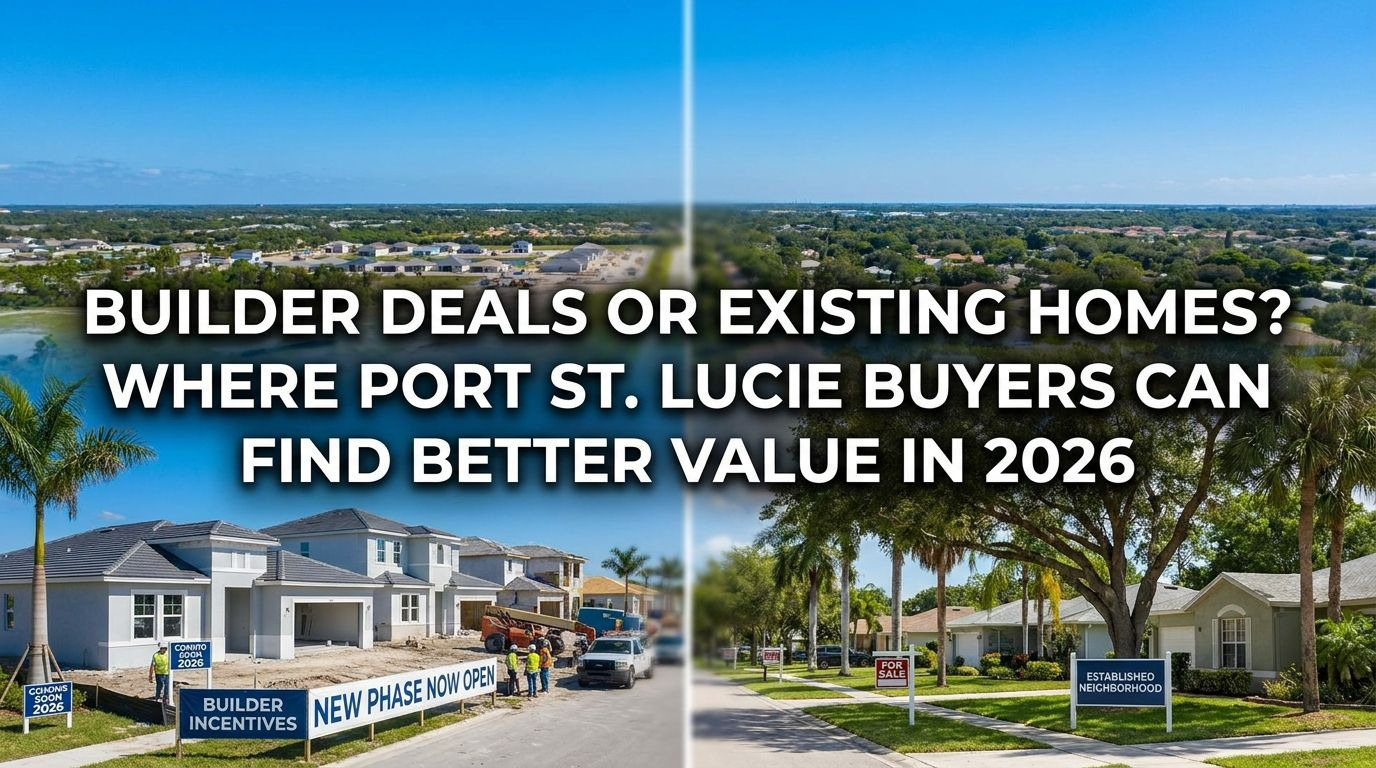
Builder Deals or Existing Homes? Where Port St. Lucie Buyers Can Find Better Value in 2026
The new construction vs resale Port St. Lucie question, answered with August 2026 numbers: live builder incentives, rate buydowns and price cuts, compared against resale pricing, taxes, HOA and CDD costs and five-year ownership cost.
A Port St. Lucie buyer can walk into a builder sales centre in August 2026 and see an advertised mortgage rate that appears dramatically lower than the broader market. The same buyer can spend the afternoon touring resale homes and find sellers who have already reduced prices, completed expensive improvements, or may contribute toward closing costs.
Which is the better deal? There is no honest answer until the two homes are compared on the same financial basis.
That is especially true here, because new construction and resale compete directly in and around Tradition and western Port St. Lucie. As of August 13, 2026, Freddie Mac’s national 30-year fixed benchmark was 6.67%. Against that backdrop, one national builder is currently advertising a select Port St. Lucie quick-move-in promotion with a 2.375% first-year rate as part of a temporary buydown on a 7/6 ARM — while another is showing property-specific price cuts of $20,000 on one Tradition home and $75,000 on another, and a third advertises a modest $2,500 closing-cost credit.
There is no universal “2026 builder incentive” — and no universal resale discount either. The buyer who gets the better value is usually the one who compares price, financing, cash to close, taxes, HOA and CDD, insurance, included improvements, near-term maintenance and five-year ownership cost on one worksheet. That is the comparison this guide builds.
Quick Answer: Is New Construction or Resale the Better Deal in Port St. Lucie in 2026?
Either can win. New construction can offer the stronger early monthly payment when a builder is heavily subsidising financing or discounting a specific inventory home. Resale can offer better total finished-home value when the property already includes improvements, a desirable established lot, and a seller who will negotiate price or closing costs.
The correct comparison is not builder price versus resale asking price. It is: total cash required + realistic monthly payment + taxes + HOA/CDD + insurance + included improvements + expected maintenance + financing cost over the period you expect to own the home. In August 2026, live Port St. Lucie builder offers vary substantially by builder, homesite, loan product, lender and closing date.
Time-sensitive content — verified August 14, 2026. The builder promotions described here are dated examples of how incentive structures work. Several carry August 31, 2026 contract deadlines and will have expired or changed by the time many readers arrive. Treat them as illustrations of structure, not current offers — and request the incentive sheet for the exact property on the day you negotiate. This article is not lending, tax, legal, insurance or financial advice.
What This Guide Covers
- Why Builder Financing Looks So Powerful in 2026
- Price Discounts Can Matter More Than the Promotion
- Resale Sellers Have Incentives Too
- Use the Full Monthly Payment
- Preferred Lender or Independent Lender?
- Taxes Can Reverse the Apparent Winner
- Maintenance vs Completed Improvements
- Where Tradition Makes the Math Interesting
- The Side-by-Side Worksheet
- Three Hypothetical Comparisons
- FAQ
Where this fits. Our guide to builder incentives versus resale discounts dissects the incentive structures themselves — buydown mechanics, credits and the five-year test. The new-construction buyer playbook covers the purchase process. This page is the property-type decision: builder inventory or existing home, compared with August 2026 market numbers.
Why Builder Financing Looks So Powerful in 2026
Freddie Mac reported a 6.67% national average for a 30-year fixed mortgage on August 13, 2026 (15-year: 5.96%). That is only a broad national benchmark — not a quote for any Port St. Lucie borrower — but it explains why a builder’s subsidised rate attracts attention immediately.
A lower rate can beat a lower price on monthly payment
Suppose two homes cost approximately the same. One builder uses incentive dollars to reduce financing costs; the resale seller reduces the purchase price modestly. For a financed buyer, the builder’s financing can create a lower early monthly payment even when the new home’s price is not dramatically lower. Calculate both cash-price value and financing value — they are not the same.
A live example, dated August 2026
One national builder’s current Port St. Lucie promotion — for select quick-move-in homes contracted August 10–31 and closing by September 30, requiring its affiliated lender and closing agent to receive the incentive — illustrates the structure. The published example: $427,900 purchase price, $385,110 loan, 10% down, a conventional 7/6 ARM with a temporary buydown:
- Year 1: 2.375%
- Year 2: 3.375%
- Years 3–7: 4.375% (the initial ARM note-rate period)
- Advertised APR: 5.793% — and the rate begins adjusting after year seven under the loan’s contractual terms
Using that same $385,110 principal on a simple 30-year amortisation illustration:
| Rate used for illustration | Approx. monthly principal & interest |
|---|---|
| 2.375% | $1,497 |
| 3.375% | $1,703 |
| 4.375% | $1,923 |
| 6.67% (national fixed benchmark) | $2,477 |
These are mathematical illustrations only. They omit property tax, insurance, HOA, CDD, mortgage insurance, loan fees and ARM adjustments — and the 6.67% figure is a national fixed-rate benchmark, not a competing quote for the same borrower. Still, the point lands: the difference between an early buydown payment and prevailing fixed-rate financing can be hundreds of dollars per month.
But which rate should you compare? All of them.
Do not compare the resale loan at its full note rate only against the builder’s year-one temporary rate. Ask: what is the note rate? Fixed or adjustable? Temporary or permanent buydown? What is the APR? What is the payment in year one, two, three — and after the subsidy ends? If it is an ARM, when can it first adjust and under what caps? What cash is required, what lender fees apply, and what happens if you refinance or sell?
Temporary buydown ≠ permanent rate reduction
A temporary buydown subsidises the payment for an initial period. A permanent buydown uses discount points or loan pricing to reduce the note rate for the life of the loan. The CFPB explains that points involve more upfront cost in exchange for a lower rate, that lender credits work in reverse — and that the rate change per point varies by lender, loan product and market. Do not convert “the builder is giving me $20,000 toward the rate” into “this mortgage is permanently X% cheaper.” Ask for the Loan Estimate.
Buyer financing rule. Never reject an affiliated-lender incentive automatically — it can be genuinely valuable. But never accept it because of the billboard rate either. Compare the complete Loan Estimate.
Price Discounts Can Matter More Than the Mortgage Promotion
Some builders reduce specific home prices instead of — or in addition to — subsidising financing. In Tradition’s active-adult segment, one current quick-move-in home shows an advertised $75,000 reduction (from $696,320 to $621,320, September 2026 completion), while another home in the same community shows $20,000. A third builder’s Riverland-area community advertises just $2,500 toward closing costs under specified affiliated-services terms.
That spread tells you something important: “how much is the builder discount?” is the wrong question. Ask “what incentive applies to this homesite today?”
A $75,000 reduction sounds decisive — verify it
Before concluding you are receiving $75,000 more value than a resale buyer, ask: what was the home’s actual prior marketed price? Which options and lot premium are included? What design selections are installed? What HOA and CDD apply? What financing incentive remains available with the reduced price? Can incentives be combined? And what would comparable resale homes cost? The builder’s “was” price is transaction information — not automatically market value. The appraisal and competitive market still matter.
Compare the home as delivered
The meaningful comparison is Builder Home A as delivered at closing against Resale Home B as delivered at closing. Do not compare a new home’s base plan against a resale’s finished kitchen, pool, blinds, landscaping, fence and storage — and do not assume the resale has upgrades merely because it is older. Inventory the actual property. Our guide to what a base price does not include covers the cost-composition side.
Upgrades have different values to different buyers
A quick-move-in with upgraded flooring, kitchen selections and a screened lanai delivers real value to the buyer who would have chosen those options — and less to the buyer who dislikes the selections. “$50,000 in upgrades” is not automatically $50,000 of market value. The reverse applies to resale: a seller who spent $70,000 renovating did not necessarily create $70,000 of value. Money spent is not identical to market value created, on either side.
Quick-move-in homes deserve special attention
In 2026, the strongest builder deals tend to attach to completed or nearly completed inventory with specific closing windows — the current financing promotion above is expressly limited to eligible quick-move-in homes. That can make an inventory home financially different from ordering the same floor plan from scratch. If your goal is value rather than custom design, compare actual available homes: full price with lot premium and options, incentive, financing terms, closing costs, HOA, CDD, taxes, insurance and required closing date.
Resale Sellers Have Incentives Too — They Just Look Different
Builders package incentives professionally. Resale incentives are negotiated inside the offer, which makes them less visible at first. A resale seller may offer or negotiate a price reduction, closing-cost contribution, prepaid-cost assistance where allowed, repair credit, rate-buydown contribution, roof or HVAC replacement, closing-date flexibility and other lawful terms. Not every seller will agree to any of these — but the possibilities belong in the comparison.
Seller credit versus builder credit
A dollar from a builder and a dollar from a resale seller can be treated similarly under mortgage rules, because both can be interested-party contributions. For Fannie Mae-eligible loans, sellers, builders and developers are interested parties, and permitted financing concessions can cover allowable closing costs and prepaids within program limits. So the better question is not “is it a builder credit or a seller credit?” It is: “what can my loan legally use this credit for, and what financial problem does it solve?”
Credits do not become cash in your pocket
A $15,000 contribution is not normally a $15,000 cheque after closing. Loan rules govern allowable use — Fannie Mae, for example, states that interested-party contributions cannot fund the borrower’s required down payment, required reserves or minimum contribution. Ask the lender how much of the credit you can actually use.
Price reduction and closing credit are economically different
Suppose a seller will agree to either a $15,000 price reduction or a $15,000 allowable closing credit. The reduction lowers the purchase price and payment modestly; the credit may reduce cash needed at closing, pay eligible costs, or potentially support approved discount-point financing. For a cash-constrained buyer the credit may be more useful; for another buyer the lower price wins. Run both versions with your lender.
Resale sellers can solve condition costs
If inspection and insurance identify a real issue — an older roof, aging HVAC, deferred maintenance — a seller may repair, replace, credit or reduce price. Do not count on it before negotiating, but do not compare the home as though the asking price were always the final economic package either.
Motivation profiles differ
Builders are businesses managing inventory: sometimes inflexible on a homesite’s price but aggressive on financing. Individual homeowners weigh closing certainty, timelines, occupancy and net proceeds: sometimes inflexible on dates but flexible on price. Value exists in the entire transaction, not one line of it.
Monthly Payment Is Where Builders Can Win — But Use the Full Payment
The most persuasive builder offer is often a monthly payment. It becomes misleading if you compare only principal and interest. Your housing budget is: principal + interest + taxes + homeowners insurance + mortgage insurance + HOA + CDD and other assessments.
Add realistic property taxes — for both homes
Do not use a vacant-lot or construction-period tax bill for new construction, and do not automatically use the seller’s current bill for resale. The St. Lucie County Property Appraiser warns that an ownership change can reset assessed value and remove the previous owner’s exemptions and caps — and states directly that past taxes are not a reliable projection of future taxes. Its estimator even has a separate first-time-homeowner/new-construction path, and it excludes non-ad valorem assessments. Our guide to how Port St. Lucie property taxes change after you buy covers the mechanics.
Add CDD correctly
Tradition deserves special attention: the district separates operation-and-maintenance from debt-service assessments, and obligations must be checked for the specific parcel. Do not assume “new construction = CDD” and “resale = no CDD” — a resale inside a district still carries district assessments. As of August 2026, Tradition’s FY 2025/2026 budget is final while FY 2026/2027 remains proposed; if your closing lands in the next fiscal year, review the adopted budget when it publishes. See our breakdown of Tradition HOA and CDD fees for verified current figures.
Add HOA, insurance and mortgage insurance
Two similarly priced properties can carry very different association obligations — and higher dues are not automatically worse if they include services the other property leaves to the owner. Insurance must be quoted on the actual properties: a new home’s construction characteristics can matter to underwriting, but so can a resale’s recently replaced roof and documented wind mitigation. No specific premium should be assumed for either.
The real payment comparison
| Component | Builder home | Resale home |
|---|---|---|
| Principal & interest | Actual quote | Actual quote |
| Property tax estimate | Property-specific | Property-specific |
| Insurance | Actual quote | Actual quote |
| Mortgage insurance | If applicable | If applicable |
| HOA | Verified | Verified |
| CDD / non-ad valorem | Verified parcel | Verified parcel |
| Total monthly housing cost | Calculate | Calculate |
Only then ask which monthly payment is lower.
Port St. Lucie buyer rule. Never let a temporarily subsidised mortgage payment hide a higher recurring HOA, CDD, tax or insurance expense. If the builder financing saves $250 a month during an incentive period but the home’s recurring community costs run $250 a month higher, much of the advantage disappears — and the reverse happens too.
Preferred Lender or Independent Lender? Compare the Package, Not the Brand
Builder-affiliated financing can be valuable — and it can come with conditions. The current promotion described above requires the builder’s financing arm and seller-selected closing agent to receive the incentive, while expressly noting the buyer is not required to use those services merely to purchase the home. That distinction matters: the incentive is tied to the services, not the house.
Do not ask only “what’s your rate?”
Ask the builder lender for the Loan Estimate: note rate, APR, fixed or adjustable status, term, points, origination charges, buydown details, lender credits, builder credits, estimated cash to close, mortgage insurance and the future payment schedule. Then request comparable terms from an outside lender — and compare the same loan type. A 7/6 ARM with a temporary buydown against a 30-year fixed with zero points are different financial products, not two prices for the same thing.
Use the CFPB’s five-year comparison
The CFPB recommends comparing Loan Estimates on interest rate, monthly payment, mortgage insurance, loan costs, lender credits, cash to close — and the “In 5 Years” borrowing-cost comparison on page three. That figure is particularly useful when weighing a large upfront incentive, a temporary buydown, discount points and a conventional resale loan against each other.
Ask for three time horizons
- Year 1 — immediate affordability
- Year 5 — comparing temporary incentives and points
- Year 10 — if you realistically expect to keep the property and the original mortgage
“You can refinance later” is not an incentive analysis. Refinancing requires a future rate environment, property value, credit profile and loan availability that no one can guarantee today. A builder promotion should work financially under the loan terms you are actually signing — if rates later make a refinance attractive, evaluate it then.
When the builder lender wins: the incentive contribution is large, the note rate competitive, fees reasonable, the payment structure fits your timeline and no outside lender can match the total package. When an outside lender wins: base market pricing is stronger, the incentive does not offset the rate and fee difference, the loan product fits better, ARM risk is undesirable, or the builder’s closing deadline conflicts with your needs. There is no rule requiring either conclusion — the promotion should survive the spreadsheet.
Taxes Can Reverse an Apparently Better Deal
Both property types hide tax traps — in opposite directions.
Resale: the seller may have Homestead Exemption and years of Save Our Homes protection. When ownership changes, assessed value can reset to market value and the seller’s exemptions and caps are removed. Seller tax bill ≠ buyer future tax guarantee.
New construction: the parcel’s record may reflect vacant land or incomplete improvements as of the relevant January 1 assessment date. Copy that bill into a mortgage calculator and the payment looks wonderful — until the completed home receives its post-construction assessment.
Compare future-tax assumptions equally
If Builder Home A and Resale Home B both cost $450,000, do not use future assessed taxes for A and the seller’s protected historical taxes for B — that biases the comparison. Estimate each from the new buyer’s expected ownership status, apply your own Homestead eligibility (and Florida portability, if you have it) consistently to both, and add non-ad valorem assessments separately, because the county estimator excludes them.
New Saves Near-Term Maintenance — Resale Can Include Expensive Improvements Already Done
A new home may bring a newer roof, HVAC, appliances, plumbing and electrical, plus builder warranty protections whose actual terms should be read before purchase. An existing home may have older systems — or may have replaced them recently. Age alone does not answer the value question.
Build a five-year capital list for both
For the resale: roof, HVAC, water heater, appliances, pool equipment, exterior work and renovations you actually plan, using inspections and contractor estimates. For the new home: landscaping, blinds, ceiling fans, fixtures, fence, gutters, screened enclosure, pool, storage and outdoor improvements — only the items you genuinely expect to buy.
Two mirror-image examples
Finished resale vs basic new home: the resale has pool, blinds, fence, mature landscaping and a 6-year-old roof; the new home has none of those but new systems, a $10,000 lower price and a $20,000 financing incentive. If you would spend $70,000 recreating the resale’s features, the comparison changes completely.
Updated new home vs deferred-maintenance resale: the resale has an 18-year-old roof, aging HVAC and dated systems at $25,000 less. If its first years of capital needs exceed that difference, the new home wins even at the higher price. The correct answer is property-specific.
Two slogans to retire. “Resale has better value per square foot” ignores condition, lot, financing, HOA, CDD and improvements. “New is maintenance-free” ignores that every property has ownership expenses — newness changes the risk profile, it does not eliminate it.
Tradition Is Where the New-vs-Resale Math Gets Especially Interesting
Tradition contains both newer construction and established resale inventory side by side, making it the clearest Port St. Lucie area for this comparison. Builder financing promotions and quick-move-in price cuts are live there now; resale offers established lots, observable surroundings, completed pools and enclosures, and known rear exposures.
A finished street has information value
With resale you can often observe the adjacent homes, established landscaping, traffic pattern, lot privacy and nearby construction as they actually are. In a developing phase, some of those conditions can still change — which is not negative, but means distinguishing what exists today from what is proposed.
CDD and HOA: parcel by parcel
Do not assume the newer home carries the higher CDD or that the older resale has none — check the tax bill and district for each. And compare association services, not just the dues number. Our Tradition fee guide shows how sharply district assessments moved this fiscal year.
Location can outweigh an incentive
A buyer may prefer a particular lot, street, view, floor plan or established section. A $20,000 builder incentive does not make those preferences disappear — and a resale premium does not make the incentive meaningless. Financial value and property preference have to meet. The same applies outside the master-planned areas: in St. Lucie West, Torino and established Port St. Lucie, a specific golf lot, lakefront position or non-HOA property may simply have no new-construction substitute — and a recently updated resale there can combine location advantages with low near-term maintenance.
How to Run the New Construction vs Resale Port St. Lucie Comparison Correctly
Use one worksheet. Do not use the builder’s brochure for one property and a portal’s payment calculator for the other.
Normalise the purchase price
Builder contract price after homesite and options, against a realistic negotiated resale price. Not the builder base price if the home you want costs more; not an undiscussed resale discount.
List every incentive
Builder: price reduction, financing subsidy, closing-cost contribution, design credit, upgrade package. Resale: negotiated reduction, seller contribution, repairs, replacements.
Determine what is actually usable
Send the credits to your lender and ask how much your loan program allows. Interested-party contribution limits are why a headline credit is not automatically usable in full.
Obtain actual Loan Estimates
Not quoted rates in e-mails. Standardised Loan Estimates, from the affiliated lender and at least one outside lender.
Compare payment today — and after incentives expire
P&I, mortgage insurance, taxes, insurance, HOA, CDD now; then the payment when the temporary subsidy ends, and the ARM adjustment terms if applicable.
Compare cash to close
A household may prefer preserving $15,000 in reserves even at a slightly higher price; another may prioritise the lowest long-term cost. Neither is wrong — but choose deliberately.
Add immediate completion costs
Builder: blinds, fence, pool, landscaping, upgrades after closing. Resale: inspection repairs, roof or HVAC, renovations. Use actual plans and estimates.
Compare five-year borrowing cost
Use the Loan Estimate’s “In 5 Years” figure, as the CFPB recommends, and add the five-year view of HOA, CDD and known capital differences at current values — labelled as a current-cost illustration, not a forecast.
Compare exit flexibility
What happens if you move in three, five or ten years? A buyer paying significant points for a permanent rate reduction needs time to recover the upfront cost.
Decide which differences matter to you
The cheapest theoretical property is not automatically the right home — and neither is the one with the most attractive model centre. The goal is knowing what you are paying for.
The 2026 worksheet
| Category | New construction | Resale |
|---|---|---|
| Contract / purchase price | Exact homesite price | Actual negotiated offer |
| Price reduction | Verify current offer | Negotiate |
| Rate buydown (temp or permanent) | Verify terms | Possible if negotiated and allowed |
| Closing-cost assistance | Often promoted; verify eligibility | Negotiable |
| Preferred-lender requirement | May be tied to the incentive | Usually none |
| Lot premium / upgrades | Verify what is included | Existing improvements |
| Property taxes | Estimate completed value | Recalculate after ownership change |
| HOA / CDD | Verify parcel | Verify parcel |
| Insurance | Actual quote | Actual quote |
| Near-term roof/HVAC risk | Generally newer | Property specific |
| Warranty | Review actual builder terms | Property-specific / third-party |
| Cash to close & 5-year cost | Loan Estimate | Loan Estimate |
| Timeline | Inventory or construction schedule | Negotiated completed-home closing |
Three Hypothetical Port St. Lucie Comparisons
Educational illustrations — not actual listings or mortgage quotes.
Builder wins the monthly-payment comparison
Builder home at $430,000 with substantial financing support and $250 in combined monthly HOA/CDD, versus a resale at $410,000 with standard financing, $100 HOA, no CDD — and a roof likely needing replacement within several years. The resale is $20,000 cheaper, yet if the builder financing cuts the monthly mortgage cost by several hundred dollars, the new home can carry the lower total payment initially. The follow-up question: what happens after the temporary benefit expires? If the payment rises materially later, the resale becomes more competitive over a longer ownership period. Lesson: lower price does not always mean lower early monthly cost.
Resale wins the finished-home comparison
Builder home at $445,000 with a $20,000 incentive but no pool, no fence and basic window treatments, versus a resale negotiated at $450,000 with $7,500 seller contribution — including pool, fence, updated kitchen, window treatments and a newer roof. If the buyer would spend $60,000 or more creating those features after buying new, the resale delivers more usable value despite the higher nominal price. Lesson: incentive dollars and completed-improvement dollars must be compared together.
Builder wins on risk reduction
Resale at $395,000 with a roof nearing replacement, older HVAC, a higher insurance quote and a $20,000 concession available, versus a new home at $425,000 with newer systems and an acceptable insurance quote. The resale discount appears stronger — but if roof, HVAC and insurance differences absorb most of the savings, the new home fits a conservative buyer’s budget better. Lesson: a negotiated discount is only valuable after foreseeable ownership costs are subtracted.
Comparing new construction with resale? Both tax histories mislead — in opposite directions. See how to run a property tax estimate for each property so the monthly comparison is built on the same basis.
FAQ: New Construction vs Resale Port St. Lucie Buyers Ask About
Sometimes, but not universally. A new home can be cheaper on monthly payment when the builder subsidises financing aggressively; a resale can be cheaper as a completed ownership package when it already includes expensive improvements or has lower recurring community costs. Compare the actual purchase price, usable concessions, mortgage terms, taxes, insurance, HOA and CDD, immediate improvements and five-year borrowing cost. No citywide average can tell you which of two specific homes is the better value.
Yes, but they differ substantially by builder, community, homesite, financing and closing date. As of mid-August 2026, one national builder advertised a temporary-buydown financing promotion on eligible quick-move-in homes with an August 31 contract deadline; a Tradition active-adult community showed property-specific savings of $20,000 on one home and $75,000 on another; and a Riverland-area community advertised $2,500 toward closing costs. These are snapshots, not permanent programs — request the incentive sheet for the exact property on the day you negotiate.
A builder rate buydown uses incentive funds to reduce the buyer’s mortgage cost under the lender’s program. It can be temporary — payments subsidised for an introductory period — or permanent, where discount points or loan pricing reduce the note rate for the life of the loan. The CFPB explains that points exchange higher upfront cost for a lower rate, that lender credits work in reverse, and that the exact rate impact per point varies by lender and market. Ask for a Loan Estimate showing the real structure.
Not necessarily. One current Port St. Lucie promotion advertises 2.375% in year one and 3.375% in year two as a temporary buydown attached to a 7/6 ARM with a 4.375% note-rate structure through year seven and an advertised APR of 5.793% — with the rate adjusting after the initial period under the loan’s terms. That is very different from a 30-year fixed mortgage at 2.375%. Read the full rate schedule, the APR and the ARM adjustment terms before comparing it with anything.
Use the lender that produces the best complete package — not automatically the builder lender, and not automatically an outside lender. Affiliated financing can include incentives no outside lender can duplicate, but the promotion is typically conditioned on using the specified services. Compare actual Loan Estimates on rate, payment, mortgage insurance, loan costs, credits, cash to close and the five-year borrowing cost. If the builder lender still wins after that comparison, the incentive is genuinely valuable.
Potentially, yes — subject to the purchase contract, appraisal and loan-program rules. For Fannie Mae transactions, sellers, builders and developers are all interested parties, and permitted financing concessions can cover specified closing costs and prepaids within program limits. Ask your lender how much contribution your specific loan allows before structuring the offer, because a credit exceeding the eligible costs may not deliver its full anticipated benefit.
No. A price reduction lowers the purchase price and modestly lowers the payment; a credit can reduce eligible closing expenses and may support approved financing costs, preserving cash at closing. They affect cash flow differently — a buyer short on closing funds may value the credit more, while another buyer prefers the permanently lower price. Run both scenarios through your lender before choosing.
Do not assume so. For Fannie Mae loans, interested-party contributions generally cannot fund the borrower’s required down payment, required reserves or minimum borrower contribution. Other programs have their own rules. Your lender should confirm exactly what the incentive can legally pay before you count it in your cash plan.
Do not assume so in either direction. A new home’s historical tax record may reflect vacant land or incomplete improvements rather than the finished residence, while a resale seller’s bill can be artificially low for the buyer because of the seller’s homestead exemptions and Save Our Homes history. The St. Lucie County Property Appraiser warns that ownership changes can reset assessments and that past taxes are not reliable projections. Estimate both homes from your own expected post-purchase position.
Many parcels within the Tradition Community Development District structure carry CDD assessments with separate operation-and-maintenance and debt-service components — and a resale inside a district continues to carry district assessments. Do not treat CDD as exclusively a new-construction cost, and do not assume any specific amount without checking the parcel’s tax bill and the district’s current adopted budget.
Many builders offer warranty structures commonly described as 1-2-10 — roughly one year on workmanship, two years on major systems and ten years on qualifying structural elements — but the actual documents govern, so read the specific warranty before signing. A resale generally comes without an automatic warranty; third-party home warranties can be purchased but carry service fees and limitations, and some recent improvements may have transferable manufacturer or contractor warranties worth verifying. Warranty value is real but should be weighed against the resale’s already-completed improvements.
Often not. Resale purchases in Florida commonly include negotiated inspection, financing and appraisal contingencies. Builder purchase agreements are typically the builder’s own contracts and may structure deposits, timelines, changes and remedies differently — and some limit contingencies a resale buyer would expect. That does not make the builder contract unacceptable; it means you should read it, budget the deposit risk, still obtain independent inspections where permitted, and involve a Florida real estate attorney when legal interpretation is needed.
It is often the strongest candidate, because many current promotions attach to selected completed inventory with specific closing windows. But “quick move-in” does not guarantee best value — compare the price, included design selections, lot, financing, completion date, HOA and CDD against both other builder inventory and competing resales. A discounted inventory home you dislike is not a better value merely because it carries the biggest incentive.
Not automatically. A temporary buydown can make one property look unusually inexpensive during the first year or two. Compare the payment now, the payment after the subsidy ends, cash to close, total five-year financing cost, recurring HOA and CDD, taxes, maintenance and property fit. The best home is the one whose financial structure still makes sense after the introductory incentive is removed from the comparison.
So Where Is the Better Value in 2026?
It depends on what “value” means for your household. Lowest initial monthly payment? A builder with heavily subsidised financing may win. Lowest permanent purchase price? A motivated resale seller may win. Lowest cash at closing? Either — depending on loan limits. Most completed improvements for the money? An updated resale is hard to beat. Newest systems and lowest near-term replacement risk? New construction may deserve its premium. A specific established lot or streetscape? Resale may offer something no homesite can duplicate.
The mistake is choosing sides before choosing properties. Find the two or three homes that actually fit your needs, then run the same spreadsheet on each: contract price, minus usable incentives, plus cash to close, real financing cost, realistic taxes, HOA, CDD, insurance, necessary improvements and near-term maintenance. Use an actual Loan Estimate, an actual tax estimate, actual association information and the specific incentive that applies on the day you negotiate. Then decide.
Jeannie Jacobson is a licensed Florida real estate sales associate with RE/MAX Gold serving Port St. Lucie and the Treasure Coast. This article provides general real estate information and is not individualised lending, tax, legal, insurance, appraisal or financial advice. Builder promotions, mortgage rates, credits, community assessments, property taxes and inventory can change without notice. Verify property-specific terms with the builder or seller, lender, St. Lucie County Property Appraiser, applicable association or CDD, insurance professional and attorney when appropriate. Information verified August 14, 2026.