

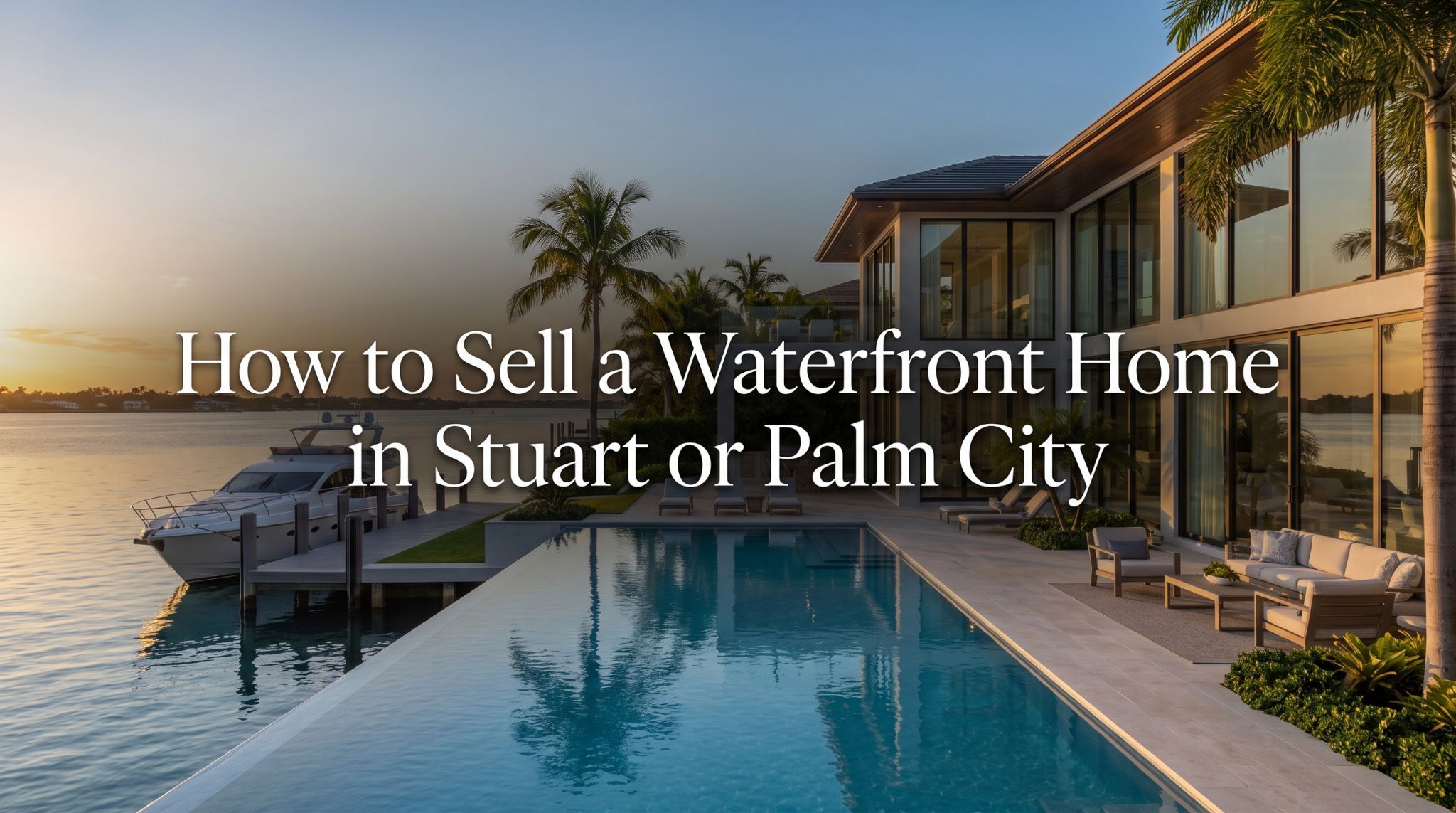
How to Sell a Waterfront Home in Stuart or Palm City
Position boating access, dock documentation, insurance, and luxury marketing to reach qualified Treasure Coast waterfront buyers.
Request a Stuart Home ValuationSchedule a Listing Consultation
Quick Answer: How Do You Sell a Waterfront Home in Stuart or Palm City?
The decision to sell a waterfront home in Stuart or Palm City involves a variable inland sellers never face: your buyer is not buying a house — they are buying access to water, and every dollar of your price above the inland comparable depends on how precisely you can document that access. Classify your access exactly (depth at mean low water, bridge clearance, run time to the inlet, linear feet of frontage), assemble the permit and survey file before listing, resolve seawall and dock questions in advance, obtain an elevation certificate and wind mitigation report, price against matched-access comparables rather than citywide medians, and market with aerial and water-perspective imagery. Every question you leave unanswered gets priced against you.
Educational only. This article reflects information believed accurate as of July 2026 and is not legal, tax, insurance, or engineering advice. Marine permitting requirements, floodplain regulations, flood insurance program terms, and building code editions are site-specific and subject to change — verify current requirements with Martin County or the applicable municipality, the Florida Department of Environmental Protection, the U.S. Army Corps of Engineers, and licensed professionals. Consult a Florida real estate attorney and a qualified tax professional regarding your particular situation.
What This Guide Covers
Why most waterfront listings underperform. They are marketed as though the water sells itself. It does not. A serious buyer for a Sewall’s Point or Rocky Point property will ask about bridge clearance, controlling depth at mean low water, dock permit status, seawall age, elevation certificate, and flood insurance history — usually within the first ten minutes. A listing that answers those questions in the marketing materials attracts a different caliber of buyer than one that answers them three weeks into an inspection period.
Related reading on the site. This guide focuses specifically on Stuart and Palm City — Martin County submarkets, dock and seawall permitting, and matched-access pricing. For the broader regional version, see selling a waterfront home on the Treasure Coast, plus the Stuart FL market guide and the Palm City real estate market update.
The Stuart and Palm City Waterfront Market You’re Selling Into
Waterfront is not one market. Pricing, buyer profile, and marketing strategy differ enormously between an oceanfront condominium on Hutchinson Island, a deep-water estate in Sewall’s Point, and a canal home in Old Palm City.
Where Martin County Stands in 2026
| Indicator | Where it stands |
|---|---|
| Median sale price, March 2026 | $606,250, up 2.8% year over year |
| $1.25M–$1.499M segment | Doubled year over year |
| $2M–$2.999M segment | Up 16.7% year over year |
| Active inventory, late July 2026 | Roughly 788 listings countywide |
| Average days on market | 87 days; median list price near $634,500 |
| Palm City | Closer to 108 days, supply near six to seven months |
Two observations matter for a waterfront seller. First, average sale price declined year over year even as the median rose — a signal that fewer ultra-high-end transactions closed, not that the core market weakened. Second, an 87-day countywide average includes a great deal of ordinary inland inventory. Well-documented waterfront with real boating access behaves differently, and generic market statistics will mislead you in both directions.
Read the numbers together and a pattern emerges: this is a balanced market where ordinary listings sit — and where genuinely scarce waterfront product with verified boating access continues to find qualified buyers, often from Palm Beach County, where the same money buys considerably less water.
The Submarkets
Sewall’s Point
The peninsula between the Indian River and the St. Lucie River, with some of Martin County’s most established waterfront estates. Deep-water dockage, mature landscaping, and a small-town governance structure buyers value.
Rocky Point
Boating-focused neighborhoods on the south side of the St. Lucie River with direct-access dockage and a strong owner-operator boating culture.
Sailfish Point
Oceanfront and marina living at the southern tip of Hutchinson Island, with club membership and a private marina — a distinct luxury submarket with its own comparable set.
Hutchinson Island
Oceanfront condominiums and homes, where the analysis shifts toward association health, milestone inspection status, reserves, and beach dynamics rather than dockage.
North River Shores & Snug Harbor
Established Stuart-area waterfront mixing canal and river frontage, popular with buyers who want boating without an estate budget.
Manatee Pocket & Port Salerno
Working-waterfront character with excellent inlet proximity, appealing to serious boaters and to buyers who value authenticity over polish.
Palm City Riverfront & Canal
Properties along the South Fork of the St. Lucie River and the connected canal systems, plus gated club communities — Harbour Ridge, Monarch, Palm Cove Golf & Yacht — where water access and golf combine.
Jensen Beach, Hobe Sound & Jupiter Island
Adjacent submarkets that compete for the same buyer and belong in your competitive analysis even though they are not your address.
Who Actually Buys Treasure Coast Waterfront
- Palm Beach and Broward County move-north buyers — the largest single source, trading a smaller lot and busier surroundings for water frontage and Martin County’s slower pace. They know exactly what waterfront costs to the south, which makes them value-aware rather than price-insensitive
- Northeast and Midwest second-home and relocation buyers — frequently searching months ahead, heavily dependent on video and aerial imagery, often shortlisting before ever visiting
- Boaters buying access, not architecture — for this group the dock is the primary asset, and they will accept a dated kitchen for the right depth and the right bridge situation
- Retiring and semi-retiring professionals drawn by Cleveland Clinic Martin Health, airport access, and the absence of high-rise development
- International buyers, where FIRPTA considerations enter on the seller side and marketing reach genuinely matters
The Martin County advantage worth naming. The county’s growth management framework — including its long-standing building height restrictions and comprehensive plan limits — has kept it from developing the high-rise coastal density found to the south. That scarcity is a real part of why waterfront here holds value, and it belongs in your listing narrative rather than being left implicit.
Seasonality
Treasure Coast demand strengthens as northern residents arrive for the winter and softens through late summer. The effect is more pronounced on second-home and luxury waterfront than on primary-residence inland inventory, because the buyer pool is disproportionately seasonal. For most waterfront sellers, that argues for having the property fully prepared, photographed, and documented before the season builds — not for listing in September with the intention of “getting ready” during October.
Did you know? A meaningful share of Martin County waterfront buyers begin their search from outside Florida and shortlist properties before ever seeing them in person. That means aerial video, a labeled site plan, and a dock specification sheet are not luxury extras — they are how your home gets onto the list at all.
Water Access Is the Product: Classify It Precisely
“Waterfront” is a category, not a description. Two homes on the same river can differ by hundreds of thousands of dollars based on what a boat can actually do from the dock. Your first job as a seller is to define your access in terms a buyer’s broker and a marine surveyor would recognize.
The Access Hierarchy
Ocean Access, No Fixed Bridges
A vessel can reach the St. Lucie Inlet and the Atlantic without passing under a fixed-height bridge. This is the single most valuable phrase in Treasure Coast waterfront marketing — and it must be accurate.
Ocean Access With Fixed Bridges
Reachable, but with a vertical clearance ceiling that eliminates sailboats and larger sportfish with towers. Still valuable — you simply need to state the controlling clearance.
River or Intracoastal Frontage Without Practical Inlet Access
Beautiful water, excellent for smaller craft and paddle sports, priced differently from boating-access property.
Canal Frontage
With access to the river system, where controlling depth and canal width determine what actually fits.
Lake, Pond, or Preserve Frontage
A view amenity rather than a boating asset. Market it honestly as a view — buyers who discover otherwise mid-transaction become former buyers.
The Numbers Every Serious Buyer Will Ask For
Assemble these before you list. Each one should appear in your marketing materials.
- Controlling depth at mean low water (MLW) at the dock and along the route to open water. “Deep water” is a claim; “5 feet at MLW at the dock face” is a specification
- Vertical clearance of any fixed bridge between your dock and the inlet, and the route it applies to — buyers with sailboats or tower-equipped boats screen on this first
- Distance and running time to the St. Lucie Inlet, stated honestly, including any no-wake zones that affect it
- Water frontage in linear feet, measured on the survey rather than estimated
- Dock dimensions, configuration, and material
- Boat lift capacity in pounds, plus lift type and age
- Maximum vessel length the dockage practically accommodates
- Shoreline type — seawall, riprap, natural, or mangrove — and its condition and age
- Orientation and exposure, which determines both sunset views and wind and wave exposure
The Okeechobee Waterway
Properties with St. Lucie River access sit on the eastern end of the Okeechobee Waterway, which crosses the state through the St. Lucie Canal and Lake Okeechobee to the Gulf. For a segment of buyers, cross-state passage is a genuine feature worth naming — and the lock and bridge clearances along that route are part of the specification.
Riparian Rights and What You Actually Own
Waterfront ownership in Florida involves the boundary between private upland and state sovereignty submerged lands, generally at the mean high water line. Riparian rights — including reasonable access to the water, view, and the right to wharf out subject to regulation — attach to the upland parcel. Practically:
- Your deed does not typically convey ownership of the submerged bottom beneath your dock. The state holds sovereignty submerged lands in public trust
- Structures extending over sovereignty lands generally require authorization, and in some cases a submerged land lease, particularly for larger docks or any revenue-generating use
- A current boundary and mean high water line survey is the document that resolves most questions here. If yours is decades old, order a new one before listing
Buyers with counsel will ask about this. Sellers who have already answered it close faster.
Seagrass, Aquatic Preserves, and Environmental Overlays
Portions of the Indian River Lagoon and adjacent waters carry aquatic preserve designations and documented seagrass beds. These affect what can be built, expanded, or dredged — and they affect a buyer’s plans for a larger vessel or an expanded dock. If a buyer intends to upgrade the dockage, environmental conditions on your parcel will govern what is approvable. Knowing the answer in advance — rather than watching a buyer discover a constraint during due diligence — protects your transaction.
Water Quality: Address It Directly
Martin County waterfront buyers ask about water quality and Lake Okeechobee discharge events, and pretending the topic does not exist damages credibility with exactly the informed buyers you want. The honest, defensible approach is factual: discharge management is governed by federal and state water management operations and varies year to year; conditions differ substantially by location within the estuary; and buyers should review publicly available water quality monitoring data for the specific area. Point them to the data rather than offering reassurance you cannot support. Buyers respect a seller who answers the hard question plainly, and they discount one who deflects it.
Turning Specifications Into Positioning
Once you have the numbers, translate them into the buyer’s language:
“Ocean access with no fixed bridges — approximately 20 minutes to the St. Lucie Inlet, 5 feet at mean low water at the dock face, 16,000-pound lift, 100 feet of river frontage on a 2024 survey.”
Compare that to “beautiful waterfront home with dock and boat lift.” The first sentence pre-qualifies buyers and eliminates tire-kickers. The second generates showings from people whose boat will not fit.
Expert tip. Take a boat out from your own dock and record the run to the inlet on video, with the bridges visible. For an out-of-state buyer deciding whether to book a flight, three minutes of that footage does more than twenty listing photos — and it documents your access claim in a way that is hard to dispute later.
Docks, Lifts, and Seawalls: The Documentation That Sells the Property
Marine improvements are where waterfront transactions succeed or collapse. A buyer’s inspection contingency on a waterfront home frequently includes a marine survey, and unpermitted or failing structures surface fast.
Understanding the Permitting Layers
Florida waterfront construction typically involves three levels of oversight, and owners are often unaware that all three apply.
| Level | What it governs |
|---|---|
| Local | Martin County or the applicable municipality issues the building permit for the dock, lift, or seawall. Records are searchable through the local building department — this is where open or expired permits show up. |
| State | FDEP administers the Environmental Resource Permit program. Many single-family residential docks qualify for an exemption or Letter of Authorization rather than a full permit, based on size, location, and impact — commonly tied to over-water coverage thresholds and conditions including private use only, no obstruction to navigation, and no harm to seagrass, mangroves, or Outstanding Florida Waters. Occupying state-owned submerged lands may separately require authorization or a submerged land lease. In some areas delegation runs through the South Florida Water Management District. |
| Federal | The U.S. Army Corps of Engineers reviews work in navigable waters, often under a Nationwide Permit, with coordination among agencies including National Marine Fisheries Service and the Florida Fish and Wildlife Conservation Commission where protected habitat or species may be involved. |
State exemptions do not override local requirements, and local approval does not satisfy state or federal requirements. All three layers stand independently.
What to Assemble Before Listing
- Original dock permit and final inspection or certificate of completion
- Boat lift permit, capacity rating, installation date, and any service records
- Seawall permit, construction date, engineering documents, and any repair history
- FDEP authorization, exemption determination, or Letter of Authorization
- Submerged land lease documentation, if applicable, including term, fees, and transferability
- USACE authorization where it applies, and any dredging permits with the date of the last dredge
- Current survey showing the dock, seawall, riparian lines, and mean high water line
- Recent marine survey or seawall inspection, if you have one
If a structure was built without permits — which happens more often than owners expect on properties held for decades — find out now. Options include after-the-fact permitting, disclosure with a price adjustment, or removal. Discovering it during a buyer’s due diligence costs you leverage and often costs you the buyer.
Seawall Condition Is a Pricing Event
Seawalls have finite service lives, and replacement is expensive enough to move a purchase price materially. Warning signs a buyer’s inspector will look for: cap cracking and separation, rust staining indicating reinforcement corrosion, tie-back failure, soil voids or sinkholes behind the wall, panel rotation or leaning, and washout at joints.
Understand the substantial repair threshold before you plan work. Under floodplain and local regulatory frameworks used in Florida jurisdictions, once repair work exceeds a defined proportion of the wall — commonly measured at 50% of the shoreline length or 50% of the cost of the barrier — the project can convert from a repair into a full replacement, triggering structural review, an engineer of record, and state and federal review. A project that begins as patching the worst section can cross that threshold once an engineer opens it up. Budget for the possibility before construction starts, and confirm current thresholds with the local building department.
For sellers, this creates a clear decision: obtain an engineer’s assessment and either complete the work, price for it transparently, or offer a documented credit. What does not work is hoping the buyer’s inspector misses it.
Dock and Lift Condition
- Pilings — marine borer damage, wrap condition, plumb and stability
- Decking and stringers — rot, fastener corrosion, structural deflection
- Lift — cable age and condition, motor function, bunk or cradle condition, and whether the rated capacity matches modern vessel weights. A 7,000-pound lift on a river where buyers run 30-foot center consoles is functionally undersized
- Utilities — dock power, water, and lighting, and whether they are permitted and GFCI-protected
- Fixed accessories — davits, fish cleaning station, kayak launch, ladder
Should You Repair Before Listing?
- Fix what blocks a transaction — structural seawall failure, an unpermitted structure, a non-functioning lift, dangerous decking. These narrow your buyer pool or kill financing and insurance
- Consider fixing what is cheap and visible — decking, dock lighting, pressure washing, piling wraps, a fresh lift service. Small money, disproportionate impression
- Usually do not replace a functional-but-dated dock with a new one, or upgrade lift capacity speculatively. Buyers with specific vessels have specific requirements, and a credit lets them build what they actually want
Flood Zones, Elevation, and Insurance: The Value Drivers Sellers Overlook
Insurance is the quiet variable that determines how many buyers can afford your home. On waterfront property it is not a closing detail — it is a pricing input, and increasingly a marketing asset.
Know Your Flood Zone Precisely
- Zone VE — coastal high hazard area subject to wave action; the most restrictive construction requirements and generally the highest premiums
- Zone AE — special flood hazard area with a published Base Flood Elevation; common along the St. Lucie River and connected waterways
- Zone X — moderate or minimal risk, outside the mandatory purchase requirement. Note that a substantial share of national flood claims come from outside high-risk zones, so coverage remains advisable
Pull the designation for your specific parcel rather than your neighborhood. On peninsulas and along river frontage, zone boundaries can cross a single property.
The Elevation Certificate Is a Marketing Document
Under FEMA’s Risk Rating 2.0 methodology, fully implemented across the NFIP, pricing no longer depends on flood zone alone — rating now incorporates property-specific factors including distance to the water source, flood type, elevation, and rebuild cost.
A practical consequence for sellers: an Elevation Certificate is no longer required to purchase NFIP coverage, because FEMA uses its own elevation data sources. But a policyholder may submit one, and if it shows the structure sits meaningfully above the Base Flood Elevation, it can lower the premium.
That turns the Elevation Certificate into a competitive tool. When your listing can hand a buyer’s agent a document showing the lowest floor sits well above BFE, that buyer can obtain an accurate quote instead of a worst-case estimate. Listings without one force buyers to assume the worst, and buyers price in what they cannot verify. If no certificate exists, a Florida-licensed surveyor typically prepares one for a few hundred dollars — among the highest-return dollars you will spend on a waterfront listing.
What Buyers Should Know About Current Flood Rating
- Premium increase caps — statutory limits allow annual NFIP increases of up to 18% for primary residences, while several other categories including non-primary residences are subject to a 25% annual increase until reaching full-risk rates. On a Treasure Coast second home, that distinction matters to a buyer’s long-term cost projection
- Community Rating System discounts — participating communities earn policyholder discounts ranging from 5% to 45% based on classification. If your jurisdiction participates well, that is a genuine selling point — verify the current class rating
- Increased Cost of Compliance coverage — most NFIP policies include ICC coverage providing up to $30,000 toward elevating, relocating, or demolishing a substantially damaged structure
- Mitigation credits for elevating the structure, elevating machinery and equipment above the lowest floor, and installing compliant flood openings
- Private flood insurance has grown as an alternative to the NFIP, sometimes with broader coverage or higher limits — buyers should compare both
- NFIP authorization — the program has operated on a long series of short-term reauthorizations and has lapsed on several occasions, including during the late-2025 federal shutdown, when new policies could not be issued. Because lenders require flood coverage to close in high-risk zones, a lapse can stall closings. Confirm current authorization status when scheduling a closing date, and know that private flood coverage is not subject to that risk
The 50% Rule Every Waterfront Seller Should Understand
FEMA’s substantial improvement and substantial damage standard — the “50% rule” — holds that when the cost of improvements or repairs equals or exceeds 50% of the structure’s market value (excluding land), the entire building must be brought into compliance with current floodplain construction requirements. Florida building officials enforce this closely. Two implications:
- If you are considering a major renovation before listing, confirm with the building department whether it triggers the rule. A renovation that forces elevation of the entire structure changes the economics completely
- Buyers planning renovations will ask. Knowing your structure’s assessed improvement value and how a prospective project would be measured against it lets you answer intelligently rather than leaving a buyer to assume the worst
Note also that the Florida Building Code continues to evolve, with a new edition scheduled to take effect at the end of 2026. Buyers planning substantial work should verify which code edition will govern their permits.
Windstorm and Property Insurance
Separate from flood entirely. On coastal Martin County property, carriers evaluate:
- Roof age, material, and permit date — the dominant variable. Shingle roofs beyond 15 years commonly draw surcharges or declinations; many carriers require replacement around 20
- Opening protection — impact windows and doors or rated shutters throughout produce meaningful credits and widen the carrier pool
- Four-point inspection findings on older homes — Federal Pacific or Zinsco panels, cloth wiring, polybutylene supply, cast iron drain lines
- Construction type and wind mitigation features, documented through a wind mitigation inspection
- Proximity to the coast, which affects both availability and pricing
Order a current wind mitigation inspection before listing and include it in your marketing package. On a well-built waterfront home with impact glass and a newer roof, it is direct evidence that the carrying cost is lower than a buyer would otherwise assume.
Build the insurance package into the listing. The strongest waterfront listings hand a buyer’s agent a folder containing the flood zone determination, the Elevation Certificate, the wind mitigation report, the roof permit date, and the seller’s current premium figures with the caveat that the buyer’s own rating will differ. This is not oversharing. It is removing the largest source of buyer uncertainty on Florida coastal property — and it separates your listing from every competitor that leaves those questions unanswered.
Did you know? Under Fla. Stat. § 689.302, Florida sellers of residential property must complete and deliver a written flood disclosure to the buyer at or before contract execution, on a standalone form. The requirement was expanded effective October 1, 2025 and now covers whether you have filed a flood-damage insurance claim, whether you have received flood damage assistance from any governmental source, and whether you have knowledge of flooding that damaged the property during your ownership. On waterfront property this is not a formality — complete it carefully and keep your documentation.
Property Upgrades: What Returns on Waterfront and What Doesn’t
Waterfront sellers routinely overspend on the wrong improvements. The organizing principle: buyers pay for the water, for resilience, and for outdoor living. They discount your taste in finishes.
Improvements That Reliably Return
- Seawall repair or replacement, documented. Not glamorous, but it removes the largest single unknown from a buyer’s analysis. A documented, engineered, permitted seawall with a known installation date converts a scary line item into a solved problem
- Dock and lift function — structurally sound with a working lift of adequate capacity, serviced, cleaned, and documented
- Impact windows and doors — insurance credits, storm protection, noise reduction, and a signal of overall property quality. On waterfront especially, among the strongest returns available
- Roof replacement when the existing roof is near end of life — it determines insurability, which determines the buyer pool. Sell with a 21-year-old roof and you have restricted yourself to cash buyers
- Outdoor living space — waterfront buyers spend their time facing the water. A functional covered outdoor area, updated pool decking, and quality outdoor lighting extend the experience buyers came for
- Landscaping that frames the view rather than blocking it — selective trimming that opens water sightlines from the primary living areas is inexpensive and changes how the property photographs and shows
- Generator and elevated mechanical equipment — practical resilience features that resonate with buyers who have thought about storm season
- Pressure washing, paint, and dock lighting — small money, disproportionate effect on first impressions from both the street and the water
Before touching any mangroves, confirm compliance with Florida’s mangrove protection requirements. Trimming is regulated, violations carry penalties, and an enforcement action discovered during a buyer’s due diligence is a far more expensive problem than an obstructed sightline.
Improvements That Usually Don’t Return
- Full kitchen and bath remodels immediately before sale — buyers at this price point have opinions and will renovate to their own taste
- Speculative dock expansion or lift capacity upgrades — buyers with specific vessels have specific requirements, and a credit is better than a guess
- Pool resurfacing unless the surface is genuinely failing
- High-end interior finishes in a property whose value is concentrated in land and water access
- Elaborate landscape installations that will read as a maintenance burden to some buyers
The Preparation Sequence
Assess and Document First
Marine survey or seawall inspection, wind mitigation, elevation certificate, permit search, current boundary survey. Everything downstream depends on knowing what you actually have.
Resolve Blockers
Unpermitted structures, failing seawall, non-functioning systems, insurability problems. These narrow the buyer pool before anyone sees a photograph.
Do the High-Return Cosmetic Work
Paint, pressure washing, decking, lighting, and landscaping that opens water sightlines from the primary living areas.
Stage for the Lifestyle
Outdoor living areas set up as a buyer would use them. Interior staging matters less here than on inland luxury property; outdoor staging matters much more.
Photograph and Film — Including From the Water
Clear the dock deck, coil the hoses, remove the gear. A clean dock with good evening lighting photographs as an asset; a cluttered one photographs as a chore.
Remove the boat for photography unless the boat conveys or is genuinely scaled to showcase the dockage. Buyers want to picture their own vessel there.
Budgeting the Work
Set the improvement budget against a net-proceeds analysis rather than against a wish list. Ask your agent for two written scenarios: as-is value with the current condition documented and priced accordingly, and improved value after a defined, costed scope of work — each with estimated net proceeds and estimated time to contract.
On waterfront property, the as-is path is frequently competitive, because the buyer pool includes people who intend to renovate regardless. The improvements that survive that logic are the ones affecting insurability, safety, and the marine structures — which is exactly the list above.
Expert tip. If you do one thing before listing, get an engineer or marine contractor to assess the seawall and put it in writing. A documented “seawall inspected, sound, no remediation required” from a credentialed professional removes the single largest source of buyer anxiety on Treasure Coast waterfront — and it costs a fraction of what an inspection-period renegotiation will.
Pricing a Waterfront Home When Comparable Sales Are Scarce
Pricing inland property is largely an exercise in adjustment. Pricing waterfront is an exercise in judgment, because the truly comparable sale often does not exist.
Why Standard Comparable Analysis Breaks Down
- Small sample size — in a given quarter there may be only a handful of closed sales with genuinely similar access in your submarket
- Access variation dominates — two homes on the same street can differ by $300,000 based on bridge clearance and depth at the dock
- Improvements vary wildly — seawall age, dock condition, and lift capacity are not captured in square footage
- Land value dominates — on premium waterfront the structure is often the smaller share of value, which means the usual price-per-square-foot logic misleads
- The luxury tiers behave independently — Martin County’s $1.25M–$1.499M and $2M–$2.999M segments moved sharply year over year while the broader market held steady. Citywide medians tell you nothing about a $2.4 million estate
Building a Defensible Number
| Input | How to use it |
|---|---|
| Closed sales with matched access | Prioritize access equivalence over proximity. A sale two miles away with the same bridge situation and comparable depth is a better comparable than the house next door on a canal that dead-ends. |
| A widened time window | Where inventory is thin, look back six to twelve months rather than ninety days, with market-condition adjustments applied and explained. |
| Explicit waterfront premium isolation | Identify paired sales — a waterfront property and a comparable non-waterfront property in the same neighborhood — to isolate what the water is actually worth in that submarket. |
| Frontage-based analysis | Linear feet of usable water frontage, adjusted for orientation, depth, and access quality. |
| Marine improvement adjustments | Built from actual contractor estimates. A property needing $180,000 of seawall replacement is not a $180,000 discount to a buyer — it is often more, because buyers price in disruption and risk as well as cost. |
| Active competition and expired listings | What a buyer can choose instead, and where the market has already refused to transact. On thin-inventory waterfront, expired listings are unusually informative. |
| Absorption rate by price band | With Palm City supply near six to seven months and Martin County averaging 87 days, your specific band and access class may behave very differently from either figure. |
The Appraisal Problem
Waterfront appraisals are harder, and a low appraisal on a financed purchase can unwind a transaction. Reduce the risk:
- Assemble a comparable package for the appraiser — the sales you relied on, with your reasoning on access equivalence and improvement adjustments
- Provide the documentation file — survey, elevation certificate, dock and seawall permits, wind mitigation, and marine improvement specifications
- Expect out-of-area appraisers on some assignments, and understand they may not know that a fixed bridge two miles downstream changes everything
- Know your contract’s appraisal provisions and decide in advance what you will do with a shortfall
Cash buyers are a meaningful share of the Martin County luxury waterfront market, which removes this risk entirely on some transactions — one reason cash offers deserve serious weight even at a slightly lower price.
Pricing Strategy in a Balanced Market
With county inventory near 788 listings and average marketing times in the 87-to-108-day range, this is not a market that forgives aspirational pricing.
- Price at the top of the supportable range, not above it. The best traffic arrives in the first two to three weeks and search alerts fire once
- Set review checkpoints in writing with your agent before listing — a defined showing threshold by day 21 and an offer threshold by day 45, each triggering a specific response
- Understand carrying costs. On waterfront property, taxes, insurance, dock maintenance, landscaping, and pool service commonly run several thousand dollars a month. Three extra months of overpricing frequently exceeds the reduction you were avoiding
- Watch the showing-to-offer ratio. Many showings without offers indicates a condition or expectation issue; few showings indicates price or presentation
Beware the highest suggested price. Suggesting an inflated list price to win a listing is common, and it does more damage on waterfront than anywhere else, because thin comparable data makes any number arguable. Ask any agent proposing a price to show you the closed sales, the access classification of each, and the adjustments. A number without that support is a marketing claim, not an analysis. Compare it against a Stuart home valuation that isolates the water premium and shows its reasoning line by line.
Luxury Marketing: Reaching Qualified Treasure Coast Waterfront Buyers
Your buyer is probably not driving past your house. They are searching from Palm Beach, Boston, Chicago, Toronto, or overseas, and the first version of your home they encounter is a set of images on a screen.
Photography and Video Are the Product
- Aerial imagery is mandatory. Waterfront property cannot be understood from the ground. Drone stills and video should show the property in context — the water, the dock, the route to open water, the relationship to the inlet and to neighboring properties
- Water-perspective imagery. Photograph and film the home from a boat. This is the view that sells the property to a boater, and almost nobody does it
- Twilight photography. On waterfront with western exposure, sunset imagery over the river is the single most compelling image you will produce
- Full video walkthrough, including the dock, the lift, the outdoor living areas, and the approach from the water
- Floor plan and site plan — the site plan is arguably more important, showing water frontage dimensions, dock configuration and dimensions, setbacks, and the property boundary relative to the shoreline
- The specification sheet — a one-page document with access classification, depth at MLW, bridge clearance, run time to the inlet, frontage in linear feet, dock and lift specifications, seawall age, flood zone, elevation, and roof age. Attach it to the MLS listing. Buyer agents will use it, and it will get your property onto shortlists
Where the Marketing Actually Goes
- MLS with complete, accurate data — every waterfront-relevant field populated. Buyers filter on these attributes, and an unpopulated field removes you from searches entirely
- Syndication to the major consumer portals, where most searches begin
- Luxury network distribution where your brokerage participates, extending reach to out-of-market and international audiences
- Targeted digital advertising aimed at specific buyer geographies — Palm Beach and Broward move-north buyers, Northeast and Midwest second-home buyers
- Boating-audience channels — yacht brokers, marine service businesses, and boating publications reach people whose primary purchase criterion is dockage
- Agent-to-agent marketing — direct outreach to agents with active buyers in your price band, and to luxury brokerages in Palm Beach County whose clients are looking north
- Broker events rather than public open houses on high-value waterfront, for both effectiveness and security
Listing Copy That Works
Lead with the differentiator. The first two lines appear in portal previews and determine whether anyone clicks.
| Version | Effect |
|---|---|
| “Welcome to this stunning waterfront estate offering luxury living at its finest.” | Describes nothing. Generates showings from people whose boat will not fit. |
| “Ocean access with no fixed bridges — 5 feet at MLW, 24,000-pound lift, and 140 feet of St. Lucie River frontage, twenty minutes to the inlet.” | Pre-qualifies. Buyers who need those specifications read further; those who do not move on — which is exactly what you want. |
Privacy, Security, and Showing Protocol
- Pre-qualification before showings — proof of funds or a verified pre-approval, standard practice at this price point and not an insult
- Accompanied showings rather than lockbox access
- Consideration of what appears publicly — some sellers prefer limited interior imagery or restrictions on aerial shots that reveal security features
- Discretion about occupancy patterns, particularly for seasonal owners
Should You Consider an Off-Market or Pre-Market Approach?
Some waterfront sellers ask about selling quietly, and there are legitimate reasons — privacy, tenancy, or a seller who is not fully committed. Be clear-eyed about the tradeoff: limiting exposure limits competition, and competition is what produces the best price. In a balanced market with 87-day average marketing times, the case for restricting exposure is weaker than it would be in a frenzy. A brief pre-market period to generate early interest before full launch can work; a permanent off-market strategy usually costs the seller money. Whatever you choose, understand your brokerage’s policies and any applicable MLS rules, and make sure the decision is documented as yours.
One compliance note on marketing. Under Chapter 475, Florida Statutes, licensees owe duties of honesty and fair dealing and must disclose known material facts affecting residential property value that are not readily observable — under both transaction brokerage and single agency. On waterfront, that includes access limitations, known seawall problems, and flood history. Marketing that overstates access — describing a property as having ocean access when a fixed bridge limits it, or “deep water” when the controlling depth is three feet — creates liability for the seller and the licensee both. Precision protects you, and it also happens to be what sells the property. See our waterfront marketing approach.
Disclosures, Contracts, and Closing a Waterfront Sale
Waterfront transactions carry due diligence layers that inland sales do not. Anticipating them keeps a contract on schedule.
Your Disclosure Obligations
The baseline duty. Florida’s requirement under Johnson v. Davis obligates a seller of residential property to disclose facts materially affecting value that are not readily observable and not known to the buyer. Selling “AS IS” limits your obligation to repair — not to disclose. On waterfront property, material facts commonly include known seawall deterioration, unpermitted marine structures, flooding history, prior water intrusion, dock or lift defects, boundary or riparian disputes, dredging history and shoaling, and any pending regulatory matters affecting the shoreline.
Flood disclosure. Fla. Stat. § 689.302 requires a standalone written flood disclosure delivered at or before contract execution, expanded effective October 1, 2025 to cover flood-damage insurance claims, assistance received from any governmental source, and knowledge of flooding that damaged the property during your ownership. Complete it yourself — your licensee can provide the form and explain it, but the disclosure is the seller’s responsibility.
HOA and condominium disclosure. In mandatory HOA communities, Fla. Stat. § 720.401 requires the statutory disclosure summary before contract execution, with a three-day right to void if not provided. Condominium sales carry parallel requirements under Fla. Stat. § 718.503, and Hutchinson Island and other coastal condominium buyers will scrutinize association financials, reserves, milestone inspection status, and any structural integrity reserve study. Pending special assessments must be disclosed and will affect price.
Estoppel certificate. Ordered under Fla. Stat. § 720.30851 for HOA communities, showing outstanding assessments, fees, and violations. Order it the week the contract is signed — associations routinely use the full statutory window, and waterfront closings have no slack.
Expect a Marine Survey
Sophisticated waterfront buyers order one, and it examines what a general home inspector does not: seawall condition and remaining life, piling integrity, dock structure, lift condition and rated capacity, and water depth soundings at the dock and along the access route. Sellers who have already commissioned their own assessment enter that conversation with information rather than surprise. Sellers who have not are negotiating from a report they have never seen.
Riparian Rights, Leases, and What Transfers
Confirm before contract:
- How riparian rights are described in the deed and on the survey
- Whether a submerged land lease exists, its term, its annual fee, and its transferability — some require consent or reassignment, which takes time
- Whether dock permits are transferable or require notification to the issuing agency
- Any shared dock, easement, or access agreements with neighbors, and whether they are recorded
- Association rules governing dockage in communities with deeded or assigned slips
A submerged land lease that requires assignment approval can add weeks. Find out in week one.
Contract Considerations
- Use realistic timelines. Waterfront due diligence takes longer — a 30-day close on a property requiring a marine survey, an estoppel, and a lease assignment is optimistic
- Define what conveys. Boat lifts and davits generally convey as fixtures; boats, dock boxes, and equipment often do not. Spell it out
- Address the seawall and dock explicitly rather than leaving them to a general inspection provision
- Set the inspection period to accommodate a marine survey, which may require scheduling around tide and weather
- Anticipate insurance timing. The buyer needs both windstorm and flood coverage bound — if the NFIP is in a lapse period, confirm the private-market path before setting a closing date
FIRPTA on the Seller Side
The Foreign Investment in Real Property Tax Act requires withholding when the seller is a foreign person — generally 15% of the amount realized, with a reduced 10% rate available in certain owner-occupied transactions between $300,001 and $1,000,000 and a limited exemption at or below $300,000 where the buyer will occupy the property.
Treasure Coast waterfront has meaningful international ownership, and this applies more often here than most sellers expect. Two steps prevent a problem: determine tax status early, including for trusts and entities holding title; and where withholding would exceed the actual tax liability, apply for a withholding certificate on IRS Form 8288-B before closing, which can substantially reduce or eliminate the amount held. Closing agents apply FIRPTA conservatively because liability can fall on the buyer — expect signed certifications from every seller.
Closing Costs and Customs
In Martin County, custom — always negotiable and controlled by the contract — generally has the seller paying documentary stamp tax on the deed at $0.70 per $100 of consideration and the owner’s title insurance policy, plus prorated taxes and any association fees through closing. On a $1,200,000 waterfront sale, deed stamps alone run $8,400. Add commission as agreed, estoppel and lien search fees, curative title work, and any negotiated credits. Ask your agent for a written net sheet before you accept an offer, not after.
The Closing Sequence
Title and lien search, including recorded easements and shared-access agreements. Survey review against the mean high water line and dock placement. Marine survey and any negotiated response. Estoppel delivery. Submerged land lease assignment where applicable. Buyer’s insurance bound — windstorm and flood. Final walkthrough including the dock, lift operation, and any negotiated repairs. Closing Disclosure review. Recording and disbursement.
One warning that applies to every transaction and matters more as the number gets larger. Wire fraud targeting real estate closings is a persistent threat. Verify wiring instructions verbally, using a phone number you obtained independently — never a number contained in an email. Never accept last-minute changes to wire instructions.
FAQ: Selling Waterfront in Stuart and Palm City
There is no single percentage, because the premium depends almost entirely on access quality rather than on water views alone. Ocean access with no fixed bridges commands the largest premium; fixed-bridge access commands less; river frontage without practical inlet access less again; and lake or preserve frontage is priced as a view amenity. Depth at mean low water, linear feet of frontage, dock and lift condition, and orientation all move the number materially. The defensible way to establish it is paired-sales analysis — comparing waterfront and non-waterfront sales in the same neighborhood to isolate what the water is actually worth in your specific submarket.
It means a vessel can travel from your dock to the St. Lucie Inlet and the Atlantic without passing beneath a bridge of fixed vertical clearance. It matters because fixed bridges impose a hard ceiling on vessel height — eliminating sailboats and larger sportfish boats with towers and outriggers from consideration entirely. For a segment of Treasure Coast buyers, this is the first filter applied and the last one compromised on. If your property has fixed-bridge access, state the controlling clearance rather than omitting it. Buyers verify, and an overstated access claim discovered mid-transaction costs you the buyer and creates disclosure exposure.
Almost certainly yes. Florida waterfront construction typically involves three layers: a local building permit from Martin County or the municipality, state authorization through FDEP’s Environmental Resource Permit program (many single-family docks qualify for an exemption or Letter of Authorization based on size and impact), and federal review by the U.S. Army Corps of Engineers in navigable waters. Occupying state-owned submerged lands may also require a submerged land lease. If a structure was built without permits — common on long-held properties — your options are after-the-fact permitting, disclosure with a price adjustment, or removal. Discover it before listing, not during a buyer’s due diligence.
Get an engineer’s assessment first, then decide with numbers. If the wall is failing, replacement removes the largest unknown from a buyer’s analysis and typically returns well. If it is sound, a written professional assessment stating so is worth a fraction of the cost and delivers much of the benefit. Understand the substantial repair threshold before planning work: once repair exceeds a defined proportion of the shoreline or the barrier’s cost — commonly measured at 50% — the project can convert into a full replacement requiring structural review, an engineer of record, and state and federal review. Confirm current thresholds with the local building department before construction starts.
You are not required to have one, and under FEMA’s Risk Rating 2.0 an Elevation Certificate is no longer required to purchase NFIP coverage. But having one is a significant marketing advantage. If the certificate shows your lowest floor sits meaningfully above the Base Flood Elevation, a buyer can submit it to obtain a lower premium — and more immediately, they can get an accurate quote instead of assuming a worst case. Buyers price in what they cannot verify. A Florida-licensed surveyor typically prepares one for a few hundred dollars, which makes it among the highest-return pre-listing expenditures on coastal property.
Substantially, because it determines the buyer’s carrying cost and therefore what they can afford to pay. Under Risk Rating 2.0, pricing reflects property-specific factors — distance to water, elevation, flood type, and rebuild cost — rather than flood zone alone. Statutory caps limit annual NFIP increases to 18% for primary residences, while non-primary residences face up to 25% annually until reaching full-risk rates, which matters for second-home buyers. Community Rating System participation can produce policyholder discounts of 5% to 45%. Private flood insurance is a growing alternative worth comparing. Provide the flood zone determination, elevation certificate, and your claims history up front.
FEMA’s substantial improvement and substantial damage standard holds that when the cost of improvements or repairs equals or exceeds 50% of the structure’s market value excluding land, the entire building must be brought into compliance with current floodplain construction requirements — which can mean elevating the structure. Florida building officials enforce it closely. It matters to sellers in two ways: a major pre-listing renovation may trigger it and change the project’s economics completely, and buyers planning renovations will ask how their intended scope measures against your structure’s value. Knowing the answer lets you address it credibly instead of leaving the buyer to assume the worst.
Martin County averaged roughly 87 days on market countywide in late July 2026, with Palm City running closer to 108 days and supply near six to seven months. Those are broad averages across all property types. Well-documented waterfront with verified boating access and current condition records frequently moves faster; properties with unresolved seawall questions, unpermitted structures, or aspirational pricing sit considerably longer. Add 30 to 60 days from contract to closing, and build in extra time for a marine survey, an HOA estoppel, and any submerged land lease assignment — waterfront due diligence takes longer than inland transactions.
Yes, particularly in the upper price tiers, and they deserve serious consideration even at a modestly lower number. A cash purchase eliminates appraisal risk entirely — which matters more on waterfront than anywhere else, because thin comparable data and out-of-area appraisers make low appraisals a real hazard. Evaluate every offer on net proceeds and certainty of closing rather than headline price: financing type, appraisal and inspection contingencies, closing timeline, and the buyer’s actual qualification. Ask your agent for a written comparison of each offer’s net proceeds before responding.
Buyer traffic historically strengthens as northern residents arrive for the winter season and softens through late summer, and the effect is more pronounced on second-home and luxury waterfront than on inland primary residences, because the buyer pool is disproportionately seasonal. The practical implication is less about a calendar date and more about readiness: the goal is to have documentation assembled, marine structures assessed, cosmetic work finished, and photography completed before the season builds — rather than listing in the fall and preparing afterward. A property that launches fully prepared captures the strongest traffic window.
Flooding, yes — both under Florida’s general disclosure duty from Johnson v. Davis for known material facts not readily observable, and specifically under Fla. Stat. § 689.302, which requires a standalone written flood disclosure at or before contract execution covering flood-damage claims, governmental assistance received, and knowledge of flooding that damaged the property during your ownership. On regional water quality and Lake Okeechobee discharge questions, the sound approach is factual rather than reassuring: conditions vary by year and by location within the estuary, and buyers should review publicly available monitoring data for the specific area. Informed buyers respect a direct answer and discount evasion.
FIRPTA generally requires withholding of 15% of the amount realized when the seller is a foreign person, with a reduced 10% rate in certain owner-occupied transactions between $300,001 and $1,000,000 and a limited exemption at or below $300,000 where the buyer will occupy the property. Given the international ownership present in Treasure Coast waterfront, this applies more often than sellers expect — including where title is held by a foreign trust or entity. Determine tax status at the outset, and where withholding would exceed your actual liability, apply for a withholding certificate on IRS Form 8288-B before closing to reduce or eliminate the amount held. Work with a CPA experienced in FIRPTA.
Sell the access. Document everything. The sellers who do best classify their water access precisely — depth at mean low water, bridge clearance, run time to the inlet, linear feet of frontage — and put those specifications in the marketing rather than in a conversation three weeks later. They assemble the documentation file before listing: permits, survey, elevation certificate, wind mitigation, seawall assessment. They fix what blocks a transaction and skip what merely flatters their taste. They price against matched access comparables instead of citywide medians. And they market with aerial and water-perspective imagery to a buyer pool that is largely shopping from somewhere else.
Start With What Your Property Can Prove
Schedule a no-obligation waterfront consultation and we’ll walk the dock and seawall with you, identify the documentation gaps worth closing before you list, and build a valuation against matched access comparables — not a citywide average.
Schedule a Listing ConsultationRequest a Stuart Home Valuation
Jeannie Jacobson · Licensed Florida Real Estate Professional · RE/MAX Gold · Stuart, Palm City & the Treasure Coast
This article is provided for general educational purposes and reflects information believed accurate as of July 2026. It is not legal, tax, insurance, or engineering advice. Marine permitting requirements, floodplain regulations, flood insurance program terms, and building code editions are site-specific and subject to change — verify current requirements with Martin County or the applicable municipality, the Florida Department of Environmental Protection, the U.S. Army Corps of Engineers, and licensed professionals. Market statistics are reported by third parties using differing methodologies and should be treated as context rather than as a valuation of any individual property. Results vary by property, buyer demand, financing, competition, condition, access classification, and contract terms, and no specific price, timeline, or sale outcome can be guaranteed. Consult a Florida real estate attorney and a qualified tax professional regarding your particular situation. Last updated July 31, 2026.