

Luxury Buyer Guide | Port St. Lucie · Palm Beach · Boca Raton
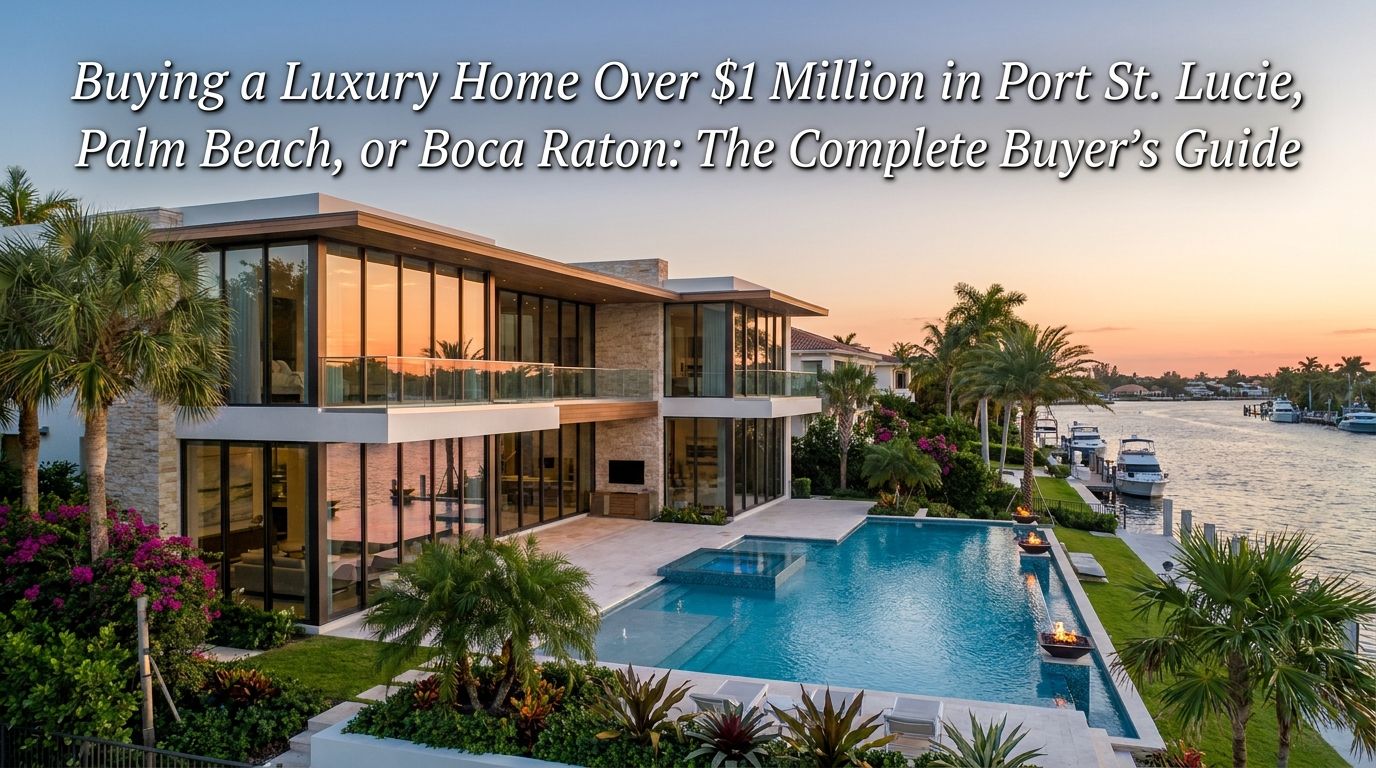
Buying a Luxury Home Over $1 Million in Port St. Lucie, Palm Beach, or Boca Raton
By Jeannie Jacobson, REALTOR® | RE/MAX Gold | Last reviewed September 2026
Above $1,000,000 a Florida purchase becomes a risk-management project. Insurance availability, flood elevation, association and club approvals, jumbo appraisals, and reassessed property taxes all have to be settled inside a defined window — and the three markets in this guide handle each one differently.
Quick Answer. Buying a $1 million-plus home in Port St. Lucie, Palm Beach, or Boca Raton follows a sequence. Choose the market that fits your priorities, sign a written buyer agreement, confirm financing or proof of funds, obtain insurance quotes early, complete Florida-specific due diligence inside the inspection period, and close with the right ownership structure and homestead filing. Skipping the insurance step is the most common expensive mistake.
This guide is real estate education, not legal, tax, insurance, lending, appraisal, or investment advice. Market figures vary by source, geographic definition, and reporting period, and are directional. No specific price, timeline, appraisal value, insurance premium, loan approval, or tax outcome can be guaranteed.
What This Guide Covers
- Why $1 Million-Plus Buying in Florida Is Different
- Port St. Lucie vs. Palm Beach vs. Boca Raton: Which Market Fits You?
- How Buyer Representation Works in Florida After 2024
- Financing: Jumbo Loans, Asset-Based Options, and Cash
- How to Search, Tour, and Access Off-Market Homes
- What Due Diligence Does a Florida Luxury Purchase Require?
- How to Write a Strong Offer Without Giving Away Protection
- Closing: Title, Vesting, and Wire Safety
- After Closing: Homestead, Domicile, and Protection
- FAQ: Buying a Luxury Home in Florida
- Conclusion
Comparing the wider region first? See Port St. Lucie vs. Stuart vs. Jensen Beach • Boca Raton housing trends and forecast
Why $1 Million-Plus Buying in Florida Is Different
Buying a luxury home in Port St. Lucie, Palm Beach, or Boca Raton involves a set of risks that buyers below $1,000,000 rarely encounter, and several of them can end a transaction after you are already under contract.
Insurance availability is the first. Citizens Property Insurance Corporation, the state-created insurer of last resort, is generally unavailable once a dwelling’s replacement cost reaches $700,000, with a $1 million threshold only in Miami-Dade and Monroe counties, according to a 2026 Florida Senate bill analysis. That means essentially every home in this price band must be insured through an admitted carrier writing high-value coverage or through the surplus lines market. Whether a specific property can be insured at a workable premium is a question you answer during the inspection period or discover at the closing table.
Flood is a second, separate question. A homeowners policy does not cover flood damage. Federal flood coverage carries building limits far below what a $1 million-plus home costs to rebuild, which pushes high-value buyers toward private or excess flood coverage. Elevation, flood zone, and any prior claim history all feed that pricing.
Approvals can govern your timeline. Cooperative boards on the island of Palm Beach approve purchasers. Club communities in Boca Raton and Port St. Lucie have membership structures and transfer requirements. None of that moves faster because you are paying cash.
Jumbo appraisals introduce a gap risk that cash buyers avoid and financed buyers must plan for. And property taxes reset. A purchase resets assessed value to just value as of the following January 1, so the seller’s current bill tells you very little about yours.
The three markets handle these differently. Port St. Lucie’s luxury segment is small, newer, and concentrated in club and waterfront settings, with Community Development District assessments common in master-planned areas. Palm Beach means, first, the Town of Palm Beach on the barrier island — an apex market defined by scarcity, cooperative ownership, and municipal review. Boca Raton splits between the City of Boca Raton east of I-95 and unincorporated Palm Beach County communities west of it, a distinction that changes millage, permitting, and services.
Jeannie Jacobson is a Florida-licensed sales associate with RE/MAX Gold, based in Port St. Lucie, serving from St. Lucie County south into Palm Beach County. She is ranked among the Top 1% of Realtors in the United States based on annual production, was voted the 2022 and 2023 “People’s Choice Award” for Treasure Coast Favorite Realtor®, and is fluent in English and Spanish. She hosts educational homebuyer events in Port St. Lucie, Palm Beach Gardens, and Boca Raton. You can learn more about Jeannie’s background and read verified client reviews, which include buyers from Canada.
What follows is the sequence, in order, with the Florida-specific detail at each step.
Choosing a Market
Port St. Lucie vs. Palm Beach vs. Boca Raton: Which Luxury Market Fits You?
These three markets differ in housing stock, price ceiling, ownership structure, and carrying cost. The right choice depends on what you are optimizing for: newer construction and land per dollar, scarcity and location, or a specific club and waterfront profile.
What $1,000,000, $2,000,000, and $5,000,000 Buys in Each Market
Price alone does not describe what you get. The table below compares housing type, lot and water profile, and construction era at three price points, in qualitative terms where verified per-square-foot data for the luxury band is not separately published.
| Price point | Port St. Lucie (St. Lucie County) | Palm Beach (Town of Palm Beach) | Boca Raton (city and unincorporated west) |
|---|---|---|---|
| $1,000,000 | Near the top of the local market. Newer custom or semi-custom construction in golf and club communities, or riverfront. Larger lots than comparable money buys to the south. | Entry point on the island, typically condominium or cooperative rather than single-family. Cooperative ownership carries board approval and possible financing restrictions. | Near or below the local luxury threshold, which the Institute for Luxury Home Marketing placed around $1,200,000 for single-family as of its July 2026 report. Condominiums, townhomes, and some west-side gated product. |
| $2,000,000 | Upper tier locally. Larger custom homes, premium golf frontage, or deeper riverfront. A small comparable pool, so adjustments matter more than averages. | Still generally condominium, cooperative, or a smaller in-town property. Land value dominates and replacement construction is constrained. | Around the segment median. The combined Boca Raton and Delray Beach luxury single-family median was $2,300,000 as of the June 2026 activity reported in July 2026. |
| $5,000,000 | Rare. Typically oceanfront on South Hutchinson Island or an exceptional waterfront parcel. Expect very few comparable sales. | Single-family becomes accessible in parts of the island, subject to location and condition. Palm Beach County recorded 170 sales at $10,000,000 or more through August 2026. | East-side Intracoastal and oceanfront, or the larger estate lots in west-side country clubs. Jurisdiction and club structure drive carrying cost. |
| Dominant ownership form | Fee simple single-family; HOA and CDD assessments common in master-planned areas | Fee simple, condominium, and cooperative; board approval common | Fee simple single-family and condominium; mandatory club membership in some communities |
Sources and periods. Boca Raton and Delray Beach luxury single-family median and threshold: Institute for Luxury Home Marketing, July 2026 report reflecting June 2026 activity for the combined two-city market, accessed September 2026. Palm Beach County $10M+ count: MIAMI REALTORS® + RWorld August 2026 statistics, accessed September 2026. Other cells are qualitative descriptions of housing stock, not price claims, because no verified $1M+ price-per-square-foot breakout was located for each market. Verify current conditions before relying on any figure.
Port St. Lucie: Newer Construction, Golf and Club Communities, Riverfront
Port St. Lucie’s $1 million-plus segment is the smallest of the three and the newest. Recorded luxury activity concentrates in Tesoro Club and Astor Creek Golf and Country Club, the higher-priced Valencia communities within Riverland, PGA Village and PGA Village Verano, frontage on the North Fork of the St. Lucie River, and, in the surrounding county, Fort Pierce and South Hutchinson Island for Intracoastal and oceanfront property. All sit in St. Lucie County; Hutchinson Island addresses frequently carry Fort Pierce mailing designations.
Market-wide, St. Lucie County’s median single-family closing was $410,000 in August 2026 with 5.5 months of single-family inventory as of September 15, 2026, per BeachesMLS data. That is a market-wide figure across all price bands and tells a $1 million-plus buyer only that the luxury tier here sits several multiples above the local median — which is precisely why comparable sales are scarce.
Two structural points matter to a buyer. First, a meaningful share of high-end new construction in these communities is sold directly by builders and may never appear in the MLS as a closed comparable, so public records research through the St. Lucie County Property Appraiser becomes part of the work. Second, master-planned areas commonly carry Community Development District (CDD) assessments on the tax bill. A CDD assessment typically has two parts: debt service, which repays the bonds that funded infrastructure and usually has a defined payoff term, and operations and maintenance, which is ongoing. Ask for both figures on any specific address, and ask whether the debt portion can be prepaid.
For orientation, see the Port St. Lucie market overview, and if you are considering a builder contract, the new construction buyer playbook covers how those agreements differ from resale contracts.
Palm Beach: The Island, the Approval Culture, and the Mainland Corridor
The Town of Palm Beach is a separate incorporated municipality on the barrier island, roughly 4.2 square miles, with areas commonly described as the North End, Midtown, the Estate Section, and the South End. It is the county’s apex luxury market, and it operates on its own rules.
Cooperative ownership is common here and behaves unlike a condominium. Under Chapter 719, Florida Statutes, a cooperative owner holds shares in a corporation plus a proprietary lease rather than a deeded unit. Boards commonly approve purchasers and may restrict or prohibit financing. For a buyer, that can matter more than price: an all-cash purchase may still be declined, and a financed purchase may not be possible at all in certain buildings.
The Town also maintains its own review bodies for architectural and landmark matters and enforces seasonal restrictions on construction activity. If your purchase contemplates renovation, confirm current requirements and timing with the Town before you set expectations, because approval calendars can govern a project more tightly than contractor availability.
Where this guide discusses the mainland luxury corridor rather than the island, it names the municipality — Palm Beach Gardens country club communities, the North Palm Beach and Juno Beach waterfront, and West Palm Beach waterfront and historic districts. “Palm Beach” and “Palm Beach County” are not interchangeable, and conflating them produces bad comparisons. For mainland context, see the Palm Beach Gardens market overview.
Boca Raton: East-Side Waterfront, Downtown, and West-Side Country Clubs
Boca Raton requires a jurisdictional question before any other. The City of Boca Raton covers the eastern portion including downtown, the Mizner Park area, the Intracoastal, and the oceanfront. West of the city, large gated communities use Boca Raton mailing addresses but sit in unincorporated Palm Beach County. That distinction changes millage, permitting authority, and municipal services.
Inside city limits, $1 million-plus activity includes Royal Palm Yacht and Country Club, The Sanctuary, Golden Harbour, Boca Harbour, Por La Mar, and oceanfront and Intracoastal condominium buildings. West of the city, in unincorporated Palm Beach County, comparable activity appears in St. Andrews Country Club, The Oaks at Boca Raton, Woodfield Country Club, Boca West, the Polo Club, Boca Bridges, and Stone Creek Ranch. Confirm the jurisdiction of any specific address against Palm Beach County Property Appraiser records rather than assuming from the mailing address.
Club structure is the second variable. Ask whether membership is mandatory or optional, equity or non-equity, what the initiation or capital contribution is, what annual dues cover, whether a food and beverage minimum applies, and what transfers when you eventually sell. Two homes at the same purchase price in different communities can differ by tens of thousands of dollars a year once membership is included.
See the Boca Raton market overview for current conditions.
Travel Access, Healthcare, and Daily-Life Logistics
Described factually and without ranking: Palm Beach International Airport serves Palm Beach County directly and is the nearest major commercial airport to both the Town of Palm Beach and Boca Raton. Fort Lauderdale-Hollywood International Airport is an alternative for Boca Raton buyers. Port St. Lucie buyers most commonly use Palm Beach International, with Orlando International a longer alternative to the north. Brightline provides rail service with stations in the region. General aviation is available at several county airports.
Drive times vary substantially by time of day and by season, particularly between November and April, so drive your actual route at your actual hour before committing. The same applies to the hospital or medical facility you would use and to any commute you expect to make.
On schools: public school assignment is set by address and changes over time. Confirm current assignment for a specific address with the School District of Palm Beach County or St. Lucie Public Schools directly rather than relying on a listing or a neighborhood reputation.
Property Taxes: The Component You Must Model Before You Offer
Florida property tax is calculated from just value, reduced to assessed value by any applicable caps, reduced again by exemptions to reach taxable value, then multiplied by the combined millage rate of every taxing authority covering the parcel. A mill is $1 of tax per $1,000 of taxable value.
The single most important point for a buyer: a purchase resets assessed value to just value as of the following January 1. The seller’s current bill may reflect decades of Save Our Homes protection that does not transfer to you. Modeling your taxes from that bill is the most common budgeting error in Florida luxury purchases.
| Component | What it is | Homestead purchase | Non-homestead purchase |
|---|---|---|---|
| Just value | The property appraiser’s estimate of market value as of January 1 | Reset following your purchase | Reset following your purchase |
| Assessment cap | Limit on annual assessed value increases | Save Our Homes: 3% or CPI change, whichever is lower, beginning the year after you qualify | 10% annually on non-school levies |
| Homestead exemption | Reduction in taxable value for a Florida permanent resident | First $25,000 applies to all levies including school; a second portion up to $25,000 applies to non-school levies and is inflation-indexed under Amendment 5 | None |
| Combined millage | County, municipality, school district, and special districts added together | Varies by parcel; pull the actual rate for the address | Varies by parcel; pull the actual rate for the address |
| Non-ad valorem | Assessments not based on value | CDD debt service and operations, solid waste, drainage district, fire where applicable | Same |
How to get your actual number. This guide does not quote a millage rate for a specific jurisdiction, because published figures for Port St. Lucie, the Town of Palm Beach, the City of Boca Raton, and unincorporated west Boca varied materially across the sources reviewed in September 2026. Pull the rate yourself: the Palm Beach County Property Appraiser publishes proposed millage rates for every taxing authority in its TRIM materials, and the St. Lucie County Property Appraiser publishes the equivalent, along with tax estimator tools that let you model a purchase price. Run the estimate on your intended purchase price before you write an offer, and confirm your lender will escrow on the reassessed figure rather than the seller’s current bill.
Keep exploring: West Palm Beach market overview
Representation
How Buyer Representation Works in Florida After 2024
Since August 17, 2024, an MLS participant working with a buyer must have a written agreement with that buyer before touring a home. Compensation is negotiable and set by that written agreement, and it is no longer communicated through the MLS.
Those two changes, which followed the practice changes after the National Association of REALTORS® settlement, altered how buyers engage an agent. The mechanics are worth understanding before you schedule a first showing, because the document you sign defines what you are entitled to and what you will pay.
Transaction Broker, Single Agent, or No Brokerage Relationship?
Florida recognizes three brokerage relationships, and the default is not the one most buyers assume.
A transaction broker, defined in Fla. Stat. § 475.278, provides limited representation to one or both parties. Duties include dealing honestly and fairly, accounting for all funds, using skill, care, and diligence, disclosing all known facts that materially affect the value of residential real property and are not readily observable, presenting all offers and counteroffers in a timely manner unless directed otherwise in writing, and limited confidentiality. Florida presumes this relationship unless another is established in writing.
A single agent represents one party with fiduciary duties including loyalty, confidentiality, obedience, full disclosure, and accounting. It requires the statutory single agent disclosure in writing.
A no brokerage relationship means the licensee does not represent you, though limited statutory duties still apply.
The practical difference shows up in confidentiality. Under limited confidentiality, certain information is protected unless you authorize disclosure. Under single agency, the duty is broader. Ask which relationship your agreement establishes, and ask for it in writing. Jeannie Jacobson is licensed as a sales associate with RE/MAX Gold and can explain which relationship applies to your situation before you sign anything.
What a Written Buyer Agreement Covers
Read the agreement before signing. The terms that matter most:
- Term. How long it runs, and whether it renews automatically. A shorter initial term is a reasonable request if you are still evaluating the relationship.
- Geography and property type. Some agreements are limited to a county, a city, or a price band. If you are comparing Port St. Lucie against Boca Raton, make sure the agreement covers both.
- Services. What the agent will actually do, including showings, research, negotiation, and coordination through closing.
- Compensation. The amount or method, how it may be satisfied, and what happens if a seller contributes less than that amount.
- Termination. How either party ends the agreement, with what notice, and whether any obligation survives.
- Protection period. Whether compensation is owed if you purchase a property you were shown after the agreement ends.
Who Pays the Buyer’s Agent Now?
It depends on what you negotiate. Compensation may be paid by the buyer, by the seller as a concession, or by a combination. No rate is standard, customary, or set by law, and any description suggesting otherwise is inaccurate.
In practice, many buyers ask the seller to contribute toward buyer-broker compensation as a concession within the offer. That request is negotiated like any other term, alongside price, deposit, and closing date. If the seller contributes less than your agreement provides, the difference is yours to cover, which is why understanding the number before you tour matters.
How a seller concession interacts with your loan is a question for your licensed mortgage loan originator, since concession limits vary by loan program and by loan-to-value.
Why Representation Matters More Above $1,000,000
The value of an agent changes character in this price band. Four functions carry most of it.
Access. Office-exclusive and delayed-marketing listings exist under current MLS rules, and a buyer without an agent participating in the MLS will not learn about them. Approvals. Cooperative board packages, club membership applications, and association approvals have their own timelines and document requirements. Financing coordination. Jumbo underwriting and appraisal scheduling have to be sequenced against a contract calendar. Insurance coordination. Getting an address-specific quote inside the inspection period is the step that most often determines whether a financed purchase can close at all.
Did you know? Under Florida’s brokerage relationship duties, a licensee must disclose all known facts that materially affect the value of residential real property and are not readily observable — and that duty applies regardless of which brokerage relationship exists. A transaction broker owes it, a single agent owes it, and it applies even where no brokerage relationship has been established. If a licensee knows something material about a property that you cannot see, they are obligated to tell you.
Financing
Financing a $1M+ Home: Jumbo Loans, Asset-Based Options, and Cash
Most financed purchases in this price band are jumbo loans, underwritten to each lender’s own guidelines rather than to agency standards. Cash is also common at the top of these markets, which changes what sellers optimize for when comparing offers.
What Makes a Loan “Jumbo,” and the 2026 Limits
A jumbo loan is any mortgage above the FHFA conforming loan limit for the county. For 2026, the Federal Housing Finance Agency set the baseline conforming loan limit for a one-unit property at $832,750, effective January 1, 2026, an increase of $26,250 from 2025. The high-cost ceiling for one-unit properties is $1,249,125, and in Florida only Monroe County qualifies as high-cost, according to Florida Realtors reporting of the FHFA announcement.
Both Palm Beach County and St. Lucie County therefore use the $832,750 baseline. Any loan amount above that figure in either county is a jumbo loan. Note the distinction that trips buyers up: the limit applies to the loan amount, not the purchase price. A $1,000,000 purchase with $200,000 down produces an $800,000 loan, which is still conforming.
Down Payment, Reserves, and Qualification
Jumbo guidelines are set by the individual lender because the loan is held on the lender’s balance sheet or sold to private investors rather than to Fannie Mae or Freddie Mac. There is no single published standard, so this guide describes the factors rather than quoting ranges.
Lenders generally evaluate down payment size, post-closing reserves expressed in months of housing payment, credit profile, debt-to-income ratio, income documentation and stability, and the property type. Condominium and cooperative purchases add project-level review. Reserve requirements are the factor buyers most often underestimate, because they sit on top of the down payment and closing costs rather than inside them.
Florida adds a variable that lenders in other states weigh less heavily: the housing payment includes homeowners insurance, flood insurance where required, association dues, and any CDD assessment. A high insurance quote can push a debt-to-income ratio past a lender’s ceiling on a purchase that otherwise qualifies.
Asset-Based and Portfolio Structures, Explained
Several structures exist for buyers whose income documentation does not fit standard underwriting. These are described conceptually, not recommended; which one fits, if any, is a question for a licensed mortgage loan originator.
- Full-documentation jumbo: conventional income and asset verification, above the conforming limit.
- Portfolio loan: the lender keeps the loan rather than selling it, allowing more flexible guidelines set internally.
- Asset-depletion or asset-utilization: qualifying income is calculated from documented liquid assets rather than from employment income.
- Pledged-asset: a securities portfolio is pledged as additional collateral, which can affect down payment requirements without liquidating holdings.
- Bank-statement: income is documented from deposit history, used by some self-employed borrowers.
Paying Cash, Then Financing Later
Cash purchases remove appraisal and loan-approval risk entirely, which carries real weight with sellers in a market where Palm Beach County recorded 47.7 percent of all closed sales as cash transactions in July 2026, per BeachesMLS and Florida Realtors county statistics.
Buyers who purchase with cash and later want a mortgage sometimes use delayed financing, a structure that allows a cash-out refinance sooner than standard seasoning rules would otherwise permit, subject to program requirements. The rules and timing are specific and change; discuss them with a licensed mortgage loan originator before you close with cash, because some requirements depend on how the purchase is documented.
Pre-Approval Versus Proof of Funds
Listing agents at this price band evaluate both, and the depth matters more than the existence of a document.
A proof of funds letter or account statement shows liquid assets as of a date. It does not show that funds are unencumbered or that they will remain available, so recency matters. A pre-approval letter indicates a lender reviewed something, but a letter issued after an underwriter examined tax returns, asset statements, and credit is a materially stronger document than one generated from stated information.
Expect a listing agent to ask which lender issued the letter and what was verified. Providing that proactively strengthens your position.
Jeannie works with Matt Weaver, described on this site as the Nation’s #1 Mortgage Originator for 2022 purchase units, as a working relationship. Buyers may choose any lender they wish, and no referral is required or expected.
Appraisal Gaps on Jumbo Loans
If a lender’s appraisal comes in below the contract price, the lender lends against the appraised value. The difference becomes yours to cover, renegotiate, or walk away from depending on your contract terms.
Protections to discuss with your agent and attorney before writing: keeping an appraisal contingency, defining a specific gap amount you will cover rather than an open-ended commitment, requiring the seller to provide comparable sales documentation, and setting a realistic appraisal deadline. Some lenders require a second appraisal above certain loan amounts; those thresholds vary by institution, so ask your originator directly rather than assuming.
The Closing Disclosure Three-Business-Day Rule
Under the TILA-RESPA Integrated Disclosure rule, on most consumer mortgage loans you must receive the Closing Disclosure at least three business days before consummation. This is a floor on the timeline, not a formality, and certain changes after issuance restart the period. Build it into any closing date you agree to.
The Five-Step Financing Sequence
1
Assemble financial documentation. Two years of tax returns and W-2s or 1099s, recent pay stubs, two to three months of complete asset statements, documentation of any gift funds, and entity or trust documents if you plan to take title that way. Self-employed buyers should start earlier, because qualifying income is calculated differently.
2
Obtain a substantive pre-approval. Ask for the strongest version your lender offers, ideally with underwriter review completed before you shop. Confirm the letter states what was verified. Ask the originator what their jumbo guidelines require for reserves and down payment at your target price.
3
Discuss rate strategy and structure. Fixed versus adjustable, points, lock length, and whether a portfolio or asset-based structure fits your documentation. Compare Loan Estimates from more than one lender; the standardized format exists so you can compare side by side.
4
Appraisal. Ordered after the contract is executed. Provide your agent’s comparable analysis to the lender where permitted. If the value comes in short, your contract terms determine your options, which is why those terms are negotiated before you need them.
5
Clear to close. Underwriting conditions are satisfied, insurance binders are delivered, and the Closing Disclosure is issued. Respond to conditions within a day; delayed documentation is the most common cause of a postponed closing. Do not open new credit, change jobs, or move large sums between accounts during this window.
Keep exploring: model a jumbo payment
The Search
How to Search, Tour, and Access Off-Market Luxury Homes
Searching well in this price band means filtering on Florida risk factors, not only on bedrooms and square footage. It also means understanding that a portion of luxury inventory is not publicly marketed at any given moment.
Setting Search Criteria That Reflect Florida Risk
Standard portal filters do not surface the variables that determine your carrying cost and your ability to close. Add these to your criteria from the start:
- Construction year and code vintage. Florida building code requirements strengthened substantially over the past three decades, and newer construction generally insures better.
- Roof age, material, and permit date. The dominant variable in windstorm pricing. Ask for the permit date rather than the seller’s recollection.
- Opening protection. Impact-rated windows and doors, or rated shutters, throughout rather than partially.
- Flood zone and elevation. Zone A or AE, coastal A, Zone V or VE, or Zone X, plus whether an elevation certificate exists.
- Water access specifics where relevant: linear feet of frontage, controlling depth at the dock, vertical clearance of any fixed bridge between the property and open water, and whether dock, lift, and seawall are permitted.
- Association, club, and CDD costs as a monthly figure, not a footnote.
A home that cannot be insured at a workable premium is not a candidate at any price, which is why these filters belong at the search stage rather than the inspection stage.
Private Showings and What Sellers Will Ask Before a Tour
At this price band, showings are typically by appointment and accompanied rather than lockbox access. Expect the listing side to request verification of capacity before scheduling: a recent proof of funds document for a cash purchase, or a pre-approval letter identifying the lender and what was verified for a financed one.
This is standard practice and should be applied uniformly to every prospect. Having your documentation ready shortens the scheduling conversation and, in a competitive situation, can determine whether you see a property first.
Office-Exclusive and Delayed-Marketing Listings
In March 2025 the National Association of REALTORS® adopted a policy called Multiple Listing Options for Sellers, which operates alongside the Clear Cooperation Policy. MLSs had until September 30, 2025 to implement it. It created two categories a buyer should understand.
An office exclusive listing is one the seller directed not be disseminated through the MLS and not publicly marketed. It is filed with the MLS but not distributed to other participants, which means it is visible only within the listing brokerage.
A delayed marketing exempt listing is filed with the MLS and visible to MLS participants, but without immediate public marketing through IDX and syndication. Each MLS sets its own delay period.
For a buyer, the consequence is direct: neither category appears on consumer portals during its exempt period. An agent participating in the MLS can see delayed marketing listings; nobody outside the listing brokerage sees office exclusives. Broker-to-broker, one-to-one communication about exempt listings does not trigger Clear Cooperation requirements, so relationships genuinely matter here in a way they do not at lower price points. Note also that MIAMI REALTORS® + RWorld announced that MIAMI MLS and BeachesMLS merged on May 11, 2026, so confirm current local rules rather than relying on older guidance.
New Construction and Pre-Construction
Builder contracts differ from the Florida Realtors and Florida Bar resale contract in ways that matter: deposit structure and whether deposits are refundable, construction timelines and delay provisions, change-order pricing, warranty terms, and dispute resolution. Some builder agreements limit inspection rights or specify the closing agent.
Bring your representation to the first visit to a sales center. Many builders require your agent to be present at initial registration for representation to apply to your purchase. Registering alone and returning with an agent later frequently does not work.
Two further cautions. Do not skip inspections on new construction; a third-party inspection before drywall and again before closing is ordinary practice, not an insult to the builder. And do not skip insurance quotes on new construction either — newer homes generally price better, but the quote still has to be obtained for your specific address.
Touring Remotely
A substantial share of buyers in these markets purchase from another state or country, including seasonal owners and buyers from Canada. A workable remote process includes live video walkthroughs conducted by your agent with time for questions, full photography and floor plans reviewed in advance, a trusted local inspection team engaged on your behalf, and documentation delivered digitally for review.
Florida permits remote online notarization for many documents, and closing agents differ in what they can accommodate. Confirm your closing agent’s capabilities early if you will not attend in person, and confirm any lender requirements, which can be stricter than state law allows.
Ready to see properties rather than listings? Private showings are scheduled by appointment, with capacity verification handled in advance so your time on the ground is spent on homes that actually fit. Book a private showing and tell us which of the three markets you are weighing.
Keep exploring: search current luxury listings
Due Diligence
What Due Diligence Does a Florida Luxury Purchase Require?
Insurance quotes, flood and elevation verification, inspections, permit history, title and survey, association and club documents, and a tax reassessment estimate — all completed inside the inspection period, not after it. The inspection period is the window in which you can still cancel and recover your deposit under the Florida Realtors and Florida Bar “AS IS” contract.
Work these in parallel rather than sequentially. The insurance item in particular has the longest tail and the highest chance of ending a transaction.
1. Insurance quotes: windstorm, flood, and excess liability. Request address-specific quotes the day the contract is signed. Citizens Property Insurance Corporation is generally unavailable at this price band: a 2026 Florida Senate bill analysis states that a personal dwelling must generally have a replacement cost below $700,000 to be eligible, with a $1 million threshold only in counties the Office of Insurance Regulation deems to lack competitive options, and with Miami-Dade and Monroe treated separately. Coverage therefore comes from admitted carriers writing high-value policies or from the surplus lines market, arranged through a licensed Florida insurance agent.
2. Flood zone, elevation certificate, and flood history. Identify the FEMA flood zone for the specific parcel and locate an existing elevation certificate, or have a Florida-licensed surveyor prepare one. Federal flood coverage carries building limits well below the rebuild cost of a $1 million-plus home, so private or excess flood coverage is commonly required to reach adequate limits. Review the seller’s flood disclosure carefully; it is a standalone form the seller must deliver at or before contract execution.
3. Inspections: general, roof, wind mitigation, and specialty. Order a general inspection plus a roof assessment and a wind mitigation inspection documented on the Florida Office of Insurance Regulation uniform mitigation verification form, which affects your premium directly. Add specialty inspections the property calls for: elevator, generator, pool and spa equipment, seawall and dock, sewer scope, irrigation and well, and a four-point inspection on older construction.
4. Permit history and open permits. Request the permit record for the address from the building department with jurisdiction — the City of Port St. Lucie Building Department, the City of Boca Raton development services, or the applicable Palm Beach County department for unincorporated parcels. Open or expired permits on pools, generators, impact windows, additions, and marine structures are common and become the new owner’s problem after closing.
5. Survey, title commitment, easements, and encroachments. Order a current boundary survey and review it against the title commitment. Look for recorded easements, setback issues, encroachments by or onto neighboring property, and, on waterfront, the mean high water line and any submerged land lease. Questions about what a title exception means belong with a Florida real estate attorney.
6. Association, club, and CDD documents. Obtain governing documents, current budget and financial statements, reserve information, leasing and renovation rules, minutes from recent meetings, the estoppel certificate, and the full club membership structure including initiation or capital contribution, annual dues, any minimums, and transfer requirements. For CDD communities, get the debt service and operations and maintenance figures separately.
Why You Must Estimate Taxes at Your Purchase Price
Your property tax bill will not match the seller’s. A purchase resets assessed value to just value as of the January 1 following the change in ownership, and any Save Our Homes benefit the seller accumulated does not transfer to you.
On a long-held property the gap can be substantial. Use the county property appraiser’s tax estimator with your intended purchase price, then confirm your lender is escrowing on that figure rather than on the current bill. A lender that escrows from the seller’s bill produces an escrow shortage and a payment increase in your second year — a predictable surprise that is entirely avoidable by asking one question during underwriting.
Waterfront-Specific Checks
Waterfront adds a documentation layer. Confirm that the dock, boat lift, and seawall are permitted, and gather the authorizations, which may separately involve the Florida Department of Environmental Protection, the U.S. Army Corps of Engineers, and local government. Approval from one agency does not substitute for another.
Verify the lift’s rated capacity against the vessel you intend to keep, the controlling water depth at the dock, and the vertical clearance of any fixed bridge between the property and open water. Construction seaward of the coastal construction control line on sandy beaches requires a permit from the Florida Department of Environmental Protection under Fla. Stat. § 161.053, which matters for oceanfront purchases and for any renovation you contemplate.
Seawall condition deserves an engineer’s assessment rather than a general inspector’s note, because replacement is expensive enough to change the economics of a purchase. For how flood zone and coverage interact in the Treasure Coast specifically, see the flood zone and insurance guide.
Condominium and Cooperative Purchases
Buildings three stories or taller carry obligations that now shape value directly. Milestone inspections under Fla. Stat. § 553.899 and structural integrity reserve studies under Fla. Stat. § 718.112 apply to condominium and cooperative buildings at that height, and their findings drive reserve funding and special assessments.
Request the milestone inspection status and report, the structural integrity reserve study and the association’s funding response, current reserve balances, and any assessment adopted or under discussion. Under Fla. Stat. § 718.503, a non-developer unit owner must provide specified documents and the buyer has a related cancellation right. For property in a mandatory homeowners’ association, Fla. Stat. § 720.401 requires the buyer receive the disclosure summary, and failure to provide it gives a right to void within 3 days of receipt, ending at closing.
Cooperative purchases on the island of Palm Beach add board approval under Chapter 719. Ask what the application requires, how long review takes, how often applications are declined, and whether financing is permitted at all in that building.
Buying From a Foreign Seller: FIRPTA
Under the Foreign Investment in Real Property Tax Act, when the seller is a foreign person the buyer generally must withhold 15 percent of the amount realized and remit it. The reduced 10 percent rate applies only to certain residence purchases at $1,000,000 or less, so it does not apply anywhere in this price band.
The obligation sits on the buyer, which surprises people. In practice the closing agent administers the withholding and collects certifications from all sellers, but the liability runs to you if it is handled incorrectly. Determine seller tax status early, including where title is held by a trust or entity, and work the mechanics through with a CPA or tax advisor experienced in FIRPTA. A seller may apply for a withholding certificate on IRS Form 8288-B before closing to reduce withholding, which can affect your closing timeline.
The Buyer Affidavit Under Florida’s Foreign Principal Law
Florida restricts certain purchases of real property by persons and entities tied to designated foreign countries of concern under Fla. Stat. §§ 692.201 through 692.205, and requires a buyer affidavit at closing. The requirement is administered by the closing agent as part of the closing package.
Described neutrally: the affidavit asks the buyer to attest to facts the statute specifies. Questions about whether and how the law applies to a particular buyer or ownership structure are legal questions for a Florida real estate attorney, and this guide does not attempt to answer them.
Expert Tip: order insurance quotes the day the contract is signed. In coastal Florida, insurability decides whether a financed purchase can close. The sequence that fails looks like this: a clean inspection report, the buyer releases the inspection contingency, and three weeks later no carrier will write the property at a premium the buyer’s debt-to-income ratio can absorb — with the cancellation right already expired. The sequence that works runs the insurance quote in parallel with the inspection, so an unworkable number surfaces while you still have the right to renegotiate or cancel.
The Offer
How to Write a Strong Offer Without Giving Away Your Protection
A competitive offer is not one that strips out contingencies. It is one that gives the seller certainty on the terms they care about while keeping the protections that let you verify what you are buying.
Deposit Size and Escrow Holder
A larger escrow deposit signals commitment without costing you anything, because it is credited toward your purchase at closing and remains protected by your contingencies. At the luxury level, deposits are frequently structured in two installments: an initial deposit on execution and an additional deposit at the end of the inspection period.
Who holds the deposit is a contract term. Brokerage-held escrow is governed by Chapter 475 and Florida Real Estate Commission rules; deposits are frequently held instead by a title company or a closing attorney. Confirm in writing that your deposit was received by the named escrow agent, and meet the delivery deadline exactly — missing it can place you in default in the first days of the contract.
Inspection Period Length and What to Accomplish Inside It
The inspection period under the “AS IS” version of the Florida Realtors and Florida Bar contract gives you a right to cancel and recover your deposit. Its length is negotiated, and the right number depends on what you must complete rather than on a convention.
Work backward from the tasks in Section 5. Scheduling inspectors, receiving reports, obtaining address-specific insurance quotes, reviewing association and club documents, and getting a survey and title commitment reviewed all take real time, and specialty inspectors book out. A shorter period is more attractive to a seller and is only safe if you can actually finish. Do not shorten the period below what the insurance quote requires, because that is the item most likely to change your decision.
Financing and Appraisal Contingencies Versus Gap Language
A financing contingency protects you if the loan does not come through. An appraisal provision determines what happens if the lender’s value comes in below the contract price.
Buyers competing in a multiple-offer situation sometimes offer appraisal-gap language, agreeing to cover a shortfall up to a stated amount. The key word is stated: a defined cap is a calculated risk, while an open-ended commitment to cover any gap is not. Cash buyers avoid the question entirely, which is part of why cash carries weight in these markets.
Discuss with your agent and attorney which protections to keep, which to shorten, and which to quantify before you are under time pressure.
Personal Property and Furnishings
Designer furnishings, art, rugs, and equipment are frequently part of a luxury negotiation. These belong on a separate bill of sale rather than inside the real property contract.
The reasons are practical. Lenders appraise and finance real property, generally not personal property. Allocating value to personal property affects the amount of consideration subject to documentary stamp tax on the deed. And a clear written inventory prevents disputes at the final walkthrough about what was supposed to remain. How the allocation is treated for tax purposes is a question for your CPA; how it is documented at closing is a question for the closing agent.
Leasebacks, Closing Dates, and Seasonal Timing
Sellers in these markets frequently need time after closing, particularly if they are building or relocating on a school or business calendar. Offering a post-closing occupancy period can be worth more to a seller than additional price.
If you agree to one, document it properly: length, rent or fee, security deposit, utilities and maintenance responsibility, insurance coverage during the occupancy period, and consequences of holding over. Your lender may also restrict post-closing occupancy on an owner-occupied loan, so confirm before agreeing. Have the arrangement drafted by a Florida real estate attorney rather than handled by side agreement.
On timing: these markets carry a pronounced seasonal rhythm, with more activity from roughly November through April. That affects competition, inspector and contractor availability, and, in the Town of Palm Beach, construction restrictions. It does not follow that any particular month produces a better price.
Escalation Clauses and Multiple-Offer Situations
An escalation clause states that your offer increases above a competing bona fide offer by a set increment, up to a stated ceiling. Mechanically it requires definitions: what counts as a competing offer, what proof the seller must provide, and what the ceiling is.
Understand the trade-offs before using one. It reveals your maximum to the seller. Not all sellers or listing agents will entertain it, and some contracts and brokerages discourage the structure. It also does not address non-price terms, which frequently decide luxury transactions. No offer structure guarantees acceptance, and any advice suggesting otherwise should be treated with caution. Discuss the specific language with your agent and a Florida real estate attorney.
| Offer term | What it protects | How sellers tend to view it | Negotiation notes |
|---|---|---|---|
| Escrow deposit size | Nothing for the buyer directly; it is credited at closing | Read as a signal of commitment | Increasing it costs nothing while contingencies remain; confirm the escrow agent and meet the deadline |
| Inspection period | Right to cancel and recover the deposit after investigation | Shorter is more attractive; long periods read as uncertainty | Shorten only to what you can actually complete, including the insurance quote |
| Financing contingency | Exit if the loan is not approved | A risk to be assessed against the strength of the pre-approval | A fully underwritten approval lets you shorten the period safely |
| Appraisal provision | Protection if lender value falls below contract price | A meaningful risk on financed offers in thin-comparable markets | Consider a stated gap cap rather than waiver or an open commitment |
| Closing date | Your own timeline | Flexibility is often valued highly | Costs you little if your lender can perform; ask what date the seller prefers |
| Post-closing occupancy | Nothing for the buyer; it is a concession | Frequently worth more than added price | Document terms and insurance; confirm lender restrictions first |
| Seller concession request | Reduces cash needed at closing, including toward buyer-broker compensation | Evaluated as part of net proceeds, not separately | Negotiable in every transaction; confirm loan program limits with your originator |
| Escalation clause | Nothing; it is a bidding mechanism | Accepted by some, declined by others | Reveals your ceiling; define proof requirements and cap precisely with counsel |
Writing an offer in a market you are still learning? The terms that win a luxury transaction are frequently not the price. Schedule a private consultation to walk through deposit structure, contingency strategy, and timing for the specific property you are considering.
Closing
Closing on a Luxury Home: Title, Vesting, and Wire Safety
Closing involves three decisions buyers frequently make too late: how title will be held, which title endorsements to obtain, and how funds will move safely. The vesting decision in particular should be settled before the closing package is prepared.
Title Commitment, Owner’s Policy, and Endorsements
The title commitment lists what the underwriter will insure and what it will not. Schedule B exceptions are the operative part: recorded easements, restrictions, covenants, survey matters, and anything else carved out of coverage.
An owner’s title insurance policy protects your interest in the property; a lender’s policy protects the lender and is required on a financed purchase. Who pays for the owner’s policy is a negotiable contract term, and local custom differs by county. Endorsements can extend coverage for specific concerns and are worth discussing with a Florida real estate attorney. Read every Schedule B exception and ask what each one means for your intended use of the property, particularly if you plan to renovate, build, or add marine structures.
How to Take Title
Florida recognizes several vesting forms, and the choice affects homestead eligibility, privacy, creditor exposure, and federal reporting. This is a legal and tax decision.
| Vesting form | Homestead eligibility | Privacy in public records | Other considerations |
|---|---|---|---|
| Individual name | Available to a Florida permanent resident who owns and occupies as a permanent residence | Name appears in the recorded deed | Simplest structure; estate planning handled separately |
| Joint with another individual | Depends on who occupies as a permanent residence | Both names appear | Survivorship depends on how the deed is worded |
| Tenancy by the entireties | Available where occupancy requirements are met | Both names appear | A form available to married couples in Florida with distinct creditor characteristics; discuss with counsel |
| Revocable trust | Commonly preserved where the beneficiary occupies as a permanent residence; confirm with counsel and the property appraiser | Trust name appears rather than individual names | Used for estate planning and probate avoidance; lenders may have requirements |
| LLC or other entity | Generally not eligible, because homestead requires ownership by a natural person residing there | Entity name appears; members are not in the deed | Non-financed transfers to entities and certain trusts trigger federal reporting; financing options narrow |
General description only, not legal or tax advice. Homestead eligibility, creditor protection, estate planning, and tax treatment depend on facts this table cannot capture. Consult a Florida real estate attorney and a CPA before deciding how to take title, and decide before the closing package is prepared, because changing vesting afterward requires a new deed and additional cost.
One federal item to know: FinCEN’s Residential Real Estate Rule took effect March 1, 2026, after an extension from December 1, 2025. It requires certain reporting persons, generally the closing or settlement agent, to file a report on non-financed transfers of residential real property to legal entities and applicable trusts. It does not apply to transfers to natural persons or to purchases financed through institutions with anti-money-laundering programs. If you plan a cash purchase through an entity or trust, expect the closing agent to collect beneficial ownership information and build that into your timeline.
Expert Tip: settle the vesting question before the title commitment is ordered. Buyers routinely decide how to take title in the final week, and by then the deed, the loan documents, the insurance binder, and any entity formation all have to change together. Changing vesting after the closing package is drafted means a new deed, new signatures, and additional cost, and in a financed purchase the lender must approve the structure. Raise it with your Florida real estate attorney and CPA in the first week of the contract, alongside the insurance quote.
Buyer Closing Costs, Illustrated
Buyer-side costs in Florida include several items that surprise out-of-state purchasers, particularly the documentary stamp tax on the note and the nonrecurring intangible tax on the mortgage, both of which apply only when financing.
| Buyer-side item | $1,500,000 with 80% financing ($1,200,000 loan) | $3,000,000 with 80% financing ($2,400,000 loan) | $6,000,000 cash |
|---|---|---|---|
| Documentary stamp tax on the note $0.35 per $100 of the loan amount |
$4,200 | $8,400 | None — no note |
| Nonrecurring intangible tax on the mortgage 2 mills on the loan amount |
$2,400 | $4,800 | None — no mortgage |
| Lender’s title policy | Per promulgated rate, simultaneous-issue basis | Per promulgated rate, simultaneous-issue basis | Not applicable |
| Owner’s title policy | Negotiable; local custom varies by county | Negotiable; local custom varies by county | Negotiable; local custom varies by county |
| Survey | Per surveyor quote; scope varies with lot and waterfront | Per surveyor quote | Per surveyor quote; advisable even without a lender |
| Inspections | General, roof, wind mitigation, plus any specialty | Same, with more specialty items likely | Same; cash does not reduce the need |
| Prepaid insurance and escrows | Typically a full year of coverage plus escrow reserves | Typically a full year plus reserves; flood may be separate | Insurance still required; no lender escrow |
| Association capital contribution | Where applicable, per governing documents | Where applicable; club initiation may be separate and substantial | Where applicable; confirm transfer requirements |
| Recording and closing fees | Per closing agent schedule | Per closing agent schedule | Per closing agent schedule |
Illustration only; actual costs depend on the contract, county custom, and closing agent calculations. Documentary stamp tax on notes is computed at $0.35 per $100 of the loan amount and the nonrecurring intangible tax at 2 mills on the mortgage amount. Documentary stamp tax on the deed, computed at $0.70 per $100 of consideration in counties other than Miami-Dade, is customarily a seller cost but is a negotiable contract term. Request a written buyer estimate from your closing agent and a Loan Estimate from your lender for figures specific to your transaction.
Wire Fraud
Criminals target real estate closings by sending fraudulent wiring instructions that closely imitate legitimate ones. A buyer moving a seven-figure down payment is a substantial target.
Verify wiring instructions by telephone with your closing agent, using a number you obtained independently, before sending any funds. Never rely on instructions or changes to instructions received by email alone. Treat any last-minute change as fraudulent until confirmed by voice with a person you know. This single habit prevents the largest avoidable loss in the entire transaction.
The Six Closing Stages
1
Title and survey review. Read the title commitment with your attorney, resolve Schedule B exceptions that affect your plans, and compare the survey against recorded easements and setbacks. Raise objections within the contract’s timeframe.
2
Final insurance binder. Bind windstorm and, where required, flood coverage with an effective date matching closing. On a financed purchase the lender must receive evidence of coverage before it will clear the loan. Confirm limits reflect replacement cost rather than purchase price.
3
Closing Disclosure review. On most consumer mortgage loans you receive it at least three business days before consummation. Compare every figure against your Loan Estimate and ask about anything that moved. That window exists for you to catch errors.
4
Final walkthrough. Verify condition, confirm negotiated repairs were completed, and check that personal property on the bill of sale remains. Test the air conditioning, run water, operate the pool equipment and any lift, and open the electrical panel.
5
Signing and funding. Execute the closing package, including the buyer affidavit required under Florida’s foreign principal conveyance law, and wire funds only after voice verification. Remote online notarization may be available; confirm with your closing agent and lender in advance.
6
Recording and keys. The deed is recorded with the Clerk of the Circuit Court and Comptroller in the county where the property sits, funds disburse, and possession transfers per the contract or any agreed occupancy arrangement. Change the locks and access codes, and register with the association and any club.
Keep exploring: review recent sales
After the Keys
After Closing: Homestead, Domicile, and Protecting Your Investment
Three filings and one seasonal habit determine much of what your Florida home costs to hold. All of them have deadlines, and none of them generates a reminder.
Filing for Homestead
The homestead exemption under Article VII, Section 6 of the Florida Constitution is available to a Florida permanent resident on the property owned and occupied as a permanent residence as of January 1 of the tax year. Application is made to the county property appraiser on Form DR-501, generally by March 1.
The exemption has two parts: the first $25,000 applies to all levies including school taxes, and a second portion up to $25,000 applies to non-school levies and is now indexed to inflation under the constitutional amendment approved in November 2024. Published figures for the 2026 indexed total varied across the sources reviewed in September 2026, so confirm the exact current amount with your county property appraiser rather than relying on a secondhand number.
Beyond the dollar reduction, homestead status starts the Save Our Homes cap, which limits annual increases in assessed value to 3 percent or the change in the Consumer Price Index, whichever is lower. Over a long hold, that cap is worth considerably more than the exemption itself. Where March 1 falls on a weekend, confirm the operative deadline with the property appraiser.
Portability for Buyers Leaving Another Florida Homestead
If you are selling one Florida homestead and buying another, portability may let you transfer accumulated Save Our Homes benefit, up to $500,000, to the new property. It is claimed alongside the homestead application, on a separate form, within a statutory window.
That window has been amended in recent years, so confirm the current deadline directly with the county property appraiser before relying on it. For a buyer moving from, for example, a long-held Broward or St. Lucie County homestead into a Palm Beach County purchase, this can be worth thousands of dollars annually and is routinely overlooked.
Declaration of Domicile
A declaration of domicile under Fla. Stat. § 222.17 is a sworn statement filed with the clerk of the circuit court evidencing Florida domicile. It is one piece of evidence among many, not a switch that changes your residency.
Buyers relocating from higher-tax states should understand that former states examine residency claims and weigh many factors. Florida imposes no state personal income tax under Article VII, Section 5 of the Florida Constitution, but whether and when you become a Florida resident for another state’s tax purposes is a question for a CPA or tax attorney familiar with both states. Do not treat a declaration of domicile, a driver’s license, or a voter registration as conclusive on its own.
The TRIM Notice and the Value Adjustment Board
Each August, Florida property appraisers mail a Notice of Proposed Property Taxes, commonly called the TRIM notice. It shows your just value, assessed value, exemptions, and the proposed millage from each taxing authority, along with hearing dates.
Read it the year after you buy, because that is the year your reassessment appears. If the just value exceeds what comparable sales support, you may petition the Value Adjustment Board, and the petition deadline is printed on the notice itself. The window is short and measured in days from the notice date. Confirm the exact deadline on your notice rather than assuming, and contact the property appraiser’s office first — many questions resolve informally without a petition.
Hurricane Readiness for a Luxury Home
Hurricane season runs June 1 through November 30. Practical steps after closing:
- Locate and label shutters or panels, confirm all hardware is present, and practice installation before you need it. If the home has impact glass, keep the product documentation with your insurance file.
- Service the generator on the manufacturer’s schedule and confirm fuel supply arrangements. A standby generator that has not been exercised is not a standby generator.
- Scan and store off-site your policies, elevation certificate, wind mitigation report, permit records, survey, and a room-by-room photo and video inventory of the home and its contents.
- Know your evacuation zone, which is distinct from your flood zone. Barrier island addresses evacuate earlier and more often than mainland ones.
- Plan for absence if the home will be unoccupied part of the year. Confirm with your licensed insurance agent how your policy treats vacancy or unoccupancy, and arrange for someone to secure the property before a storm.
Keep exploring: Port St. Lucie market data for 2026 • browse current listings
FAQ
FAQ: Buying a Luxury Home in Florida
How much do I need down to buy a $1.5 million home in Florida?
There is no single answer, because a loan above the county conforming limit is a jumbo loan underwritten to each lender’s own guidelines rather than to a published agency standard. For 2026 the FHFA baseline conforming limit is $832,750 in both Palm Beach County and St. Lucie County, so a $1,500,000 purchase financed at 80 percent produces a $1,200,000 jumbo loan. Lenders evaluate down payment, post-closing reserves, credit, debt-to-income, and property type together. Reserves are the requirement buyers most often overlook, since they sit on top of the down payment and closing costs. Ask a licensed mortgage loan originator what their guidelines require at your price point.
What is the jumbo loan limit in Palm Beach County and St. Lucie County in 2026?
Both counties use the FHFA baseline conforming loan limit of $832,750 for a one-unit property in 2026, effective January 1, 2026. Any loan amount above that figure is a jumbo loan. The national high-cost ceiling for one-unit properties is $1,249,125, but in Florida only Monroe County qualifies as a high-cost area, according to Florida Realtors reporting of the FHFA announcement. One distinction matters: the limit applies to the loan amount, not the purchase price. A $1,000,000 purchase with $200,000 down produces an $800,000 loan, which remains conforming rather than jumbo.
Is Port St. Lucie less expensive than Boca Raton or Palm Beach for luxury homes?
Generally yes, and the difference is structural rather than marginal. Port St. Lucie’s luxury segment is smaller and newer, concentrated in golf and club communities and waterfront, and $1,000,000 sits near the top of the local market rather than at its entry point. For comparison, the combined Boca Raton and Delray Beach luxury single-family median was $2,300,000 as of June 2026 activity reported by the Institute for Luxury Home Marketing in July 2026, with a local luxury threshold near $1,200,000. The trade-off is a thin comparable pool in Port St. Lucie, which makes careful valuation more important, not less.
Do I have to sign a buyer agreement before touring luxury homes in Florida?
If you are working with an MLS participant, yes. Since August 17, 2024, under the practice changes that followed the National Association of REALTORS settlement, an MLS participant working with a buyer must have a written agreement with that buyer before touring a home. Read it before signing. The terms that matter most are the length of the term, the geographic and property-type scope, the services included, the compensation amount and how it may be satisfied, termination rights, and any protection period after the agreement ends. If you are comparing multiple markets, confirm the agreement covers all of them.
Who pays the buyer’s agent when I buy a luxury home?
It is negotiated and set by written agreement. Compensation may be paid by the buyer, by the seller as a concession, or by a combination. No rate is standard, customary, or established by law, and offers of buyer-broker compensation are no longer communicated through the MLS. In practice many buyers request a seller concession toward compensation within the offer, negotiated alongside price, deposit, and closing date. If the seller contributes less than your written agreement provides, the difference is yours. Ask your licensed mortgage loan originator how a concession interacts with your loan program, since limits vary by program and loan-to-value.
How much will property taxes be on a $2 million home I buy in Boca Raton?
You have to calculate it for the specific parcel, and you cannot use the seller’s current bill. A purchase resets assessed value to just value as of the January 1 following the change in ownership, and any Save Our Homes benefit the seller accumulated does not transfer. The calculation runs from just value, reduced by any applicable cap and by exemptions to reach taxable value, multiplied by the combined millage of every taxing authority covering the parcel, plus non-ad valorem assessments. Jurisdiction matters in Boca Raton, because city and unincorporated county rates differ. Use the Palm Beach County Property Appraiser’s tax estimator with your intended purchase price.
What inspections should I order on a luxury home in Florida?
At minimum a general inspection, a roof assessment, and a wind mitigation inspection documented on the Florida Office of Insurance Regulation uniform mitigation verification form, which affects your insurance premium directly. Add a four-point inspection on older construction and specialty inspections the property calls for: elevator, generator, pool and spa equipment, seawall and dock, sewer scope, irrigation and well. Also run a permit search with the building department that has jurisdiction, because open or expired permits become your responsibility after closing. Do not skip inspections on new construction; a third-party inspection before drywall and again before closing is ordinary practice.
Can I get homeowners insurance on a high-value coastal home in Florida?
Usually yes, but not through the state insurer of last resort. A 2026 Florida Senate bill analysis states that a personal dwelling must generally have a replacement cost below $700,000 to be eligible for Citizens Property Insurance Corporation, with a $1 million threshold only in counties the Office of Insurance Regulation deems to lack competitive options, and separate treatment for Miami-Dade and Monroe. Homes in this price band are therefore insured through admitted carriers writing high-value coverage or through the surplus lines market. Roof age, opening protection, construction type, and flood zone drive availability and pricing. Obtain an address-specific quote during the inspection period through a licensed Florida insurance agent.
Should I buy my Florida home in my own name, a trust, or an LLC?
That is a legal and tax decision, and the trade-offs are real. Homestead exemption requires ownership by a natural person who resides at the property, so an LLC generally does not qualify, while a revocable trust commonly preserves eligibility where the beneficiary occupies the home as a permanent residence. Entities offer privacy in public records but narrow financing options, and non-financed transfers to legal entities and applicable trusts trigger federal reporting by the closing agent under FinCEN’s Residential Real Estate Rule, effective March 1, 2026. Decide before the closing package is prepared, and consult a Florida real estate attorney and a CPA.
How long is the inspection period in a Florida purchase contract?
It is negotiated rather than fixed. Under the “AS IS” version of the Florida Realtors and Florida Bar contract, the inspection period gives the buyer a right to cancel and recover the deposit. Set the length by working backward from what you must complete: scheduling inspectors and receiving reports, obtaining address-specific insurance quotes, reviewing association and club documents, and getting the survey and title commitment reviewed. Specialty inspectors book out, and association documents take time to arrive. A shorter period is more attractive to a seller, but do not shorten it below what the insurance quote requires, since that is the item most likely to change your decision.
When should I file for the homestead exemption after I close?
File with your county property appraiser on Form DR-501, generally by March 1, for the tax year in which you owned and occupied the property as your permanent residence as of January 1. If you close in, for example, June, you would file for the following tax year. Filing does more than reduce taxable value: homestead status starts the Save Our Homes cap, which limits annual assessed-value increases to 3 percent or the change in the Consumer Price Index, whichever is lower, and over a long hold that cap is worth more than the exemption. If you are leaving another Florida homestead, ask about portability at the same time.
How does Jeannie Jacobson help buyers find luxury homes from Port St. Lucie to Boca Raton?
Jeannie Jacobson is a Florida-licensed sales associate with RE/MAX Gold, based in Port St. Lucie, serving from St. Lucie County south into Palm Beach County. She is ranked among the Top 1% of Realtors in the United States based on annual production, was voted the 2022 and 2023 People’s Choice Award for Treasure Coast Favorite Realtor, has been mentored by Mike Ferry, and is fluent in English and Spanish. She hosts educational homebuyer events in Port St. Lucie, Palm Beach Gardens, and Boca Raton. Her buyer process sequences insurance quotes, permit and association review, and financing coordination inside the inspection period rather than after it.
Conclusion: One Sequence, Three Different Preparations
Buying a luxury home in Port St. Lucie, Palm Beach, or Boca Raton follows the same order every time. Choose the market that fits your priorities. Sign a written buyer agreement and understand which brokerage relationship it establishes. Confirm financing or proof of funds before you tour. Obtain address-specific insurance quotes the day you go under contract. Complete Florida-specific due diligence inside the inspection period. Close with the right ownership structure, then file for homestead.
What changes across the three markets is the preparation each one demands.
Port St. Lucie rewards attention to new construction contracts and CDD review. A large share of the luxury inventory here is builder product, with agreements that differ materially from the resale contract, and master-planned communities carry Community Development District assessments split between debt service and operations. Bring representation to the sales center on your first visit, and get both CDD figures for any address you are considering.
Palm Beach rewards attention to approvals, cooperatives, and scarcity. On the island, a cooperative board can decline a purchaser regardless of price, financing may be restricted or prohibited in certain buildings, and Town review bodies and seasonal construction restrictions can govern a renovation timeline more tightly than any contractor. Ask about approval requirements before you fall in love with a unit, not after.
Boca Raton rewards attention to jurisdiction, club structure, and waterfront specifics. Whether an address sits in the City of Boca Raton or in unincorporated Palm Beach County changes millage, permitting, and services. Whether a club membership is mandatory or optional, equity or non-equity, and what it costs annually can exceed the difference in purchase price between two homes you are comparing.
Across all three, the item that most often ends a transaction is the one buyers treat as administrative: the insurance quote. Citizens Property Insurance Corporation is generally unavailable above a $700,000 dwelling replacement cost, so coverage for a $1 million-plus home comes from the private or surplus lines market, and whether a specific property can be insured at a workable premium is knowable in week one of your inspection period.
If you are weighing these markets against one another, the useful first conversation covers your priorities, your financing structure, and your timeline — before any showing is scheduled.
Buying Above $1 Million on Florida’s East Coast?
Start with a conversation about which of the three markets fits your priorities, then tour properties that actually qualify.
This article is general real estate education reflecting information believed accurate as of September 2026. It is not legal, tax, financial, insurance, lending, appraisal, inspection, or accounting advice. Market figures vary by source, geographic definition, and reporting period, and are directional rather than definitive. Statutes, rules, MLS policies, loan limits, insurance eligibility thresholds, and federal reporting requirements change. Results vary by property, financing, competition, condition, and contract terms, and no specific price, timeline, appraisal value, insurance premium, loan approval, tax outcome, or purchase result can be guaranteed. Real estate compensation is negotiable and set by written agreement; no rate is standard or established by law. Consult a Florida real estate attorney, a CPA or tax advisor, a licensed Florida insurance agent, and a licensed mortgage loan originator regarding your specific situation. Equal Housing Opportunity. We comply with the Federal Fair Housing Act and the Florida Fair Housing Act.
Jeannie Jacobson, REALTOR® | RE/MAX Gold | Ranked among the Top 1% of Realtors in the United States
Trusted Port St. Lucie / Port Saint Lucie Real Estate Agent ( Buyer’s & Listing Agent )
Treasure Coast Luxury Homes | Waterfront Homes | New Construction | Investment Properties | Relocation
Cell: 772-877-0268 | Office: 561-926-3551
jeanniemjacobson@gmail.com | jeanniehomesforsale.com | About | Reviews | Contact
10850 S US Hwy 1, Port St Lucie, FL 34952 | FL Lic #SL3516612
English | Español