

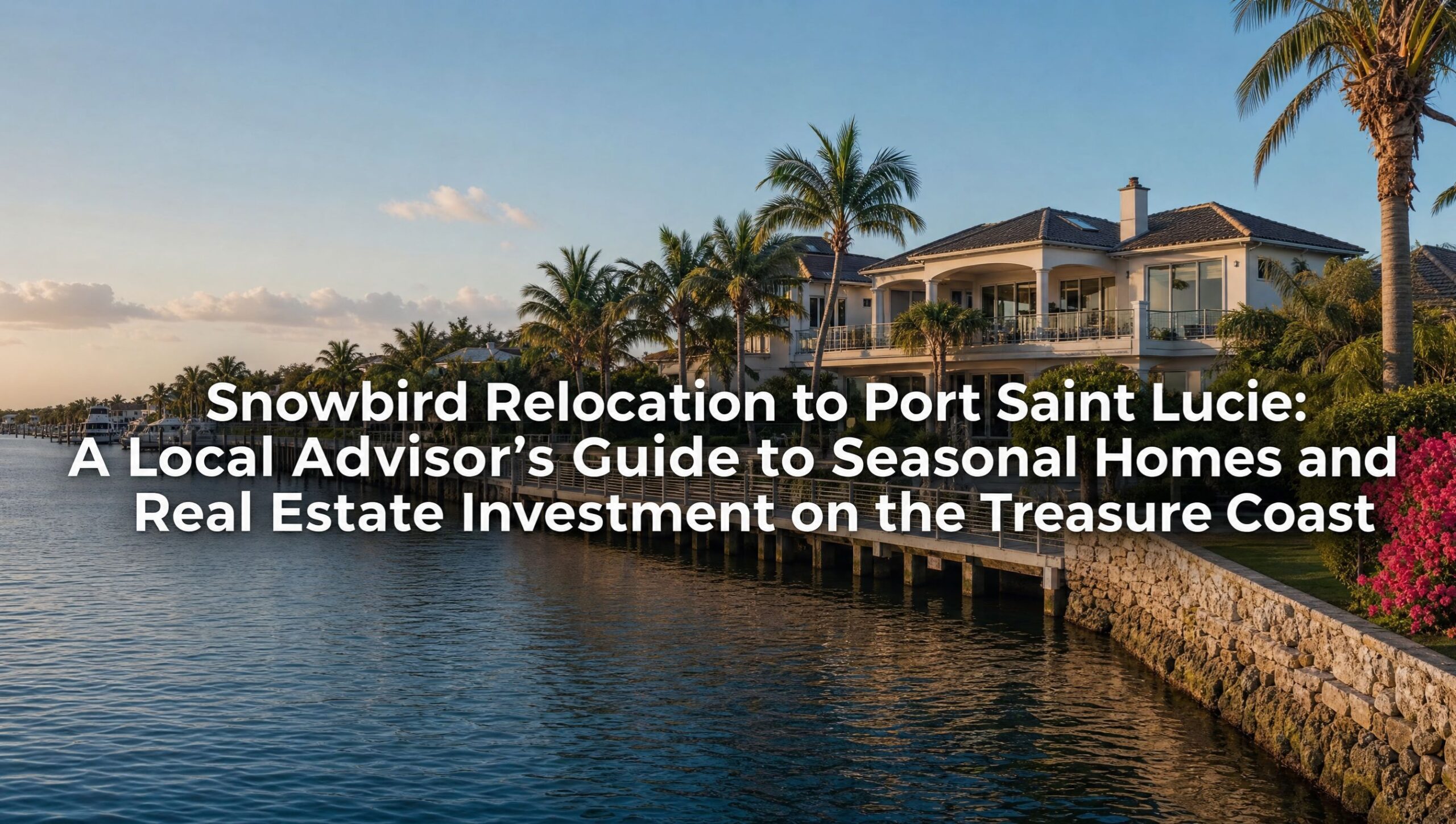
Snowbird Relocation to Port Saint Lucie: A Local Advisor’s Guide to Seasonal Homes & Real Estate Investment on the Treasure Coast
Written the way I’d talk you through it across the table — honestly, in plain English, with an eye on the decisions that actually matter. We’ll cover why snowbirds keep choosing Port Saint Lucie, the 2026 market, which property types and neighborhoods fit which lifestyles, how PSL stacks up against Jensen Beach, Stuart, Jupiter, West Palm Beach, Boca Raton, Vero Beach and the rest of the region, and the tax, insurance, title and compliance realities that catch unprepared part-time owners off guard. There’s a detailed FAQ and an ownership checklist you can actually use.
Quick Answer: Is Port Saint Lucie a Good Choice for Snowbirds & Seasonal Investors?
Yes — for most snowbirds and seasonal real estate investors, Port Saint Lucie is one of the strongest values on Florida’s southeast coast. It pairs mild, dry winters and a deep selection of 55+, gated, golf and waterfront communities with home prices that generally run below neighboring Palm Beach County markets, all within easy reach of beaches, boating, healthcare and two major airports. The trade-offs to plan for are real but manageable: St. Lucie County carries one of Florida’s higher property-tax rates, Florida homeowners insurance is expensive statewide, and coastal homes need careful wind and flood coverage. Snowbirds who budget honestly for those carrying costs — and who get local guidance on neighborhoods and compliance — tend to be very happy here. Buyers chasing oceanfront luxury, walkable downtowns or equestrian living may prefer certain surrounding towns, which we compare in detail below.
What This Guide Covers
- Why Snowbirds Are Choosing Port Saint Lucie
- 2026 Market Overview
- Best Property Types for Snowbirds
- Best Areas Near Port Saint Lucie
- Honest Comparisons: PSL vs. the Region
- A Seasonal Owner’s Investment Strategy
- Florida Compliance: Taxes, Homestead, Title & Insurance
- Seasonal Ownership Checklist
- Snowbird Lifestyle & Seasonal Events
- Frequently Asked Questions
- Conclusion & Next Steps
Why Snowbirds Are Choosing Port Saint Lucie
Over the past decade, Port Saint Lucie has gone from a sleepy bedroom community to one of the fastest-growing cities in the country, and a genuine favorite among snowbirds and seasonal buyers. The appeal is easy to understand once you’ve spent a winter here: warm, dry, sunny days from November through April, an enormous range of homes and communities, golf and boating and beaches within easy reach, and prices that — while no longer “cheap” — still tend to stretch a budget further than comparable spots in Palm Beach or Martin County to the south.
The climate does exactly what you want
Mild, sunny, refreshingly dry winters with daytime highs typically in the 70s and low humidity from late fall through spring — golf, tennis, pickleball, boating and beach walks as an everyday option. Summers are hot, humid and stormy (hurricane season June–November), which is exactly why the snowbird rhythm works.
Real value compared with the coast
Compared with Jupiter, Palm Beach Gardens, Boca Raton or West Palm Beach to the south, PSL generally offers newer construction, larger lots and resort-style amenities at a friendlier price point. A budget that buys a modest condo in a premier Palm Beach County community can often buy a single-family pool home in a gated PSL neighborhood.
Genuine variety of homes & communities
One of Florida’s largest cities by area, PSL offers master-planned communities like Tradition and Riverland, established golf neighborhoods in St. Lucie West and PGA Village, waterfront and boating-access homes near the St. Lucie River, classic single-family neighborhoods, and a healthy supply of villas, townhomes and condos for lock-and-leave living.
Lifestyle, healthcare & access
Atlantic beaches at Hutchinson Island and Jensen Beach are a short drive; the St. Lucie River and Intracoastal offer boating and fishing; golf is a regional pastime. PSL also has expanding hospital systems, sits on I-95 and the Turnpike, is roughly an hour from Palm Beach International and two from Orlando, and Brightline rail runs through the region.
The city also hosts spring training baseball — the New York Mets train in the area — a beloved seasonal ritual. To get a feel for the range, browse current Port Saint Lucie homes for sale across price points and community types, or start with the Port Saint Lucie community overview.
A Short Conversation Saves Months of Guesswork
If a winter base on the Treasure Coast is starting to feel realistic, let’s talk through what your budget and goals actually buy here — no pressure, just local knowledge.
Book a Snowbird Chat Browse HomesPort Saint Lucie Real Estate in 2026: What Buyers & Investors Should Know
A market that has shifted toward buyers
After the frantic run-up of 2020 through 2022, the market has normalized into far healthier, more balanced territory. As of 2026, median home prices sit roughly in the $390,000 to $450,000 range depending on the month and data source, with prices essentially flat to modestly down year over year rather than spiking. Homes are commonly taking 80 to 90 days to sell, and most listings receive only about one offer on average. For buyers, that’s genuinely good news: the bidding wars, waived inspections and “30 offers in a weekend” chaos of the pandemic era have faded. Today’s market gives you time to tour properly, conduct real due diligence, and negotiate on price, repairs and closing costs.
Inventory and negotiation opportunity
One defining feature of the current market is improved inventory — simply more to choose from than a couple of years ago, and longer days on market mean sellers are often more willing to negotiate. Patient, well-prepared buyers can do very well right now. If you’re tracking conditions closely, the Port Saint Lucie real estate market guide is a useful way to stay current, since local data shifts month to month.
What to expect going forward
Most local forecasts call for modest, sustainable appreciation — generally low single digits annually — as easing mortgage rates and steady in-migration meet a growing but not oversupplied inventory. A fair caution: forecasts are estimates, not promises. But the structural drivers behind PSL — population growth, relative affordability, no state income tax, and continued migration into Florida — remain firmly in place.
Due diligence matters more than the headline price
Here’s the part many out-of-state buyers underestimate: in Florida, the sticker price is only the beginning. Property taxes (especially for a non-homestead second home), insurance (wind and flood included), and HOA or condo fees can move your true monthly cost dramatically. Two similar-looking homes can have very different total costs of ownership depending on location, elevation, roof age, and community. Always underwrite the full carrying cost — not just the mortgage — before you fall for a listing. We break down each of those cost drivers in the compliance section.
Underwrite the Full Carrying Cost, Not Just the Mortgage
Get real, address-level tax, insurance, and HOA numbers on a specific home before you get attached — it’s the single best way out-of-state buyers avoid a budget surprise.
Request a Cost Review See the Market GuideBest Property Types for Snowbirds
There’s no universally “right” home for a seasonal resident — it depends on how much maintenance you want, whether you plan to rent, and how the place fits your winter. Here’s an honest look at the main options.
Single-family homes
The most space, privacy and control, plus the broadest resale appeal and rental flexibility. The trade-off is maintenance — roof, yard, possibly a pool, and a longer storm-prep list you (or a manager) handle, including while you’re away. Great for buyers who want room for visiting family and long-term flexibility, often paired with a home-watch service.
Pool homes
Hugely popular and a boost to enjoyment and rental appeal — just budget for year-round upkeep (including the off-season) and factor screen enclosure and equipment condition into your inspection. A strong resale and rental feature, but also a recurring cost and a safety consideration.
Villas and townhomes
A middle path: more space and privacy than a condo, with an HOA that often handles exterior maintenance and landscaping — ideal for lock-and-leave living. Lighter maintenance than a single-family home, usually lower fees than a full-service condo, and solid resale appeal among downsizers and snowbirds.
Condos
The lowest-maintenance way to own — lock the door, fly north, and the building handles the exterior. The trade-offs are monthly fees, master-policy insurance dynamics, potential special assessments, and (very important in Florida now) reserve funding. Following recent state reforms, many associations are completing structural inspections and building reserves, which can mean higher fees. Always review financials and the reserve study, and browse condos and villas to compare what fees actually deliver.
55+ communities
Purpose-built for snowbird life — resort pools, fitness centers, clubhouses, pickleball, tennis and organized social calendars bundled into the HOA, with a built-in community that’s a major plus part of the year. Trade-offs are age-occupancy rules and HOA fees. Explore the area’s 55+ communities in Port Saint Lucie to compare amenity packages and price points.
Gated communities
Popular for added security and consistent upkeep — which matter when a home sits empty for months. Expect HOA fees and architectural rules in exchange for peace of mind and curb appeal. A strong fit for seasonal owners who value low worry.
New construction
Abundant in master-planned areas like Tradition and Riverland. The appeal: modern layouts, newer roofs and systems (which can help with insurance), warranties and lower near-term maintenance. The trade-offs: premium pricing, lot premiums, possible CDD fees, and build timelines. The new-construction playbook weighs it against resale.
Waterfront & boating-access
A dream — and a premium. Be especially diligent on flood zones, wind and flood insurance costs, seawall and dock condition, and elevation. These homes carry the highest enjoyment value and the highest carrying costs, so the numbers deserve extra scrutiny.
Investment properties
If income is part of your plan, think about the property as a rental from day one: layout, furnishability, neighborhood rental demand, HOA or condo rental restrictions, and management needs. Some snowbirds buy a home they’ll eventually retire into and rent it seasonally in the meantime — verify the specific community’s rules before you buy. The St. Lucie County investment & landlord guide helps you model it.
Condo, Villa, Pool Home, or New Construction?
Each property type carries a different maintenance load, fee structure, and insurance profile. Let’s match the right one to how you actually want to spend your season — and whether you plan to rent.
Find Your Property Type Compare 55+ CommunitiesBest Areas Near Port Saint Lucie for Snowbirds
One of the joys of this region is how different each community feels. Here’s an orientation to the neighborhoods and towns snowbirds ask about most, and who each one tends to suit.
Tradition
A large, amenity-rich master-planned community on the western side of PSL — a walkable town center, parks, events, and a mix of 55+ and all-ages neighborhoods. Best for buyers who want newer construction, organized community life, and resort-style amenities. The Tradition homes collection is a good place to compare its sub-neighborhoods.
St. Lucie West
One of the city’s established master-planned areas, blending golf communities, shopping, dining and the spring-training ballpark — often a slightly lower entry point than the newest construction while still delivering strong amenities. Best for a settled, well-served location with golf and essentials close by.
PGA Village
A golf-lover’s haven anchored by the PGA Golf Club (including PGA Verano), offering golf-course living, resort amenities and active-adult options. Best for snowbirds for whom golf is central to the winter. See the PGA Village guide.
Sandpiper Bay
A more established riverside area known for its resort roots and proximity to the St. Lucie River — suits buyers who want a waterfront-leaning, recreational setting with boating and golf nearby, without top-tier coastal pricing.
Southbend
A residential area popular for value-oriented single-family homes — appealing to buyers and investors looking for more attainable price points in an established setting, prioritizing budget and long-term ownership over resort amenities.
Fort Pierce
Just north in St. Lucie County — a revitalizing historic downtown, a working waterfront, real beach access and generally lower prices. Best for snowbirds who want authentic Old Florida character and beach proximity on a tighter budget. See the Fort Pierce area.
Hutchinson Island
The barrier island along St. Lucie and Martin counties — the area’s premium coastal address, with oceanfront and Intracoastal condos and homes and direct beach access. Best for buyers who must be on the water, with the caveat that coastal exposure means higher wind and flood insurance and extra diligence on elevation. Search island and waterfront listings.
Jensen Beach
A charming, beachy small town in Martin County just south — a laid-back coastal vibe, excellent fishing, and a strong sense of community. Best for beach-focused snowbirds who want a relaxed town feel near the water. See the Jensen Beach area (note Martin County’s tax rates, schools and rules differ from St. Lucie’s).
Stuart
The Martin County seat — a beloved waterfront town with a picturesque historic downtown, superb boating and fishing, and a more upscale, charming feel. Best for buyers who want walkable downtown character and serious boating access, at somewhat higher prices. See Stuart.
Palm City
A quieter, family- and golf-friendly Martin County community with gated neighborhoods, golf and easy river access in a suburban setting. Best for buyers who want a calm, well-kept community with good amenities near Stuart. See Palm City.
Vero Beach
To the north in Indian River County — a quieter, more genteel pace, lovely beaches, arts and culture, and an established, upscale-but-relaxed feel. Best for snowbirds who prioritize tranquility, beach access and a refined small-city atmosphere. See Vero Beach.
Jupiter
In northern Palm Beach County — a relaxed, upscale, beachy and boating-centric lifestyle with excellent dining and natural beauty. Best for luxury-leaning seasonal buyers prepared for higher prices than PSL. See Jupiter.
Palm Beach Gardens
Polished and amenity-rich — golf (including PGA National), upscale shopping at the Gardens Mall, and master-planned communities. Best for a refined golf-and-shopping lifestyle with strong healthcare access, at Palm Beach County prices. Explore Palm Beach Gardens.
Wellington
The equestrian capital of the region — famous for its winter polo and show-jumping season and spacious, horse-friendly properties. Best for equestrian snowbirds and those who want room and a strong seasonal social scene. See Wellington.
West Palm Beach
A real city with a walkable downtown, waterfront events, the Kravis Center, the Norton Museum and an easy airport. Best for snowbirds who want city life and amenities, at higher prices than PSL. See West Palm Beach.
Boca Raton
Upscale, beautifully maintained and amenity-loaded — luxury communities, excellent shopping and dining, and a polished South Florida lifestyle. Best for a higher-end, country-club-style seasonal life, with prices to match. See Boca Raton.
Boynton Beach
More attainable than Boca or Delray while still close to the coast, with a growing dining and marina scene and a solid selection of 55+ communities. Best for value-minded snowbirds who want Palm Beach County proximity without top-tier pricing. See Boynton Beach.
Delray Beach
Famous for its lively, walkable Atlantic Avenue downtown, arts scene and beach — a vibrant, social coastal lifestyle. Best for snowbirds who want walkable nightlife, culture and beach in one charming package, at a premium. See Delray Beach.
So Many Towns — Which One Is Yours?
From Tradition’s town center to Hutchinson Island’s beaches to Stuart’s downtown, the right community depends on your priorities and budget. Let’s narrow it down before you fly in to tour.
Plan a Community Tour Ask a LocalPort Saint Lucie vs. the Treasure Coast & Palm Beach County
Buyers love to ask “should I be in Port Saint Lucie or ___?” Here’s how I’d frame the most common comparisons. There’s no single winner — it’s about matching the place to your priorities and budget.
PSL vs. Jensen Beach
Choose PSL for more home for your money, newer master-planned communities, and amenities. Choose Jensen Beach if being a short walk or drive from the beach in a relaxed, small-town coastal setting is the priority — typically at a coastal premium with less inventory.
PSL vs. Stuart
Choose PSL for value, variety and newer communities. Choose Stuart for walkable downtown charm, serious boating, and a more upscale waterfront-town feel — generally at higher prices.
PSL vs. Fort Pierce
Choose PSL for newer construction, master-planned amenities and broad selection. Choose Fort Pierce for lower prices, beach proximity and authentic Old Florida character — a value and investor favorite.
PSL vs. Vero Beach
Choose PSL for value, growth and amenities. Choose Vero Beach for a quieter, more genteel, arts-and-beach pace in a smaller, established city.
PSL vs. Jupiter
Choose PSL for significantly more affordability and space. Choose Jupiter for upscale coastal living, boating and natural beauty — at a meaningfully higher price. Largely a budget-and-luxury decision.
PSL vs. Palm Beach Gardens
Choose PSL for price and newer master-planned options. Choose Palm Beach Gardens for a polished golf-and-shopping lifestyle, top healthcare and prestige — at Palm Beach County pricing.
PSL vs. West Palm Beach
Choose PSL for affordability, space and a calmer pace. Choose West Palm Beach for genuine city life — walkable downtown, culture, waterfront events and easy airport access — at higher prices. It comes down to city-vs-suburb preference and budget.
PSL vs. Boca Raton
Choose PSL for value and a relaxed, growing community. Choose Boca Raton for upscale, country-club-style living, premium shopping and a polished coastal scene — at significantly higher prices.
PSL vs. Delray Beach
Choose PSL for affordability and space. Choose Delray Beach for a vibrant, walkable downtown, arts and beach energy — at a premium.
PSL vs. Wellington
Choose PSL for coastal proximity, value and broad community options. Choose Wellington if equestrian living and the winter polo season are central to your plans — a specialized, horse-centric market.
Want a Side-by-Side Tailored to Your Must-Haves?
Budget, beach proximity, walkability, golf, boating, equestrian — tell me your priorities and I’ll sort the best-fit towns in a few minutes.
Get a Custom Comparison Contact JeannieReal Estate Investment in Florida: A Seasonal Owner’s Strategy
A seasonal home and an investment aren’t mutually exclusive — many Treasure Coast buyers blend the two. Here’s how to think about it.
Personal-use second homes
The simplest case: you buy primarily for your own winters. No rental income, but full control, no tenant wear, and a place that’s ready whenever you arrive. Financing for a second home differs from an investment property, so talk to a lender who knows the distinction.
Long-term rentals
Renting on an annual lease (generally more than six months) provides steadier, simpler income and avoids the tourist development tax that applies to shorter stays. The trade-off is you can’t use the home yourself during the lease — a solid fit for investors prioritizing cash-flow stability over personal use.
Seasonal & mid-term furnished rentals
Here’s where the Treasure Coast shines. The winter influx of snowbirds creates strong demand for furnished seasonal rentals (often by the month or season), frequently at premium rates. Many owners rent furnished in winter and use the home in the off-season, or rent mid-term to traveling professionals. Furnished rentals require more setup and management but can perform well in this market.
Vacation (short-term) rentals — verify the rules first
Nightly and weekly vacation rentals are where compliance gets serious. Florida regulates vacation rentals through a mix of state law and local ordinances, and — critically — many HOAs and condo associations restrict or outright prohibit short-term rentals and impose minimum lease terms. Never assume; verify the exact rules for the specific property and community before you buy with this strategy in mind.
Future retirement homes & 1031 exchanges
Plenty of snowbirds buy now, use or rent the home seasonally, and convert it to a primary residence at retirement — at which point homestead and Save Our Homes benefits can kick in. If that’s your plan, structure the purchase and your records with the eventual residency change in mind. Separately, a 1031 like-kind exchange can let investors defer capital gains taxes when selling one investment property and buying another, under strict IRS rules and timelines — but it generally applies to investment or business-use property, not a personal-use second home. Work with a qualified intermediary and a CPA before you sell anything.
Cash flow vs. lifestyle value — and the rules that govern it
Be clear with yourself about the goal. A pure cash-flow investor optimizes for yield; a lifestyle buyer accepts lower returns for personal enjoyment; most snowbirds land in between. Three recurring realities make or break seasonal-rental plans: community rules (rental caps, minimum leases, approval processes), local rental compliance (registration and taxes), and management (who handles the property, tenants and storms while you’re away). Budget for professional property management if you won’t be local year-round, and confirm every rule in writing before closing. The investment-property resources for St. Lucie County are built to help you model this realistically.
Blending a Winter Home With Rental Income?
Seasonal, annual, or mid-term — the right structure depends on the property, the community’s rules, and your goals. Let’s model realistic numbers before you commit.
See the Investor Guide Run the NumbersFlorida Compliance for Snowbirds: Taxes, Homestead, Title & Insurance
This is the section most guides gloss over, and it’s the one that costs people the most when they get it wrong. Read it carefully, then verify the specifics for your situation with the right professionals.
Florida homestead exemption — why many snowbirds don’t qualify
Florida’s homestead exemption is available only on your permanent, primary residence. If your main home is up north and PSL is your seasonal place, you generally do not qualify for homestead on the Florida property. And you can claim a residency-based homestead benefit in only one state — claiming it in Florida while also taking a resident benefit elsewhere is considered fraud and can bring back taxes, penalties and interest. To qualify, you must own and occupy the home as your permanent residence as of January 1 of the tax year and apply through the county property appraiser by March 1. Florida uses an intent test (driver’s license, voter and vehicle registration, address on tax filings, local ties) rather than a strict day count.
Save Our Homes assessment limitation & portability
Once you have homestead, the Save Our Homes cap limits annual increases in assessed value to the lesser of 3% or the change in the Consumer Price Index. Over time in a rising market, this creates a widening gap between market value and the much lower assessed value — long-term homesteaded owners pay far less than a new buyer on an identical house. This is one of the biggest reasons snowbirds eventually convert to full-time residency. Portability lets you transfer accumulated Save Our Homes benefit (up to $500,000) to a new Florida homestead, generally within three years — but only between Florida homesteads.
Non-homestead property taxes — what second-home owners face
As a non-homestead owner, you won’t get the homestead exemption or the 3% cap. Florida does provide a separate protection: a 10% annual cap on assessment increases for most non-homestead properties (this cap excludes the school-tax portion, and events like new construction or a change of ownership can reset it). So your assessed value can’t spike without limit, but you’ll be taxed on a larger base than a homesteaded neighbor. Budget around the full, non-homestead bill.
Reassessment after purchase — the classic out-of-state surprise
Here’s the mistake I see constantly: a buyer estimates taxes from the seller’s current tax bill. Don’t. When a property sells, the assessed value typically resets toward the new market value (often the purchase price), which can mean a substantially higher tax bill than the prior owner paid — especially if the seller held a long-time homestead with a low capped value. Always estimate your taxes based on your likely assessment and status, not the listing’s current taxes.
St. Lucie County tax rates & TRIM notices
Buyers should know that St. Lucie County has carried one of the higher overall property-tax (millage) rates in Florida in recent years, above the statewide average. The exact rate is set annually by the various taxing authorities and changes each budget cycle, so always pull a current estimate for the specific property. Each August, Florida owners receive a TRIM (Truth in Millage) notice showing the proposed assessed value, exemptions and millage rates, with information on public budget hearings and how to challenge an assessment. Read it carefully every year.
Title insurance, ownership structure & estate planning
Always obtain an owner’s title insurance policy and a thorough title search at purchase to protect against liens, errors, fraud or competing claims; Florida closings are typically handled by title companies or real estate attorneys. How you hold title has tax, liability and estate-planning consequences — common options include sole ownership, tenancy by the entirety (married couples, with creditor-protection benefits), joint tenancy with right of survivorship, a revocable living trust (often used by out-of-state owners to avoid Florida probate on the property after death), or an LLC (common for investment properties). Even part-time owners hold Florida real property, which can trigger ancillary probate here if not planned around. Florida has no state estate or inheritance tax, but coordinate your overall plan — ideally across both states — with a Florida attorney and your CPA before closing.
Homeowners insurance, wind & hurricane deductibles
If you finance, your lender will require homeowners insurance (and flood insurance in a designated flood zone) and won’t close without proof of coverage. Florida homeowners insurance is among the most expensive in the nation, and second/vacation homes can be priced higher because a home sitting empty for months carries added risk. Florida policies typically include a separate hurricane/windstorm deductible calculated as a percentage of dwelling coverage (commonly 2%, 5%, or even 10%), not a flat dollar amount — on a $400,000 home, a 5% hurricane deductible is $20,000 out of pocket before coverage applies. In some coastal areas, windstorm coverage is excluded from the base policy and must be purchased separately.
Flood insurance & Citizens Property Insurance (2026 change)
Flood is never covered by a standard homeowners policy — not even storm-surge flooding from a hurricane. Flood requires a separate policy through the National Flood Insurance Program (NFIP) or a private flood insurer. Note a significant change: as of January 1, 2026, policyholders of Citizens Property Insurance (Florida’s state-backed insurer of last resort) with homes insured above $400,000 in dwelling coverage are required to carry flood insurance to keep their Citizens wind coverage, with the requirement expanding to additional Citizens policyholders in subsequent years regardless of flood zone. Even where flood insurance isn’t legally required, coastal and low-lying buyers should treat it as essential. Always get actual wind and flood quotes on the specific property before removing your inspection contingency.
Rental, condo & community insurance nuances
A home you rent out — especially short-term — generally needs different coverage (often a dwelling/landlord or short-term-rental policy); standard homeowners policies may exclude or limit rental activity. In a condo, the association’s master policy typically covers the building structure and common areas, while you need an individual unit-owner (HO-6) policy for your interior, belongings, liability and often your share of master-policy deductibles. Understand exactly where the master policy ends and yours begins — and budget for potential special assessments tied to insurance or structural reserves.
HOA & condo document review
Before you buy into any community, review the HOA or condo documents thoroughly: rules and restrictions, fees, reserve studies and financial statements, pending or planned special assessments, rental and pet rules, approval processes, and (in condos) recent structural-inspection status. Florida’s recent condo-safety and reserve laws have led many associations to raise fees or levy assessments — this is essential diligence, not a formality.
55+ occupancy rules
Age-restricted communities operate under federal housing rules that generally require at least one occupant aged 55+ in a large share of units and limit permanent younger residents. Guests and adult children can usually visit within set limits, but permanent occupancy by someone under the age threshold is typically restricted. If multi-generational use matters to you, confirm the specific community’s rules in writing.
Short-term rental rules & tourist taxes
Short-term rental regulation in Florida is a patchwork of state law and local ordinances that differs by city, county and association. Practically, if you rent a property for six months or less, you’ll generally owe Florida state sales tax plus the county tourist development (“bed”) tax and must register with the Florida Department of Revenue. In St. Lucie County, the tourist development tax is 5%, on top of state and local sales tax — and notably, owners typically remit it directly to the county (some platforms don’t collect it for you here). Some cities and counties also require business tax receipts or rental registration. Rules and enforcement change, so verify current requirements with the city, the county tax collector, and the Florida Department of Revenue before listing.
Out-of-state & foreign buyer considerations
Out-of-state buyers face no special purchase restriction — just the residency, tax and logistical planning covered throughout this guide. Foreign buyers, however, should be aware of Florida’s SB 264 (effective July 1, 2023), which restricts certain individuals and entities tied to specified “countries of concern” from acquiring some Florida real property, with the strictest limits applying to buyers connected to China and to property near military installations and critical infrastructure. The law is detailed and has been subject to legal challenges; affected buyers must complete required affidavits at closing and should consult a Florida real estate attorney before proceeding.
Property management & vacancy risk
A home that sits empty for months carries real risk: storms, leaks, humidity and mold, pests, and security. Many seasonal owners use home-watch services, smart-home monitoring, and professional property managers, and prepare the home for hurricane season before heading north. Communities with strong HOAs that handle exteriors reduce this burden — part of why they’re so popular with snowbirds.
Compliance Is Where Good Local Guidance Pays for Itself
If any of the above raises a question for your situation, we can point you to trusted local attorneys, CPAs, title companies and insurance pros — and run property-specific tax and insurance numbers.
Book a Planning Call Contact the TeamSeasonal Home Ownership Checklist
A practical, in-order checklist for snowbirds and seasonal investors:
- Clarify your intended use. Primary-eventual, second home, or rental? This drives taxes, insurance and financing.
- Estimate taxes based on your status — not the seller’s bill. Assume reassessment toward your purchase price; non-homestead means no 3% cap.
- Request insurance quotes early. Get homeowners, wind and flood quotes on the specific property during your contingency period, before you’re committed.
- Review the flood zone and elevation. Check the FEMA flood designation and the home’s elevation, especially for coastal or waterfront property.
- Review HOA/condo rules and finances. Read the governing documents, reserve study, financials and any pending special assessments.
- Confirm rental restrictions in writing. Verify minimum lease terms, rental caps and approval rules if income matters to you.
- Inspect thoroughly. Roof age and condition, HVAC, plumbing, electrical, pool/equipment, and signs of prior water intrusion or wind damage.
- Review condo reserves and assessments. Understand reserve funding and any structural-inspection findings under current Florida law.
- Confirm title and ownership structure. Get owner’s title insurance; decide on sole ownership, trust, LLC or joint ownership with professional input.
- Arrange property management. Line up a manager or home-watch service if you won’t be local year-round.
- Prepare for hurricane season. Shutters/impact protection, a storm plan, and coverage in place before June.
- Set up the essentials. Utilities, security/monitoring, lawn care, pest control, and a storm-prep routine for your departures.
Want this checklist worked through on an actual property? That’s a normal part of how the team helps buyers — just reach out.
Run the Checklist on a Real Property
Found a home you like? Let’s work through taxes, insurance, flood zone, HOA finances, and rental rules together — before you remove a single contingency.
Walk Through a Property Check a Home’s ValueSnowbird Life in Port Saint Lucie: Lifestyle & Seasonal Events
Part of buying here is buying into a season, and the Treasure Coast delivers a full one. While exact event dates shift year to year, here’s the kind of winter rhythm snowbirds enjoy.
On the water and the greens
Atlantic beaches at Hutchinson Island and Jensen Beach, boating and fishing on the St. Lucie River and Intracoastal, and golf nearly every day of the season — from PGA Village to dozens of community courses. Pickleball has exploded across the area’s communities and parks.
Markets, arts and downtown life
Seasonal farmers markets, art and craft festivals, waterfront festivals, and a growing roster of downtown and riverfront dining keep weekends full. Cultural venues and community theaters round out the calendar, and the broader region (West Palm Beach, Stuart, Vero Beach) adds museums, performing-arts centers and gallery nights within an easy drive.
Baseball and the polo set
Spring training baseball is a cherished local ritual — the New York Mets train in Port Saint Lucie — drawing fans throughout late winter. For those who venture south, Wellington’s winter polo and equestrian season is a spectacle unto itself.
Holiday and community gatherings
Boat parades, tree lightings, holiday markets and community events fill December, and master-planned communities like Tradition run their own packed social calendars all season.
The practical good life
Beyond events, snowbirds value the everyday: nature preserves and riverfront parks and trails, expanding healthcare and specialty care, convenient shopping and restaurants, and easy access to Palm Beach International and Orlando airports plus Brightline rail. It adds up to a winter that’s active and engaged — not just warm.
Frequently Asked Questions: Port Saint Lucie Snowbird & Seasonal Real Estate
Tap any question to expand the answer.
Yes. Port Saint Lucie offers mild, dry winters, a deep selection of 55+, gated, golf and waterfront communities, and prices generally below neighboring Palm Beach County — all near beaches, boating, golf, healthcare and major airports. The main things to plan for are St. Lucie County’s higher property taxes and Florida’s costly insurance.
It depends on your priorities. Tradition and St. Lucie West suit buyers who want master-planned amenities; PGA Village fits golfers; Hutchinson Island and Jensen Beach suit beach lovers; Stuart and Vero Beach appeal to those wanting charm or a quieter pace. There’s no single best area — only the best fit for your lifestyle and budget.
Generally no, unless Florida becomes your permanent, primary residence. The homestead exemption applies only to a permanent primary home, and you can claim a residency-based benefit in just one state. Many snowbirds qualify later if and when they make Florida their primary residence.
Second (non-homestead) homes don’t receive the homestead exemption or the 3% Save Our Homes cap; instead they’re protected by a 10% annual assessment-increase cap (excluding school taxes). You’ll generally pay more than a homesteaded neighbor on an identical home, and your assessment typically resets toward market value after purchase.
Often yes, and it’s wise even when not required. Flood is never covered by standard homeowners insurance and needs a separate NFIP or private policy. Lenders require it in designated flood zones, and given Florida’s exposure — plus expanding Citizens flood requirements in 2026 — many advisors recommend it for nearly all Florida homes.
Typically homeowners coverage, a separate hurricane/windstorm deductible (and sometimes a standalone windstorm policy on the coast), and separate flood insurance. If you rent the home, you’ll likely need landlord or short-term-rental coverage instead of a standard owner-occupied policy. Get specific quotes early.
Often yes, but it depends entirely on the community and your plan. Many neighborhoods allow seasonal or annual rentals, while some HOAs and condo associations restrict or prohibit short-term rentals and set minimum lease terms. Verify the specific rules in writing before you buy.
It varies, and rules can change. The City of Port St. Lucie has not historically imposed heavy short-term-rental licensing, but state and county taxes apply and HOA/condo rules often restrict short stays. Always confirm current city, county and association rules before listing a short-term rental.
Yes, generally. Rentals of six months or less are typically subject to Florida sales tax plus the county tourist development (“bed”) tax — 5% in St. Lucie County — and you must register with the Florida Department of Revenue. In St. Lucie County, owners often remit the tourist tax directly to the county.
Very. They bundle resort amenities, social calendars and low-maintenance living into the HOA, with a built-in community of peers — ideal for part-time residents. Just confirm the age-occupancy rules and the HOA fees, and review the community’s finances before buying.
Usually yes for visits, within limits. Age-restricted communities generally require at least one resident 55+ and limit permanent occupancy by younger people, but guests and adult children can typically visit for defined periods. Check the specific community’s rules if extended or multi-generational stays matter to you.
Yes — they’re a snowbird staple for lock-and-leave convenience. The building handles the exterior while you’re away. Weigh the monthly fees, master-policy and HO-6 insurance dynamics, reserve funding, and potential special assessments before you commit.
Reserves and assessments can significantly affect your costs. Following recent Florida condo-safety reforms, many associations are funding reserves and completing structural inspections, which can raise fees or trigger special assessments. Always review the reserve study, financials and any pending assessments before buying.
Neither is universally better — it’s about priorities. West Palm Beach offers genuine city life, culture and an easy airport at higher prices; Port Saint Lucie offers more space, newer communities and better value at a calmer pace. Choose West Palm for urban energy, Port Saint Lucie for affordability and room.
For pure beach proximity and a small-town coastal feel, Jensen Beach is appealing. You’ll typically pay a coastal premium and find less inventory than in Port Saint Lucie. Many buyers split the difference by living in Port Saint Lucie and enjoying Jensen Beach’s beaches nearby.
Often, yes — if budget allows. Jupiter delivers upscale coastal living, boating and natural beauty at meaningfully higher prices than Port Saint Lucie. Luxury-focused buyers may prefer Jupiter; value-focused buyers get far more home in Port Saint Lucie.
Yes, for those wanting upscale, country-club-style living. Boca Raton offers luxury communities, premium shopping and a polished coastal scene — at significantly higher prices than Port Saint Lucie. It’s a premium market best suited to higher budgets.
Yes, especially if you want walkability and energy. Delray Beach’s lively Atlantic Avenue, arts scene and beach make it a vibrant, social choice — at a premium. Buyers wanting nightlife and culture pay more than they would in Port Saint Lucie.
Absolutely, if horses and polo are your world. Wellington is the region’s equestrian hub with a famous winter season and horse-friendly properties. For non-equestrian buyers, the value and coastal proximity of Port Saint Lucie usually make more sense.
Yes. Vero Beach offers a genteel, arts-and-beach pace in a smaller, established city — ideal for snowbirds prioritizing tranquility. Port Saint Lucie offers more growth, amenities and home for the money if you want a livelier, larger community.
It can be a smart choice. New construction offers modern layouts, newer roofs and systems (which can help with insurance), warranties and lower near-term maintenance. Weigh premium pricing, possible CDD fees and build timelines, and compare against well-maintained resale homes.
It depends on use and budget. A pool adds enjoyment and can boost rental and resale appeal, but it brings year-round maintenance costs and safety considerations. If you’ll use it often or rent the home, a pool can pay off; if not, factor in the upkeep.
With a plan and the right help. Use home-watch services, smart-home monitoring and a property manager; prepare for hurricane season before leaving; and maintain insurance, lawn, pest and pool service. HOA communities that handle exteriors reduce the burden.
Sometimes, but with caveats. A 1031 exchange defers capital gains taxes on investment or business-use property under strict IRS rules and timelines — it generally does not apply to a personal-use second home. Work with a qualified intermediary and CPA to confirm eligibility before selling.
It depends on your goals. Investors often use an LLC for liability separation; out-of-state owners often use a revocable living trust to avoid Florida probate. Each has tax and practical trade-offs — decide with a Florida attorney and CPA before closing.
At minimum, a full home inspection covering roof, HVAC, plumbing, electrical and structure, plus a wind mitigation inspection (which can lower insurance), and pool/seawall/dock inspections where relevant. Consider a four-point inspection on older homes, which many insurers require.
By guiding you through every step locally — matching you to the right neighborhoods, running realistic tax and insurance numbers, flagging HOA and rental rules, and connecting you with trusted attorneys, inspectors, lenders and insurance professionals. Reach out to start with a no-pressure conversation.
Make Port Saint Lucie Your Treasure Coast Starting Point
If you’re weighing a winter home or a seasonal investment on Florida’s southeast coast, Port Saint Lucie deserves to be at the center of your search. It offers a rare combination — mild, dry winters, an active outdoor lifestyle, a genuinely wide range of homes and communities, and prices that still tend to stretch further than the marquee markets to the south. For investors, the same forces that draw snowbirds (population growth, no state income tax, and strong seasonal-rental demand) make it a serious candidate for long-term, conservatively underwritten ownership.
At the same time, the surrounding region gives you options the rest of Florida can’t match in one place. Want beachfront? Look to Hutchinson Island or Jensen Beach. Crave a walkable downtown and boating? Consider Stuart or Delray Beach. Chasing luxury or a quieter pace? Jupiter, Boca Raton, Palm Beach Gardens and Vero Beach each have a case. Part of doing this well is honestly matching the place to your priorities and budget — and being clear-eyed about Florida’s real costs, especially property taxes, insurance, and the compliance details around homestead, title, HOAs and rentals.
Your First Treasure Coast Season May Be Closer Than the Next Snowstorm
When you’re ready to compare communities, run real numbers on a specific home, and navigate the tax and insurance details with someone who does this every day, let’s talk. Whether it’s your first winter escape or your next investment, you’ll make a better decision with local expertise beside you.
Book a Free Consultation Start Browsing HomesDisclaimer: This article is for educational purposes only and is not legal, tax, insurance, or financial advice. Market data, tax rates, insurance requirements, and Florida laws change over time and vary by individual circumstance, city, county, HOA, and property. Always consult licensed real estate, legal, tax, insurance, and financial professionals — and verify current figures with the appropriate local agencies — before making any purchase, residency, or financial decision. All information is deemed reliable but not guaranteed. Equal Housing Opportunity.