

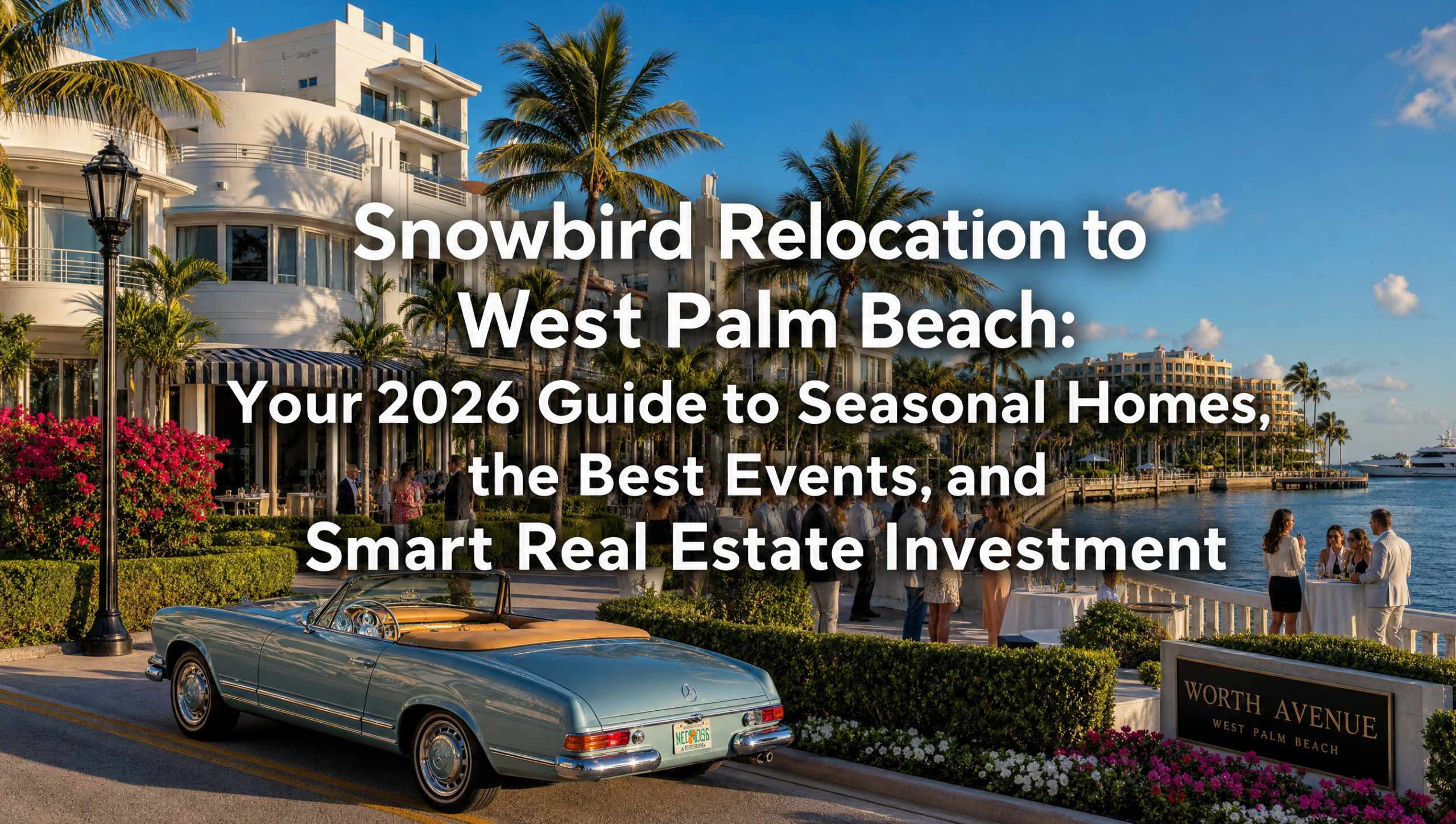
Snowbird Relocation to West Palm Beach: Your 2026 Guide to Seasonal Homes, the Best Events & Smart Real Estate Investment
West Palm Beach gives you sunshine and a city — a walkable downtown, a world-class cultural scene, and a social season packed from the GreenMarket in November to SunFest in May. This straight-talk guide covers the 2026 market with real numbers, walks the neighborhoods, maps a full season of events, and digs into the unglamorous-but-essential compliance details — homestead, property taxes, title, and insurance — for part-time Florida residents and investors.
Quick Answer: Is West Palm Beach a Good Place for Snowbirds in 2026?
Yes — especially if you want a real city alongside your sunshine. West Palm Beach pairs mild, dry winters with a walkable downtown, beaches, an easy airport (PBI), Brightline rail, and a packed November-to-April calendar — SunFest, polo in Wellington, spring training, the waterfront GreenMarket, and the Kravis Center. As of 2026 the market has shifted in buyers’ favor: median prices roughly $385,000–$440,000, inventory up to a buyer’s-market level of supply, homes sitting ~80–85 days, and bidding wars gone. A genuine plus versus some Florida markets: Palm Beach County’s effective property tax rate averages roughly 1% — moderate by Florida standards. The trade-offs to budget for are Florida’s high homeowners insurance and the wind/flood coverage coastal living requires. This guide gives you the numbers, the neighborhoods, the season, and the compliance rules in full.
What This Guide Covers
- Why Snowbirds Fall for West Palm Beach
- A Snowbird’s Winter: The Season & Events
- The 2026 Market: An Honest Snapshot
- Where to Buy: Neighborhoods & Communities
- Does the Investment Math Work?
- Snowbird Relocation Logistics
- Compliance FAQ: Taxes, Homestead, Title & Insurance
- Quick Answers to Common Questions
- How to Buy Smart: Step by Step
- Final Thoughts & Next Steps
Why Snowbirds Fall for West Palm Beach
There are dozens of Florida towns that will sell you sunshine. West Palm Beach gives you sunshine and a city — and that combination is the whole story. This guide is written for three kinds of readers who often overlap: snowbirds planning a seasonal escape (and maybe an eventual permanent move), real estate investors sizing up Palm Beach County, and part-time residents who already have a foot in Florida and want to understand the rules and opportunities better.
A real downtown, not just a beach
West Palm Beach has an actual, walkable, lived-in downtown core. Clematis Street and The Square anchor a district of restaurants, rooftop bars, and boutiques; the Kravis Center brings Broadway, symphony, and ballet all winter; and the Norton Museum of Art hosts Art After Dark and its beloved December Jazz Brunch. You can have a cultural life here — not just a tan.
Genuinely convenient location
Right on the Atlantic, with Palm Beach International (PBI) minutes from downtown — making the trip home for a grandkid’s birthday refreshingly painless. Brightline higher-speed rail connects you to Fort Lauderdale, Miami, and Orlando without touching I-95, and the Palm Beaches stretch from Jupiter to Delray and Boca.
Winter weather that delivers
Dry, sunny winters with daytime highs in the 70s and low humidity, November through April — golf-every-morning, dinner-on-the-water, no-jacket-required weather. Summers are hot, humid, and stormy (hurricane season runs June–November), which is exactly why the snowbird rhythm works: you’re here for the best of it.
Prices with real range
West Palm Beach isn’t cheap — this is South Florida — but it offers genuine range. Across the bridge on Palm Beach Island you’re in legendary luxury territory, but in West Palm proper you’ll find historic bungalows, mid-century homes, and a deep condo market that puts a snowbird budget within reach of the water and downtown.
To see how that range plays out today, browse current West Palm Beach homes and condos for sale and notice how much the price-per-neighborhood story varies, or start with the West Palm Beach community overview.
What Does Your Snowbird Budget Actually Buy Here?
From lock-and-leave downtown condos to historic bungalows and oceanfront, local knowledge beats a search filter every time. Get a no-pressure conversation about what your number really buys in West Palm Beach.
Browse Homes & Condos Book a Snowbird ChatA Snowbird’s Winter in West Palm Beach: The Season, the Events, the Rhythm
Here’s where West Palm Beach really earns its reputation. “The season” isn’t marketing language here — it’s a genuine social calendar that swings into gear around November and runs hard through April, exactly when you’ll be in town.
The season ignites
As the snowbirds roll in, downtown lights up — literally. Winter Wonderland at The Ben sets up a real-ice outdoor skating rink (yes, ice, in Florida) with chalets and holiday cocktails from early November into early January. Lion Country Safari runs its Lantern & Lights Safari Nights. The waterfront West Palm Beach GreenMarket — one of the best farmers markets in the state — returns every weekend from October through mid-April with up to a hundred vendors along Clematis Street. And the Norton Museum kicks off its winter cultural season.
The calendar goes full throttle
January is when you’ll wonder how you ever filled a winter up north. The South Florida Fair rolls in for 17 days of rides, concerts, and fair food. Palm Beach International Polo season opens in nearby Wellington and runs through April — Sunday afternoons of champagne, divot-stomping, and world-class horses. The Kravis Center is in full swing, and the weather is showing off.
Spring training and golden afternoons
Baseball fans, this is your month. Spring Training brings Major League teams to the area from late February through late March — few finer ways to spend a 75-degree afternoon than in a small ballpark with a hot dog and a home team. Polo continues, the green market hums, and the social season peaks with galas, art fairs, and waterfront festivals nearly every weekend.
The grand finale
The season closes with a bang. SunFest — Florida’s largest waterfront music and art festival — takes over the Flagler Drive waterfront the first week of May, drawing 85,000-plus people for multiple days of national-act concerts along the Intracoastal. It’s the perfect send-off before many snowbirds head north for summer.
The point isn’t just to make you want to book a flight (though, fair). It’s to show that wintering in West Palm Beach means buying into a lifestyle with a built-in calendar — which, not coincidentally, is also why the area’s seasonal-rental and snowbird-friendly communities stay in such high demand from November through April. If income from your property is part of the plan, that packed season is your best friend.
Want to Own Where the Season Happens?
Walkable to the GreenMarket and Clematis, or near the polo grounds and spring-training ballparks — the right location turns the season’s calendar into your front yard. Let’s find yours.
Plan Your Search Explore the AreaThe West Palm Beach Real Estate Market in 2026: An Honest Snapshot
Lifestyle sells the dream, but numbers make the decision. Here’s where the market actually stands as of mid-2026 — the good, the cautious, and what it means for you.
Prices have stabilized into a more balanced market
After the wild ride of 2020 through 2022, West Palm Beach has settled into a healthier, more balanced rhythm. As of spring 2026, median home prices are running roughly in the $385,000 to $440,000 range depending on the month and the data source, with single-family medians around the high $300s to low $400s and recent months showing modest year-over-year gains. Translation: prices are no longer rocketing, but they haven’t fallen off a cliff either — they’ve normalized.
Homes are taking longer to sell — and that’s good for you
In 2026, West Palm Beach homes are averaging around 80 to 85 days on the market, noticeably longer than a year earlier. Active inventory has climbed into the low thousands of listings, with months-of-supply pushing toward the 7-to-8-month range that economists generally consider a buyer’s market. After years of sellers holding all the cards, the balance of power has shifted. If you’re the buyer, this is exactly the environment you want: time to look, room to negotiate, and far less pressure to waive inspections or overpay in a panic.
What this means for each kind of buyer
- The seasonal snowbird: you’ve caught the market at a friendly moment — tour properly, sleep on a decision, and negotiate on price, repairs, and closing costs.
- The real estate investor: a more balanced market plus West Palm Beach’s deep, reliable seasonal-rental demand creates real opportunity, especially for buyers who run conservative numbers and hold for the long haul. The West Palm Beach market forecast & investment outlook is built for exactly this kind of analysis.
- The current part-time resident: today’s data is a useful gut-check on your equity and whether it’s time to upgrade, downsize, or add a second property. A quick home valuation shows where you stand.
A word of realism
Forecasts for the area generally call for modest, sustainable appreciation rather than another boom — and that’s healthy. But two cost realities deserve respect before you fall in love with a listing: Florida’s homeowners insurance is among the most expensive in the country, and coastal properties carry extra wind and flood considerations. We dig into both in the compliance section, because they belong in your budget from day one, not as an afterthought.
Get Real, Address-Level Numbers
Market medians are a starting point, not an answer. Get true pricing, tax, and insurance estimates for a specific home before you get attached — it’s the single best way to avoid a budget surprise.
Request a Cost Estimate See the Market OutlookWhere to Buy: West Palm Beach Neighborhoods & Nearby Palm Beach County Communities
West Palm Beach and its surrounding communities offer remarkable variety — from historic in-town bungalows to oceanfront high-rises to equestrian estates. Where you buy shapes your whole experience: your walk to the water, your insurance bill, your HOA, and the texture of your daily life.
Downtown & the waterfront condos
If you want to lock the door and fly north without a worry, downtown’s condo market is built for you. High-rises and mid-rises along Flagler Drive and around The Square put you steps from the GreenMarket, Clematis Street dining, the Kravis Center, and Intracoastal views — with building amenities and exterior maintenance handled for you. It’s the lowest-maintenance way to own in the heart of the action, which is exactly why it’s so popular with seasonal residents. Browse downtown condos for sale to see the range from attainable to luxury.
El Cid, Grandview Heights, SoSo & the historic districts
For buyers who want character — Mediterranean Revival, Spanish-style, and craftsman bungalows on brick streets under live oaks — West Palm’s historic neighborhoods are the heart and soul of the city. El Cid sits right on the Intracoastal with some of the most charming architecture in South Florida; Grandview Heights is walkable to downtown and beloved for its restored bungalows; SoSo (South of Southern) offers a leafy, residential feel close to everything. The West Palm Beach buyer guide compares these historic districts in depth.
Northwood & the up-and-coming pockets
Northwood and the districts just north of downtown have been on the rise for years, offering historic homes at relatively more accessible prices and a creative, evolving vibe. For value-minded buyers and investors who like getting in before a neighborhood fully arrives, these pockets are worth a serious look.
Palm Beach Island & Singer Island
Across the bridges lies the legendary Town of Palm Beach — Worth Avenue, oceanfront estates, and old-money grandeur. It’s a different price universe entirely, but for buyers shopping at the top of the market, nothing else feels quite like it. North of downtown, Singer Island (Riviera Beach) delivers true oceanfront condo living with direct beach access and resort-style buildings — a favorite for snowbirds who want sand and surf right outside the lobby. As with all coastal property, factor in the higher insurance and wind/flood considerations covered below; you can search current oceanfront and island listings to compare.
Jupiter, Wellington & the wider county
Zoom out and Palm Beach County opens up beautifully. Jupiter to the north offers a relaxed, beachy, boating lifestyle with excellent dining. Wellington to the west is the equestrian capital — home to the polo and show-jumping world, with spacious properties and a strong winter-season community. Lake Worth Beach just south has an artsy, eclectic, walkable downtown and more attainable prices, while Delray Beach and Boca Raton further south add even more options. A knowledgeable local agent can help you weigh these communities against your budget, your lifestyle, and your tolerance for a commute to the beach.
Describe Your Ideal Winter Day — We’ll Match the Neighborhood
This is genuinely hard to figure out from listing photos. Tell us how you want to spend your season and we’ll point you to the neighborhoods that actually deliver it — and steer you away from the ones that won’t.
Get Matched to a Neighborhood Contact the TeamReal Estate Investment in West Palm Beach: Does the Math Work?
Plenty of people arrive as snowbirds and leave as investors — because once you understand the local rhythm, the rental opportunity is hard to ignore. Here’s a grounded look, including the parts that don’t make the brochure.
The bull case
The fundamentals are genuinely strong. Population growth and in-migration to Palm Beach County have been robust for years, and people moving in is the most durable driver of housing demand there is. No state income tax gives Florida a structural advantage. A deep, reliable seasonal-rental market — fueled by that November-to-April calendar — means furnished winter rentals can command premium rates. And the influx of finance and corporate relocations to the area in recent years (the “Wall Street South” effect) has broadened the year-round economy beyond tourism and retirement.
Seasonal vs. annual rentals
Most investors here run one of two plays. The seasonal (snowbird) rental targets the winter months, renting furnished homes by the month or the season at higher rates — strong income when occupied, but with off-season vacancy and more hands-on management. The annual rental prioritizes steady, year-round occupancy at lower monthly rents and simpler operations. Some investors blend the two. The right call depends on the property, the neighborhood, and your appetite for management — exactly the kind of question the West Palm Beach investment & market resources help buyers model with realistic local numbers.
The honest counterweight
Now the part that keeps disciplined investors out of trouble. Florida’s homeowners insurance is among the priciest in the nation, coastal properties may need separate wind and flood coverage, and HOA and condo fees in amenity buildings can run several hundred dollars a month (sometimes much more, plus special assessments). A pro-forma that glosses over these will badly overstate your returns. The investors who win here underwrite conservatively, budget generously for insurance and carrying costs, verify rental rules before buying, and hold for the long term rather than chasing a quick flip.
A note on short-term rentals
If you’re eyeing nightly or weekly vacation rentals, tread carefully. Florida short-term rental rules involve a mix of state law and local municipal ordinances, and individual condo and HOA documents frequently restrict or outright ban short-term rentals and set minimum lease terms. Always confirm the exact rules for the specific building or community before you buy with that strategy in mind.
Model the Investment Before You Make It
Seasonal or annual, condo or bungalow — get conservative, neighborhood-specific rent and carrying-cost numbers (taxes, insurance, HOA, vacancy) before you write an offer. That’s how disciplined investors stay out of trouble.
See the Investment Outlook Run the Numbers With JeannieMaking the Move: Snowbird Relocation Logistics That Actually Matter
Buying the home is the headline. Living the snowbird life smoothly is the fine print — and it’s where a little planning pays off all season long.
The big fork: second home or future primary?
The most consequential question you’ll answer is whether West Palm Beach is a second home or a future primary residence. This single choice drives your homestead eligibility, your property tax treatment, your insurance options, and even your estate plan. Many snowbirds start part-time and later establish Florida residency to capture the tax advantages — a path we map out in the FAQ. There’s no universally right answer; it depends on your finances, your ties up north, and your timeline.
Healthcare and Medicare
Quality healthcare is a top priority, and the Palm Beaches deliver, with major hospital systems and deep specialty care. If you’re on Medicare, understand how your coverage travels: Original Medicare works nationwide, but many Medicare Advantage plans are network-based and may not cover routine care in Florida. Snowbirds often choose coverage that functions in both their home state and Florida — review it before each season.
Looking after a home you’re not always in
A seasonal home sits empty for months, which raises real questions: security, storm prep, humidity and mold control, lawn and pool care, and mail handling. Home-watch services, smart-home monitoring, and trusted local property managers are the standard solutions. This is also a big reason condos and HOA communities are so popular with snowbirds — somebody else handles the exterior while you’re away.
The little things that add up
Whether to keep a car in Florida year-round, how to forward mail, where to set up local banking and providers — none of it is hard, but it’s easy to underestimate. A good local agent plugs you into the network of services that make seasonal living frictionless, well beyond the closing table. Get in touch for a relocation game plan.
Planning Your First Season? Don’t Piece It Together Alone
From choosing the right neighborhood to lining up the home-watch, insurance, and maintenance contacts that make a part-time Florida home actually work — get a relocation game plan built around your timeline.
Build My Relocation Plan Reach Out AnytimeCompliance FAQ: Homestead, Property Taxes, Title & Insurance for Snowbirds
This is the section most guides skip — and the one that costs people real money when they get it wrong. Below are detailed, accurate answers to the compliance questions West Palm Beach snowbirds ask most. Tap any question to expand it.
Generally, no — not unless West Palm Beach becomes your permanent, primary residence. Florida’s homestead exemption applies only to a taxpayer’s permanent primary residence. If your main home is up north and West Palm Beach is your winter place, you don’t qualify for homestead on the Florida property. And you can claim a residency-based homestead benefit in only one state — claiming homestead in Florida while also taking a resident exemption (or in-state benefit) elsewhere is considered fraud and can trigger back taxes, penalties, and interest.
Florida doesn’t set a strict minimum number of days. The test is intent, backed by objective evidence. To establish Florida as your permanent home and qualify for homestead, you generally demonstrate intent through actions like getting a Florida driver’s license, registering to vote in Florida, registering your vehicles here, filing federal taxes from your Florida address, and building local ties (doctors, banks, professionals). You must own and occupy the home as your permanent residence as of January 1 of the tax year, and apply through the Palm Beach County Property Appraiser by March 1. Temporary absences — summers up north, travel, medical care — don’t break the exemption as long as you intend to return.
For those who qualify, Florida homestead provides up to a $50,000 exemption on assessed value (a first $25,000 applying to all taxing authorities, and a second $25,000 applying to non-school taxes on assessed value above $50,000). There are additional exemptions for seniors, veterans, and persons with disabilities, subject to eligibility limits. Just as valuable is the Save Our Homes cap, discussed next.
Save Our Homes (SOH) is a constitutional cap limiting the annual increase in the assessed value of a homesteaded property to the lesser of 3% or the change in the Consumer Price Index. Over years of rising prices, this creates a growing gap between a home’s market value and its much lower assessed value — meaning long-time homesteaded owners pay dramatically less than a new buyer would on the identical house next door. It’s one of the biggest financial reasons snowbirds eventually convert to full-time Florida residency: the longer you hold homestead, the more the cap rewards you.
Portability lets a Florida homesteaded owner transfer their accumulated Save Our Homes benefit (the gap between market and assessed value) to a new Florida homestead — up to $500,000 of transferred benefit — generally within a three-year window. If you sell one Florida homestead and buy another, portability can carry your tax savings along. Note it applies to moves between Florida homesteads; it can’t transfer a benefit from another state.
As a non-homestead property, your West Palm Beach home won’t get the homestead exemption or the 3% Save Our Homes cap. But Florida does provide a separate protection: a 10% annual cap on assessment increases for most non-homestead properties (this cap does not apply to the school-tax portion of your bill, and events like new construction or a change of ownership can reset it). So a second home is taxed less favorably than a homestead, but your assessed value still can’t spike without limit year to year. Budget around the full, non-homestead tax bill.
Here’s some genuinely good news relative to other Florida markets: Palm Beach County’s effective property tax rate averages roughly 1% of assessed value — moderate by Florida standards and notably lower than some neighboring counties to the north. That said, your actual bill depends on the specific municipality and all the overlapping taxing authorities, and the exact millage is set each year. Always pull a current estimate for the specific property. The Palm Beach County Property Appraiser offers a public access (PAPA) tool, and a good local agent will run realistic tax numbers for any home you’re seriously considering — especially important for a second home with no homestead cap.
In plain terms: your taxable value (assessed value minus any exemptions) is multiplied by the total millage rate (the sum of all the taxing authorities that apply to your property, expressed in dollars per $1,000 of taxable value). A non-homestead property has a higher taxable value — no exemptions — so it’s taxed on a larger base than an otherwise-identical homestead. That’s the core reason converting to homestead eventually saves serious money.
Several matter. First, how you hold title affects estate planning and probate. Florida recognizes sole ownership, tenancy by the entirety (for married couples, with creditor-protection benefits), joint tenancy with right of survivorship, and ownership through a revocable living trust or an LLC (common for investment properties). Out-of-state owners frequently use a living trust to avoid Florida probate on the property after death. Second, always get an owner’s title insurance policy and a thorough title search at purchase, to protect against liens, errors, or competing claims. Third, if you also own property in another state, coordinate your overall estate plan across both. Because these choices carry tax and legal consequences, involve a Florida real estate attorney and your CPA before closing.
It’s worth reviewing. Even part-time owners hold Florida real property, which is subject to Florida law on death — potentially triggering ancillary probate here if not planned around. Many snowbirds title their Florida home in a revocable living trust (or structure ownership otherwise) to avoid a separate Florida probate. Florida has no state estate or inheritance tax, which helps, but transferring the property still requires planning. Consult a Florida estate attorney.
This is one of the most important and most expensive parts of Florida ownership. Florida homeowners insurance is among the costliest in the country, well above the national average, and second/vacation homes can be priced differently (sometimes higher) than primary residences because a home sitting empty for months carries added risk. A standard Florida policy typically carries a separate hurricane/windstorm deductible, calculated as a percentage of dwelling coverage (commonly 2%, 5%, or even 10%) rather than a flat dollar figure — on a $400,000 home, a 5% hurricane deductible is $20,000 out of pocket before coverage kicks in. In some coastal areas, windstorm coverage is excluded from the base policy entirely, requiring a separate windstorm policy through a private carrier or Florida’s state-backed insurer of last resort, Citizens Property Insurance. Barrier-island and oceanfront properties (think Singer Island or Palm Beach) are most affected. The practical takeaway: get actual insurance quotes — wind and flood included — on the specific property before you remove your inspection contingency.
Flood is never covered by a standard homeowners policy — not even flooding from a hurricane’s storm surge. Flood requires a separate policy through the National Flood Insurance Program (NFIP) or a private flood insurer. Note an important change: as of January 1, 2026, Citizens policyholders with homes insured above $400,000 in dwelling coverage must carry flood insurance to keep their Citizens wind coverage, with the requirement expanding to additional Citizens policyholders in subsequent years regardless of flood zone. Even where it isn’t legally required, coastal and low-lying buyers should treat flood coverage as essential.
You may not be required to, but seriously consider it. Flood maps get redrawn, much of South Florida is low and flat, and a large share of flood claims come from properties outside the highest-risk zones. Given Florida’s exposure to heavy rain and storm surge — plus the 2026 expansion of Citizens’ flood requirements — many advisors recommend flood coverage for nearly all Florida homes. Get a quote and decide with eyes open.
There are encouraging signs. Florida’s 2022–2023 insurance reforms have drawn new private carriers into the state, and Citizens has been shedding policies to the private market while moderating some rate pressure at recent renewals. Still, premiums remain high in absolute terms, and the new flood requirements add cost for many owners. Treat any improvement as gradual, and budget from real current quotes — not optimism.
Florida has no state personal income tax — a major reason people relocate here. But your tax-residency status for your home state’s income tax is a separate question governed by that state’s rules (often day-count tests and domicile factors), and some high-tax states scrutinize departing residents closely. If lowering your home-state income tax is part of your motivation, work with a CPA to establish Florida domicile properly and document it. The same evidence that supports a homestead claim — driver’s license, voter registration, time in state — supports your income-tax domicile position.
If you rent your Florida property short-term (generally six months or less), you’ll typically be responsible for collecting and remitting Florida sales tax and county tourist development (“bed”) tax on those rentals, and registering with the state. Requirements vary and platforms sometimes handle part of it. Investors planning seasonal or vacation rentals should confirm registration and tax-collection obligations for Palm Beach County before listing.
The cardinal rule: don’t claim residency-based benefits in two states at once, and make sure your stated intent matches your actions. If you tell Florida you’re a permanent resident for homestead but simultaneously claim a resident benefit elsewhere, you’re exposed. Conversely, if you intend to make Florida home, follow through with the full set of residency steps so your homestead and income-tax positions are well documented. When in doubt, get professional advice before you file anything.
Compliance Questions Specific to Your Situation?
This FAQ is a strong start, but your circumstances are yours alone. We can point you to the right local attorneys, CPAs, and insurance pros — and run the property-specific tax and insurance numbers that turn these general rules into a real budget.
Book a Planning Call Contact the TeamQuick Answers to the Questions Snowbirds Ask Most
Beyond compliance, buyers researching West Palm Beach tend to circle the same practical questions. Tap any to expand.
Yes — especially if you want a real city alongside your sunshine. You get mild, dry winters, a packed November-to-April events calendar (SunFest, polo, spring training, the GreenMarket, the Kravis Center), beaches, a walkable downtown, an easy airport, and a wide range of neighborhoods and price points. The main trade-offs to plan for are high insurance costs and coastal wind/flood considerations — both manageable with realistic budgeting.
As of 2026, median prices run roughly $385,000 to $440,000, with enormous variation by neighborhood. Downtown and in-town condos and historic-district bungalows offer the most accessible entry points; Singer Island oceanfront and Palm Beach Island sit at the premium end. Condos are often the sweet spot for snowbirds thanks to lock-and-leave convenience. Browse current listings to see what your budget buys.
Conditions in 2026 favor prepared buyers more than they have in years. Prices have stabilized, inventory has grown to a buyer’s-market level of supply, homes are sitting longer, and bidding wars have faded — giving you time, choice, and negotiating leverage. As always, the right time depends on your finances and timeline more than on perfectly timing the market.
Often yes — but it depends entirely on the building or community. Many allow seasonal or annual rentals; some condo associations and HOAs restrict or ban short-term rentals and impose minimum lease terms. If rental income is part of your plan, verify the specific rules before you buy, and budget for management, taxes, and off-season vacancy.
The honest list: high homeowners insurance plus separate wind and flood coverage in many areas; hurricane season exposure (June–November); hot, humid summers; HOA and condo fees that can include special assessments; and South Florida traffic during peak season. None are dealbreakers for most buyers — but all belong in your budget and your decision.
Versus quieter Gulf Coast or central-Florida retirement markets, West Palm Beach trades some affordability and calm for culture, walkability, beaches, and a genuine social season. Versus Miami or Fort Lauderdale, it’s a bit calmer and often more attainable while keeping big-city amenities within reach. The pitch is city life plus coast plus season — a combination that’s hard to find elsewhere.
How to Buy Smart: A Step-by-Step Plan
Let’s turn all of this into a clear sequence so you move from browsing to owning without the costly missteps.
Get clear on your purpose first
Seasonal escape you’ll eventually retire into? Pure investment? Something in between? Your answer drives the neighborhood, the property type, the financing, and your tax and insurance strategy.
Build a true all-in budget
Look past the purchase price. Construct a realistic monthly number that includes the non-homestead property tax estimate, actual insurance quotes (wind and flood included), HOA or condo fees (and a cushion for special assessments), maintenance, and — for a seasonal home — home-watch or property management. Carrying costs are where Florida surprises people.
Sort out financing or cash early
Even in a buyer’s-leaning market, sellers respond to strong, qualified buyers. If you’re financing, work with a lender experienced in second homes and investment properties, which are underwritten differently than primary residences.
Choose the right local agent
This matters more than most buyers realize. An agent who specializes in snowbird and investor deals in the Palm Beaches will steer you to the right neighborhoods, run accurate tax and insurance numbers, flag rental restrictions, and connect you with the attorneys, inspectors, and insurance pros you need. See why buyers choose Jeannie Jacobson in West Palm Beach.
Tour with carrying costs in mind
Evaluate not just the property but the tax and insurance profile of its location, the HOA rules and fees, the roof age and construction, and the flood elevation. Two similar-looking homes can have very different total costs of ownership.
Do thorough due diligence
Get a professional inspection, obtain insurance quotes during your contingency window, review HOA and condo documents (including rental and pet rules and any pending assessments), and engage a Florida real estate attorney for title and closing — especially for investment purchases or trust/LLC ownership.
Plan residency and estate details deliberately
If you intend to establish Florida residency for tax and homestead purposes, map the steps with a CPA and attorney and execute them properly. If Florida is a second home, structure title and estate documents to avoid unnecessary Florida probate. Handle this early; it’s far cheaper than fixing it later.
Close, build your support network, and enjoy
Once you own, line up your home-watch service, storm plan, maintenance providers, and local accounts so your seasonal life runs smoothly from the very first winter.
Your West Palm Beach Winter Is Closer Than You Think
Snowbird relocation comes down to a simple trade: swap the worst of winter for the best of somewhere warm — without giving up the life you love. West Palm Beach is one of the rare Florida markets that lets you keep all of it. You get the beaches and the golf, sure, but you also get a real downtown, a world-class cultural scene, a social season packed from the GreenMarket in November to SunFest in May, and a range of neighborhoods and prices that can fit a genuinely wide set of budgets. For investors, the same forces — population growth, no state income tax, and that deep seasonal-rental demand — make the area a serious candidate for long-term, conservatively underwritten investment.
The secret to doing it well is honesty and preparation. Go in understanding the real costs — Florida’s high insurance premiums, the wind and flood coverage that coastal living requires, the HOA fees, and the compliance rules that govern homestead, residency, title, and rentals. Budget for all of it, lean on the right local and professional guidance, and your West Palm Beach winter can be everything you’re picturing and a sound financial decision besides.
Move From Reading to Doing
Compare neighborhoods, run real numbers on a specific home, and navigate the compliance details with someone who does this every day — whether it’s your first winter escape or your next investment. Your first West Palm Beach season might be closer than the next snowstorm.
Book a Free Consultation Start Browsing HomesDisclaimer: This article is for general informational and educational purposes only and does not constitute legal, tax, insurance, or financial advice. Real estate market data, tax rates, insurance requirements, and Florida laws change over time and vary by individual circumstance. Always consult licensed Florida professionals — a real estate attorney, CPA, licensed insurance agent, and the Palm Beach County Property Appraiser — and verify current figures before making any purchase, residency, or financial decision. All information is deemed reliable but not guaranteed. Equal Housing Opportunity.