

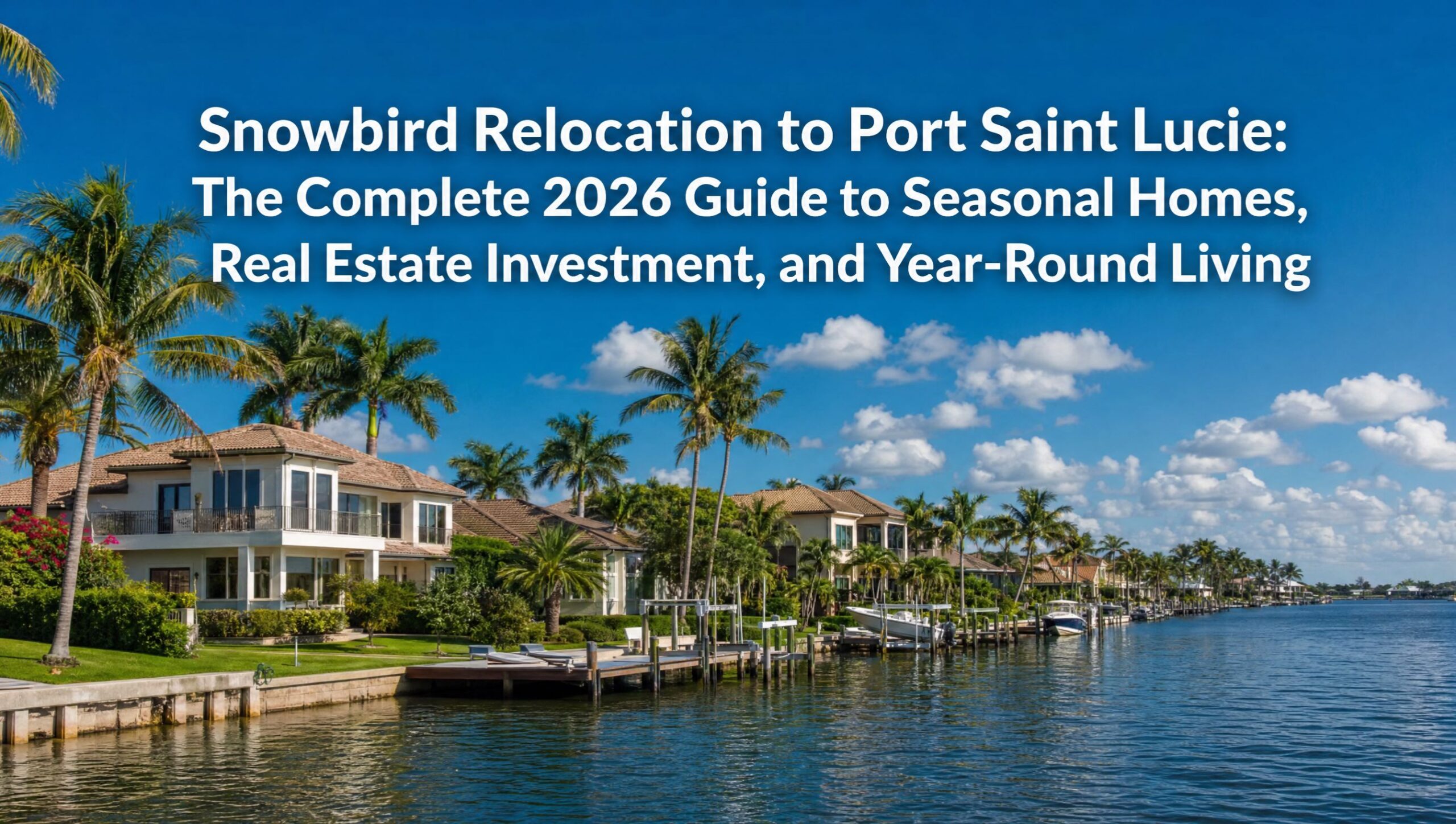
Snowbird Relocation to Port Saint Lucie: The Complete 2026 Guide to Seasonal Homes, Real Estate Investment & Year-Round Living
Every winter, hundreds of thousands of snowbirds trade icy driveways and heating bills for palm trees, warm Atlantic breezes, and golf in January — and increasingly the place they choose on Florida’s Treasure Coast is Port Saint Lucie. This guide covers home prices, the 2026 market, the best snowbird neighborhoods, the investment case, relocation logistics, and a detailed, compliance-focused FAQ on homestead, property taxes, title, and insurance for part-time Florida residents.
Quick Answer: Is Port Saint Lucie a Good Place for Snowbirds in 2026?
Yes — for the right buyer. Port Saint Lucie (PSL) offers mild, dry winters, abundant golf and outdoor recreation, a deep selection of 55+ and master-planned communities, expanding healthcare, and home prices well below marquee Florida coastal markets like Naples or the Palm Beaches, all within reach of major airports and Atlantic beaches. As of 2026 the market has cooled into balanced, buyer-friendly territory — median prices roughly $390,000–$450,000, more inventory, longer days on market, and real negotiating leverage. The two trade-offs every buyer must budget for are Florida’s high homeowners insurance (with separate wind and flood coverage in many areas) and St. Lucie County’s high property tax rate, both manageable with realistic planning. This guide walks through prices, neighborhoods, the investment case, logistics, and the compliance details that part-time residents most often get wrong.
What This Guide Covers
- Why Snowbirds Are Choosing Port Saint Lucie
- The 2026 Market: Buyers & Investors
- Where to Buy: Neighborhoods & Communities
- Is the Treasure Coast a Smart Investment?
- Snowbird Relocation Logistics
- Compliance FAQ: Taxes, Homestead, Title & Insurance
- Common Snowbird Questions
- How to Buy Smart: Step by Step
- Final Thoughts & Next Steps
Why Snowbirds Are Choosing Port Saint Lucie
Once a quiet bedroom community between West Palm Beach and the Space Coast, Port Saint Lucie has become one of the fastest-growing cities in the United States and one of the most talked-about destinations for seasonal residents, retirees, and real estate investors alike. If you are researching snowbird relocation to PSL, you almost certainly have a long list of questions — how much homes actually cost, whether this is a smart time to buy, what it really costs to insure a Florida home in 2026, whether you will owe a fortune in property taxes if PSL is only your winter address, and how the lifestyle compares to better-known markets like Naples, Sarasota, or The Villages. This guide is written for three overlapping audiences: snowbirds planning a seasonal or eventual permanent move, investors evaluating the Treasure Coast, and current part-time residents who want to better understand the rules, costs, and opportunities of owning here.
For decades, the classic snowbird playbook ran through a handful of Florida markets — the Gulf Coast around Naples and Fort Myers, the southeast metros of Fort Lauderdale and Boca Raton, or central retirement hubs like The Villages. Port Saint Lucie barely registered. That has changed dramatically, and for reasons that go well beyond marketing.
Location: the Treasure Coast sweet spot
PSL sits on Florida’s Atlantic coast, roughly midway between the Palm Beaches and the Space Coast/Orlando attractions — close enough to Palm Beach International (about an hour south) and Orlando International (about two hours north) to make travel home manageable, yet far enough from South Florida congestion that prices, traffic, and crowds are meaningfully lower.
Climate built for winter escapes
Winters are mild and dry, with daytime highs typically in the 70s and low humidity — ideal for the golf, tennis, pickleball, boating, and beach days that fill a snowbird’s calendar from November through April. Summers are hot, humid, and stormy, which is exactly why the seasonal rhythm works so well.
A lower cost of entry
Compared with Naples, Sarasota, or the Palm Beaches, PSL offers newer construction, larger lots, and resort-style amenities at a noticeably lower price point. A budget that buys a modest condo in a premier Gulf Coast market can buy a single-family home with a pool in a gated PSL community.
Growth, infrastructure & the “discovery” effect
PSL has ranked among the fastest-growing large U.S. cities for years, bringing new hospitals, expanded medical campuses, retail, dining, and major employers. For snowbirds that means quality healthcare and services close at hand; for investors, sustained population growth is one of the most reliable long-term tailwinds a housing market can have.
If you want to dig into the data behind that growth, the Port St. Lucie real estate market report tracks these trends in detail, and the broader Port Saint Lucie community page is a good orientation to the area.
Curious What Your Winter Budget Buys in Port Saint Lucie?
From gated 55+ villas to pool homes and waterfront condos, see what’s available in today’s buyer-friendly market — then get a personalized shortlist built around your budget, lifestyle, and timeline.
Browse Homes for Sale Book a Snowbird ConsultationThe Port Saint Lucie Real Estate Market in 2026
Understanding current conditions is essential before you make any move. Here is an honest snapshot of where the PSL housing market stands as of mid-2026.
Prices have cooled into balanced, buyer-friendly territory
After the extraordinary run-up of 2020 through 2022, the market has normalized. As of 2026, median home prices sit in roughly the $390,000 to $450,000 range depending on the data source and month, with year-over-year prices essentially flat to slightly down — a modest correction of around 2% from the peak rather than a crash. Homes are taking longer to sell, commonly 80 to 90 days on market, and most listings receive only about one offer on average. For buyers, this is meaningful good news: the bidding wars, waived inspections, and dozens-of-offers chaos of the pandemic era are gone. Today’s market gives buyers time to tour properties, conduct proper due diligence, negotiate on price and terms, and ask for repairs or closing-cost help.
Inventory is growing and giving buyers leverage
One of the defining features of the 2026 market is improved inventory. Months of supply have risen from the razor-thin levels of recent years, giving snowbirds and investors more to choose from and more room to negotiate. More inventory plus longer days on market is the textbook profile of a market where patient, well-prepared buyers can do very well. Browsing current Port Saint Lucie homes for sale is the best way to get a feel for what your budget buys in today’s conditions, and the 2026 market overview puts the numbers in context.
The outlook: modest, sustainable growth
Looking forward, most local forecasts call for modest price appreciation in the low single digits — roughly 2% to 4% annually — as easing mortgage rates and steady demand meet a growing but not oversupplied inventory. That is a return to the kind of sustainable, healthy growth that long-term owners and investors generally prefer over volatile boom-and-bust swings. It is worth stating plainly: real estate forecasts are estimates, not guarantees, and local conditions can shift. But the structural drivers behind PSL — population growth, relative affordability, and continued in-migration to Florida — remain firmly in place.
What this means for the three buyer personas
- The seasonal snowbird: an invitation to take your time and buy right. You are not competing against a wall of cash offers, and you have leverage to negotiate.
- The real estate investor: balanced conditions plus a growing rental and seasonal-rental population create attractive entry points — particularly for buyers who run conservative numbers and hold for the long term.
- The current part-time resident: today’s data is a useful benchmark for understanding your equity position and whether to upgrade, downsize, or add a second property. A quick home valuation shows where you stand.
Get the Real Numbers Before You Decide
Market medians are a starting point — your decision should rest on real figures for a specific home, including the non-homestead tax estimate and actual insurance quotes. Let’s run them together.
Request a Market & Cost Review See the Market ReportWhere to Buy: PSL Neighborhoods & Surrounding Treasure Coast Communities
Port Saint Lucie is large — geographically one of the biggest cities in Florida — and the surrounding St. Lucie County area adds even more variety. Where you buy shapes everything: your commute to the beach, your access to golf, your HOA fees, your insurance costs, and your lifestyle.
Tradition and Riverland: master-planned, amenity-rich living
If you picture the modern Florida snowbird lifestyle — resort pools, clubhouses, pickleball, walking trails, and a packed social calendar — you are picturing communities like Tradition and Riverland on the western side of PSL. Riverland alone is a sprawling Kolter community designed around wellness, with Valencia-branded 55+ villages, a town center, and extensive amenities. The Tradition & Riverland community guide is a good place to compare the sub-neighborhoods and amenity packages.
55+ and active-adult communities
PSL has a deep bench of 55+ communities purpose-built for snowbirds — names that come up again and again include Del Webb at Tradition, Esplanade at Tradition, Four Seasons at Wylder, Cascades at St. Lucie West, and PGA Village Verano. These communities typically bundle resort-style pools, fitness centers, spas, tennis and pickleball courts, social clubs, and organized activities into the HOA — a turnkey lifestyle that is especially appealing if you are only in residence part of the year. Explore the best 55+ communities in Port Saint Lucie to see which fits your budget and lifestyle.
Golf communities
Golf is woven into the fabric of the area. PGA Village is home to the PGA Golf Club, and communities throughout the region offer everything from private club memberships to relaxed, golf-adjacent living, with a climate that almost never forces you off the course. For buyers who want a fairway view or a club membership as part of the package, the PGA Village golf-community guide is a useful starting point.
St. Lucie West and the established core
St. Lucie West is one of PSL’s more established master-planned areas, with a mix of golf communities, shopping, dining, and the spring-training ballpark that hosts the New York Mets. It tends to offer a slightly lower entry point than the newest Tradition and Riverland construction while still delivering strong amenities and convenience. Buyers weighing brand-new versus established should also review the new-construction playbook.
Hutchinson Island: beachfront and barrier-island living
For snowbirds who want to be on the water, Hutchinson Island — the barrier island running along St. Lucie and Martin counties — offers oceanfront and Intracoastal condos and homes. This is the area’s premium coastal address, with direct beach access, but it comes with important considerations: higher insurance costs, windstorm and flood requirements, and the realities of coastal exposure. Beachfront living is wonderful, but it demands a clear-eyed understanding of the carrying costs covered later in this guide. You can search current waterfront and island listings and review the insurance section below before committing.
Jensen Beach, Stuart & Fort Pierce
Just south of PSL, Jensen Beach (in Martin County) offers a charming, beachy, small-town feel with excellent dining and fishing. Further south, the historic waterfront towns of Stuart and Port Salerno have their own character, while Fort Pierce to the north has a revitalizing downtown, a working waterfront, and generally lower prices that draw value-focused buyers and investors. Buyers who straddle the St. Lucie–Martin county line should note that property tax rates, school districts, and some regulations differ between counties — a detail worth confirming with a local agent. The Port St. Lucie vs. Stuart vs. Jensen Beach comparison weighs these options side by side, and families can review the best PSL neighborhoods for families.
Not Sure Which Community Fits Your Snowbird Lifestyle?
Tradition, Riverland, St. Lucie West, PGA Village, or the barrier island — each has a different price point, fee structure, and feel. Let’s match you to the right neighborhood before you fly down to tour.
Plan a Community Tour Compare 55+ CommunitiesReal Estate Investment in Port Saint Lucie: Is the Treasure Coast a Smart Buy?
Beyond the snowbird lifestyle, PSL has become a genuine focus for real estate investment in Florida. Here is a grounded look at the case — including the risks.
The bull case for investors
The fundamentals are straightforward. Population growth: PSL has been one of the nation’s fastest-growing large cities for years, and people moving in is the single most durable driver of housing demand. Relative affordability: prices remain well below comparable coastal Florida markets, leaving room for appreciation and giving rentals more favorable price-to-rent dynamics. No state income tax: Florida’s lack of a personal income tax is a structural advantage for residents and the broader economy. A built-in seasonal rental market: the snowbird influx from November through April creates strong demand for furnished seasonal rentals, often at premium rates.
Seasonal and long-term rental strategies
Investors generally pursue one of two playbooks. The seasonal (snowbird) rental strategy targets the winter market, renting furnished homes by the month or season at higher rates — the trade-off is off-season vacancy risk and more intensive management. The annual rental strategy prioritizes year-round occupancy and steadier cash flow, typically at lower monthly rates. Some investors blend the two. A local agent who understands rental demand by neighborhood can help you model realistic numbers; the Port Saint Lucie investment-property & landlord guide is built for exactly this kind of analysis.
Run conservative numbers — and respect the carrying costs
Here is the honest counterweight to the bull case. Florida’s carrying costs have risen sharply and can make or break an investment. St. Lucie County has one of the highest property tax rates in Florida, homeowners insurance in Florida is among the most expensive in the nation (with additional windstorm and flood requirements in coastal areas), and HOA fees in amenity-rich communities can run several hundred dollars a month. A pro-forma that ignores these realities will badly overstate your returns. The investors who do well here underwrite conservatively, budget generously for taxes and insurance, and hold for the long term rather than betting on quick flips. The tax and insurance sections below give you the specifics to build a realistic model.
Short-term rental regulation
If you are considering short-term vacation rentals (nightly or weekly stays), be aware that Florida’s regulatory landscape involves a mix of state law, county rules, and municipal ordinances, and HOA and condo association documents frequently restrict or prohibit short-term rentals outright. Always confirm the specific rules for the exact community and property before you buy with that strategy in mind. This is a place where local, property-specific guidance is essential.
Building a Treasure Coast Investment Portfolio?
Get conservative, neighborhood-specific rent and carrying-cost numbers — taxes, insurance, HOA, and realistic vacancy — before you write an offer. That’s the difference between a good deal and an expensive lesson.
See the Investor Guide Run the Numbers With JeannieSnowbird Relocation Logistics
Buying the home is only part of the equation. Living the snowbird life smoothly — and deciding whether and when to make Florida your permanent home — involves a set of practical logistics.
Part-time vs. permanent: the central decision
The most consequential question a snowbird faces is whether Florida is a second home or a future primary residence. This single decision drives your homestead exemption eligibility, your property tax treatment, your insurance options, and even your estate planning. Many snowbirds start as part-time residents and later establish Florida residency to capture the tax advantages — a path covered in detail in the compliance FAQ below. There is no single right answer; it depends on your finances, your ties to your home state, and your long-term plans. If a permanent move is on the horizon, the relocating to Port St. Lucie guide walks through the full transition.
Healthcare and Medicare
Access to quality healthcare is a top priority for most snowbirds, and PSL has invested heavily here with hospital systems and expanding specialty care. If you are on Medicare, understand how your coverage travels: Original Medicare is accepted nationwide, but many Medicare Advantage plans are network-based and may not cover routine care in Florida. Snowbirds frequently choose coverage that works in both their home state and Florida, and it is worth reviewing your plan before each season.
Managing a home you are not always in
A seasonal home sits empty for months, which raises real considerations: security, storm preparation, humidity and mold control, lawn and pool maintenance, and mail handling. Many snowbirds use home-watch services, smart-home monitoring, and trusted local property managers. Communities with strong HOAs often handle exterior maintenance, which is part of why amenity-rich 55+ neighborhoods are so popular with part-time residents.
Vehicles, mail, and the practical setup
The recurring logistics — whether to keep a car in Florida year-round, how to handle mail forwarding, and how to set up local banking and service providers — are easy to underestimate. A good local agent can connect you with the network of service providers that make seasonal living frictionless, well beyond the closing table. Reach out anytime to get oriented.
Make Your First Florida Winter Effortless
From home-watch and storm plans to local doctors, banking, and maintenance pros, a local team gets your seasonal setup running before you ever land. Let’s build your support network.
Get Connected Locally Read the Relocation GuideCompliance FAQ: Property Taxes, Homestead, Title & Insurance for Snowbirds
This is the section most snowbird guides skip — and the one that costs people the most money when they get it wrong. Below are detailed, accurate answers to the real estate compliance questions part-time Florida residents ask most. Tap any question to expand it.
Generally, no — not unless Florida is your permanent, primary residence. Florida’s homestead exemption is available only on a taxpayer’s permanent primary residence. If PSL is your winter home and you maintain your primary residence in another state, you are not eligible for the Florida homestead exemption on the PSL property. Equally important: you can claim a homestead (or equivalent residency-based) exemption in only one state. Claiming homestead in Florida while also claiming a residency-based benefit in your home state is considered fraud and can carry steep back-tax, penalty, and interest consequences.
Florida does not impose a strict minimum-days requirement to establish residency for homestead. Instead, the test is intent, supported by objective evidence. To establish Florida as your permanent residence and qualify for homestead, you generally need to demonstrate intent through actions such as obtaining a Florida driver’s license, registering to vote in Florida, registering your vehicles in Florida, filing federal taxes using your Florida address, and establishing local ties (physicians, banks, professional relationships). You must own and occupy the property as your permanent residence as of January 1 of the tax year, and the standard application deadline is March 1. Temporary absences — travel, a seasonal stay up north, medical care — do not defeat the exemption as long as you intend to return.
For those who qualify, Florida homestead provides up to a $50,000 exemption on assessed value (a first $25,000 that applies to all taxing authorities, and a second $25,000 that applies to non-school taxes on assessed value above $50,000). There are additional exemptions for seniors, veterans, and persons with disabilities, subject to income and eligibility limits. Just as valuable is the Save Our Homes cap, which limits how fast your assessed value can rise once you have homestead.
Save Our Homes (SOH) is a constitutional cap that limits the annual increase in the assessed value of a homesteaded property to the lesser of 3% or the change in the Consumer Price Index. Over time, in a rising market, this can create a large gap between a home’s market value and its (much lower) assessed value — meaning long-term homesteaded owners pay dramatically less in taxes than a new buyer would on an identical house next door. This is one of the biggest financial reasons snowbirds eventually convert to full-time Florida residency: the longer you hold homestead, the more the cap works in your favor.
Portability allows a Florida homesteaded owner to transfer their accumulated Save Our Homes benefit (the gap between market and assessed value) to a new Florida homestead — up to $500,000 of transferred benefit — generally within a three-year window. If you sell one Florida homestead and buy another, portability can carry your tax savings with you. Note that portability applies to moves between Florida homesteads; it does not transfer a benefit from another state. If you are upsizing or relocating within Florida, ask the property appraiser how portability would apply to your specific situation.
As a non-homestead property, your PSL home will not receive the homestead exemption or the 3% Save Our Homes cap. However, Florida does provide a separate protection: a 10% annual cap on assessment increases for most non-homestead properties (this cap does not apply to the school-tax portion of your bill, and certain changes like new construction or a change of ownership can reset it). So while a second home is taxed less favorably than a homestead, your assessed value still cannot jump without limit year to year. Plan your budget around the full, non-homestead tax bill.
Yes — buyers should go in clear-eyed. St. Lucie County has carried one of the highest overall millage (property tax) rates in Florida in recent years, well above the statewide average. The exact rate is set annually by the various taxing authorities and changes each budget cycle, so you should always pull a current estimate for the specific property. The St. Lucie County Property Appraiser publishes a tax estimator tool, and a good local agent will run realistic tax numbers for any home you are seriously considering. For a second home without homestead protection, taxes are one of the largest line items in your carrying cost — do not estimate them casually.
In simplified terms: your taxable value (assessed value minus any exemptions) is multiplied by the millage rate (expressed in mills, or dollars per $1,000 of taxable value) for all the taxing authorities that apply to your property. A non-homestead property has a higher taxable value (no exemptions) and is therefore taxed on a larger base than an otherwise-identical homestead. Because PSL’s millage is on the higher end statewide, the difference between owning as a homestead versus a second home can be substantial over time.
Several. First, how you hold title matters for estate planning and probate avoidance — Florida recognizes forms such as sole ownership, tenancy by the entirety (for married couples, offering creditor protection), joint tenancy with right of survivorship, and ownership through a revocable living trust or LLC (common for investment properties). Out-of-state owners frequently use a living trust to avoid Florida probate on the property after death. Second, always obtain an owner’s title insurance policy and a thorough title search at purchase to protect against liens, errors, or competing claims. Third, if you own in another state too, coordinate your overall estate plan across both. Decisions about title and entity structure have tax and legal consequences, so involve a Florida real estate attorney and your CPA before closing.
It is strongly worth reviewing. Even part-time owners hold real property in Florida, and that property is subject to Florida law on death — potentially triggering ancillary probate in Florida if not planned around. Many snowbirds title their Florida home in a revocable living trust or otherwise structure ownership to avoid a separate Florida probate. Florida has no state estate or inheritance tax, which is an advantage, but the mechanics of transferring property still require planning. Consult a Florida estate attorney.
This is one of the most important — and most expensive — parts of owning Florida property. Homeowners insurance in Florida is among the most costly in the country, running well above the national average, and second/vacation homes can be priced differently (sometimes higher) than primary residences because a home that sits empty for months presents added risk. A standard Florida homeowners policy typically includes a separate hurricane/windstorm deductible, calculated as a percentage of your dwelling coverage (commonly 2%, 5%, or even 10%) rather than a flat dollar amount — on a $400,000 home, a 5% hurricane deductible is $20,000 out of pocket before coverage kicks in. In some coastal areas, windstorm coverage is excluded from the base policy entirely, requiring a separate windstorm policy through a private carrier or Florida’s state-backed insurer of last resort, Citizens Property Insurance. The practical takeaway: get actual insurance quotes on the specific property — including wind and flood — before you remove your inspection contingency.
Flood is never covered by a standard homeowners policy — not even flood caused by a hurricane’s storm surge. Flood coverage requires a separate policy through the National Flood Insurance Program (NFIP) or a private flood insurer. Note a significant change: as of January 1, 2026, Citizens policyholders with homes insured above $400,000 in dwelling coverage are required to carry flood insurance to keep their Citizens wind coverage, with the flood requirement expanding to additional Citizens policyholders in subsequent years regardless of flood zone. Even where flood insurance is not legally required, coastal and low-lying Florida buyers should treat it as essential.
You may not be required to, but you should seriously consider it. Flood zones are redrawn over time, much of Florida is low and flat, and a large share of flood claims come from properties outside the highest-risk zones. Given Florida’s exposure to heavy rain and storm surge — and the 2026 expansion of Citizens’ flood requirements — many advisors recommend flood coverage for nearly all Florida homes. Get a quote and make an informed decision rather than assuming you are safe because of your zone.
There are some encouraging signs. Florida’s 2022–2023 insurance reforms have drawn new private carriers into the state, and Citizens has been shedding policies to the private market while moderating some rate pressure at recent renewals. That said, Florida premiums remain high in absolute terms, and the new flood-coverage requirements add cost for many owners. Treat any improvement as gradual, and budget based on real current quotes rather than optimistic assumptions.
Florida has no state personal income tax, which is a major reason people relocate here. However, your tax-residency status for your home state’s income tax is a separate question that depends on that state’s rules (often involving day-count tests and domicile factors), and some high-tax states scrutinize departing residents closely. If reducing your home-state income tax is part of your motivation, work with a CPA to establish Florida domicile properly and document it — the same residency evidence that supports a homestead claim supports your income-tax domicile position.
If you rent your Florida property short-term (generally six months or less), you will typically be responsible for collecting and remitting Florida sales tax and county tourist development (“bed”) tax on those rentals, and registering with the state. Requirements vary, and platforms sometimes handle part of this. Investors planning seasonal or vacation rentals should confirm the registration and tax-collection obligations for St. Lucie County before listing.
The cardinal rule: do not claim residency-based benefits in two states at once, and make sure your stated intent matches your actions. If you tell Florida you are a permanent resident to get homestead, but you are simultaneously claiming a resident exemption, in-state tuition, or a homeowner benefit elsewhere, you are exposed. Conversely, if you intend to make Florida home, follow through with the full set of residency steps so your homestead and income-tax-domicile positions are well documented. When in doubt, get professional advice before you file anything.
Get the Compliance Details Right the First Time
Homestead, residency, title structure, and the right insurance quotes can save — or cost — you thousands. We’ll connect you with the Florida attorneys, CPAs, and insurance pros who handle snowbird purchases every day.
Book a Planning Call Contact the TeamCommon Snowbird Questions, Answered Directly
Beyond compliance, snowbirds researching Port Saint Lucie tend to ask a recurring set of practical questions. Tap any to expand.
Yes — for the right buyer. PSL offers mild, dry winters, abundant golf and outdoor recreation, a deep selection of 55+ and master-planned communities, expanding healthcare, and prices below marquee Florida coastal markets, all within reach of major airports and beaches. The main trade-offs to weigh are Florida’s high insurance costs and St. Lucie County’s high property taxes, both manageable with realistic budgeting.
As of 2026, median home prices run roughly $390,000 to $450,000, with significant variation by community, age of construction, lot, and proximity to water. Inland single-family homes and villas in 55+ communities tend to offer the best value; oceanfront Hutchinson Island condos and homes sit at the premium end and carry higher insurance costs. Browse current listings to see what your budget buys.
Conditions in 2026 favor prepared buyers more than they have in years. Prices have cooled and flattened, inventory has grown, homes sit on the market longer, and bidding wars have faded — giving you time, choice, and negotiating leverage. As always, the right time to buy depends on your personal finances and timeline more than on trying to time the market perfectly.
Often, yes — but it depends on the community. Many neighborhoods allow seasonal or annual rentals, while some HOAs and condo associations restrict or prohibit short-term rentals and may impose minimum lease terms. If rental income is part of your plan, verify the specific community’s rules before you buy, and factor in management, taxes, and off-season vacancy. The landlord guide covers this in depth.
The honest list: high homeowners insurance and the need for separate wind and flood coverage in many areas; St. Lucie County’s high property tax rate; hurricane season exposure (June through November); summer heat and humidity; and HOA fees in amenity communities. None of these are dealbreakers for most buyers, but all of them belong in your budget and your decision.
Compared with The Villages, PSL is coastal (beaches within reach), less uniformly age-restricted, and offers more variety of community types. Compared with Naples, PSL is considerably more affordable and less crowded, though Naples offers a more established luxury market. Port Saint Lucie’s pitch is value plus coastal access plus growth — a balance that fits a broad range of snowbird budgets.
How to Buy Smart: A Step-by-Step Approach
Pulling it all together, here is a practical sequence for moving from research to ownership without costly missteps.
Define your purpose first
Are you buying a seasonal home you will eventually retire into, a pure investment property, or something in between? Your answer shapes the neighborhood, the property type, the financing, and the tax and insurance strategy.
Set a true all-in budget
Go beyond the purchase price. Build a realistic monthly figure that includes the non-homestead property tax estimate, actual insurance quotes (wind and flood included), HOA or condo fees, maintenance, and — for a seasonal home — home-watch or property management. The carrying costs are where Florida surprises people; do not underestimate them.
Get pre-approved or organize your cash
Even in a buyer’s-leaning market, sellers respond to strong, qualified buyers. If you are financing, talk to a lender experienced with second homes and investment properties, which are underwritten differently than primary residences.
Choose the right local agent
This matters more than buyers often realize. An agent who specializes in snowbird and investor transactions on the Treasure Coast will steer you toward the right communities, run accurate tax and insurance numbers, flag rental restrictions, and connect you with the attorneys, inspectors, and insurance pros you need. See why local buyers choose Jeannie Jacobson in Port St. Lucie.
Tour with carrying costs in mind
When you visit homes, evaluate not just the property but the insurance and tax profile of its location, the HOA rules and fees, the roof age and construction, and flood elevation. Two similar-looking homes can have very different total costs of ownership.
Do thorough due diligence
Get a professional inspection, obtain insurance quotes during your contingency period, review HOA and condo documents (including rental and pet rules and any pending assessments), and engage a Florida real estate attorney for title and closing questions — especially for investment purchases or trust/LLC ownership.
Plan the residency and estate piece deliberately
If you intend to establish Florida residency for tax and homestead purposes, map out the steps with a CPA and attorney and execute them properly. If Florida is a second home, structure title and estate documents to avoid unnecessary Florida probate. Get this right early; it is far cheaper than fixing it later.
Close, set up your support network, and enjoy
Once you own, line up your home-watch service, storm plan, maintenance providers, and local accounts so your seasonal life runs smoothly from the first winter on.
Why Port Saint Lucie Deserves a Spot on Your Shortlist
Snowbird relocation is, at its heart, a search for more — more sunshine, more comfort, more time doing the things you love in a climate that cooperates. Port Saint Lucie has quietly become one of the best places in Florida to find exactly that, pairing mild Treasure Coast winters and a deep selection of amenity-rich communities with prices that remain accessible relative to the state’s marquee markets. For investors, the same forces — population growth, relative affordability, no state income tax, and a robust seasonal rental market — make the area a serious candidate for long-term, conservatively underwritten investment.
The keys to doing it well are honesty and preparation. Go in understanding the real costs — Florida’s high insurance premiums, St. Lucie County’s elevated property taxes, the wind and flood coverage that coastal living requires, and the compliance rules that govern homestead, residency, title, and rentals. Budget for all of it, get the right local and professional guidance, and the Port Saint Lucie snowbird life can be everything you are picturing and a sound financial decision besides.
Ready to Move From Research to Reality?
Compare communities, run real numbers on a specific home, and navigate the compliance details with a local expert who does this every day — whether you are chasing your first winter escape or building a Treasure Coast investment portfolio.
Book a Free Consultation Start Browsing HomesDisclaimer: This article is for general informational and educational purposes only and does not constitute legal, tax, insurance, or financial advice. Real estate market data, tax rates, insurance requirements, and Florida laws change over time and vary by individual circumstance. Always consult licensed Florida professionals — a real estate attorney, CPA, licensed insurance agent, and the St. Lucie County Property Appraiser — and verify current figures before making any purchase, residency, or financial decision. All information is deemed reliable but not guaranteed. Equal Housing Opportunity.