

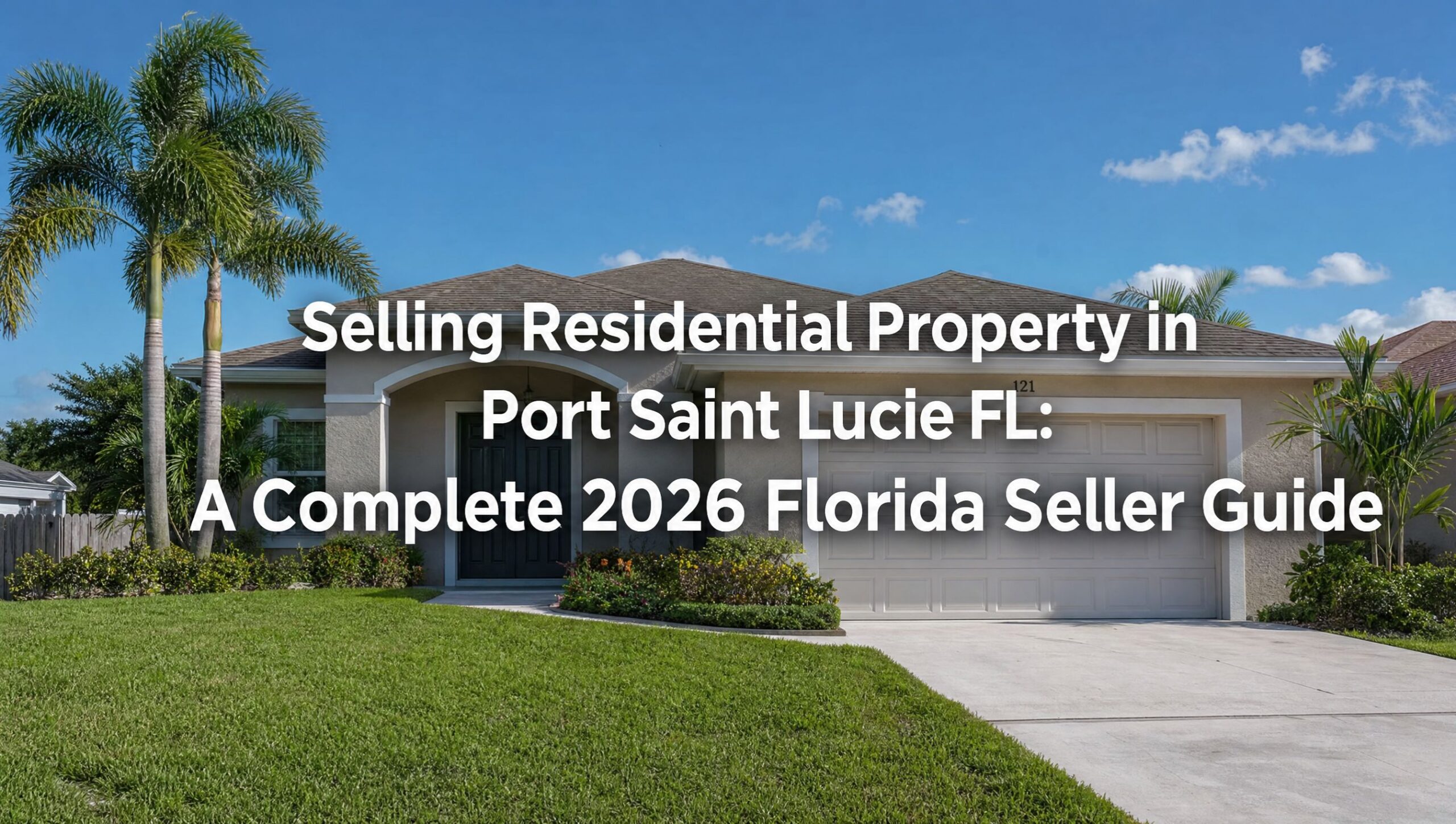
Selling Residential Property in Port Saint Lucie FL: A Complete 2026 Florida Seller Guide
From Tradition and St. Lucie West to Torino, Southbend, Becker Road, and the no-HOA neighborhoods of PSL — here is the complete Florida home-selling process for Port Saint Lucie FL in 2026: pricing strategy, preparation, disclosures, flood and insurance, HOA documents, marketing, offers, inspections, appraisal, title, and closing, explained step by step.
Quick Answer: How Do You Sell a Home in Port Saint Lucie FL in 2026?
Selling in Port Saint Lucie (PSL) is a series of steps, not one event: review your home’s value with local data, prepare and document the property, disclose known material facts, handle flood and HOA paperwork up front, launch with professional marketing, manage showings, then review offers on net proceeds and certainty — not just price — before navigating inspections, appraisal, title, and closing. The 2026 PSL market is more balanced than the recent boom and buyers compare resale homes against new construction, so accurate pricing and clean presentation matter more than ever. The first two weeks on market are critical, and most financed closings take about 30 to 45 days. This guide walks through every step.
Why Selling a Home in Port Saint Lucie FL Requires a Smart 2026 Strategy
Selling residential property in Port Saint Lucie FL can be a strong opportunity, but it is not a market where sellers should simply put a sign in the yard, upload a few photos, and hope buyers rush in. Port Saint Lucie — also written as Port St. Lucie or PSL — has become one of the most important residential markets on Florida’s Treasure Coast. Buyers come here for space, newer homes, master-planned communities, no-HOA neighborhoods, gated subdivisions, golf communities, parks, shopping, medical access, and a more relaxed lifestyle than many larger South Florida markets.
That buyer demand is real. But buyers in 2026 are more careful than they were during the fastest-moving market years. They are watching mortgage payments. They are comparing your home against new construction. They are asking about roof age, homeowners insurance, flood zones, HOA fees, property taxes, wind mitigation, open permits, inspections, and repair costs. They are not just asking, “Do I like this house?” They are asking, “Does this home make financial sense?”
That shift matters. A well-prepared, properly priced, professionally marketed home can still attract serious buyers. But an overpriced home with weak photos, unclear documentation, or obvious deferred maintenance may sit longer, require price reductions, and lose leverage during negotiations.
This guide walks you through the complete Florida home-selling process with a specific focus on Port Saint Lucie FL. You will learn how to prepare your property, price it correctly, handle Florida seller disclosures, understand local buyer expectations, manage inspections and appraisals, avoid closing delays, and move forward with confidence. When you are ready for a personal strategy, start with Jeannie Jacobson’s local resource for selling your home in Port Saint Lucie FL.
Curious what your PSL home could sell for today? Start with a free, no-obligation home valuation, then review the broader Florida 2026 seller guide for the statewide essentials. This page focuses on what is specific to selling in Port Saint Lucie.
What’s Your Port Saint Lucie Home Worth in 2026?
Pricing is the foundation of a smooth sale — and in PSL you’re competing with new construction. Get a local, data-backed valuation based on real comparable sales, your neighborhood, and current competition.
Request a Free Home Valuation Talk to JeannieThe Port Saint Lucie FL Market: What Sellers Need to Know
Port Saint Lucie is a large, fast-growing residential city with many different submarkets, which means there is no one-size-fits-all selling strategy. A home in Tradition does not compete the same way as a home in Southbend. A St. Lucie West golf community property attracts a different buyer than a no-HOA home near Floresta or Bayshore. A newer home near Becker Road may be compared against builder inventory, while an established pool home in Torino may stand out because of lot size, landscaping, and move-in readiness. To sell well in Port Saint Lucie, you need to understand your buyer pool. Explore the area on Jeannie’s Port St. Lucie community page.
Why Buyers Choose Port Saint Lucie
Buyers are drawn to PSL for several practical reasons: more home for the money compared with many coastal South Florida cities, newer construction and master-planned communities, no-HOA neighborhoods for flexibility, gated communities with amenities, 55+ and resort-style communities, golf neighborhoods in and around St. Lucie West and PGA Village, convenient access to I-95 and Florida’s Turnpike, shopping/dining/parks/schools/medical services, a quieter Treasure Coast lifestyle, and proximity to Fort Pierce, Jensen Beach, Stuart, Palm City, and beaches. Your marketing should connect your property to the buyer most likely to care about it — a no-HOA home with a fenced yard should speak to buyers who want freedom for pets, work vehicles, or boats; a Tradition home should highlight amenities, walkability, newer construction, medical access, and lifestyle; a St. Lucie West home should emphasize convenience, golf, shopping, and I-95 access; a Becker Road property should speak to commuters and move-up buyers. Generic marketing misses those details.
Port Saint Lucie Neighborhood Context for Sellers
Tradition is one of the most recognizable communities in PSL — buyers search here for newer homes, planned neighborhoods, sidewalks, lakes, shopping, dining, medical facilities, community events, gated sections, and 55+ options. Sellers should be ready to explain HOA fees, what the community offers, age restrictions if applicable, and how the home compares with nearby new construction or recent resales.
St. Lucie West and PGA Village attract buyers who want convenience, golf access, shopping, restaurants, schools, medical offices, and easy I-95 access; PGA Village and nearby golf communities appeal to buyers wanting a more polished, gated lifestyle. Sellers should pay close attention to HOA documents, club or golf-related costs, roof age, and how the home compares with similar properties.
Torino and northern PSL are popular with buyers who want residential space, newer homes, larger floor plans, and a quieter suburban setting — highlight lot size, pool features, upgrades, garage space, and commuting access. Southbend, Floresta, Bayshore, and established PSL neighborhoods appeal to buyers who want traditional neighborhoods, larger yards, fewer restrictions, and no mandatory HOA in many sections; emphasize flexibility, location, outdoor space, and improvements, and prepare older homes carefully since buyers look closely at roof age, HVAC, plumbing, electrical, windows, drainage, and insurance. The Becker Road corridor and western PSL matter for buyers commuting toward I-95, Palm City, Stuart, or Martin County — because buyers may compare these homes against new construction, presentation and pricing must be especially sharp.
2026 Market Conditions: Why Pricing Matters More Now
The Port Saint Lucie real estate market in 2026 is more balanced than the rush of earlier years. Sellers still have opportunities, but buyers are more deliberate — which makes pricing correctly from the beginning critical. During the hottest years, some sellers could push price aggressively and still receive offers; in today’s market, overpricing often leads to longer days on market, fewer showings, weaker offers, and price reductions. A stale listing can become a problem, with buyers and agents asking why it has been on the market so long, whether something is wrong, whether the seller is unrealistic, and whether there are inspection, insurance, HOA, or appraisal concerns. That does not mean you should underprice — it means your list price should be supported by current data, recent comparable sales, active competition, condition, upgrades, location, and buyer demand. For current local context, Jeannie’s Port St. Lucie real estate market report for 2026 helps sellers understand pricing, inventory, days on market, and buyer trends.
The PSL Home-Selling Process: Steps 1–7
From a realistic home-value review through disclosures and a possible pre-listing inspection, here is how the first half of a Port Saint Lucie sale unfolds.
Start With a Local Home Value Review
Before you clean, stage, photograph, or list, you need a realistic value range. A strong Port Saint Lucie pricing analysis should consider recent closed sales in your neighborhood, pending sales where available, active listings buyers will compare against, nearby price reductions, days-on-market trends, square footage and floor plan, lot size and view, pool/patio/screen enclosure/outdoor living, roof age, HVAC and water heater age, impact windows or storm shutters, kitchen and bath updates, flooring and paint condition, HOA fees and amenities, flood zone and insurance factors, new construction competition, and seller concessions in recent sales.
The right price is not just a number — it is a positioning strategy. If you price too high, you may help competing homes look like better values; if you price too low without a plan, you may leave money behind. The goal is to launch where buyers see the home as a serious contender. A professional home valuation is the right starting point.
Prepare the Home Before Listing
Preparation is one of the easiest ways to protect your equity. Buyers notice more than sellers think — dirty grout, worn paint, cluttered counters, overgrown landscaping, stained driveways, old screens, pet odors, and small repairs all create doubt even when they are not expensive. Start with the basics: deep clean; declutter counters, closets, pantry, garage, and storage; touch up paint; replace burned-out bulbs; repair loose handles, leaky faucets, damaged screens, and sticking doors; pressure-wash the driveway, walkway, patio, and exterior; trim landscaping and refresh mulch; clean windows and sliders; remove strong odors; make the front entry welcoming; and keep the home cool for showings.
In Florida, buyers also pay close attention to major systems — before listing, know the age and condition of your roof, HVAC, water heater, electrical panel, plumbing, pool equipment, irrigation, windows, and storm protection. If a major issue exists, you do not always have to repair it before listing, but you should know about it, disclose when required, and price with strategy. Jeannie’s seller resources can help homeowners think through preparation, timing, and expected proceeds before going live.
Gather Important Documents Early
A smooth sale is easier when you have the right paperwork ready. Buyers, inspectors, lenders, title companies, and insurance providers may ask for documentation — sellers who provide clear answers reduce uncertainty and keep the transaction moving. Before listing, gather (if available) a survey, roof permit or replacement documentation, HVAC age and service records, water heater age, appliance warranties, a wind mitigation report, a four-point inspection, pool service records, pest treatment records, receipts for major improvements, HOA documents, condo documents if applicable, a flood elevation certificate, solar lease or financing documents, security system details, open permit information, and insurance claim documentation if relevant.
This is especially important in Port Saint Lucie because many buyers are insurance-conscious. A roof permit, wind mitigation report, or documentation of impact windows can make buyers feel more confident. Uncertainty makes buyers hesitate; documentation helps them move forward.
Understand Florida Seller Disclosure Requirements
Florida sellers generally need to disclose known facts that materially affect the value of residential property when those facts are not readily observable and are not already known to the buyer. In normal language: if you know about a serious issue that could affect a buyer’s decision, do not hide it. Common disclosure issues may include roof leaks, water intrusion, mold history, foundation or structural issues, plumbing problems, electrical defects, HVAC problems, termite or wood-destroying-organism issues, drainage problems, prior insurance claims, unpermitted work, boundary disputes, open permits, code violations, known HOA or condo problems, and pool or equipment defects.
Disclosing a known issue does not mean your home will not sell — many homes sell with disclosed defects. The key is transparency, pricing, and negotiation strategy. Problems usually get worse when sellers try to avoid them: a buyer may discover the issue during inspection, insurance review, appraisal, title search, or after closing, which can create delays, cancellations, or legal risk. A clear seller disclosure protects the transaction and helps everyone deal with facts instead of surprises.
Be Ready for Florida Flood Disclosure Questions
Florida residential sellers must be ready for flood disclosure requirements and flood insurance questions. Port Saint Lucie is not a beach city, but flood risk can still vary by address — some properties are near canals, drainage areas, waterways, low-lying lots, or stormwater systems, while other homes may have minimal flood concerns. Buyers will want to understand the specific property, not just the city.
Before listing, know whether your home is in a FEMA flood zone, whether flood insurance is currently carried, whether your lender required it, whether you know of past flood damage or flood insurance claims, whether you have an elevation certificate, whether there have been drainage issues, and whether any flood mitigation work was done. Standard homeowners insurance usually does not cover flood damage — if your property has a favorable flood profile, that can help your marketing; if flood insurance is required or recommended, it is better to be clear early than let buyers guess.
Know How HOA Rules Affect the Sale
Many Port Saint Lucie properties are in HOAs, master-planned communities, gated neighborhoods, 55+ communities, or condo associations. If your home is in an HOA, buyers will want to know monthly or quarterly dues, what they include, amenities, rental restrictions, pet rules, parking and vehicle rules, age restrictions if applicable, architectural guidelines, lawn-care responsibilities, capital contributions, transfer fees, application requirements, pending assessments, and litigation if known.
Florida requires HOA disclosure for properties subject to mandatory homeowners association membership — if the buyer does not receive the required documents on time, the transaction can become more complicated. For sellers in Tradition, St. Lucie West, PGA Village, Verano, Valencia, or other planned communities, HOA documentation is part of the buyer’s decision. If your HOA is well-run with strong amenities and reasonable fees, use that as a selling point; if fees are higher, your marketing should clearly explain what buyers receive in return.
Consider a Pre-Listing Inspection
A pre-listing inspection is not required, but it can be helpful for some sellers. It may make sense if your home is older, the roof is aging, the property has not been maintained consistently, you want fewer surprises after contract, you are selling an inherited property, you live out of state, you suspect insurance-related issues, or you want to repair items before listing. A pre-listing inspection can help you decide what to fix, what to disclose, and how to price — and it may reduce buyer anxiety if you make the report available with repair receipts.
That said, pre-listing inspections are not right for every seller. Once you learn about an issue, you may need to disclose it. Talk through the pros and cons before deciding.
Get a Pricing Strategy & Net-Sheet Before You List
Know your likely sale price, estimated net proceeds, repair priorities, and ideal timeline before your home goes live. Jeannie’s PSL seller’s playbook shows how strategic prep and launch planning help you compete with new construction.
See the PSL Seller’s Playbook Book a ConsultationSteps 8–15: From Marketing to Closing
Once your home is prepared and priced, the focus shifts to a strong launch, smart negotiation, and a clean closing.
Launch With Professional Marketing
Your marketing launch is where strategy becomes public. Most buyers see your home online before they ever schedule a showing — if the photos are weak, the description is generic, or the price does not make sense, they may never walk through the door. A strong Port Saint Lucie marketing plan should include professional photography, strong MLS presentation, buyer-focused listing copy, neighborhood-specific descriptions, search-friendly keywords, social media exposure, email marketing to active buyers and agents, clear showing instructions, an open-house strategy where appropriate, follow-up with buyer agents, and feedback tracking.
Good listing copy does more than say “beautiful home” — it explains why the home matters. A Tradition home might highlight community events, newer construction, medical access, dining, and walkability; a St. Lucie West home might highlight I-95 access, golf, restaurants, and shopping; a no-HOA home might highlight flexibility for boats, pets, work vehicles, or outdoor projects; a pool home might highlight screened outdoor living, privacy, and year-round Florida enjoyment. In today’s market you need more than exposure — you need the right story told to the right buyers.
Manage Showings With Buyer Psychology in Mind
A showing is not just a visit — it is a buyer’s chance to imagine living in your home. Before showings: turn on lights, open blinds, keep the home cool, clear kitchen and bathroom counters, make beds, remove pet bowls and litter boxes when possible, secure valuables/mail/prescriptions/personal documents, put away laundry, keep the garage organized, make outdoor spaces easy to access, and avoid strong candles or fragrances.
In Florida, smell and temperature matter — a warm, stuffy home feels uncomfortable quickly, and heavy fragrance can make buyers wonder what is being covered up. Clean, bright, cool, and neutral is the goal. If showings are slow, review the data: Is the price too high? Are photos weak? Is the home hard to show? Are buyers choosing nearby homes with newer roofs, better upgrades, or lower HOA fees? Feedback helps you adjust before the listing loses momentum.
Review Offers Beyond the Price
When offers come in, it is tempting to focus only on the purchase price — but the highest offer is not always the strongest. Review each offer carefully: purchase price, escrow deposit, financing type, cash or mortgage, loan approval timeline, inspection period, appraisal terms, closing date, seller credits requested, rate-buydown requests, repair expectations, contingency on the buyer’s home sale, HOA or condo approval requirements, included appliances and personal property, title and closing terms, and buyer financial strength.
In Port Saint Lucie, sellers may see buyers request closing cost credits, inspection credits, or interest-rate-buydown assistance. Those requests are not automatically bad — what matters is your net proceeds, risk level, and likelihood of closing. A clean offer with strong financing and a realistic timeline may be better than a higher offer with weak terms.
Navigate Inspections Without Panic
After the contract is signed, the buyer usually schedules inspections quickly. Common inspections in Port Saint Lucie include a general home inspection, roof inspection, four-point inspection, wind mitigation inspection, WDO or termite inspection, pool inspection, mold or moisture evaluation, sewer scope where appropriate, septic inspection if applicable, well water testing if applicable, and HOA or condo document review. Many Florida sales use an “As Is” contract — that does not mean inspections do not matter; it usually means the buyer has the right to inspect and decide whether to continue during the inspection period, while the seller is not automatically obligated to make repairs.
If the buyer asks for repairs or credits, stay calm and look at the request strategically: Is the issue legitimate? Was it already disclosed? Does it affect insurance? Could it affect appraisal or financing? Would another buyer raise the same concern? Is a repair, credit, or price adjustment the best solution? Is the buyer still committed? Do not take inspection requests personally — a measured response can save a good transaction.
Prepare for the Appraisal
If the buyer is financing, the lender will usually order an appraisal. The appraiser reviews the home, recent comparable sales, condition, location, and market data to confirm value for the lender. Appraisal issues are less likely when the home is priced realistically from the start, but they can still happen — especially if the contract price is above recent comparable sales or the property has unique features. If the appraisal comes in low, options may include the buyer bringing additional cash, the seller reducing the price, the parties renegotiating terms, the buyer disputing the appraisal with stronger comparable sales, or the transaction cancelling if the contract allows. A good listing strategy includes appraisal awareness from day one — the goal is not just to get an offer, but to get an offer that can close.
Title Search, Liens, Permits, and Closing Details
During the closing process, the title company reviews the property’s ownership history and checks for issues that may affect transfer. Common title and closing issues include unreleased mortgages, old liens, judgments, unpaid property taxes, open permits, code violations, incorrect names on title, estate or probate issues, divorce or ownership disputes, solar financing or liens, HOA estoppel delays, and boundary or survey concerns. Sellers should address known issues early — if you know there is an open permit, old lien, probate concern, solar loan, or title issue, do not wait until closing week.
Port Saint Lucie sellers should also think about permits for additions, fences, pools, patios, screen enclosures, sheds, water heaters, roofs, electrical work, and HVAC changes, because buyers may ask whether improvements were properly permitted. Title problems can delay closing, but many are solvable if handled early.
Understand Homestead Exemption and Property Tax Timing
Florida homestead exemption can affect sellers and buyers. If the home you are selling is your primary residence and you have homestead exemption, that exemption generally stays with you through the year of sale; the buyer must apply for their own homestead exemption after closing if they will use the home as a primary residence. If you are selling one Florida homestead and buying another Florida primary residence, ask about Save Our Homes portability — it may allow you to transfer part of your accumulated assessment benefit to your next homesteaded property, subject to eligibility and timing rules.
Sellers should also understand that buyers may not have the same tax bill you currently have. If you owned the home for years with homestead protection, the buyer’s future assessed value may reset after purchase, which can affect their monthly payment expectations. Clear tax conversations reduce surprises.
Closing Day and Final Walkthrough
Before closing, the buyer usually completes a final walkthrough to confirm the home is in the expected condition, agreed repairs were completed, included appliances remain, and no new damage has occurred. As a seller, you should remove personal belongings, leave the home clean, keep utilities on through the walkthrough, leave keys/remotes/gate cards/mailbox keys/manuals as agreed, complete negotiated repairs, provide receipts if repairs were required, avoid removing fixtures unless excluded in the contract, leave trash and debris removed, and keep communication clear.
At closing, the necessary documents are signed, funds are transferred, the deed is recorded, and ownership changes hands. After closing, cancel utilities, update your mailing address, save your settlement statement, cancel or transfer insurance at the right time, and speak with your tax professional about proceeds, capital gains questions, or homestead portability.
Selling and Buying Your Next Home? Plan the Move First
Whether you need to sell first to unlock equity, buy first with a bridge strategy, or negotiate a post-closing occupancy period, the time to plan is before your listing goes live. Let’s map your timeline and net proceeds.
Plan Your Move Get Your Home ValueCommon Mistakes Port Saint Lucie Sellers Should Avoid
Selling a home is emotional, but the market rewards clear strategy. Avoid these common mistakes:
- Pricing based on hope instead of local data
- Ignoring new construction competition
- Listing before the home is clean and photo-ready
- Using weak photos or generic listing copy
- Hiding known defects
- Waiting too long to check open permits
- Underestimating buyer concerns about roof age and insurance
- Delaying HOA documents
- Refusing to consider reasonable inspection negotiations
- Overlooking curb appeal
- Assuming all online estimates are accurate
- Taking buyer feedback personally
- Choosing the highest offer without reviewing terms
- Waiting until closing week to solve title issues
- Forgetting about homestead portability planning
The goal is not just to sell. The goal is to sell with less stress, fewer surprises, and a stronger net result. See how Jeannie has guided other Treasure Coast sellers on her reviews page.
Avoid Costly Mistakes — Sell With a Local Pro
From accurate pricing and disclosures to inspections, appraisal, and a clean closing, an experienced local professional helps protect your time and equity. Let’s talk through your home and your goals.
Contact Jeannie Explore Selling in PSLFAQ: Selling Residential Property in Port Saint Lucie FL
These are the questions sellers ask most about selling property in Port Saint Lucie in 2026. Tap any question to expand the answer.
Yes, but sellers need a realistic strategy. Port Saint Lucie still has active buyer demand, especially for well-priced homes in good condition, but buyers are more selective than they were during the hottest market years. Pricing, presentation, insurance readiness, and strong marketing matter more now. A home valuation is the best first step.
The timeline depends on price, condition, location, property type, and buyer demand. Sellers should usually plan for several weeks to secure the right contract and about 30 to 45 days from contract to closing if the buyer is financing. Homes that are overpriced or have major condition concerns may take longer.
Start with a local home value and selling strategy consultation. You need to understand your likely price range, competition, preparation needs, expected net proceeds, and timeline before you list. A strong plan before launch usually prevents problems later — begin with the Port Saint Lucie seller resource.
Florida sellers generally need to disclose known material facts that affect the property’s value and are not readily observable to the buyer. This can include water intrusion, roof leaks, mold, structural issues, unpermitted work, boundary disputes, open permits, or other important defects. Flood disclosure is also an important part of Florida residential sales.
Yes, Florida sellers should be prepared to provide required flood disclosure information. In Port Saint Lucie, flood concerns can vary by exact address, especially near canals, drainage areas, waterways, or low-lying lots. Even when flood insurance is not required, buyers may ask about prior flooding, claims, and elevation information.
If your property is in an HOA, buyers need to understand dues, rules, restrictions, assessments, amenities, and approval requirements. Missing or delayed HOA documents can slow a transaction, especially in communities like Tradition, St. Lucie West, PGA Village, Verano, and other planned neighborhoods. Sellers should gather HOA details before listing.
It depends on the repair, cost, and likely return. Cleaning, paint touch-ups, landscaping, pressure washing, and small repairs are often worth doing before listing. Larger items such as roof, HVAC, plumbing, or electrical issues should be reviewed strategically because they can affect inspections, insurance, financing, and buyer confidence.
Many buyers focus on price, monthly payment, roof age, insurance cost, flood zone, HOA fees, location, commute routes, schools, community amenities, and overall condition. Buyers in Tradition may compare your home against new construction, while no-HOA buyers may focus on flexibility, yard size, and recurring costs.
The exemption itself does not transfer to the buyer. If you are buying another Florida primary residence, you may be able to transfer part of your Save Our Homes benefit through portability if you meet the requirements. Speak with the property appraiser or a qualified tax professional so you understand timing and eligibility.
The buyer may ask for repairs, a credit, a price reduction, or may cancel if the contract allows it. You are not automatically required to agree to every request, but you should respond strategically. A reasonable solution can keep a good buyer in place and protect your closing timeline.
If the buyer is financing and the appraisal is lower than the contract price, the parties may need to renegotiate. Options may include lowering the price, the buyer bringing additional cash, challenging the appraisal with stronger comparable sales, or adjusting other terms. Accurate pricing from the beginning helps reduce this risk.
New construction is a major factor in parts of Port Saint Lucie, especially around Tradition and western PSL. Buyers may compare resale homes against builder incentives, warranties, and new-home layouts. Resale sellers can compete by emphasizing location, upgrades, mature landscaping, pools, lower costs, faster move-in timing, and realistic pricing.
Seller costs vary by contract, mortgage payoff, title charges, documentary stamp taxes, prorated taxes, HOA fees, negotiated credits, and real estate commission. The best way to understand your expected proceeds is to request a seller net sheet before listing. That lets you compare different sale prices and negotiation scenarios.
It depends on your finances, equity, comfort with timing, and where you are moving. Some sellers need to sell first to unlock equity, while others may be able to buy first, use a bridge strategy, or negotiate a post-closing occupancy period. The key is to plan your move before your listing goes live.
Jeannie Jacobson helps homeowners prepare, price, market, negotiate, and close residential property sales throughout Port Saint Lucie and the surrounding Treasure Coast. Start with the Port Saint Lucie seller resource, request a free home valuation, or contact Jeannie for a personalized consultation.
Final Thoughts: Selling With Confidence in Port Saint Lucie FL
Selling residential property in Port Saint Lucie FL is not just about listing a home. It is about knowing your market, preparing your property, pricing with strategy, disclosing properly, marketing with purpose, negotiating calmly, and managing the contract all the way to closing.
The sellers who do best in 2026 understand today’s buyer. They know buyers are comparing homes carefully — that roof age, insurance, flood zones, HOA fees, taxes, and condition matter, and that the first impression online can shape the entire sale. Port Saint Lucie offers real opportunity for sellers, especially when the home is positioned correctly. Tradition, St. Lucie West, PGA Village, Torino, Southbend, Becker Road, Floresta, Bayshore, and other PSL neighborhoods all attract different buyer groups, and the right strategy speaks directly to those buyers instead of using generic marketing.
If you are thinking about selling, the best next step is to get clear on your home’s value, your timeline, your preparation needs, and your expected net proceeds. Start with Jeannie’s Port Saint Lucie home selling resource, explore the seller resources page, and review the Port St. Lucie real estate market report for 2026 to understand how current conditions may affect your sale. The right sale strategy protects your equity, reduces stress, and helps you move forward with confidence.
Ready to Sell in Port Saint Lucie FL?
Get a free home valuation and a personalized selling plan — pricing, preparation, marketing, and net proceeds — from a licensed Florida real estate professional who works the Treasure Coast.
Get Your Free Home Valuation Book a Seller ConsultationDisclaimer: This article is for general educational purposes only and is not legal, tax, mortgage, insurance, or financial advice. Real estate laws, association rules, disclosure requirements, insurance standards, and market conditions can change. Sellers should consult qualified professionals — including licensed attorneys, accountants, and tax advisors — for guidance specific to their property and transaction. All information is deemed reliable but not guaranteed and should be independently verified. Equal Housing Opportunity.
Expect flood questions from buyers. Florida’s expanded disclosure took effect October 1, 2025, and buyers now research coverage and cost in detail — see what Port St. Lucie buyers check on flood insurance so your listing is ready for those questions.