

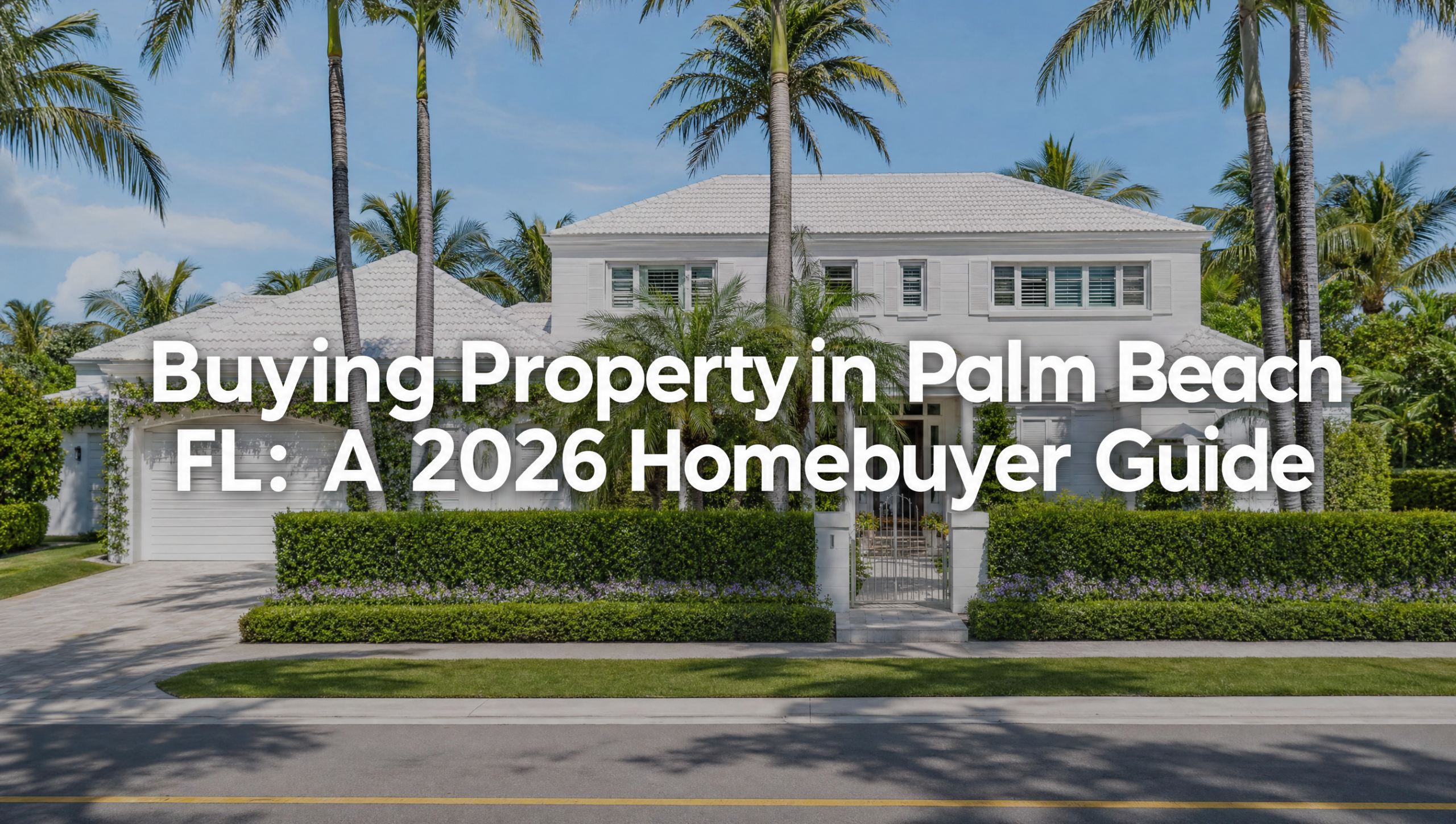
Buying Property in Palm Beach FL: A 2026 Homebuyer Guide
From Worth Avenue and in-town walkability to oceanfront estates, Intracoastal homes, and the condos and co-ops of the South End — here is how to buy property on the island Town of Palm Beach with confidence in 2026: neighborhoods, the luxury market, financing, inspections, flood and windstorm insurance, condo and co-op rules, and Florida compliance, explained step by step.
Search Palm Beach Homes for Sale Book a Free Buyer Consultation
Quick Answer: Is Buying Property in Palm Beach FL a Good Move in 2026?
The Town of Palm Beach is a barrier-island community with a global reputation — oceanfront estates, Intracoastal “lakefront” homes, elegant in-town condos and co-ops near Worth Avenue, historic architecture, and private clubs. It is a highly specialized luxury market where value swings on location, view, lot size, building financials, and coastal exposure, so citywide averages mean little. Most financed purchases close in 30 to 45 days (cash and co-op deals vary), buyers should budget roughly 2% to 5% of the price for closing costs, and the biggest local factors are flood and windstorm insurance, condo/co-op reserves and milestone inspections, and town renovation and landmark rules. This guide walks through every step.
What This Guide Covers
- Why Buying in Palm Beach Is Different
- About Palm Beach: The Island & Its Areas
- 2026 Palm Beach Market Trends
- The Florida Home Buying Process, Step by Step
- Closing Costs, Taxes & Insurance Budgeting
- Florida Compliance & Legal Terms for 2026
- Common Buyer Mistakes to Avoid
- FAQ: Buying Property in Palm Beach FL
- Final Thoughts & Next Steps
Why Buying Property in Palm Beach FL Is Different
Buying property in Palm Beach FL is not the same as buying in a typical Florida beach town. Palm Beach has its own rhythm, its own architecture, its own lifestyle, and its own real estate language.
This is a small island community with a global reputation. Buyers are drawn here for oceanfront estates, Intracoastal homes, elegant condos, historic architecture, Worth Avenue shopping, private clubs, walkable village-style areas, manicured streets, cultural institutions, and the quiet sense of privacy that Palm Beach is known for.
Palm Beach is refined, but it is not one-dimensional. Some buyers want a landmark estate with architectural history. Some want a low-maintenance condo near the ocean. Some want a seasonal residence close to Worth Avenue. Some want Intracoastal views, a boat-friendly location, or a quiet in-town address with easy access to restaurants, shops, and beach paths. Others compare Palm Beach with nearby West Palm Beach, Palm Beach Gardens, Boca Raton, Jupiter, or Delray Beach before deciding where their lifestyle fits best.
The opportunity is exciting, but the details are serious. Palm Beach real estate requires careful attention to insurance, flood zones, wind mitigation, condo financials, building maintenance, historic or landmark restrictions, title matters, inspections, property taxes, renovation rules, coastal exposure, and long-term carrying costs. A beautiful property may have complex association documents. A charming older home may need major system updates. A luxury estate may require specialized inspections for seawalls, generators, elevators, pools, docks, drainage, and high-end mechanical systems.
This guide walks you through how to buy a home in Palm Beach FL with confidence — the local market, the island lifestyle, property types, Florida buying steps, financing, inspections, closing costs, flood insurance, HOA and condo rules, legal disclosures, and common buyer mistakes to avoid. When you are ready to compare homes, start with the live Palm Beach home search to see current island listings.
Comparing the island with the mainland? Many buyers weigh Palm Beach against the city just across the bridge. See Jeannie’s West Palm Beach buyer guide and the Florida home buying guide for 15 cities for the statewide essentials that apply to any Florida purchase.
About Palm Beach FL: The Island and Its Areas
Palm Beach is located on a barrier island in Palm Beach County, across the Intracoastal Waterway from West Palm Beach. It is known for its oceanfront setting, historic estates, Worth Avenue, Mediterranean Revival architecture, private clubs, luxury shopping, cultural institutions, and carefully preserved small-town feel.
The town’s identity is deeply tied to its history — Henry Flagler’s influence, the Flagler Museum, The Breakers, Worth Avenue, Addison Mizner-style architecture, landmarked buildings, and elegant streetscapes all help define the Palm Beach lifestyle. For homebuyers, Palm Beach offers a rare blend of privacy, beauty, convenience, and prestige. The island is also compact: location differences of only a few blocks can affect value, lifestyle, walkability, views, flood exposure, and resale appeal — which is why local context matters so much here.
In-Town Palm Beach and Worth Avenue Living
The in-town area is one of Palm Beach’s most recognizable lifestyle zones. Buyers who want walkability, shopping, dining, beach access, and proximity to Worth Avenue often focus here. In-town Palm Beach may include elegant condos, boutique buildings, historic residences, townhomes, luxury single-family homes, seasonal residences, and lock-and-leave properties.
This area appeals to buyers who want convenience — restaurants, shops, galleries, beach paths, and cultural attractions without feeling far from daily needs. The trade-off is that inventory can be limited, pricing can be premium, and association documents or renovation rules may require careful review. Older buildings may have charm, but buyers should study reserves, insurance, maintenance, structural reports, and any upcoming assessments before committing.
Oceanfront Palm Beach
Oceanfront property is one of Palm Beach’s signature real estate categories — luxury estates, oceanfront condos, boutique residences, and rare parcels with direct beach access or ocean views. Oceanfront ownership is a dream for many buyers, but it comes with special considerations: windstorm insurance, flood insurance, salt-air exposure, impact glass or shutters, roof and exterior maintenance, building reserves, seawall or dune considerations, coastal construction rules, condo milestone inspections if applicable, and higher maintenance and insurance costs.
Oceanfront property should be evaluated as both a lifestyle purchase and a long-term asset. The views may be beautiful, but the condition, building financials, insurance profile, and coastal exposure matter just as much.
Intracoastal and Lakefront Palm Beach Homes
Palm Beach properties along the Intracoastal Waterway — often referred to locally as lakefront homes because of Lake Worth Lagoon — offer another highly desirable lifestyle. Buyers may be drawn to water views, sunset exposure, dockage where available, boating access, estate lots, proximity to West Palm Beach by bridge, and privacy and prestige.
For waterfront properties, inspections should go beyond the house. Buyers may need to evaluate seawalls, docks, boat lifts, drainage, generators, landscape irrigation, erosion concerns, and marine-related permits. A waterfront home’s value can be affected by water frontage, view corridors, dock potential, lot size, elevation, access, privacy, and the condition of waterfront improvements.
North End Palm Beach
The North End has a quieter, more residential feel. Buyers often like it for single-family homes, bike-friendly streets, beach access points, privacy, and a neighborhood atmosphere that feels removed from the busier in-town areas. Homes can range from older Florida residences to renovated luxury homes and newer custom builds. Key buyer considerations include lot size, renovation quality, flood zone, roof age, impact windows, elevation, parking, landscape maintenance, beach access, and permits and additions. The North End can be a wonderful fit for buyers who want Palm Beach charm with a more residential daily rhythm.
Midtown Palm Beach
Midtown Palm Beach offers a blend of residential convenience, beach access, civic amenities, condos, in-town proximity, and easy routes across the bridge to West Palm Beach. Buyers may consider Midtown if they want to be near restaurants, services, town facilities, beach paths, and cultural destinations without being directly in the busiest commercial corridors. Condos and co-ops are common here, so association review is especially important — review reserves, insurance, assessments, building condition, pet rules, rental restrictions, guest policies, parking, and renovation approval procedures before buying.
South End Palm Beach
The South End of Palm Beach often appeals to condo buyers, seasonal residents, and people who want ocean or Intracoastal views with a slightly different value profile than central or in-town Palm Beach. Many South End properties are condos or co-ops, and some offer beautiful views, beach access, pools, doormen, fitness areas, garage parking, and low-maintenance living.
The key is to compare buildings carefully. Two condos with similar views may have very different fees, reserves, insurance, assessment history, renovation rules, and financing options. South End buyers should pay special attention to monthly maintenance fees, building reserves, insurance structure, milestone inspection status, structural integrity reserve study information, concrete restoration history, elevator condition, roof and mechanical systems, rental restrictions, parking assignments, guest policies, and pet policies. A condo can be a great Palm Beach entry point, but only if the building’s financial and physical condition support the purchase.
Walkable & IconicIn-Town & Worth Avenue
Boutique condos, historic residences, and luxury homes steps from shopping, dining, and the beach. Limited inventory; study reserves and renovation rules.
Prestige & ViewsOceanfront & Lakefront
Estates and condos with ocean or Intracoastal frontage and dockage potential. Weigh windstorm/flood insurance, seawalls, and building financials.
Residential QuietNorth End
Single-family homes, bike-friendly streets, and beach access with a relaxed daily rhythm. Check elevation, roof age, impact windows, and permits.
Condos & Co-opsMidtown & South End
Full-service buildings with views and easy maintenance. Compare fees, reserves, milestone-inspection status, and financing rules building by building.
Weighing nearby markets before you commit to the island? Compare West Palm Beach, Palm Beach Gardens, and Jupiter for different lifestyle and price profiles.
Palm Beach Real Estate Market Trends in 2026
Palm Beach real estate in 2026 remains a highly specialized market. Citywide or countywide averages do not tell the whole story because property values vary dramatically by location, property type, view, condition, building, lot size, water frontage, and architecture. Palm Beach can include everything from smaller condos to multimillion-dollar estates, so buyers should avoid making decisions based only on broad market headlines.
The current market has become more selective than the rush of earlier years. Buyers have more room to evaluate, but high-quality properties in prime locations can still command serious attention. Well-located homes with strong condition, privacy, views, and updated systems remain desirable. Before making an offer, ask:
- How does this property compare with recent Palm Beach sales?
- Is the price supported by location, view, lot size, and condition?
- How long has it been on the market, and has the seller adjusted the price?
- What are the true carrying costs, and what will insurance likely cost?
- Is flood insurance required or recommended?
- Are there condo or association assessments?
- Are renovations restricted by association, landmark, or town rules?
- What will property taxes look like after purchase?
- Does the property fit your long-term lifestyle and resale goals?
For broader Palm Beach County context, review Jeannie’s South Florida home buying guide and nearby market resources such as the West Palm Beach market forecast. You can also read what past clients say on the reviews page.
The Florida Home Buying Process in Palm Beach: 11 Steps to Closing
Buying a home in Palm Beach is easier when you understand the steps before you begin. The process is similar to other Florida purchases, but the due diligence can be more detailed because of property values, older buildings, coastal conditions, and association complexity.
Get Pre-Approved or Prepare Proof of Funds
Before touring Palm Beach homes, be clear on your purchasing power. If you are financing, get a strong pre-approval from a lender experienced with Florida luxury properties, condos, co-ops, jumbo loans, portfolio lending, and complex asset profiles. A lender may review income, assets, credit, debt obligations, tax returns, liquidity, down payment, reserves, property type, condo or co-op eligibility, and insurance expectations.
Common financing options include conventional loans, jumbo loans, portfolio loans, adjustable-rate mortgages, asset-based lending, condo financing, co-op financing where available, renovation loans, and cash purchase strategies. Cash buyers should prepare proof of funds before making an offer — in Palm Beach, sellers often expect buyers to show financial strength quickly, especially for high-value properties.
Your budget should include more than the purchase price. Account for property taxes, homeowners insurance, flood insurance, windstorm coverage, condo or co-op fees, HOA dues, club costs, maintenance, staff or service costs, utilities, landscaping, and renovation expenses. You can model financing scenarios with the mortgage calculators.
Decide Which Palm Beach Lifestyle Fits You
Palm Beach is small, but lifestyle differences are meaningful. Before you search by price, decide what you want your daily life to feel like. Do you want walkability to Worth Avenue? Ocean views? The quieter North End? A condo with full-service amenities? Dockage? A seasonal lock-and-leave residence? Do you plan to renovate or want a historic property? Do you need quick access to West Palm Beach, Palm Beach International Airport, or nearby medical services?
Your answers will shape the best location and property type. In-town Palm Beach works well for buyers who want convenience. The North End appeals to buyers who want residential quiet. The South End may fit condo buyers who want views and easier maintenance. Oceanfront and lakefront properties attract buyers prioritizing water and prestige. Midtown offers a central feel with access to town amenities.
Start the Property Search
Once your financing and lifestyle goals are clear, begin comparing Palm Beach homes for sale with a careful eye. Look closely at:
- Location, lot size, view, and property age
- Roof age, HVAC, electrical, plumbing, and impact windows or shutters
- Elevation, flood zone, and insurance profile
- Association fees, building reserves, special assessments, and renovation restrictions
- Historic or landmark status
- Recent comparable sales, days on market, seller disclosures, open permits, and survey issues
Photos can be beautiful, but they do not tell the full story. In Palm Beach, the hidden details often matter as much as the visible finishes.
Tour Homes With a Local Buyer’s Eye
When touring Palm Beach property, pay attention to lifestyle, condition, and long-term cost. For single-family homes, look at roof condition, drainage, elevation, windows and doors, generator systems, HVAC zones, electrical panels, plumbing, pool and spa systems, landscaping, irrigation, security systems, seawalls or docks if applicable, prior renovations, and permit history.
For condos or co-ops, look beyond the unit — review the lobby, hallways, elevators, garage, roof, pool area, exterior paint, balconies, mechanical systems, staff structure, and general maintenance. A property may feel elegant, but your decision should be grounded in inspections, documents, insurance, and numbers.
Make a Strong, Smart Offer
When you find the right property, your offer should reflect value, condition, timing, and your risk tolerance. A Florida offer usually includes purchase price, escrow deposit, financing or cash terms, inspection period, loan approval deadline if financing, appraisal terms if applicable, closing date, title and closing agent details, personal property included or excluded, seller credits if requested, condo/co-op/HOA/association review, and special addenda if needed.
In Palm Beach, luxury offers may also address furnishings, art exclusions, staff transition issues, club considerations, generator maintenance, dock equipment, service contracts, or extended closing timelines. A strong offer is not always the highest price — it is the right combination of price, certainty, timing, and protection.
Complete Inspections Quickly
After your offer is accepted, your inspection period begins — one of the most important parts of the purchase. Common Palm Beach inspections may include a general home inspection, roof inspection, wind mitigation inspection, four-point inspection, WDO or termite inspection, pool and spa inspection, mold or moisture evaluation, sewer scope if appropriate, electrical/plumbing/HVAC specialist reviews, generator inspection, elevator inspection if applicable, seawall inspection, dock or boat-lift inspection, structural review, condo document review, and a re-inspection after repairs.
For older homes and coastal properties, inspections are especially important — salt air, storms, humidity, age, and prior renovations can all affect condition. Many Florida purchases use an “As Is” contract; that does not mean you skip inspections. It usually means the seller is not automatically required to make repairs, while you still have the right to inspect and decide within your contract deadline.
Handle the Appraisal and Loan Approval
If you are financing, your lender will usually order an appraisal. In Palm Beach, appraisals can be complex because comparable sales may be limited and small differences in location, view, lot size, architecture, and condition can create major value differences. If the appraisal supports the contract price, the loan moves forward. If it comes in low, you may need to renegotiate, bring additional cash, review comparable sales, or use your contract options.
During underwriting, avoid major financial changes — do not open new credit, finance furniture, move large sums without documentation, or make unexplained asset transfers. High-net-worth buyers may face detailed documentation requirements even with strong assets.
Complete Title Search, Survey, and Insurance Review
A title search checks ownership history and looks for liens, judgments, unpaid taxes, easements, mortgages, restrictions, or other issues affecting ownership. Title insurance helps protect against covered title problems discovered after closing — a lender’s title policy protects the lender, and an owner’s title policy protects the buyer.
Palm Beach buyers should also review the title commitment, legal description, survey, easements, encroachments, access rights, restrictions, open permits, municipal lien search, historic or landmark limitations, and recorded association documents. Insurance should be addressed early — premiums can vary significantly depending on roof age, storm protection, elevation, flood zone, construction type, distance to water, prior claims, and property value. Do not wait until the week before closing to shop insurance.
Review Condo, Co-op, HOA, and Building Documents
Palm Beach has many condos, co-ops, and association-governed properties, so document review is essential. Review monthly maintenance or HOA fees and what they include, building reserves, insurance coverage, special assessments, capital projects, milestone inspection status if applicable, structural integrity reserve study information if applicable, pending litigation, meeting minutes, rental restrictions, pet rules, guest rules, parking, staff costs, renovation rules, move-in fees, the approval process, and financing restrictions.
For co-ops, buyers should understand that ownership structure differs from a traditional condo — approval requirements, financing, taxes, and transfer rules may be different. A Palm Beach condo or co-op can be an excellent lifestyle purchase, but only when the building’s financial and physical condition make sense.
Final Walkthrough and Closing
The final walkthrough usually happens shortly before closing — your chance to confirm the property is in the expected condition, agreed repairs were completed, included items remain, and no new damage has occurred. At closing, you sign loan documents, title documents, settlement statements, disclosures, deed-related paperwork, and association documents if required.
Wire funds only after verifying instructions directly with the title company using a trusted phone number. Real estate wire fraud is a serious risk, especially in high-value transactions. Once documents are signed, funds are received, and the deed is recorded, the property is yours.
Post-Closing Steps
After closing, take care of the details that protect your investment:
- Apply for Florida homestead exemption if the property is your primary residence
- Transfer utilities and update your mailing address
- Save closing documents, keep inspection reports, and register warranties
- Review association contacts and rules; set insurance renewal reminders
- Schedule HVAC maintenance and create a hurricane preparation plan
- Keep improvement receipts, confirm your first mortgage payment date if financed, and learn town permit rules before renovating
- Review service contracts for landscaping, pool, generator, security, and pest control
Palm Beach ownership is easier when you stay organized from the first day.
Closing Costs, Property Taxes, and Insurance: Budgeting for a Palm Beach Purchase
On the island, the purchase price is only the beginning of the math — insurance, condo/co-op fees, reserves, club and service costs, and taxes can move your true carrying cost significantly. Build a budget across one-time closing costs, recurring carrying costs, and maintenance reserves before you write an offer. Here is a planning framework; your actual figures depend on your loan or cash terms, contract, insurance quotes, and negotiated credits.
| Cost Category | Typical Planning Range | What Affects It in Palm Beach |
|---|---|---|
| Buyer closing costs | Roughly 2%–5% of purchase price | Lender fees, appraisal, title costs, prepaid taxes and insurance, escrow reserves, recording fees, survey, inspections; luxury deals may add legal and due-diligence costs |
| Escrow deposit | Negotiable; often 10% on luxury deals | Price point, seller expectations, market position, financing vs. cash |
| Property taxes | Based on assessed value & millage | Assessed value may reset at your purchase price; homestead exemption and Save Our Homes caps apply only after you qualify |
| Homeowners / windstorm insurance | Varies widely; can be substantial | Roof age, storm protection, elevation, construction type, distance to water, prior claims, property value |
| Flood insurance | Property-specific | FEMA zone, elevation certificate, lender requirements — significant on a barrier island with ocean and Intracoastal exposure |
| Condo / co-op / club / service | Modest to very substantial monthly | Reserves, staff, amenities, insurance, special assessments; estates add staff, generator, pool, dock, and landscaping service contracts |
The most common tax surprise: the seller’s current bill may reflect years of homestead exemption and Save Our Homes caps that do not transfer to you. When a property sells, assessed value may reset based on the new sale price — so estimate your taxes from your expected purchase price, not the listing’s tax history.
Pressure-test your numbers with the mortgage calculators and review the checklists in the buyer resources library before you tour.
Florida Real Estate Compliance and Legal Terms Buyers Should Know in 2026
Florida real estate has specific disclosure, insurance, tax, title, condo, and association rules. You do not need to memorize every statute, but you should understand the terms that may affect your Palm Beach purchase.
Seller Disclosure Requirements
Florida sellers generally must disclose known facts that materially affect the value of residential property when those facts are not readily observable and are not known to the buyer. This may include roof leaks, water intrusion, mold history, structural issues, unpermitted work, boundary disputes, electrical problems, plumbing defects, prior repairs, or other material conditions. A seller disclosure is useful, but it is not a warranty — buyers should still inspect carefully.
Flood Disclosure and Flood Insurance
Florida requires flood risk disclosure in residential real estate transactions, and standard homeowners insurance usually does not cover flood damage. In Palm Beach, flood risk deserves serious attention because the town is a barrier island with oceanfront, Intracoastal, low-lying, and coastal exposure considerations.
Before buying, ask: Is the property in a FEMA flood zone? Is flood insurance required by the lender, and what does it cost? Has the property experienced flood damage or flood claims? Is there an elevation certificate? Are there drainage concerns? Has the property had flood mitigation work, and are mechanical systems elevated? A flood zone does not automatically mean a property is a poor choice — it means you need to understand the risk, insurance, elevation, and long-term cost.
HOA Disclosure Requirements
If a property is subject to mandatory homeowners association membership, Florida requires disclosure. In Palm Beach, association structures may include HOAs, condo associations, co-ops, building boards, or private community rules. Review governing documents, restrictions, assessments, approval procedures, renovation rules, rental limits, pet policies, guest policies, and maintenance responsibilities before closing.
Condo and Co-op Regulations
Palm Beach has many condo and co-op buildings, including older coastal and high-rise properties. In 2026, Florida condo buyers should pay close attention to building safety, reserves, milestone inspections, structural integrity reserve studies, insurance, and assessments. Before buying a condo, review the declaration, bylaws, rules and regulations, budget, reserves, insurance coverage, meeting minutes, pending litigation, special assessments, milestone inspection status if applicable, structural integrity reserve study information if applicable, maintenance responsibilities, and rental restrictions. The unit may be beautiful, but the building’s financial health can affect your future costs.
Title Requirements and Title Insurance
Title work confirms whether the seller can legally transfer ownership and whether recorded issues affect the property. Title insurance can protect against covered title defects discovered after closing — a lender’s title policy protects the lender, and an owner’s title policy protects the buyer. Review title exceptions carefully, especially for waterfront properties, historic homes, condos, co-ops, and properties with easements or prior renovations.
Property Taxes and Assessment Changes
Florida property taxes are based on assessed value, exemptions, and local millage rates, and a seller’s current tax bill may not predict your future tax bill. When you buy, the assessed value may reset based on the new sale price; if the seller had homestead exemption and Save Our Homes protections for many years, your future bill may be higher than the current tax history shown in the listing. Estimate taxes based on your expected purchase price, not only the seller’s current bill.
Homestead Exemption and Portability
If the Palm Beach property will be your primary residence and you meet Florida requirements, you may qualify for homestead exemption, which may reduce taxable value and may help limit future assessed-value increases under Save Our Homes rules. If you previously owned a homesteaded Florida property, ask about portability. Apply through the Palm Beach County Property Appraiser by the required deadline after closing.
Radon Notice
Florida real estate documents commonly include a radon gas notice. Radon is a naturally occurring radioactive gas that may present health risks at elevated levels. Testing is not always part of a standard inspection, but buyers can request radon testing during the inspection period if desired.
Environmental and Property-Specific Issues
Some Palm Beach properties require extra review because of location, age, architecture, or coastal conditions. Depending on the property, evaluate coastal exposure, salt-air wear, seawall condition, dock permits, drainage easements, beach erosion considerations, open permits, code violations, prior additions, unpermitted work, mold or moisture history, generator systems, pool and spa systems, historic or landmark restrictions, and town renovation requirements. This is especially important for oceanfront estates, lakefront homes, older properties, condos, and renovated residences.
New Construction, Renovations, and Warranties
Palm Beach has limited land, so many buyers consider renovated homes, custom rebuilds, or properties with future renovation plans. Newer construction or major renovation can offer modern systems, impact glass, updated elevation, smart-home features, generators, and better insurance profiles — but buyers should still review permits, warranties, contractor documentation, final approvals, and town compliance. If buying from a builder or developer, review warranty terms, deposit requirements, upgrade costs, construction timelines, delay clauses, final walkthrough procedures, punch-list deadlines, appliance warranties, what is included versus excluded, permit closeout, and landscaping and drainage warranties. Never assume a newly renovated home is problem-free — verify the work.
First-Time Homebuyer and Assistance Options
Palm Beach is a high-value market, so many buyers here are not using traditional first-time assistance programs. Still, some qualified buyers in Palm Beach County may qualify for state, county, or lender-based assistance depending on income, purchase price, occupancy, and program availability. Programs can change, pause, reopen, or run out of funds. For broader options, review Jeannie’s Florida home buying guide or the Hometown Heroes resource page.
Common Mistakes Palm Beach Buyers Should Avoid
Buying in Palm Beach is exciting, but it is not a market where you should move casually. Common mistakes include:
- Shopping without proof of funds or strong pre-approval
- Comparing properties only by price per square foot
- Ignoring insurance until late in the process
- Underestimating flood insurance or windstorm costs
- Skipping condo or co-op document review
- Not reviewing reserves and assessments
- Assuming a low condo price means low ownership cost
- Overlooking roof, windows, HVAC, plumbing, and electrical systems
- Not inspecting seawalls, docks, generators, elevators, or pools
- Ignoring town permitting and renovation restrictions
- Underestimating property tax changes after purchase
- Not checking open permits
- Falling in love with architecture without studying condition
- Waiting too long on a rare well-priced property
- Choosing a property before understanding lifestyle fit
The goal is not to make the process stressful — it is to help you buy with clear eyes and fewer surprises. See how Jeannie has guided other South Florida buyers on her reviews page.
FAQ: Buying Property in Palm Beach FL
These are the questions buyers ask most about purchasing property on the Town of Palm Beach island in 2026. Tap any question to expand the answer.
Yes — Palm Beach can be an excellent choice for buyers who want a luxury coastal lifestyle, privacy, architectural character, beach access, Worth Avenue convenience, cultural amenities, and long-term prestige. The right property depends on your budget, preferred lifestyle, insurance comfort, association rules, and long-term goals. Start with the live island home search.
No. Palm Beach is the island town located east of the Intracoastal Waterway. West Palm Beach is the larger city across the bridge on the mainland. Many buyers compare both because they are close, but the lifestyle, pricing, housing types, and daily experience are very different — see the West Palm Beach buyer guide to compare.
Most financed purchases take about 30 to 45 days from contract to closing, though luxury, condo, co-op, or complex financing transactions can take longer. Cash purchases may close faster if inspections, title, association approval, and document review move smoothly.
Buyer closing costs often range from about 2% to 5% of the purchase price, depending on loan type, lender fees, title costs, appraisal, prepaid taxes, insurance, escrow reserves, inspections, recording fees, and negotiated credits. Luxury purchases may involve additional legal, inspection, survey, and due-diligence costs. Model scenarios with these mortgage calculators.
Focus on roof age, HVAC, electrical, plumbing, water heater, impact windows, storm protection, drainage, moisture, pests, structural condition, pool systems, generators, elevators, permits, and insurance-related items. For waterfront homes, inspect seawalls, docks, lifts, and drainage.
Some Palm Beach County or Florida programs may exist for qualified buyers, but eligibility often depends on income, purchase price, occupancy, and funding availability. Because Palm Beach property values are high, many assistance programs may not fit island purchases. Speak with a lender early; the Hometown Heroes resource page outlines one option.
A fixed-rate mortgage keeps the same interest rate for the life of the loan. An adjustable-rate mortgage (ARM) usually starts with a fixed introductory period and then adjusts later based on loan terms. Fixed loans offer predictability; ARMs may start lower but carry future payment risk.
If the Palm Beach property is your primary residence and you meet Florida requirements, homestead exemption may reduce taxable value. It may also help limit future assessed-value increases through Save Our Homes protections. You must apply through the Palm Beach County Property Appraiser by the required deadline after closing, and prior Florida homestead owners may qualify for portability.
The main risks are flood damage, lender-required flood insurance, higher ownership costs, future premium changes, and possible resale concerns. In Palm Beach, buyers should review flood zone, elevation, drainage, prior flood history, insurance quotes, and property-specific mitigation — especially on a barrier island with ocean and Intracoastal exposure.
They can be. Monthly fees may cover insurance, staff, maintenance, amenities, reserves, security, utilities, or exterior care. Older and coastal buildings may also face assessments for structural work, concrete restoration, roofing, elevators, or insurance increases. Always review the full financial picture before buying.
It depends on your lifestyle. Condos and co-ops may offer low-maintenance ownership and seasonal convenience. Single-family homes offer more privacy, control, and outdoor space. Waterfront and estate properties offer prestige and lifestyle, but they also require more maintenance and due diligence.
Oceanfront Palm Beach property is limited and highly desirable, but buyers should evaluate more than location. Review insurance, elevation, coastal exposure, building condition, maintenance, permits, and long-term carrying costs. A strong purchase is one where lifestyle and numbers both make sense.
Often yes, but renovation rules can be strict. You may need town permits, architectural review, association approval, landmark review, contractor coordination, and careful planning around seasonal schedules. Before buying a property with renovation plans, confirm what is realistically allowed.
Yes, depending on your contract and the seller’s position. You may request repairs, credits, price adjustments, or other concessions. In an “As Is” contract, the seller may decline repairs, but you may still have inspection rights — including the right to cancel — during the agreed period.
A local real estate professional can help you compare neighborhoods, review pricing, understand condo and co-op documents, coordinate inspections, evaluate insurance concerns, and negotiate confidently. Jeannie Jacobson helps Florida buyers make informed decisions from search to closing. Contact Jeannie or book a buyer consultation to get started.
Final Thoughts: Buying With Confidence in Palm Beach
Buying property in Palm Beach FL gives you access to one of Florida’s most distinctive and prestigious coastal markets. You can choose oceanfront living, Intracoastal views, in-town walkability, Worth Avenue convenience, North End privacy, South End condos, historic architecture, or a seasonal lock-and-leave lifestyle.
But Palm Beach is not a market where you should buy based on photos alone. You need to understand the property, the location, the association, the insurance, the taxes, the contract, the inspections, and the long-term cost of ownership. A smart purchase is not just the one with the prettiest view — it is the one that fits your life, protects your budget, and supports your future plans.
Start your search with the live Palm Beach home search, compare nearby options in the West Palm Beach buyer guide, and review broader Florida buying guidance in the Florida home buying guide. Selling a home before you buy? Begin with a free home valuation.
Ready to Explore Palm Beach Real Estate?
Get local guidance on island neighborhoods, pricing, condo and co-op documents, inspections, insurance, and negotiations from a licensed Florida real estate professional.
Schedule a Free Consultation Start Your Home SearchDisclaimer: This article is for general educational purposes only and is not legal, tax, mortgage, insurance, or financial advice. Real estate laws, association rules, insurance requirements, assistance program funding, and market conditions can change. Buyers should consult qualified professionals — including licensed attorneys, lenders, insurance agents, and tax advisors — for guidance specific to their transaction. All information is deemed reliable but not guaranteed and should be independently verified. Equal Housing Opportunity.